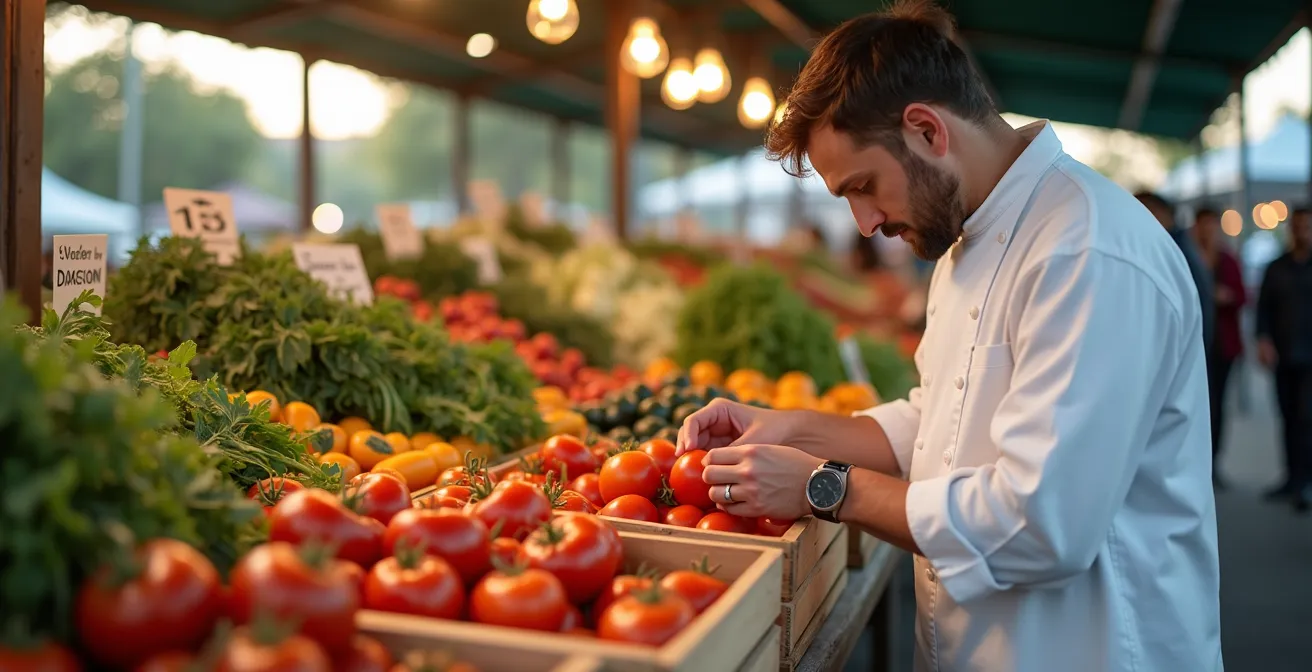
True ‘farm-to-table’ is a verifiable claim based on an auditable chain of custody, not a marketing slogan you should take on faith.
- Seasonality provides a non-negotiable alibi; an item’s presence on the menu must align with its local harvest window, which is geographically specific.
- The term ‘local’ is meaningless without a defined radius; its integrity must be questioned, from 50 miles in dense states to over 200 in sparse ones.
- Freshness, a direct result of a short supply chain, is a more reliable indicator of quality and authenticity than a potentially diluted ‘organic’ label from afar.
Recommendation: Adopt an auditor’s mindset. Question menu claims, verify sourcing geography, and follow the evidence from the farmers market to the food co-op to determine the true origin of your meal.
The term ‘farm-to-table’ conjures images of sun-drenched fields, hardworking farmers, and ingredients so fresh they taste of the earth itself. It has become the gold standard for ethical dining, a promise of quality, sustainability, and connection to the source of our food. Yet, in an era of sophisticated greenwashing, this promise is frequently broken. Many diners suspect the truth: that the ‘local’ heirloom tomatoes on their plate may have traveled hundreds of miles, and the ‘seasonal’ fish was likely frozen months ago. The common advice—to ask the server or check the website—is often a dead end, yielding vague assurances rather than concrete evidence.
This ambiguity creates a trust deficit. The core issue isn’t just about spotting a lie; it’s about the lack of a reliable framework for verification. Diners are left to guess, while restaurants exploit the gray area between genuine sourcing and clever marketing. But what if the solution wasn’t to simply trust or distrust, but to verify? What if you could apply the same rigorous principles an agricultural auditor uses to assess the integrity of a supply chain? The key isn’t to look for clues; it’s to conduct a quiet, systematic audit based on objective criteria. This isn’t about being cynical; it’s about honoring the restaurants that uphold the true ethos of the movement and holding the rest accountable.
This guide abandons generic advice and instead provides a practical, investigative framework. We will dissect the meaning of seasonality with geographic precision, scrutinize the elastic definition of ‘local,’ and establish a clear hierarchy between labels. You will learn to perform your own sourcing forensics, transforming you from a passive consumer into an informed auditor capable of discerning authenticity from fiction. By the end, you will not only know if a restaurant is truly farm-to-table, but you will also have a deeper understanding of the food systems that support it.
This article provides a complete auditor’s methodology for evaluating farm-to-table claims. The following sections break down the key inspection points, from analyzing a menu for seasonal inconsistencies to identifying authentic local food hubs on your travels.
Summary: An Auditor’s Guide to Farm-to-Table Verification
- Why You Shouldn’t See Strawberries on a Menu in December?
- How to Book a Farm Dinner Without Trespassing on Private Land?
- Local vs. Organic: Which Label Matters More for Flavor?
- The ‘Local’ Trap That Actually Means ‘Within 400 Miles’
- When to Arrive at the Farmers Market to Get the Chef’s Pick?
- Why Northwest Cuisine Is Obsessed with Mushrooms and Berries?
- How to Shop at Co-ops Instead of Superstores on Your Route?
- How to Win a Ribbon at the State Fair Without Owning a Farm?
Why You Shouldn’t See Strawberries on a Menu in December?
The first and most crucial test of a restaurant’s farm-to-table claim is its seasonal alibi. The presence of fresh produce outside of its natural, regional growing season is an immediate red flag. A menu featuring fresh strawberries in New York in December or ripe tomatoes in Minnesota in March is not sourcing from a local farm; it is sourcing from a global distributor. This principle is non-negotiable. True farm-to-table practice is constrained by nature’s calendar, and a legitimate menu will reflect this beautiful limitation through constant evolution.
An auditor’s verification goes beyond general knowledge. It requires understanding regional micro-seasons and a key governmental tool: the USDA Plant Hardiness Zone Map. This map defines the default growing seasons for specific locations across the United States. Climate change has made this even more critical, as an update confirmed that about half of the United States shifted to a new hardiness zone in 2023, altering local growing capabilities. A chef truly connected to their terroir will be acutely aware of these shifts. Look for signs of legitimate season extension, such as ‘house-pickled,’ ‘fermented,’ or ‘preserved’ items, which demonstrate a skillful strategy for using peak-season bounty year-round, rather than importing out-of-season produce.
Your Verification Checklist: Spotting Seasonal Inconsistencies
- Check the Zone: Identify the restaurant’s USDA Plant Hardiness Zone to establish a baseline for what grows locally and when.
- Verify Micro-Seasons: Research peak seasons for specific high-value items. California heirloom tomatoes peak June-September; Copper River Salmon runs May-June; Chesapeake soft-shell crabs are a May-September delicacy.
- Inspect the Language: Look for preservation keywords like “house-pickled,” “fermented,” or “preserved.” These are indicators of authentic seasonality, not red flags.
- Question the Obvious: Be highly skeptical of any menu offering fresh strawberries, peaches, asparagus, or tomatoes served far outside their natural growing window for that specific zone.
- Assess Seafood Seasonality: Apply the same logic to seafood. The availability of species like Gulf oysters (best in fall/winter) or Florida stone crabs (October-May) is strictly seasonal.
Ultimately, a menu that rarely changes is a menu that does not adhere to farm-to-table principles. The lack of certain items is as telling as the presence of others. A restaurant that proudly admits “we’re out of fresh tomatoes until July” is demonstrating more geographic integrity than one that offers them year-round.
How to Book a Farm Dinner Without Trespassing on Private Land?
Direct engagement with a farm is the ultimate verification of the farm-to-table ethos. Participating in a farm dinner, where the meal is served on the land where it was grown, closes the gap between producer and consumer entirely. However, these are private, working properties, and access must be structured and respectful. The solution is not to show up unannounced but to seek out established agritourism networks and events that formalize the farm-visit experience. These programs provide a legitimate and safe way to connect with the food source.
Leading organizations like Outstanding in the Field have popularized the concept of large-scale, traveling farm dinners. On a more regional level, states have developed their own frameworks. Vermont’s Open Farm Week and North Carolina’s Agritourism Networking Association, for example, create curated opportunities for the public to visit farms, participate in workshops, and enjoy meals. High-end destinations like Blackberry Farm in Tennessee have integrated this into a luxury resort model, where guests can join chefs to gather produce for their own cooking classes. These structured events are the authorized channels for experiencing a farm’s hospitality without infringing on its operations.
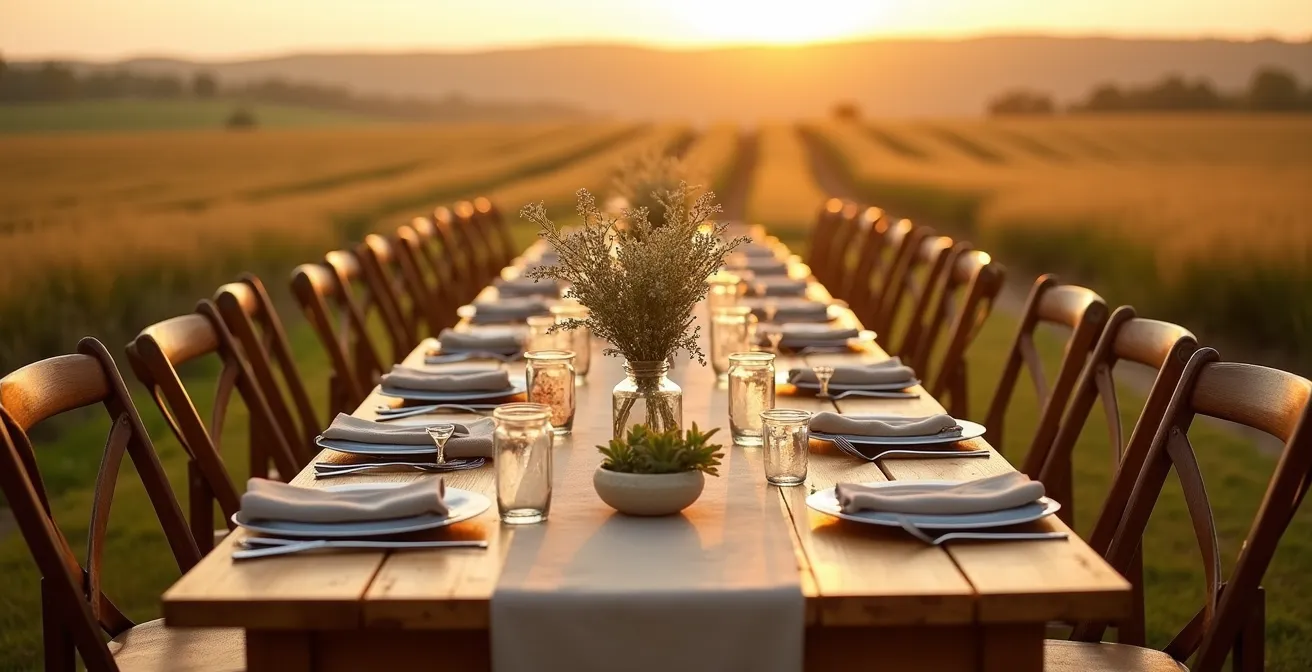
As you can see, the appeal of these events is the direct, unmediated connection to the agricultural landscape. By participating in these sanctioned activities—from pick-your-own fields to organized tours—you are not just a diner but a temporary part of the farm’s ecosystem. This is the most profound form of sourcing forensics available, offering incontrovertible proof of a chef’s or an organization’s commitment to local food systems. It moves the entire concept from an abstract menu claim to a tangible, memorable experience.
Local vs. Organic: Which Label Matters More for Flavor?
In the audit of a menu, diners often face a choice: is it better to eat a conventionally grown tomato from a farm 10 miles away or a certified USDA Organic tomato from 2,000 miles away? From a pure flavor and freshness perspective, the answer is almost always the local option. The ‘organic’ label is a certification of process—prohibiting synthetic pesticides and fertilizers—but it is not a guarantee of freshness or taste. Significant flavor degradation occurs during long-haul shipping and storage, a journey that non-local organic produce must endure.
As the esteemed Escoffier School of Culinary Arts notes in its analysis, “The Realities of Farm-to-Table”:
For pure flavor, freshness almost always wins.
– Escoffier School of Culinary Arts, The Realities of Farm-to-Table
This is because locally grown produce can be harvested at its peak ripeness, often just hours before it appears on your plate. This minimal transport time is the single greatest factor in preserving the volatile compounds that create exceptional flavor and aroma. While the ideal scenario is produce that is both local and organic, small farms often cannot afford the high cost of organic certification, even if they follow sustainable practices. Therefore, an auditor’s priority should be freshness and proximity over a distant certification.
This table breaks down the key trade-offs an auditor must consider when evaluating the source of ingredients. It clarifies why a short chain of custody often matters more for the dining experience than a certification that required cross-country transit.
| Factor | Local (Non-Certified) | USDA Organic (Non-Local) | Local + Organic |
|---|---|---|---|
| Peak Freshness | Excellent – Harvested at peak ripeness | Variable – May travel thousands of miles | Excellent – Best of both |
| Flavor Impact | Superior – Minimal transport time | Good – Depends on harvest/shipping time | Superior – Peak flavor assured |
| Cost to Small Farms | Low – No certification fees | High – $500-10,000 annually | Highest – Dual requirements |
| Environmental Impact | Low transport emissions | No synthetic pesticides but high transport | Lowest overall impact |
| Availability | Seasonal only | Year-round | Seasonal only |
The data from this comparative analysis of food sourcing clearly shows that for peak freshness and flavor, “local” is the dominant factor. While the organic label has significant value, its benefits can be negated by the logistical realities of a long supply chain. An authentic farm-to-table restaurant understands this and prioritizes its relationship with nearby growers above all else.
The ‘Local’ Trap That Actually Means ‘Within 400 Miles’
The term ‘local’ is the most abused word in the farm-to-table lexicon. For a diner in New Jersey, ‘local’ might imply a farm within the state. For a restaurant, however, it might mean a supplier in Pennsylvania or even Virginia. This ambiguity is the ‘local trap,’ and its roots lie in federal policy, not culinary standards. The widely, and often misleadingly, used definition of ‘local’ as anything within a 400-mile radius is not a consumer-facing standard for freshness. It originates from government policy; the ‘400-mile’ definition comes from the 2008 Farm Bill for determining eligibility for certain USDA programs. Restaurants have co-opted this generous definition to their marketing advantage.
A true auditor must reject this federal definition and establish a more rigorous standard of geographic integrity based on regional context. A 400-mile radius from New York City could encompass suppliers from Maine to North Carolina, rendering the term ‘local’ functionally meaningless. A more realistic and ethical definition of local must be scaled to the agricultural density of the region. A restaurant that is truly committed to local sourcing will be transparent about its partners, often naming specific farms, counties, or distinct regional appellations on its menu, rather than hiding behind the vague ‘local’ descriptor.
To conduct a proper audit, you must apply your own strict definition of ‘local.’ The following provides a practical framework for adjusting your expectations based on your location:
- Dense states (e.g., NJ, CT, MA): A 50-mile radius should be considered the benchmark for truly local sourcing.
- Mid-density states (e.g., PA, OH, NC): A 100-150 mile radius is a reasonable and verifiable standard.
- Sparse states (e.g., WY, MT, ND): Due to agricultural realities, a 200-mile radius may be a necessary and still meaningful definition of local.
The ultimate verification step is to ask the restaurant for specific farm names and their locations. If the staff can name the farm and town without hesitation, it’s a strong positive indicator. If they deflect with “it’s from a local supplier,” the claim requires much greater scrutiny.
When to Arrive at the Farmers Market to Get the Chef’s Pick?
A farmers market is a theater of the local food system, and observing who shops there—and when—is a powerful form of sourcing forensics. Chefs from genuinely local-sourcing restaurants are fixtures at these markets, but they don’t shop like regular consumers. To witness this part of the chain of custody, you must adjust your timing. The best and most limited produce, the ‘chef’s pick,’ is often claimed before the market even officially opens to the public.
Professional buyers, including chefs and their teams, typically arrive 30 to 60 minutes before the official opening bell. They have established relationships with farmers and are there for bulk purchases of the highest-quality items—the first spring ramps, the most perfect heirloom tomatoes, the choicest cuts from a local rancher. Iconic markets like the Union Square Greenmarket in New York City are prime examples, where the pre-market hour is a flurry of professional activity. Arriving early allows you to see which restaurant logos are on the vans and which chefs are personally inspecting the produce. This is direct, visual evidence of a restaurant’s commitment.
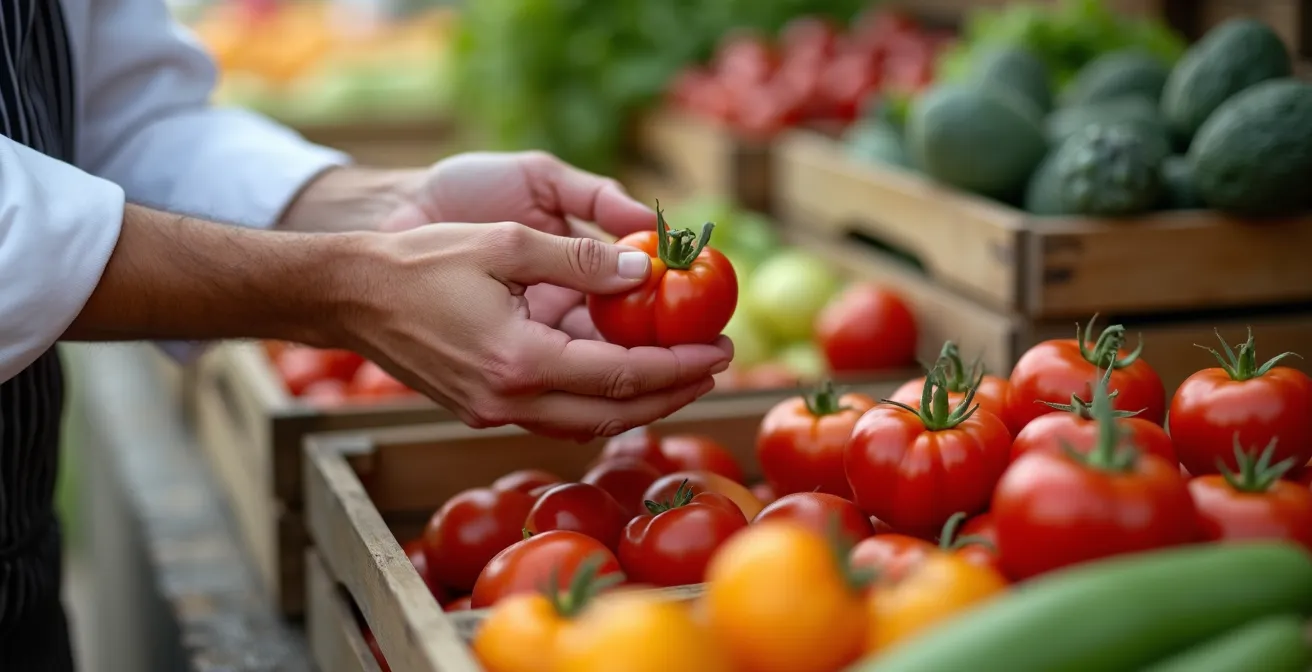
This moment of exchange, where a chef’s discerning eye selects produce directly from the farmer, is the heart of the farm-to-table relationship. It’s a transaction built on mutual respect and a shared passion for quality. Conversely, there is also value in arriving during the last hour of the market. This is when shoppers can often find ‘seconds’—produce that is slightly imperfect but ideal for preserving, sauces, or immediate use—at a discount. This mirrors the sustainable ethos of a true farm-to-table kitchen, which aims to use ingredients in their entirety and waste nothing.
Why Northwest Cuisine Is Obsessed with Mushrooms and Berries?
The culinary identity of a region is a direct reflection of its terroir—the unique combination of soil, climate, and geography. In the Pacific Northwest, this identity is inextricably linked to its damp, temperate rainforests and volcanic soil, creating a world-class environment for fungi and vaccinium (berry) species. The regional obsession with mushrooms and berries is not a trend; it is the most authentic expression of what the land provides. An auditor investigating a restaurant claiming a Pacific Northwest ethos must find this obsession reflected on the menu, timed to the region’s specific micro-seasons.
This is geographic integrity in its purest form. A menu in Portland or Seattle that doesn’t feature chanterelles or morels in the fall, or huckleberries in the late summer, is disconnected from its local foodways. These ingredients are keystones of the regional pantry. The reliance on foraged, wild ingredients is a hallmark of the area’s top chefs, who work with a network of professional foragers to bring the taste of the forest to the plate. This goes a step beyond farming into the realm of wildcrafting, an even more intimate form of local sourcing.
For a diner or traveler looking to verify or experience this, understanding the specific harvest windows is key. The PNW’s bounty is highly seasonal and dictated by weather patterns, particularly the onset of fall rains for mushrooms.
- April-May: This is the peak of morel mushroom season, celebrated at events like Oregon’s Mount Pisgah Arboretum Mushroom Festival.
- May-June: The legendary Copper River Salmon run begins, a short six-week window where this prized fish is available fresh.
- July-August: Wild huckleberry season sends foragers and chefs into the forests of Mount Hood and the Cascade Mountains.
- September-October: The first autumn rains trigger the bloom of chanterelle mushrooms, a regional delicacy.
A restaurant menu that aligns with this calendar is providing a true seasonal alibi. It proves its kitchen is in sync with the rhythms of the Pacific Northwest, offering a genuine taste of place that cannot be replicated elsewhere.
How to Shop at Co-ops Instead of Superstores on Your Route?
For a traveler conducting a food-sourcing audit on the road, food co-ops are the single most reliable hubs for authentic local products. Unlike conventional supermarkets where local items are a niche category, co-ops are fundamentally structured to support local and regional food systems. The data is unequivocal: an impact report from National Co+op Grocers (NCG) shows that on average, 25% of a food co-op’s sales derive from local products, compared to a mere 2% at traditional grocery stores. This 12-fold difference is a testament to their mission.
These stores are more than just retailers; they are community institutions with deep ties to their producers. NCG represents a network of over 165 food co-ops, each of which buys from an average of 175 local farms and producers. They serve as critical infrastructure in the local food economy, often located in areas designated by the USDA as having low food access. For an auditor, a co-op is a treasure trove of evidence. Their shelves are a directory of local growers, and their staff are trained to know the sources of the products they sell. The presence of a community bulletin board advertising CSA signups or farm events is another layer of verification.
Integrating co-ops into your travel is a simple but effective strategy for maintaining a connection to local food systems. It allows you to bypass the homogenous offerings of superstores and instead invest directly in the agricultural community of the region you are visiting.
- Locate Them: Use the National Co+op Grocers’ online store finder at ncg.coop to map out the 240+ store locations along your route.
- Look for Tags: Co-ops use clear shelf-tagging to identify items from ‘local producers,’ removing all guesswork.
- Ask Staff: The produce staff at a co-op are knowledgeable resources who can often tell you the specific farm a product came from and when it was delivered.
- Check Bulk Bins: These are often the best place to find regional specialties like local grains, beans, and flours that you won’t find anywhere else.
By making a co-op your primary grocery stop while traveling, you are actively participating in and supporting the very food systems that authentic farm-to-table restaurants rely upon. It’s a direct way to vote with your dollar for a more resilient and transparent food chain.
Key Takeaways
- Seasonal integrity is the bedrock of farm-to-table; a menu must reflect the specific, regional growing calendar.
- ‘Local’ is a meaningless marketing term without a defined, geographically appropriate radius that you, the auditor, must enforce.
- True local sourcing, even if not certified organic, almost always delivers superior flavor and freshness due to a shortened chain of custody.
How to Win a Ribbon at the State Fair Without Owning a Farm?
The ultimate act of engaging with the farm-to-table ethos is to move from consumer to creator. State Fairs, often seen as purely agricultural showcases, are in fact a democratic and accessible entry point for home cooks to participate in the food system. Winning a ribbon at a prestigious event like the Iowa State Fair, which attracts over a million people annually, is not limited to farmers. The competitions for baking, preserving, and cooking are open to the public and provide a platform for celebrating the very same principles of quality and seasonality that define the best farm-to-table cuisine.
Success in these competitions often hinges on the same criteria an auditor uses to judge a restaurant: the quality and provenance of the ingredients. A perfectly executed apple pie that uses a unique, local heirloom apple variety has a compelling story that judges favor. A jar of strawberry preserves made from berries picked at their absolute peak of summer sweetness will stand out against a competitor using out-of-season supermarket fruit. The 2024 Iowa State Fair’s “Best New Food” winner, a bacon cheeseburger eggroll, demonstrates that even innovation is welcome, but it’s the execution and quality of each component that secures the prize.
Entering these competitions transforms your role. You are no longer just verifying someone else’s chain of custody; you are creating your own. This process provides a profound, firsthand appreciation for the skill and dedication required to produce exceptional food.
- Focus on Accessible Categories: Concentrate on your strengths in areas open to all, such as baking (pies are a classic), jams, jellies, and pickles.
- Use Hyper-Local Ingredients: Make the story of your ingredients a central part of your entry. Name the farm, the orchard, or the garden where you sourced them.
- Master the Classics: Judges often value flawless execution of a traditional recipe over a complex but flawed innovation. Perfect a classic.
- Explore Agricultural Arts: If cooking isn’t your forte, consider categories like agriculture-themed photography, quilting, or crafts that celebrate farm life.
By participating, you gain entry into the community, deepen your understanding of food production, and earn a new level of respect for the farmers and chefs who live this ethos every day. It’s the final step in closing the loop, proving that the principles of farm-to-table are not just for professionals, but for anyone passionate about good food.
To truly honor the farm-to-table movement, apply this auditor’s framework on your next dining experience. Question, investigate, and reward the restaurants that demonstrate a genuine, verifiable commitment to their local food system.