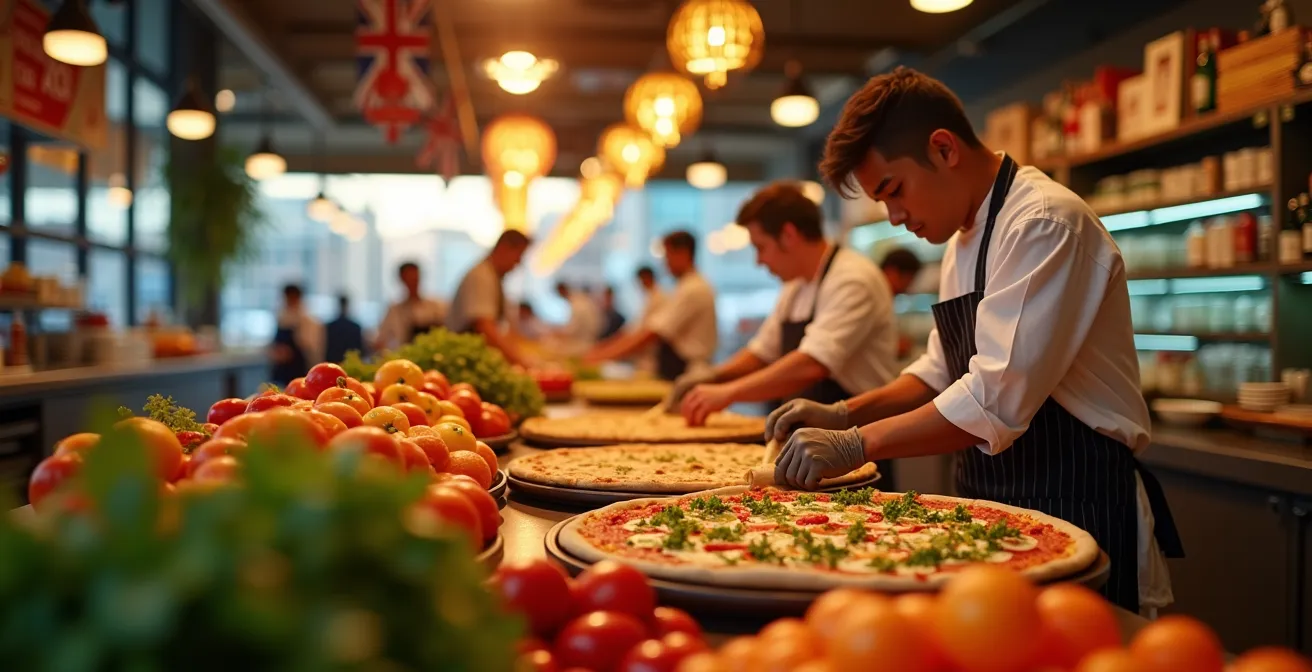
The idea of America as a culinary ‘melting pot’ is a myth; a more accurate model is ‘culinary translation,’ where immigrant foods are systematically adapted to fit pre-existing American commercial and cultural frameworks.
- Authenticity isn’t a fixed point but a story of adaptation, visible in the difference between a street taco and a Tex-Mex hard shell.
- Seemingly ‘ethnic’ creations like the California Roll are actually American inventions, designed to make foreign cuisines more palatable to a domestic audience.
Recommendation: Learn to read the ‘authenticity signals’ in menus, service, and settings to understand the true story behind the food on your plate.
What we call “American food” is, in reality, a complex library of stories told by generations of immigrants. We celebrate the ubiquity of pizza, tacos, and sushi as proof of a great cultural melting pot. We see the lines at food trucks and the vibrant aisles of ethnic markets as signs of a nation that has absorbed the world’s flavors. This narrative is comforting, but it overlooks a more profound and systematic process at play. It isn’t a simple act of addition, but one of translation.
The journey of a dish from an immigrant’s home to a mainstream American menu is rarely a direct one. It undergoes a meticulous process of adaptation, sanitation, and rebranding. Unfamiliar ingredients are swapped for common ones, challenging flavors are toned down, and complex culinary traditions are simplified into easily marketable concepts. This is the engine of culinary translation, a force that shapes everything from the ingredients in a roll of sushi to the very style of service you receive in a restaurant. It’s a constant negotiation between cultural preservation and commercial viability.
This article moves beyond the “melting pot” cliché to offer a food anthropologist’s view of the American palate. We will decode the patterns of this translation, examining how iconic dishes were invented for an American audience and how to spot the subtle signals of authenticity. We will explore the living food museums of immigrant enclaves, contrast the philosophies behind food halls and food courts, and even analyze the unspoken rules of restaurant service. By understanding this process, we can learn to read the true story of migration, assimilation, and identity written on every menu and every plate.
To navigate this fascinating culinary landscape, this guide explores the key markers and stories that define the modern American palate. The following sections will equip you with the insights to understand the food you eat in a completely new light.
Summary: Deconstructing the American Plate
- Why the ‘California Roll’ Is an American Invention, Not Japanese?
- How to Navigate Queens, NY, for the Most Diverse Food Crawl in the World?
- Street Taco vs. Tex-Mex Shell: Which Tells the True Migrant Story?
- The Menu Mistake That Signals a Restaurant Is ‘Fake Ethnic’
- How to Eat Ethiopian, Korean, and Polish Food in One Weekend in DC?
- Food Hall vs. Food Court: What Is the Quality Difference?
- American ‘Hovering’ vs. European ‘Privacy’: Which Service Style Is Better?
- How to Order from a Food Truck Like a Pro in a 20-Person Line?
Why the ‘California Roll’ Is an American Invention, Not Japanese?
The California Roll is perhaps the most successful act of culinary translation in modern history. It stands as a testament not to Japanese tradition, but to American ingenuity in making the foreign familiar. The primary obstacle to sushi’s mainstream acceptance in the 1970s was the American public’s aversion to two things: seaweed (nori) and raw fish. The solution was elegant: turn the roll “inside-out” to hide the dark nori, and replace the raw tuna or eel with a safe, creamy, and familiar ingredient—avocado, paired with cooked crab meat.
This wasn’t an evolution of a Japanese recipe; it was a ground-up invention designed for a specific market. While multiple chefs claim its creation, the first documented mention of a California roll in the Los Angeles Times was in 1979, cementing its identity as a product of the Southern California food scene. One prominent claimant, Japanese-Canadian chef Hidekazu Tojo, notes he created it in Vancouver to cater to his Western clientele’s palate, further underscoring that its origins lie firmly outside of Japan. It was designed to be a gateway, a gentle introduction to the idea of sushi.
The roll’s success demonstrates a key principle of how immigrant foods assimilate. It succeeded not by challenging the American palate’s comfort zone, but by cleverly conforming to it. By removing the “scary” elements and substituting them with acceptable alternatives, the California Roll paved the way for a national sushi boom. It is a brilliant piece of culinary diplomacy, an edible Trojan horse that introduced millions of Americans to a new cuisine by first making it look and taste like something they already understood.
How to Navigate Queens, NY, for the Most Diverse Food Crawl in the World?
If the California Roll represents culinary translation for a mass market, the borough of Queens in New York City represents its antithesis: a living library of un-translated, hyper-specific cuisines. To journey through Queens is to witness food that is still deeply tied to the communities that brought it. The diversity is staggering; it’s a place where over 150 languages are spoken, and it feels as though each one has its own corresponding menu.
The key to navigating this landscape is the No. 7 subway line, aptly nicknamed the “International Express.” This elevated train is the artery connecting a string of distinct migration footprints. A ride on the 7 is not just a commute; it is a culinary world tour. You can disembark in Jackson Heights for Tibetan momos and South Indian dosas, continue to Elmhurst for Thai boat noodles and Malaysian laksa, and end in Flushing for Sichuan hot pot and Korean barbecue. These are not fusion restaurants; they are establishments serving a specific diaspora, with menus often written primarily in their native language.
The neighborhoods below the elevated tracks are a tapestry of culture, where the food scene is an anchor for the community.
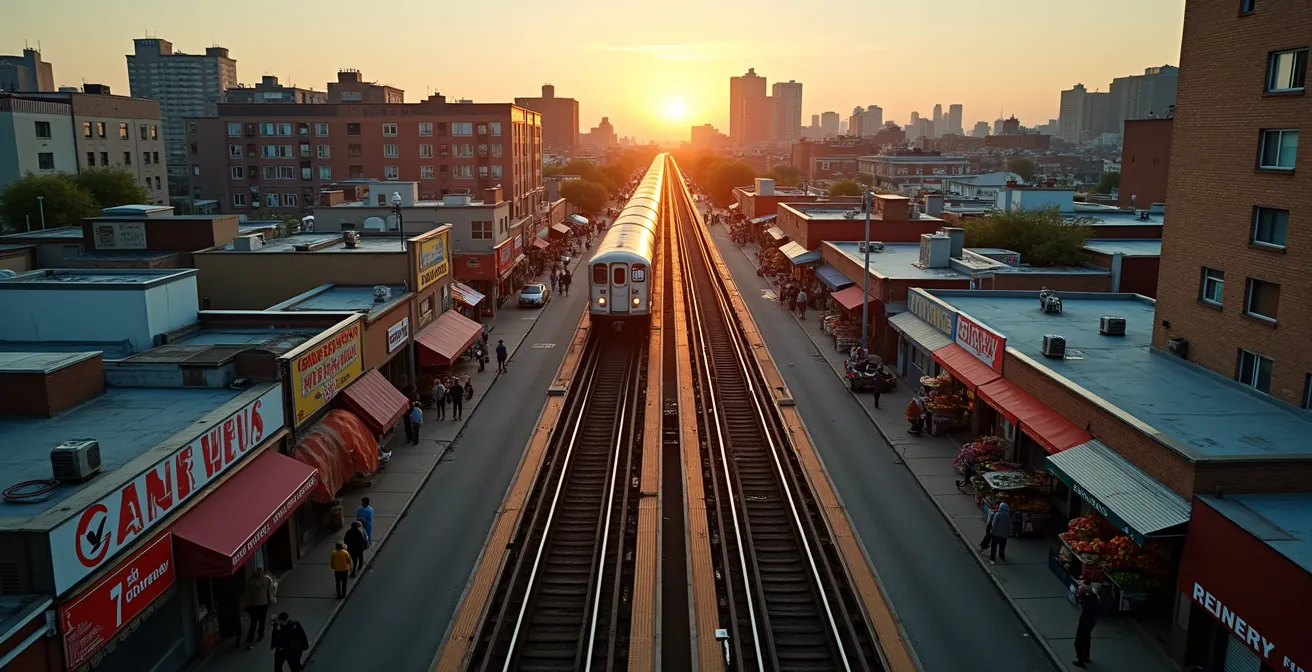
As this image suggests, the train itself acts as a connector, stitching together enclaves where culinary traditions are preserved with fierce pride. A food crawl in Queens is more than a meal; it’s an anthropological field study. It’s an opportunity to taste dishes in their most authentic form, before the pressure of economic Darwinism forces them to adapt for a broader, less familiar audience. Here, the food tells a direct, unfiltered story of migration, community, and identity.
Street Taco vs. Tex-Mex Shell: Which Tells the True Migrant Story?
Not all adaptations tell the same story. The evolution of the taco in America provides a perfect case study in two distinct paths of culinary translation, each revealing a different chapter of Mexican-American history. On one side, you have the “street taco”—small, served on a soft corn tortilla, filled with grilled meats like al pastor or carnitas, and simply garnished with cilantro and onion. This form is a direct descendant of the food of urban Mexico, brought to American cities by more recent waves of immigrants. It is food born of mobility and economic necessity, designed to be made and eaten quickly.
On the other side stands the iconic Tex-Mex hard-shell taco: a pre-formed, fried corn shell filled with ground beef, shredded iceberg lettuce, yellow cheese, and tomatoes. This is not an import from Mexico but an American-born hybrid, a product of the Tejano culture that emerged after the annexation of Texas. It reflects a longer history of fusion, incorporating the widespread availability of beef and wheat (in flour tortillas) and catering to a palate that prized crunch and mild, familiar flavors. The rise of fast-food chains like Taco Bell and Chipotle further cemented this version in the American consciousness, turning a regional hybrid into a national staple.
This table illustrates the profound differences in their cultural DNA, each a valid but distinct narrative of the migrant experience.
| Aspect | Street Taco | Tex-Mex Shell |
|---|---|---|
| Origin | Direct Mexican migration to urban centers | Tejano culture post-Texas annexation |
| Tortilla | Soft corn (indigenous) | Hard shell or flour (wheat influence) |
| Cultural Story | Recent immigrant adaptation | Border culture fusion |
| Authenticity | Closer to Mexican tradition | American-Mexican hybrid creation |
Neither taco is more “authentic” than the other; they are simply authentic to different stories. The street taco tells the story of recent arrival and cultural preservation, while the Tex-Mex taco tells a story of generations-long settlement and cultural fusion. Recognizing the difference is to understand that a single food can contain multiple, equally true histories of migration.
The Menu Mistake That Signals a Restaurant Is ‘Fake Ethnic’
As diners, we are constantly searching for “authenticity,” but how do we identify it? The menu itself is often the most revealing document, containing subtle clues—or glaring mistakes—that signal whether a restaurant is serving a specific community or a translated version for a general audience. The single biggest red flag is the “Pan-Asian” or “Pan-Latin” menu, a culinary Frankenstein that conflates distinct national cuisines into one generic offering.
When you see Japanese sushi offered alongside Thai pad thai and Vietnamese pho, it’s a strong indication that the restaurant’s focus is not on cultural fidelity but on commercial appeal. It’s a business model that hedges its bets by offering the “greatest hits” of an entire continent, stripping each dish of its specific context. This approach assumes the customer is not discerning enough to know the difference between the culinary traditions of Tokyo and Bangkok. It is the ultimate act of culinary translation, where specificity is sacrificed for broad accessibility.
The contrast between a kitchen dedicated to a specific tradition and one built for commercial fusion is often stark.
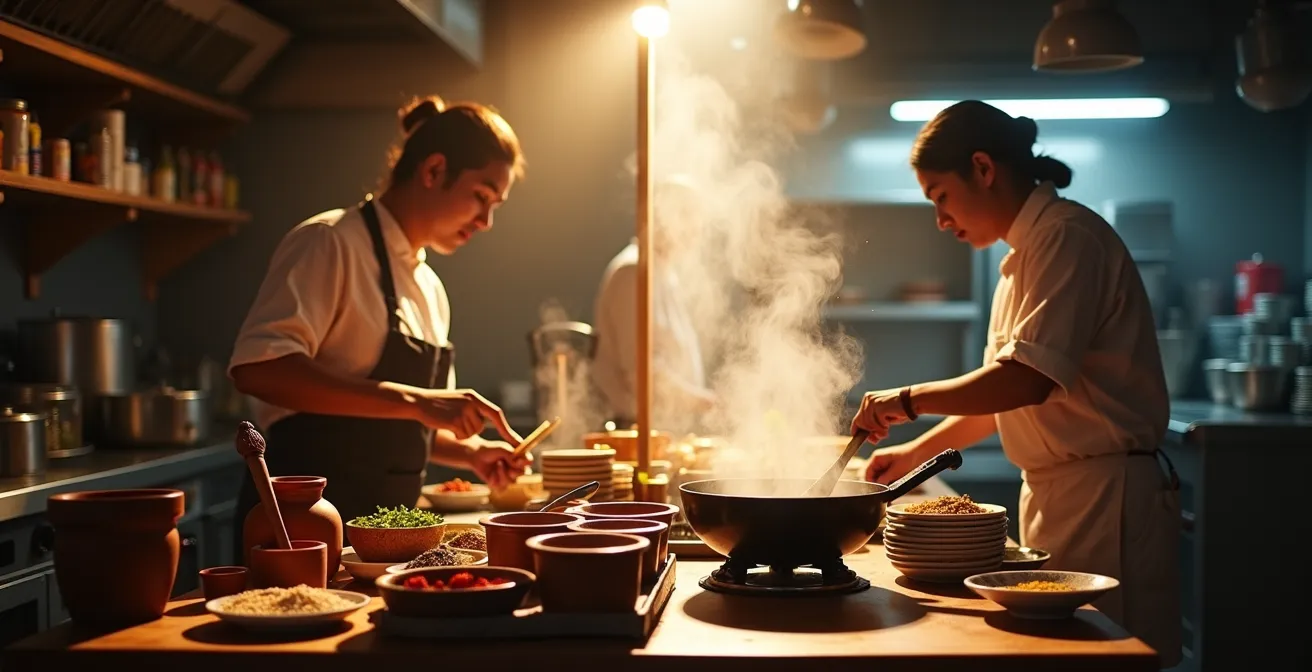
This visual metaphor captures the philosophical divide. One side represents deep, specialized knowledge passed through generations; the other represents an industrial process designed for efficiency and mass appeal. Learning to spot these signals allows you to make more informed choices about where you eat and what story your money is supporting.
Your Checklist for Spotting Inauthenticity
- The “Pan-Cuisine” Menu: Be wary of menus that mix distinct national foods, like a restaurant serving both Italian pasta and Spanish paella.
- Default Spice Levels: If you have to specifically ask for a dish to be “spicy” at a Thai or Sichuan restaurant, it means the default has been toned down for the American palate.
- Lack of Native Language: An absence of the cuisine’s native language on the menu (or a separate menu for community members) suggests the target audience is primarily non-native.
- Americanized Ingredients: Look for overuse of ingredients like cream cheese in sushi or broccoli in Chinese stir-fries without traditional alternatives being offered.
- Generic Decor: Vague, stereotypical decor that could represent an entire continent (e.g., red lanterns and bamboo for “Asia”) often signals a lack of cultural specificity.
How to Eat Ethiopian, Korean, and Polish Food in One Weekend in DC?
Just as Queens offers a condensed world tour, other American cities harbor distinct culinary ecosystems that reflect their unique immigration histories. Washington D.C. is a prime example, where a weekend food journey can reveal how different migration footprints have created geographically separate but culturally rich food scenes. The key is knowing where to look, as these communities are often clustered in specific neighborhoods tied to their historical settlement patterns.
According to a report on immigrant contributions to U.S. culture, D.C.’s diverse communities have established distinct culinary strongholds. The city’s Ethiopian population, which grew significantly following refugee resettlement in the 1970s and 80s, is concentrated in the Adams Morgan and Shaw neighborhoods. A short drive away in Annandale, Virginia, a classic suburban settlement pattern from the 1970s gave rise to one of the East Coast’s most vibrant Koreatowns. Meanwhile, the region’s Polish cuisine is historically linked to Catholic parishes, with delis and restaurants serving as community anchors.
To experience this diversity is to embark on a planned urban exploration. This isn’t about random wandering; it’s about a targeted “field study” connecting food with history:
- Friday Evening: Ethiopian in Adams Morgan. Start with a communal platter of doro wat and kitfo, eaten with spongy injera bread. This neighborhood is the heart of the largest Ethiopian community outside of Africa.
- Saturday Lunch: Korean in Annandale. Head to the suburbs for a feast of Korean BBQ, followed by a visit to a jjimjilbang (Korean spa) for a full cultural immersion.
- Sunday Brunch: Polish in the Region. Seek out a Polish restaurant for pierogi and kielbasa, and consider a side trip to Baltimore’s historic Krakus Market to see a deli that has served its community for generations.
This itinerary is more than a list of meals; it’s a journey through the city’s sociological map. It shows how immigrant groups build worlds within a city, with food serving as both a cultural anchor for the community and a welcoming gateway for outsiders.
Food Hall vs. Food Court: What Is the Quality Difference?
The physical spaces where we encounter immigrant food also tell a story. The traditional suburban mall food court and the modern urban food hall may seem similar—both offer multiple vendors under one roof—but their sociological functions are worlds apart. The food court is the classic model of culinary assimilation, dominated by national chain franchises offering speed, consistency, and budget-friendly prices. It is the endpoint of culinary translation, where ethnic foods (like the offerings at Panda Express or Sbarro) are fully standardized for a mass market.
The modern food hall, by contrast, operates on a different philosophy. It targets food enthusiasts with chef-driven concepts, culinary innovation, and premium price points. As one industry analysis notes, food halls often function as “culinary incubators.” According to a report on the Queens food industry, they provide a launchpad for immigrant and first-generation chefs by offering lower startup costs and shared infrastructure. However, there is a third, vital category often overlooked: the ethnic mall food court, found in places like Flushing, Queens, or Eden Center in Virginia. Here, the focus is neither on mass-market convenience nor on trendy innovation, but on raw authenticity for a diaspora community.
This table breaks down the fundamental differences in their roles and target audiences.
| Feature | Modern Food Hall | Traditional Food Court | Ethnic Mall Food Court |
|---|---|---|---|
| Target Market | Food enthusiasts | Mass market convenience | Diaspora community |
| Quality Focus | Culinary innovation | Speed and consistency | Authenticity |
| Typical Vendors | Chef-driven concepts | Chain franchises | Family-owned businesses |
| Price Point | Premium | Budget-friendly | Value-oriented |
| Cultural Role | Culinary incubator | Quick service | Community hub |
Understanding this distinction is key. A food court offers a glimpse of a cuisine after its journey of assimilation is complete. A food hall offers a curated, often upscale, taste of that journey. But an ethnic mall food court offers the rare chance to experience the food at its source, in a space built by and for the community itself.
American ‘Hovering’ vs. European ‘Privacy’: Which Service Style Is Better?
The story of immigrant food is not just about ingredients; it’s also about the human interactions that frame the meal. The question of “good service” is deeply cultural, and the American standard often clashes with expectations from around the world. The dominant American model can be described as “hovering”—frequent check-ins, constant water refills, and a proactive, sales-driven engagement. This style is a direct product of a commission-based economic model, where a server’s income depends heavily on tips and, by extension, on performing a certain kind of attentive, friendly service.
This contrasts sharply with the “European privacy” model, where service is seen as a professional function. The server is a salaried professional who takes your order, delivers your food, and otherwise leaves you undisturbed unless flagged down. There is no economic incentive for constant interaction. But there is a third model that is crucial to the immigrant restaurant experience: “immigrant hospitality.” This style is not driven by sales or professional distance but by a cultural imperative to treat a guest as if they were in one’s own home. It is a relationship-based model where genuine appreciation is valued over perfunctory politeness.
These philosophical differences are rooted in distinct economic and cultural realities.
| Service Style | Philosophy | Economic Model | Customer Expectation |
|---|---|---|---|
| American ‘Hovering’ | Sales-driven engagement | Commission-based (tips) | Frequent interaction |
| European ‘Privacy’ | Professional function | Salaried professional | Proactive flagging needed |
| Immigrant ‘Hospitality’ | Home-style welcome | Relationship-based | Genuine appreciation valued |
Asking which style is “better” misses the point. Each is a logical outcome of its environment. The American “hover” can feel intrusive to a European, while the European “privacy” can feel like neglect to an American. The “immigrant hospitality” model adds another layer, offering a warmth that can feel deeply personal but may lack the polished efficiency of the American system. Understanding these underlying scripts helps us appreciate the service not as a universal standard but as another fascinating expression of culture.
Key Takeaways
- The American palate was not formed by a ‘melting pot’ but by a process of ‘culinary translation,’ where foreign foods are actively adapted for commercial success.
- Authenticity is not a single point but a spectrum, revealed in the difference between a community-focused dish (street taco) and an assimilated hybrid (Tex-Mex shell).
- Learning to read ‘authenticity signals’—like pan-cuisine menus or default mild spice levels—empowers you to understand the real story behind a restaurant.
How to Order from a Food Truck Like a Pro in a 20-Person Line?
The food truck is the modern frontier of immigrant culinary entrepreneurship. It is a lean, mobile, and often family-run business that represents the most direct connection between a chef and a customer. But this vibrant ecosystem has its own unwritten rules, and navigating a 20-person line during the lunch rush requires a certain social grace. Being a “pro” isn’t about skipping the line; it’s about respecting the time and effort of the people behind the counter and the other customers around you. It is the final lesson in mindful participation in the food system.
The core principle is efficiency. The entire operation is optimized for speed, and your role as a customer is to be a seamless part of that flow. This means doing your homework. Most trucks have a specialty, a dish they are known for. Ordering it without a litany of complex modifications is a sign of respect for their craft. The menu is your script, and you should have your lines memorized before you reach the window. The intimate, face-to-face transaction at the window is the heart of the food truck experience.
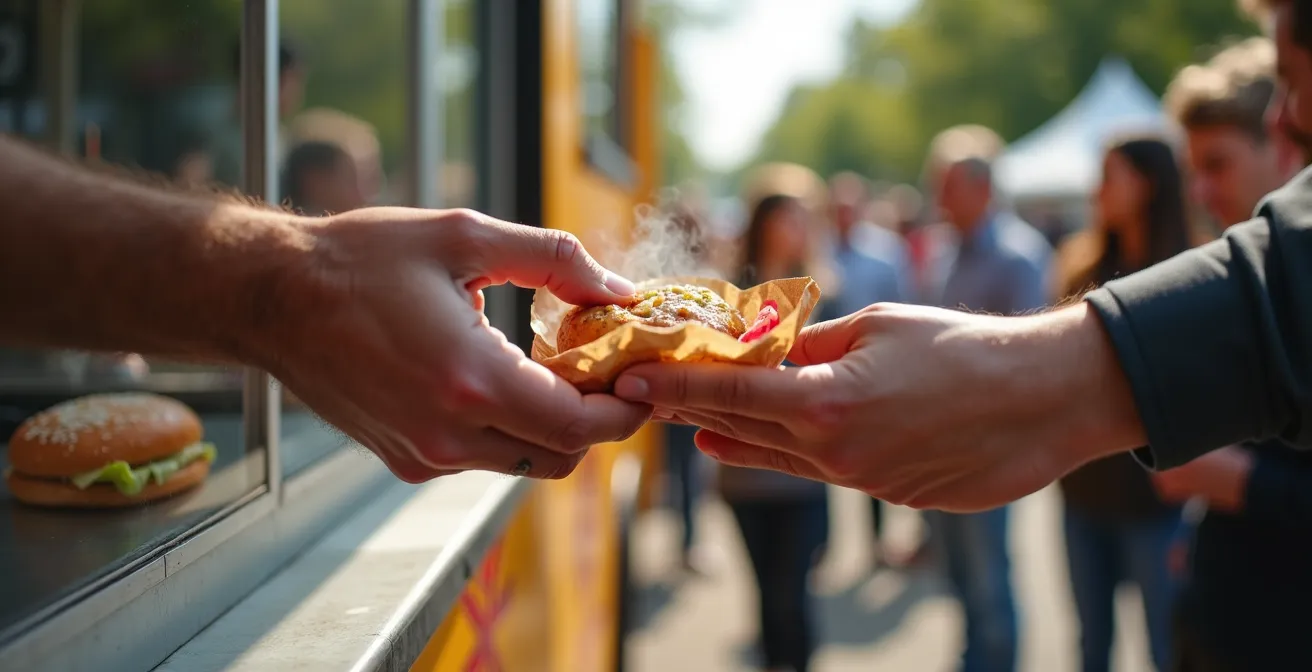
This close-up on the exchange of food and payment captures the human connection that defines street food culture. To honor this connection, follow a simple pro-level strategy:
- Do Your Research: Follow the truck on social media. They often post daily specials or secret menu items, allowing you to decide your order long before you arrive.
- Know Your Order: Review the menu while you wait in line. By the time you get to the window, you should be able to state your order clearly and concisely.
- Be Ready to Pay: Have your card or exact change out and ready. Fumbling for payment is the most common cause of delay.
- Step Aside: Once you’ve paid, move away from the window to a designated waiting area so the next person can order. This keeps the line moving smoothly.
Mastering this etiquette is the ultimate sign of respect. It acknowledges that you are not just a consumer but a participant in a delicate economic and social ecosystem, one often powered by the dreams and hard work of a single immigrant family.
By learning to decode the stories behind our food, we move beyond being simple consumers and become active, thoughtful participants in the ongoing narrative of American culture. The next time you sit down to eat, ask yourself: what story is this plate telling me?