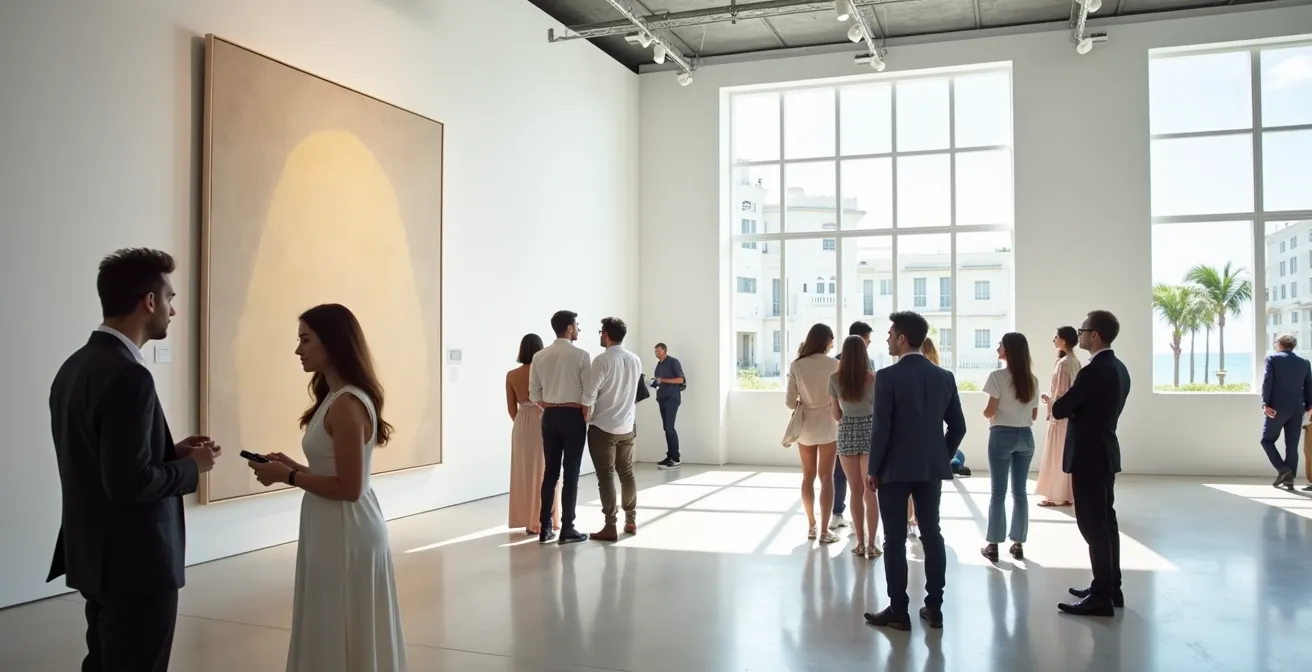
The key to acquiring art at an elite fair like Art Basel isn’t a limitless budget; it’s a surgical strategy focused on intelligence and relationships.
- Access is tiered, but strategic networking with galleries and museum memberships provides early entry points beyond the main VIP hours.
- True value is found in emerging artist sectors like ‘Positions,’ where spotting talent requires analyzing an artist’s CV, institutional signals, and price coherency—not just aesthetics.
Recommendation: Shift your focus from buying what’s ‘hot’ to investing in artists with a strong foundational trajectory. The greatest opportunities lie in what the crowd is about to discover, not what they are already looking at.
The velvet rope, the clinking champagne glasses, the hushed multi-million dollar deals—the perception of Art Basel Miami Beach is one of impenetrable exclusivity. For the aspiring collector or art lover, the event can feel more like a fortress than a fair. The common advice to “just go and look” or “talk to gallerists” dissolves in the face of an overwhelming spectacle that attracts more than 75,000 gallerists, collectors, and art lovers. The fear isn’t just about price; it’s about access, knowledge, and the feeling of being an outsider in a world with its own unwritten rules.
Many believe the only way in is with a Centurion Card or a direct line to Larry Gagosian. They resign themselves to the crowded public hours, missing the crucial early moments where relationships are formed and the most exciting works are discovered. But what if the game wasn’t about financial firepower, but about strategic intelligence? What if you could navigate this complex ecosystem not as a tourist, but as a savvy player?
This guide demystifies the process. It’s not a list of platitudes; it’s an advisor’s playbook. We will move beyond the obvious and into the actionable, showing you how to gain access, how to identify artists on the cusp of greatness, and how to manage the practicalities of a major art acquisition. Forget the millionaire myth; this is your strategy for building a meaningful collection, one smart move at a time.
This article provides a step-by-step strategic framework for navigating the fair. The following sections will guide you through everything from securing early access to identifying the red flags of a ‘tourist trap’ gallery, ensuring you can operate with confidence and precision.
Summary: Your Playbook for Art Basel Miami
- Why You Can’t Enter the Tent Before 2 PM Without a Black Card?
- How to Spot the Next Big Artist in the ‘Positions’ Sector?
- New York vs. Los Angeles: Which City Has the Better Gallery Scene Today?
- The Customs Mistake That Gets Your Art Seized at the Border
- How to See 200 Galleries in 4 Hours Without Visual Burnout?
- How to Look at a Pollock for 5 Minutes and Actually Understand It?
- How to Get a Reservation at America’s Top Michelin Spots Without a Bot?
- How to Identify a ‘Tourist Trap’ Restaurant in Under 30 Seconds?
Why You Can’t Enter the Tent Before 2 PM Without a Black Card?
The “First Choice” and “Preview” VIP cards for Art Basel’s opening hours are indeed the art world’s equivalent of a golden ticket, typically reserved for major collectors, museum directors, and top-tier clients. This tiered access system isn’t just about creating buzz; it’s a functional tool that allows serious business to be conducted before the public rush. For the galleries, these first few hours are when a significant portion of their most important sales are finalized. However, believing this is the only window of opportunity is the first mistake aspiring collectors make. The reality is that there are several strategic backdoors—what we call access hacking.

The key is to cultivate relational equity long before you land in Miami. A junior gallerist at a gallery in your home city is a powerful ally; they often have a small allocation of passes for promising new clients. Another potent strategy is leveraging museum memberships. Premier institutions like MoMA in New York or the local Pérez Art Museum Miami (PAMM) often have partnerships that grant their higher-tier members access to preview hours. This is not just a pass; it’s an affiliation that signals you are a serious and engaged member of the art community. The strategic player understands that access isn’t just bought; it’s earned through savvy engagement and foresight.
Finally, consider the timing. Arriving in the last two hours of a VIP day can be more productive than the frantic opening. The crowds have thinned, the pressure is off, and gallerists are often more relaxed and open to a genuine conversation with someone who isn’t a known mega-collector. This is your moment to make a real connection.
How to Spot the Next Big Artist in the ‘Positions’ Sector?
Once inside, the real work begins. While the main ‘Galleries’ sector is filled with multi-million dollar works by modern masters, your focus should be on sectors like ‘Positions’ and ‘Nova’. ‘Positions’ is dedicated to solo presentations by single emerging artists, offering a deep dive into their practice. ‘Nova’ features new work from up to three artists per gallery. These are the hunting grounds for future stars, with prices that are often more accessible, sometimes starting in the four-figure range and generally staying under $40,000. But how do you distinguish a future art-world star from a fleeting trend?
This is where you deploy Signal Intelligence. It’s a disciplined vetting process that goes far beyond “I like the way it looks.” You are looking for a confluence of indicators that point to a sustainable career. The gallery’s own program is your first clue. Does it have a history of launching successful artists? A quick search on their website reveals their past roster. This tells you if they are good talent spotters. Next, you must analyze the artist’s CV. Look for a recent MFA from a respected program (like Yale, Columbia, or UCLA) and, crucially, inclusion in notable group shows at established galleries or non-profits. These are early votes of confidence from other curators and professionals.
The most powerful indicator is an institutional signal. Has a museum acquired their work? Even a mention on a museum’s blog is significant. Use your phone to quickly search the artist’s name on industry-standard publications like *Artforum* or *Frieze*. Finally, assess price coherency. The price should feel logical for their career stage, the medium, and the scale of the work. If it feels wildly inflated, it’s a red flag. An artist’s long-term value is built on a series of these credible, interlocking signals.
New York vs. Los Angeles: Which City Has the Better Gallery Scene Today?
Understanding the art you see at Basel requires understanding the broader ecosystem it comes from. The United States art market is largely dominated by two coastal powerhouses: New York and Los Angeles. While both have a formidable presence at the fair, they represent different facets of the art world. Recognizing their distinct characteristics helps you contextualize the galleries you encounter and refine your collecting strategy. The rivalry is less about which city is “better” and more about what each city prioritizes.
New York remains the undisputed financial and institutional center. Its galleries, often found in the main convention center hall, represent the pinnacle of the blue-chip market. They are the homes of established masters and the titans of the secondary market—works being resold from previous collections. When you engage with a top-tier New York gallery, you are often discussing art history and established value. Los Angeles, by contrast, has become the epicenter of artistic production and contemporary experimentation. The LA galleries you find, often clustered at satellite fairs like NADA, are more likely to be championing younger artists and pushing the boundaries of contemporary practice. Engaging with an LA gallery is a conversation about the future of art.
Of course, one cannot ignore the host city. Miami’s own gallery scene has matured dramatically, with local powerhouses like David Castillo and Fredric Snitzer holding their own on the international stage. Their focus often provides a vital platform for Latin American and regional talent, contributing to an economic impact that, according to Miami Beach City Manager Alina Hudak, brings an estimated $400 million to $500 million annually in related activity. This dynamic interplay between established markets, experimental hubs, and regional forces is what makes Art Basel Miami such a rich and complex environment.
| City | Gallery Characteristics | Strategic Focus at Basel |
|---|---|---|
| New York | Blue-chip galleries in main convention center | Established masters, secondary market strength |
| Los Angeles | Emerging galleries clustered at satellite fairs | Contemporary experimentation, younger artists |
| Miami (Local) | David Castillo, Fredric Snitzer galleries | Latin American focus, regional talent |
The Customs Mistake That Gets Your Art Seized at the Border
The euphoria of acquiring your first piece at a major art fair can be quickly extinguished by a bureaucratic nightmare at the border. The most common and costly mistake a new collector makes is assuming the artwork can be simply carried home like any other souvenir. A misunderstanding of U.S. Customs regulations can lead to delays, fines, or in the worst-case scenario, seizure of your new prized possession. It is absolutely critical to treat the export process with the same seriousness as the purchase itself.
Many travelers are unaware that there is a personal duty-free exemption of only $800 for art purchases. Any work valued above this amount must be formally declared. Attempting to bypass this can be interpreted as smuggling. The gallery you purchase from should be your primary partner in this process. Most reputable galleries have extensive experience with international shipping and can handle the logistics for you, including customs brokerage. While this adds to the cost, it is an essential insurance policy against catastrophic errors.
Whether you ship through the gallery or handle it yourself, impeccable documentation is non-negotiable. You are not just transporting a painting; you are importing a high-value asset, and you must have the paperwork to prove its legitimacy, value, and ownership. This paperwork is your shield against any potential disputes with customs officials. Having it organized and ready is the mark of a professional, regardless of the price of the artwork.
Your Pre-Flight Checklist: Essential Art Purchase Documentation
- Official Invoice: Must include a detailed description of the artwork: title, artist, medium, dimensions, and the final price.
- Proof of Payment: A clear record of the transaction showing the amount paid and the gallery’s information.
- Certificate of Authenticity: A document signed by the gallery or artist, confirming the work’s legitimacy. This is the artwork’s passport.
- Gallery Contact Information: The name and direct phone number of the representative who sold you the work, in case of any questions from officials.
- Condition Report: For any artwork valued over $2,500, a report with photographs documenting its condition before shipping is crucial for insurance purposes.
How to See 200 Galleries in 4 Hours Without Visual Burnout?
The sheer scale of Art Basel is its greatest asset and its greatest challenge. With over 280 galleries under one roof, the natural impulse is to try and see everything. This is a recipe for “visual burnout”—a state of mental and physical exhaustion where art becomes a blur and you lose the ability to truly see or appreciate anything. A strategic collector does not wander; they execute a plan. Your goal is not quantity, but quality of engagement. As the editorial team at Marriott Bonvoy Traveler wisely advises, you must pace yourself. They note in their Art Basel Miami Beach Weekend Guide:
As a general rule of thumb, enjoying Art Basel is all about pacing yourself. Don’t attempt more than one or two fairs in a day.
– Marriott Bonvoy Traveler Editorial Team
The foundation of maintaining your visual stamina is pre-fair digital triage. Days before you arrive, use the Art Basel app or website to browse the virtual booths. ‘Favorite’ 20 to 30 galleries or artists that align with your taste and objectives. This becomes your personalized roadmap. Furthermore, define a personal mission. Instead of a vague goal to “see art,” create a specific, achievable objective, such as “discover three new female painters under 30” or “find a work of ceramic sculpture that challenges the medium.” This mission acts as a filter, allowing you to bypass 80% of the fair with purpose and focus on what truly matters to you.
Once on the ground, use a “hub-and-spoke” method. The central café or lounge is your base camp. From there, embark on focused 30-45 minute forays to see a cluster of your targeted booths, then return to base to rest, rehydrate, and review your notes. This prevents aimless wandering. Remember, it is far more valuable to spend ten meaningful minutes with three artworks you love than to spend thirty seconds with two hundred. The goal is to leave the fair energized by what you’ve seen, not defeated by what you’ve missed.
How to Look at a Pollock for 5 Minutes and Actually Understand It?
Confronting a major work of abstract art, like a Jackson Pollock drip painting, can be intimidating. In the bustling environment of an art fair, the temptation is to glance, feel nothing, and move on. However, understanding abstract art isn’t about “getting” a hidden message; it’s about engaging in a structured process of looking. A strategic collector knows how to analyze a work formally and contextually, unlocking a deeper appreciation that goes beyond a simple “I like it” or “I don’t.”
The process begins with a simple gut check. Stand back about ten feet from the work and allow your initial emotional response to register without judgment. Is it chaotic? Serene? Aggressive? Joyful? This first impression is a valid and important data point. Next comes the formal dive. Get close to the canvas. Forget the whole and focus on the parts. Analyze the quality of the lines—are they thick, thin, fast, slow? Examine the color relationships. Are they harmonious or clashing? Look at the texture and the material choices. Can you see the layers of paint? Is the surface glossy or matte? This is a purely visual investigation of the artist’s decisions.
Only after this formal analysis do you seek context. Read the wall text. Who is the artist? When was it made? Then, use your phone for a quick query. A tool like the Artsy app is invaluable here, as it can help you monitor artists’ markets in real-time and access their latest exhibition history. The final step is to engage the gallerist with a specific, intelligent question. Instead of “What’s this about?”, ask, “Can you tell me about their physical process?” This prompts a conversation about technique and intentionality, giving you the story behind the object and completing your understanding.
A Framework for Analyzing Abstract Art
- The Gut Check: Stand 10 feet away. Register your initial emotional response without overthinking.
- The Formal Dive: Get close. Analyze line quality, color relationships, texture, and material choices.
- The Context Query: Read the wall text and use your phone to research the artist’s statement and recent exhibitions.
- The Process Question: Ask the gallerist, “Can you tell me about their physical process?” to understand the technique behind the work.
How to Get a Reservation at America’s Top Michelin Spots Without a Bot?
Art Basel week is as much a social and culinary marathon as it is an art event. Securing a reservation at Miami’s top restaurants becomes a competitive sport, seemingly impossible without a bot or a concierge on speed dial. However, the strategic art advisor knows that the best dining experiences aren’t always at the most-hyped Michelin-starred venues. The goal is to eat well while maximizing networking opportunities and avoiding the reservation frenzy. This requires an insider’s dining strategy.
First, shift your focus to the art world haunts. Instead of fighting for a table on South Beach, target the restaurants in the Wynwood and Design District neighborhoods. This is where gallerists, artists, and curators actually eat. A well-timed lunch at a casual but credible spot near satellite fairs like Untitled or Scope can lead to more valuable conversations than a formal dinner. For those set on a top-tier restaurant, there is the “3-4 PM hack.” This is the window when the maître d’ is planning the evening service and is most receptive to a polite, direct call. They are more likely to accommodate a small party then than during the chaotic dinner rush.
A powerful alternative to the restaurant rat race is the hotel bar. After 6 PM, the lobbies of hotels like The Edition, Faena, or The Standard become the de facto social clubs of the art world. You can skip the fight for a dinner reservation and instead network over a well-made cocktail. For a truly authentic experience, take a cue from the locals. A guide by a Miami insider might recommend spots like Empanadas Sur for a quick and delicious bite, Caracas Bakery for a morning coffee and cachito, or La Latina for late-night arepas after a gallery opening party. These are the places that offer real flavor and a genuine glimpse into the city’s culture, far from the tourist throngs.
Key Takeaways
- Access to elite art fairs is less about wealth and more about strategic relationship-building and leveraging memberships.
- The most significant investment opportunities are in emerging artist sectors, identified through a rigorous analysis of “signals” like exhibition history and institutional validation.
- A successful fair experience requires a plan to combat visual burnout, focusing on a targeted mission rather than attempting to see everything.
How to Identify a ‘Tourist Trap’ Restaurant in Under 30 Seconds?
During a high-energy event like Art Basel, it’s easy to fall into a “tourist trap” for a meal—an overpriced, low-quality experience designed to prey on undiscerning visitors. The red flags are often obvious if you know what to look for: hosts actively luring you in from the sidewalk, giant laminated menus with pictures of every dish, and overpriced “Art Basel Special” cocktails. These venues thrive on convenience and location, often surrounded by souvenir shops rather than other quality establishments.
This same critical lens for identifying inauthenticity is your most powerful tool back inside the fair. The art world has its own version of tourist traps: galleries that deal in generic, decorative pieces with no clear artistic point of view. They often employ high-pressure sales tactics, offering “today only” deals that are a major red flag in an industry built on considered decisions. They will be vague about an artwork’s provenance (its history of ownership) and may not have a proper Certificate of Authenticity ready.
A legitimate gallery, by contrast, operates with an educational approach. They are eager to discuss the artist’s cohesive vision and long-term program. Their pricing is transparent and consistent with the artist’s market position, and all documentation is immaculate. The most important parallel is this: a great restaurant has a chef with a clear vision, and a great gallery has an artist with a clear vision. Your job as a collector is to learn to spot the difference between a master of their craft and someone just serving up what they think the tourists want.
| Red Flag Category | Tourist Trap Gallery | Legitimate Gallery |
|---|---|---|
| Art Quality | Generic decorative pieces, no clear artist point of view | Cohesive exhibition with artist statement |
| Sales Approach | High-pressure tactics, ‘today only’ deals | Educational approach, building relationships |
| Documentation | Vague answers about provenance | Clear certificates of authenticity |
| Pricing | Too good to be true for alleged artist | Transparent, market-consistent pricing |
Armed with this strategic framework, you are no longer just a visitor. Step into the art world with the confidence of a collector and begin building a collection that reflects your unique vision.