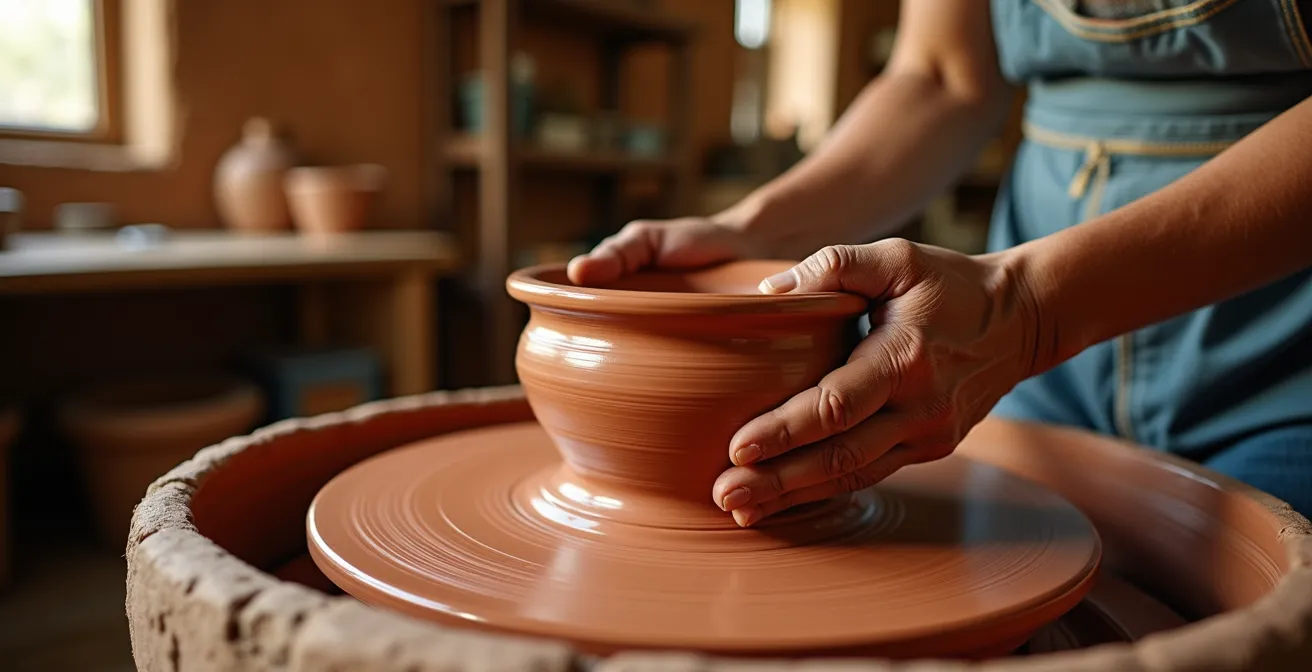
A true Santa Fe pottery retreat is not about making a souvenir; it’s a transformative process that shifts you from passive art consumer to active creator and discerning connoisseur.
- Focus on workshops with multi-session classes and clear skill progression over single-day “experiences.”
- Leverage your hands-on learning to develop a “maker’s eye” for appreciating and collecting authentic craft.
Recommendation: Prioritize studios that emphasize process and technique, and you’ll return not just with pottery, but with a new way of seeing the world.
The promise of a “maker vacation” whispers of more than just a getaway. It’s a desire to trade passive sightseeing for active creation, to feel the grit of clay under your fingernails instead of sand between your toes. You’re searching for a pottery retreat in Santa Fe, not for another souvenir to dust, but for a skill, a memory forged in the kiln, a genuine connection to a timeless craft. Yet, the travel landscape is filled with “experiences” that are more photo-op than apprenticeship. Many so-called art classes are little more than guided painting sessions fueled by wine, fun but fleeting.
The common advice is to read reviews or look at studio galleries. But this approach misses the fundamental difference between a tourist activity and a true learning immersion. The key isn’t just about the quality of the final product, but the depth of the process. What if the real value of a pottery retreat wasn’t the pot you take home, but the perspective you gain? This guide is built on a different philosophy: the Maker’s Shift. It’s about moving from a consumer of art to a creator, and in doing so, learning to see, appreciate, and engage with the world of craft on a profoundly deeper level.
We’ll explore why this hands-on process is so restorative, how to identify a workshop dedicated to real skill-building in the heart of America’s craft capital, and what to do with your creations and your newfound knowledge. This is your roadmap to an experience that reshapes more than just a lump of clay.
Summary: Finding a Santa Fe Pottery Workshop That Builds Real Craftsmanship
- Why Crafting Vacations Reduce Cortisol More Than Beach Resorts?
- Asheville vs. Santa Fe: Which City Is the True Capital of American Craft?
- The ‘Paint and Sip’ Trap That Isn’t a Real Art Class
- How to Structure a 5-Day Writing Retreat to Finish Your Novel Chapter?
- How to Transport Wet Oil Paintings on a Plane?
- How to Curate a Travel Scrapbook That Isn’t Cluttered or Tacky?
- How to Look at a Pollock for 5 Minutes and Actually Understand It?
- How to Buy Art at Art Basel Miami Without Being a Millionaire?
Why Crafting Vacations Reduce Cortisol More Than Beach Resorts?
The deep-seated urge for a hands-on vacation isn’t just a whim; it’s a neurological need. While a beach resort offers passive rest, engaging in a creative act like pottery provides a unique form of active restoration. The magic lies in a state of “flow,” where your focus is so complete that the anxieties of daily life simply fade away. This isn’t just a feeling; it’s a measurable biochemical event. Your brain is not idle; it is joyfully and completely occupied in a way that actively counteracts stress.
This phenomenon is backed by science. The goal isn’t just to distract yourself, but to engage in an activity that brings you joy and requires focus. This could be gardening, playing an instrument, or shaping clay on a wheel. The focused, repetitive motions of pottery are particularly meditative, creating a rhythm that calms the nervous system. A compelling study confirms the powerful impact of this creative engagement. Research from Drexel University found a 75% reduction in cortisol levels in adults after just 45 minutes of making art. Cortisol, the body’s primary stress hormone, plummets when you are immersed in a tactile, creative process.
This significant drop highlights why a crafting vacation can feel more deeply restorative than a week of passive lounging. While lounging provides a break, making something with your hands actively heals the mind. You’re not just escaping your stressors; you are fundamentally rewiring your response to them, building resilience and a sense of accomplishment that a beach chair simply can’t offer. This is the neurobiology of crafting: a powerful, tangible benefit that you carry with you long after the clay has dried.
Asheville vs. Santa Fe: Which City Is the True Capital of American Craft?
While cities like Asheville, North Carolina, boast a vibrant and commendable craft scene, Santa Fe, New Mexico, holds an unrivaled claim as the true heart of American craft, particularly in ceramics. The difference lies not just in the number of galleries, but in the profound, centuries-old heritage that infuses the very soil of the region. Santa Fe’s identity as a pottery hub is inextricably linked to the living traditions of the Pueblo peoples, whose ceramic artistry is among the most ancient and revered in North America.
This is where the legendary Maria Martinez of San Ildefonso Pueblo revolutionized black-on-black pottery, transforming a traditional craft into a celebrated international art form. This legacy isn’t confined to museums; it’s a dynamic, evolving presence. Contemporary Santa Fe potters work in the shadow and light of this history, with techniques like horsehair pottery drawing direct inspiration from traditional pit firing methods. This deep historical context provides a learning environment you simply cannot find elsewhere. You aren’t just learning a craft; you are stepping into a story.
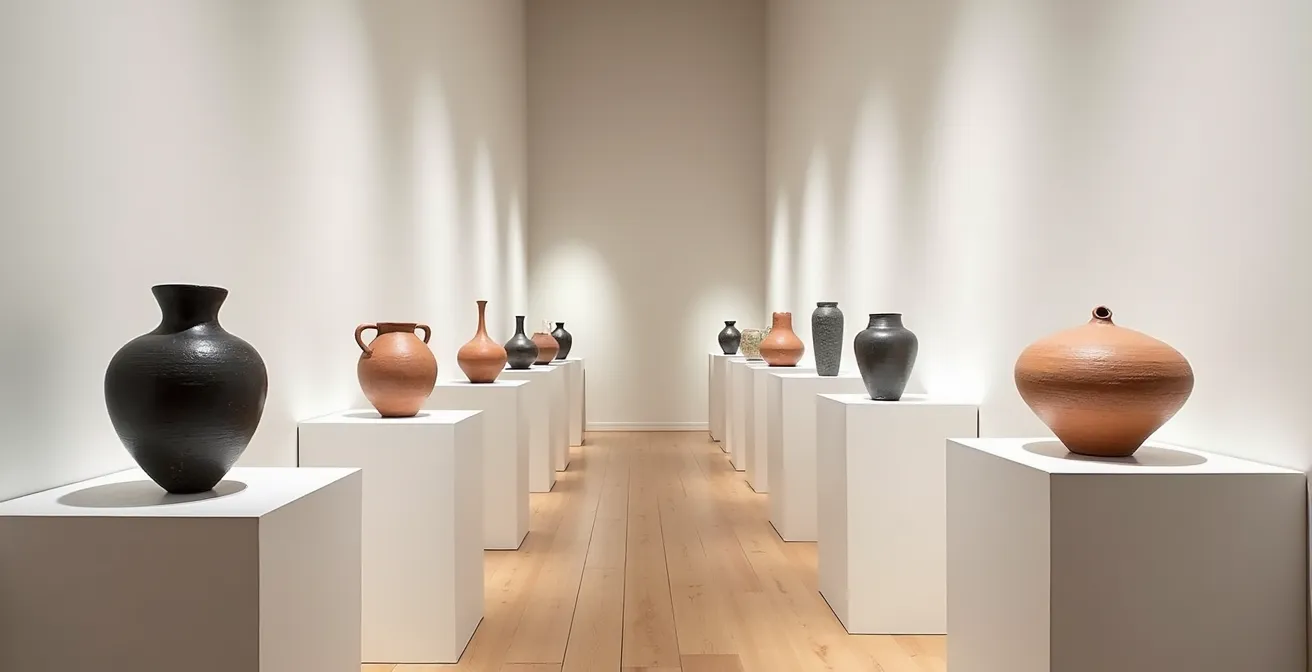
The city’s infrastructure is built around this identity. The community is not just a collection of individual artists but a supportive ecosystem. Local studios are deeply integrated into the community’s fabric, often giving back in significant ways. For instance, the impact of a studio like Paseo Pottery, which, according to their own reports, has contributed over $100,000 in donations to local nonprofits in its first five years, demonstrates a commitment that goes beyond commerce. Choosing Santa Fe is choosing a place where craft is not just a commodity but a cultural cornerstone.
The ‘Paint and Sip’ Trap That Isn’t a Real Art Class
Now that you’ve chosen Santa Fe, the most crucial step is distinguishing a genuine workshop from a superficial “experience.” The modern travel market is saturated with activities designed for quick, easy fun—the pottery equivalent of a ‘paint and sip’ night. While enjoyable, these events are not designed to teach you a skill. They are designed for you to leave with a passable object and a fun memory, often by having the instructor do the hard parts for you. The real Maker’s Shift happens when you grapple with the process yourself, failures included.
As travel expert Samantha Brown notes in a review of a premier Santa Fe studio, a great teacher has a way of putting “everybody in that magically relaxed creative zone.” This is the hallmark of a true workshop, but it must be paired with substantive instruction. Samantha Brown says of one instructor:
Heidi Loewen is the go-to clay artist and teacher to the stars, from Hollywood and beyond. Perhaps it is her nonchalance, her wild sense of humor, or the way she teaches. She simply puts everybody in that magically relaxed creative zone in her class.
– Samantha Brown, Travel Expert Review
To find a class that offers both this creative zone and real learning, you must become a discerning investigator. Look for signs of a curriculum, no matter how short. A quality indicator is an instructor who begins with a demonstration of core techniques. A major red flag is an “experience-based” class where students are expected to recycle their work back into the clay mound at the end. While this can be framed as “embracing the ephemeral,” it often means the workshop isn’t structured to produce a finished, fireable piece, which is a key part of the learning process. The goal is skill-based immersion, not just entertainment.
Your Checklist: Identifying a Serious Pottery Workshop
- Program Structure: Look for multi-week classes (e.g., 7-week courses) in beginning or intermediate techniques. For shorter retreats, look for a clear multi-day progression.
- The “Recycle” Red Flag: Be wary of experiences where you recycle your work at the end. A serious class respects your effort and guides you toward a finished piece.
- Instructor’s Role: A quality instructor demonstrates techniques first, then acts as a coach while you work independently at your own wheel. They should provide pre-wedged and centered clay for beginners to maximize learning time.
- Entry Requirements: Phrases like “No previous art experience required” are fine, but be cautious if paired with “The only requirement is a sense of humor!” This can signal a focus on entertainment over education.
- Process-Oriented Language: The studio’s website and class descriptions should talk about learning “techniques,” “process,” and “skill-building,” not just “fun,” “creativity,” and “making a souvenir.”
How to Structure a 5-Day Writing Retreat to Finish Your Novel Chapter?
While our focus is clay, the structure of any effective creative retreat, be it for writing or pottery, follows a similar arc of progressive skill-building. A great workshop is not a single, repetitive event but a structured journey. Thinking about it like a “Potter’s Arc” helps you understand what a 5-day intensive should feel like. It’s a curated progression from basic orientation to independent creation, with expert guidance at every stage. This structure is the antidote to the aimless “experience” and the foundation of real learning.
A well-designed pottery intensive will likely follow a path like this:
- Day 1: Foundation & Centering. The first session is about orientation—to the studio, the tools, and the clay itself. The primary goal is learning the most crucial and challenging first step: centering the clay on the wheel. It’s a meditative, often frustrating, process that builds the foundation for everything else.
- Days 2-3: Core Skill Focus. Once you have a feel for centering, you’ll focus on “pulling up the walls” to create a basic cylinder, the mother of all pottery forms. An expert instructor will be by your side, guiding your hands and helping you understand the physics of pressure and water.
- Day 4: Form & Refinement. With the basic cylinder form mastered, you can now explore shaping—creating bowls, mugs, or vases. This is where your personal creativity starts to merge with the technical skill you’ve acquired.
- Day 5: Finishing & The Next Step. The final day is often dedicated to trimming the bases of your pieces (the “foot”) and preparing them for the kiln. This is also when you’ll learn about glazing and the magical transformation that happens during firing.
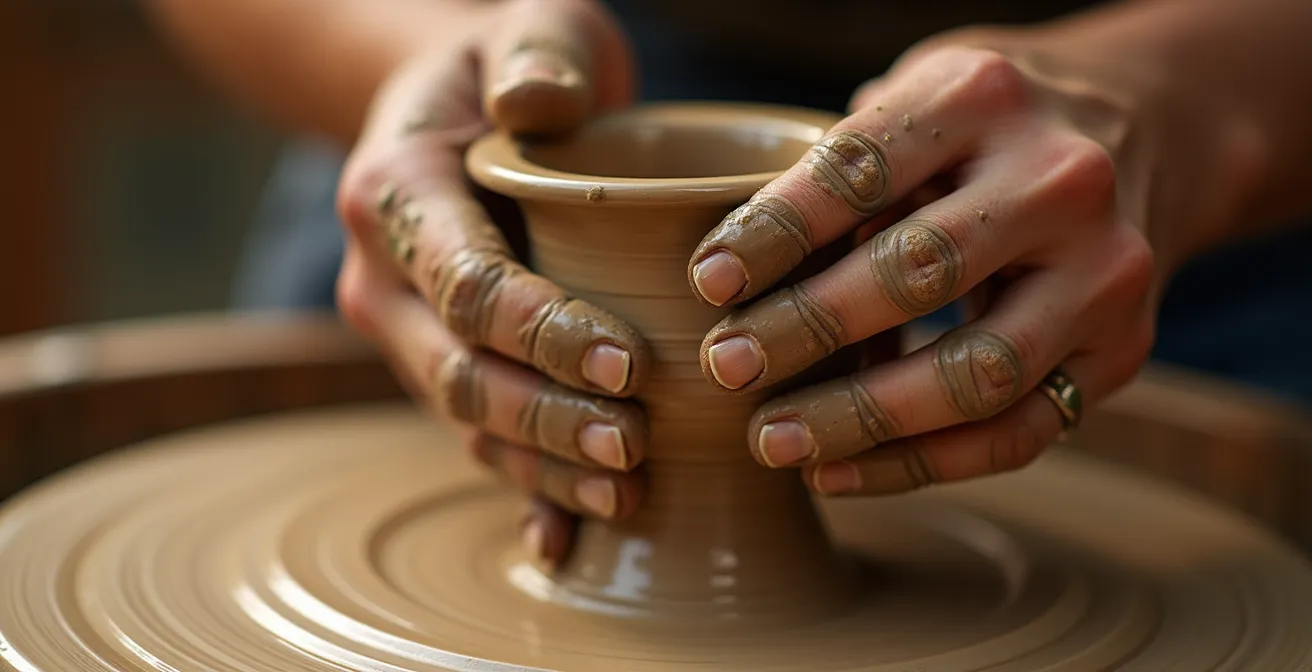
This progressive structure ensures that you are constantly building on what you’ve learned. Even in a short, two-hour introductory class, a good instructor will guide you through a miniature version of this arc. Whether you’re a complete beginner or deepening your practice, a spot at a workshop with a clear, progressive curriculum is a sign that your investment will pay off in tangible skills.
How to Transport Wet Oil Paintings on a Plane?
You’ve centered, thrown, and trimmed. Your pieces are a testament to your hard work, and the studio is preparing them for their final glaze and firing. Now comes a crucial logistical question: how do you get your new treasures home? Unlike a wet oil painting, your pottery will be fired and solid, but it’s still fragile. Shipping is almost always the best option, and reputable Santa Fe studios have this process down to a science.
Many top-tier studios will handle this for you, taking the stress out of the equation. This service is a significant value-add and another hallmark of a professional operation. They understand the nuances of packing delicate ceramics for transit.
Case Study: Heidi Loewen Studio’s Shipping Success
A prime example of a seamless process is the service offered by Heidi Loewen’s studio. After a student creates their work, Heidi herself glazes each piece. Her team then meticulously wraps, packs, and ships the finished art via UPS. The studio proudly notes that in over 15 years of shipping student work, not a single piece has been damaged. This level of care and reliability is what you should look for.
If your studio doesn’t offer a dedicated shipping service, or if you acquire other pieces during your trip, you’ll need to manage it yourself. Santa Fe is well-equipped with services that specialize in shipping art. It’s vital to choose the right carrier based on the size, value, and number of pieces you have. Insurance is a key factor; note that some carriers have surprisingly low limits for art. For particularly valuable or complex shipments, a local specialist is your best bet.
This comparative data, based on an analysis of artwork shipping options, can help you decide:
| Carrier | Insurance Limit | Best For | Cost Range |
|---|---|---|---|
| USPS Priority Mail | Economical for smallish packages | Small pottery pieces | $10-50 |
| UPS | Up to $50,000 | Medium to large ceramics | $25-100+ |
| FedEx | Only $1,000 regardless of actual value | Multiple pieces to same address | $30-150+ |
| PakMail Santa Fe | Custom art insurance | Specialized pottery protocols for Santa Fe market | Quote-based |
How to Curate a Travel Scrapbook That Isn’t Cluttered or Tacky?
As your pottery makes its way home, your focus can shift to preserving the memory of your journey. But the goal here isn’t a traditional, cluttered scrapbook. In line with the Process-Over-Product philosophy, the aim is to create a “pottery process journal” that tells the story of your learning and the Maker’s Shift you experienced. It’s less about a perfect-looking album and more about an authentic record of your creative transformation.
This journal becomes a cherished object in its own right, a testament to your experience that goes deeper than a single finished pot. One student on a girls’ weekend in Santa Fe perfectly captured this sentiment in a review:
I participated in the pottery experience while on a girls weekend in Santa Fe. So much fun. I did learn I am not very good at the wheel – but it didn’t matter because I had a great time and left with a much greater appreciation of what goes into making pottery pieces.
– TripAdvisor Reviewer, Santa Fe Activities
Her story highlights the core value: the appreciation gained is the true prize. Your process journal should capture exactly that. Instead of just pasting in ticket stubs, curate it with intention:
- Document Each Stage: Take photos of your work in progress, not just the finished pieces. Capture the lopsided first attempts, the collapsed walls, and the triumphant moment you finally center a piece. These tell the real story.
- Capture Teaching Moments: Jot down key phrases or tips from your instructor. Sketch the hand positions they demonstrated. This turns your journal into a personalized textbook.
- Include Contextual Ephemera: Your journal is the perfect home for small, authentic artifacts that root your experience in place. Think beyond postcards. Include the studio’s business card, a label from the bag of local clay, or the receipt from a small gallery purchase.
- Write Your Reflections: Describe the feeling of the clay, the frustration of a failed piece, and the elation of a small success. What did you learn about patience? About yourself? This narrative transforms your journal from a scrapbook into a memoir.
Key Takeaways
- A true craft retreat is defined by skill-building and process, not just a fun experience or a finished product.
- Santa Fe offers a uniquely deep environment for learning pottery, rooted in centuries of living Pueblo tradition.
- Your hands-on experience as a maker fundamentally changes how you see and appreciate art, giving you a “connoisseur’s eye.”
How to Look at a Pollock for 5 Minutes and Actually Understand It?
One of the most profound and unexpected outcomes of a maker vacation is the permanent upgrade it gives your eyes. After you’ve struggled to pull up an even wall on a vessel, you will never look at a simple ceramic bowl the same way again. This newfound “maker’s eye” is the key that unlocks a deeper appreciation for all forms of art, even something as seemingly chaotic as a Jackson Pollock painting. You’ve moved from spectator to someone who understands, on a visceral level, the challenges of creation.
This new lens allows you to “read” a piece of pottery with an insider’s knowledge. When you visit Santa Fe’s famed Canyon Road galleries after your workshop, you’ll see more than just beautiful objects. You’ll see the evidence of skill, the ghost of the artist’s hands, and the hundreds of small decisions that led to the final form. You’ve gained the vocabulary to deconstruct and appreciate the craft.
You can apply this new connoisseurship by consciously looking for specific details. The next time you pick up a piece of handmade pottery, use this framework to “read” it:
- Examine the ‘Foot’: Flip the piece over and look at the trimmed base. Is it smooth and deliberate? A well-executed foot is a sign of a potter who pays attention to detail and finishes their work with care.
- Assess the ‘Wall’: Run your eyes, and if possible, your fingers, along the vessel’s profile. You’re checking for consistent thickness and an even, confident curve. You’ll now appreciate how difficult it is to achieve this.
- Study the ‘Glaze’: Notice the application. Can you see how it was dipped, poured, or brushed? Look at how the glaze “breaks” (thins) over sharp edges or pools in crevices. These are not flaws; they are the expressive character of the piece.
This is the Maker’s Shift fully realized. You are no longer just a viewer; you are a fellow practitioner, able to recognize and honor the skill in another’s work. The same principle applies to looking at a Pollock; you start to think about the artist’s movements, the layering of paint, the physical act of creation, rather than just the final image.
How to Buy Art at Art Basel Miami Without Being a Millionaire?
Armed with your new connoisseur’s eye, the idea of collecting art may no longer feel intimidating. While Art Basel Miami might still be a stretch, you can absolutely start a meaningful collection of authentic craft without a millionaire’s budget. The secret is to apply the same principles you used to find a good workshop: look for authenticity, skill, and emerging talent, starting right where you are in Santa Fe.
Your journey as a maker has given you the confidence to trust your own judgment. You can now distinguish a mass-produced item from a piece with soul. Instead of heading to the most expensive galleries on Canyon Road, you can explore where the real work is happening. This is how you find high-quality, affordable art that tells a story.
Case Study: Affordable Collecting at Student Shows
Many workshops offer a clever and accessible entry point to collecting. At studios like Paseo Pottery, for instance, even if your class project is recycled, you don’t leave empty-handed. Each student receives a gallery credit (e.g., $15) to put toward a piece made by one of the talented instructors or resident artists. This not only gives you a beautiful, professional piece to take home but also supports the artists who taught you.
This direct-from-the-source approach is the key to affordable and authentic collecting. Here are some strategies to start your own collection in Santa Fe:
- Attend Studio Sales: Keep an eye out for holiday or seasonal sales at teaching studios. These events often feature beautiful work from students, interns, and teachers at prices far below those in major galleries.
- Look for Emerging Artists: Visit the galleries attached to the studios themselves. This is where you’ll find the work of the next generation of talented potters before they become big names.
- Buy Directly from Instructors: Many instructors sell their own work at the studios where they teach. This is a wonderful way to acquire a piece from someone who directly influenced your creative journey.
- Inquire About ‘Seconds’ or Student Work: Ask if the studio has a section for ‘seconds’ (pieces with minor cosmetic flaws) or sells work from advanced students. These can be incredible bargains.
By shifting your mindset from a passive tourist to an active maker, you’ve unlocked more than just a new hobby. You’ve gained a new lens through which to see the world, a deeper connection to a historic place, and the confidence to not only create but also to curate a life filled with authentic, meaningful objects. Your journey into craft is just beginning.