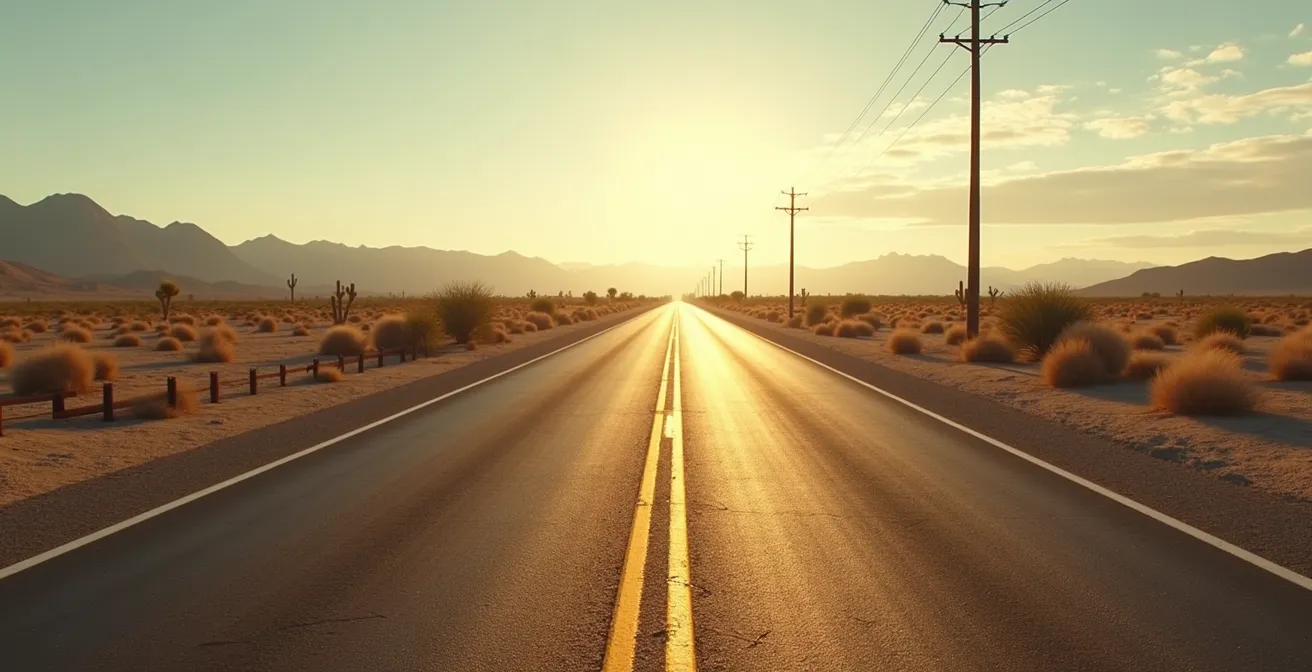
Driving Route 66 today is less about following a map and more about mastering the art of the detour and embracing its glorious disconnections.
- Standard GPS will consistently fail you; the real skill is in tracing the “ghost alignments” that shadow the interstate.
- True authenticity isn’t found in kitschy branding but in applying an “authenticity litmus test” to a diner’s parking lot or a motel’s upkeep.
Recommendation: The most memorable trip comes from strategically planning for the road’s modern imperfections, not pretending they don’t exist.
The allure of Route 66 is a powerful force in American mythology. It’s the “Mother Road,” a 2,400-mile ribbon of asphalt promising freedom, adventure, and a tangible link to a bygone era of chrome-laden road trips. Nostalgia seekers, dreaming of cruising in a classic Mustang, imagine a straight shot through a living museum of Americana. They envision glowing neon, friendly diners, and quirky roadside attractions, all neatly laid out like a storybook. This idyllic image is the road’s greatest promise and its most profound deception.
The common advice is to simply “get a good map” or “use a GPS.” But the harsh reality for the modern traveler is that Route 66 was officially decommissioned in 1985. It no longer exists as a single, contiguous highway. It’s a phantom, a scattered collection of historic main streets, forgotten two-lane blacktops, and dusty dead ends that run in the shadow of the monolithic interstates that replaced it. This isn’t just a navigation problem; it’s an existential one. Blindly following a GPS will rob you of the very soul of the journey, rerouting you onto the soulless I-40 and past the treasures you came to find.
But what if the key to an authentic Route 66 experience wasn’t in trying to perfectly recreate the past, but in mastering its fractured present? The true adventure lies not in a seamless drive, but in the detective work of tracing its ghost alignments and the wisdom to know a real slice of history from a modern tourist trap. This guide is built on that principle. We’ll bypass the generic lists and focus on the insider strategies required to truly conquer the Mother Road today, turning its confusion into the very heart of the adventure. We will explore how to navigate its lost segments, prepare your vehicle for the harsh realities of the road, and develop a critical eye for authentic experiences. This is your manual for finding the living, breathing soul of Route 66, not just the ghost on the map.
This comprehensive guide is structured to give you the strategic mindset needed for the Mother Road. The following sections break down the essential knowledge, from navigation and vehicle prep to spotting the real gems among the tourist traps.
Summary: A Strategist’s Guide to the Real Mother Road
- Why Most of Original Route 66 Is No Longer on Modern GPS Maps?
- How to Prep a Classic Mustang for a 2,000-Mile Desert Crossing?
- Wigwam Motel vs. Blue Swallow: Where to Sleep for Peak Nostalgia?
- The ‘Historic’ Diner Trap That Serves Frozen Food at Premium Prices
- How to Pace Your Route 66 Drive to See the Neon Signs at Night?
- Why Franchise Motels Are Replacing the Iconic Neon Signs?
- The ‘Charming’ Town Trap That Has Everything Closed on Tuesdays
- How to Spot a Safe Motel at a Lonely Interstate Exit?
Why Most of Original Route 66 Is No Longer on Modern GPS Maps?
The single biggest frustration for first-time Route 66 drivers is a fundamental misunderstanding of what the road is today. It’s not a single entity. Since its official decommissioning, the road has become a patchwork of state-maintained “Historic Route 66” sections, county roads, local streets, and even stretches of gravel or brick that have been bypassed for decades. Google Maps and Waze are designed for efficiency; their algorithms will relentlessly try to push you onto the faster, parallel interstates like I-40, I-55, and I-44. Asking your GPS to “take Route 66” is like asking it to find the mythical city of El Dorado.
The good news is that, despite the official removal from the highway system, a dedicated traveler can still drive a significant portion of the original path. It is estimated that over 80% of the original route can still be driven today, but finding it requires a deliberate, manual approach. These navigable segments are what enthusiasts call “ghost alignments”—sections of the old road that haunt the edges of the modern interstate. To navigate them, you must abandon the idea of a single destination and instead think in terms of waypoints. This involves using specialized apps like the EZ66 Guide, physical turn-by-turn maps, and manually adding small towns like Seligman, Arizona, or Pontiac, Illinois, as stops in your GPS to force it along the historic corridor.
The most effective strategy is to use technology as a tool, not a guide. Set your GPS to “avoid highways” and use it to navigate between the “Anchor Towns” that form the backbone of your journey. As you approach a historic segment, you’ll put the phone down and rely on paper maps or the EZ66 guide to trace the original two-lane blacktop. You’ll know you’re on the right track when the asphalt turns to worn concrete and you feel the rhythmic *thump-thump* of the original 1930s pavement seams. This is where the real journey begins.
How to Prep a Classic Mustang for a 2,000-Mile Desert Crossing?
Driving a classic car like a 1965 Mustang is the ultimate Route 66 fantasy, but it can quickly turn into a roadside nightmare without proper preparation. A vintage vehicle is not a modern rental; it’s a character in your story, and it requires special care, particularly for the grueling desert crossings in Arizona and California. The primary enemies of a classic car in the desert are heat and fuel delivery issues. Vapor lock, where gasoline boils in the fuel lines and starves the engine, is a common and trip-ending problem for carbureted engines in high temperatures. Likewise, vintage cooling systems were not designed for 110°F asphalt and modern traffic.
While any well-maintained modern car can handle Route 66 with ease, taking a classic requires a specific “desert-proofing” protocol. This goes beyond a standard tune-up. The focus must be on the cooling and fuel systems. A professional mechanic familiar with vintage cars should be your first stop. Upgrading to heat-resistant silicone hoses, installing an electric fuel pump to combat vapor lock, and adding modern coolant additives can make a world of difference. It’s not about altering the car’s character, but about giving it the resilience to survive conditions it was never built for.
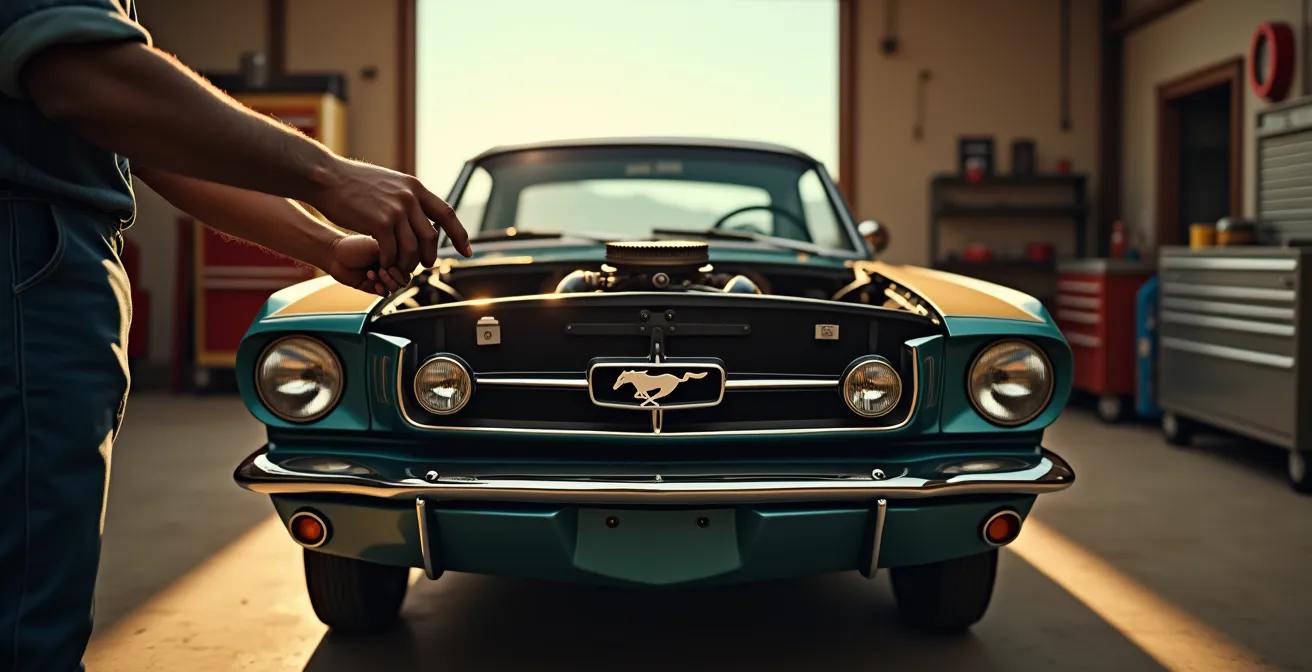
Beyond the mechanical prep, your toolkit is your lifeline. A basic set of wrenches is not enough. You must carry duplicates of the parts most likely to fail: a full set of belts, an extra water pump, and, if your car is pre-1975, points and a condenser for the distributor. Think of it as a rolling workshop. Carrying at least five gallons of extra water (for the car and for you) is non-negotiable. This level of preparation may seem excessive, but on a lonely stretch of the Mojave, it’s the difference between a minor inconvenience and a major crisis.
- Install a vapor lock prevention kit with insulated fuel lines and an electric fuel pump.
- Add modern coolant additives designed for vintage cooling systems, like Evans waterless coolant.
- Replace all rubber hoses with heat-resistant silicone alternatives rated for 300°F or higher.
- Install an auxiliary transmission cooler if you have an automatic transmission.
- Carry a minimum of 5 gallons of extra water plus concentrated coolant.
- Mount a battery cut-off switch for emergency electrical issues.
- Pack a complete spare belt set, extra oil, and a pre-1975 points/condenser kit if applicable.
Wigwam Motel vs. Blue Swallow: Where to Sleep for Peak Nostalgia?
Along Route 66, where you sleep is as much a part of the experience as what you see. The choice often comes down to two legendary establishments: the Wigwam Motel in Holbrook, Arizona, and the Blue Swallow Motel in Tucumcari, New Mexico. On the surface, they both offer a night in a historic setting, but they represent two very different philosophies of nostalgia. The Wigwam is about kitsch and iconography; the Blue Swallow is about character and authenticity. Choosing between them depends entirely on the kind of memory you want to create.
The Wigwam Motel, with its slogan “Sleep in a Teepee,” is pure, photogenic fun. The experience is centered on the novelty of its concrete and steel teepee-shaped rooms, arranged in a large circle around a collection of vintage cars. It’s an Instagram-worthy landmark, perfect for families and those looking to capture a quintessential, quirky piece of Americana. The rooms themselves are basic, but that’s not the point. The point is the picture you take in the morning, standing in the door of your teepee.
The Blue Swallow Motel, on the other hand, offers a deeper, more immersive step back in time. Meticulously restored and run with a passion for history, it feels less like a motel and more like a curated time capsule. Each room features period-correct furnishings, a working rotary phone, and its own attached garage, a holdover from the 1940s. The social atmosphere is a key part of the experience; guests gather in the courtyard at dusk to watch the famous neon sign flicker to life and share stories with the owners. As one traveler noted, the experience is profoundly different from a standard hotel:
We stayed at vintage motels along Route 66 and loved the authentic experience. The mom-and-pop motels with their original neon signs and passionate owner-operators provided the most memorable nights of our journey – far more special than any chain hotel could offer.
– Traveler’s Perspective, Independent Travel Cats
To help you decide, the following table breaks down the key differences. There is no wrong choice, only the choice that is right for your personal vision of the Mother Road.
| Feature | Wigwam Motel (Holbrook, AZ) | Blue Swallow (Tucumcari, NM) |
|---|---|---|
| Nostalgia Type | Iconic ‘kitsch’ – photogenic tepee-shaped rooms | Authentic ‘character’ – meticulous restoration |
| Neon Sign Quality | Large, partially functional vintage sign | 100% restored, complex multi-color neon |
| Room Experience | Unique tepee architecture, basic amenities | Period-furnished rooms with original fixtures |
| Social Atmosphere | Individual photo opportunities | Evening courtyard gatherings with guests |
| Best For | Instagram-worthy shots, families with kids | History buffs, authentic vintage experience |
The ‘Historic’ Diner Trap That Serves Frozen Food at Premium Prices
Just as with motels, not all “historic” diners are created equal. The resurgence of Route 66’s popularity has led to the rise of the “diner trap”—a restaurant that looks the part with chrome, vinyl booths, and a jukebox, but serves pre-made, frozen food at inflated prices. They cater to tour buses and unsuspecting tourists, banking on aesthetics over quality. The true soul of Route 66 dining lies in the family-run cafes and diners that have served their communities for generations, places where the food is simple, honest, and made from scratch. Developing an “authenticity litmus test” is crucial to avoiding disappointment.
The test begins in the parking lot. A lot full of rental cars, RVs, and tour buses is a major red flag. A lot with local pickup trucks, work vans, and a few dusty sedans is a very good sign. Inside, the menu is your next clue. An authentic diner rarely has a sprawling, multi-page menu. They have a focused list of items they do exceptionally well. They are known for *one thing*—be it the “Ugly Crust Pie” at the Midpoint Café in Adrian, Texas, or the green chile stew at a New Mexico institution. As one expert from the Route 66 Dining Guide puts it, the strategy is clear:
The goal is to find the specialty, not a place that does everything mediocrely.
– Route 66 Travel Expert, Route 66 Dining Guide
The final, and most reliable, test is to ask the locals. But you must phrase the question correctly. Don’t ask, “Where’s a good place for tourists to eat?” This will get you sent to the very traps you’re trying to avoid. Instead, ask, “Where do *you* go for a good lunch?” This small change in wording cuts through the tourist-facing veneer and gets you an honest, local recommendation. To systematize this process, use this simple audit before you commit to a meal.
Your Action Plan: The 5-Point Diner Authenticity Audit
- Parking Lot Check: Scan for local vehicles (pickup trucks, work vans) versus tourist vehicles (tour buses, rental cars). Locals are the best sign of authenticity.
- Menu Size Analysis: Review the menu. A small, focused menu (5-10 core items) suggests expertise, while a massive, fifty-item menu often indicates a reliance on frozen goods.
- Specialty Identification: Ask the server or look for signs indicating the one dish the diner is famous for. If there isn’t one, be wary.
- Location Verification: Check if the diner is on the town’s original main street. Locations built at modern interstate off-ramps are often designed purely for tourist traffic.
- Local Intel Gathering: Ask a local worker (e.g., at a gas station or shop) “Where do YOU eat?” not “Where should a tourist eat?” to get a genuine recommendation.
How to Pace Your Route 66 Drive to See the Neon Signs at Night?
Route 66 undergoes a magical transformation at dusk. The faded storefronts and quiet streets of the daytime are reborn under the warm, electric glow of vintage neon signs. Seeing this spectacle is a core part of the experience, but it doesn’t happen by accident. It requires a strategy of “Neon Pacing”—deliberately planning your daily mileage and overnight stops to ensure you are in the right place at the right time. The goal is to arrive in a town known for its neon about an hour before sunset. This positions you perfectly for the “blue hour,” a brief window of deep twilight that provides the most dramatic backdrop for neon photography.
The “blue hour” is a specific photographic term for the period after the sun has dipped below the horizon, but before the sky is completely black. During this time, the ambient light is a rich, deep blue that makes the colors of the neon pop with incredible vibrancy. This magical period, which lasts only 20-40 minutes after sunset, is the holy grail for capturing the iconic look of Route 66 at night. Missing it means shooting signs against a harsh, black sky, losing all the atmospheric detail of the buildings and the landscape. It’s a fleeting moment that must be planned for.
This means identifying “Neon Clusters” on your map. Towns like Tucumcari, New Mexico, which has one of the highest concentrations of restored neon signs, are prime overnight destinations. Others include Pontiac, Illinois, and Seligman, Arizona. Your daily driving distance needs to be flexible. In the summer, with longer days, you might cover 300-350 miles and still arrive in time for dusk. In the fall, you may need to reduce your daily mileage to 250 miles to hit your target before darkness falls. By booking your motel in one of these cluster towns, you give yourself the freedom to drop your bags, grab dinner, and then take a walk as the town’s neon history comes to life, one buzzing, glowing tube at a time.
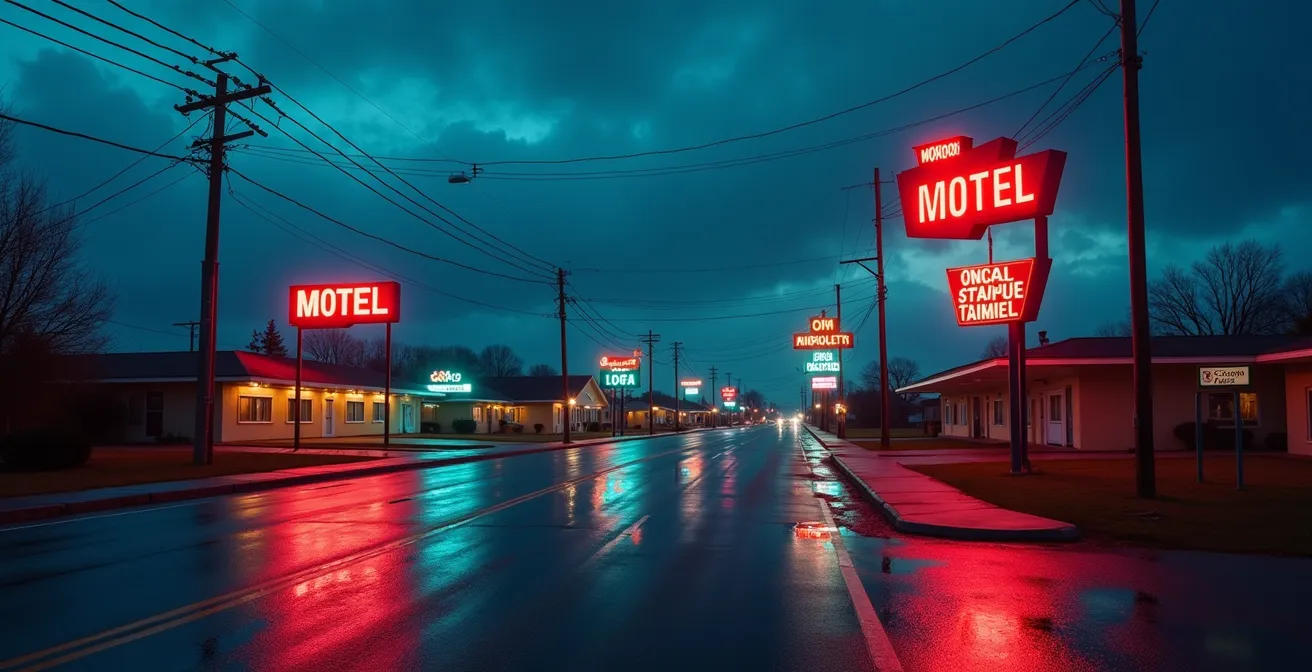
The strategy also involves recognizing which sights are *not* dependent on night viewing. A “lone beacon” sign, like the iconic one at Roy’s Motel & Café in Amboy, is often more impressive in the vast emptiness of the Mojave Desert during the day. Pacing your trip is a delicate balance, a daily calculation of miles, daylight, and a deep appreciation for the magic of twilight on the Mother Road.
h2>
Why Franchise Motels Are Replacing the Iconic Neon Signs?
Travelers often wonder why the river of neon that once defined Route 66 has dwindled to a few precious streams. The answer is a harsh economic reality: the art and craft of neon are dying, and franchise motels offer a cheaper, more standardized alternative. The iconic, buzzing signs of the mid-20th century are not just light fixtures; they are complex, hand-crafted glass sculptures filled with inert gas and charged with high voltage. They are beautiful, temperamental, and incredibly expensive to maintain.
The primary driver of neon’s decline is cost and scarcity of skill. According to Route 66 preservation reports, new custom neon signs often cost five figures to create and require specialized artisans, a stark contrast to the few thousand dollars needed for a mass-produced plastic LED sign for a chain hotel. The problem is compounded by a skills gap. The master “tube benders” who could craft and repair these signs are a dwindling generation. When a vintage sign is damaged by a storm or simply fails with age, finding someone with the expertise to repair the delicate glass tubing is both difficult and costly.
This is where the franchise motels, which now crowd the interstate exits, have a decisive advantage. Their business model is built on uniformity and low maintenance. A plastic, internally-lit sign with LED bulbs is cheap to produce, easy to install, and can be repaired by any local sign company. For a small, independent motel owner struggling with tight margins, the choice between a $30,000 repair on a historic sign and a $5,000 replacement with a maintenance-free alternative is often a purely financial one. As one preservation expert explained, the pressures are immense:
The scarcity of skilled ‘tube benders’ makes repairing old signs incredibly expensive and difficult, pushing owners towards cheaper, easier-to-maintain LED and plastic alternatives.
– Route 66 Preservation Expert, Route 66 News Analysis
Every glowing neon sign you see on Route 66 today is, therefore, an act of defiance. It represents a significant, ongoing financial commitment by a passionate owner. It’s a declaration that they value history and character over the sterile economics of the modern hospitality industry. This is why supporting these motels is not just about nostalgia; it’s about funding the preservation of a dying American art form.
The ‘Charming’ Town Trap That Has Everything Closed on Tuesdays
One of the most common and frustrating mistakes for a Route 66 traveler is what can be called the “Charming Town Trap.” You plan your itinerary meticulously, timing your arrival in a picturesque “pass-through town” like Seligman, Arizona, or Cuba, Missouri, for a Tuesday afternoon, only to find the charming general store, the quirky museum, and the beloved local café are all closed. The town looks like a ghost town, and it has nothing to do with a lack of business. It’s a fundamental misunderstanding of the small-town business rhythm.
For these small, family-run establishments, the weekend runs from Thursday to Sunday, aligning with the peak flow of tourist traffic. Consequently, Monday and Tuesday are *their* weekend. This isn’t random; it’s a sustainable business model that allows them to rest and restock after the busiest days. Your Tuesday arrival is the equivalent of showing up at a city office on a Sunday morning. The solution is to think in terms of “Anchor Towns” and “Pass-Through Towns.” Anchor Towns like Flagstaff, Amarillo, or Springfield are large enough to support 7-day-a-week operations. These are the towns to schedule for your Monday and Tuesday overnight stays, where you are guaranteed to find open restaurants and services.
Planning around these closures requires flexibility and proactivity. The golden rule of the road is to call ahead. Business hours posted on Google Maps or even on the business’s own website are notoriously unreliable for small, independent Route 66 attractions. The only way to be certain an attraction is open is to call them the morning of your visit. This simple act can save you hours of driving and a world of disappointment. By scheduling your museum and main attraction visits for the Thursday-Sunday window and using a “call-ahead” strategy, you align your journey with the reality of the road, not the assumptions of a city dweller.
Frequently Asked Questions About Small Town Hours
Why are many Route 66 attractions closed on Mondays and Tuesdays?
Small family-run businesses along the route treat Monday and Tuesday as their weekend. This is a strategic decision to recover from the Thursday-Sunday tourist rush and manage their operations sustainably, not a random schedule.
Which towns have reliable 7-day service?
Larger ‘Anchor Towns’ like Flagstaff, AZ, Amarillo, TX, and Springfield, IL, are generally large enough to maintain daily operations across most businesses. The smaller ‘Pass-Through Towns’ like Seligman, AZ, or Cuba, MO, are the ones most likely to have widespread mid-week closures.
How can I verify if a specific attraction is open?
The only truly reliable method is to call the business directly on the morning of your visit. Information on Google Maps, TripAdvisor, and even official websites is frequently outdated for these small, owner-operated establishments.
Key Takeaways
- Embrace the Detour: Stop fighting your GPS. The real Route 66 is found on the “ghost alignments” that require manual navigation and a spirit of exploration.
- Authenticity Has Tells: Learn to spot the real deal. Local pickup trucks in a diner’s parking lot are a better sign of quality than a fancy neon sign.
- Plan for the Light: The magic of Route 66 is often timed. “Neon Pacing” to arrive in key towns at dusk is as important as your route.
How to Spot a Safe Motel at a Lonely Interstate Exit?
After a long day’s drive, pulling off at a lonely interstate exit presents a final challenge: choosing a safe and clean place to rest. While the historic motels on the main streets of towns are often labors of love, the generic motels clustered at exits can be a mixed bag. Here, the charming patina of age can sometimes mask neglect and serious safety concerns. However, you can make an informed choice by using a combination of digital reconnaissance and an on-the-ground physical inspection, applying the classic “Broken Windows” theory to motel selection.
Your assessment should begin long before you arrive. Use Google Street View to do a virtual drive-by of your potential lodging. Look for clear signs of neglect: peeling paint, boarded-up windows, weeds overtaking the landscaping, or abandoned vehicles in the parking lot. These are all red flags indicating a lack of management attention. Next, dive into online reviews, but do so strategically. Filter reviews to show only the most recent (last 3-6 months) and use the search function within reviews for keywords like “safe,” “clean,” “police,” “noise,” or “bugs.” A single bad review can be an outlier, but a pattern of recent complaints is a clear warning.
Upon arrival, your eyes are your best tool. Does the property pass the “Broken Windows” test? Are the exterior lights all working? Is the parking lot well-lit and clean? Are the trash cans overflowing? These small details reflect the overall level of management care. For enhanced security, it’s generally advisable to choose motels with interior corridors over those with exterior doors that open directly onto the parking lot. The final checkpoint is the front desk. A lobby that feels secure, with an alert and professional staff, is a far better sign than a lone clerk sitting behind a thick plexiglass barrier, a feature often installed in response to previous security issues. Trust your intuition; if a place feels unwelcoming or unsafe, it’s always better to get back in your car and drive to the next town.
- Use Google Street View to inspect the property for peeling paint, boarded windows, or abandoned vehicles.
- Filter online reviews by “most recent” and search for keywords like ‘safe,’ ‘clean,’ ‘police,’ and ‘noise’.
- Choose interior corridor motels over exterior door designs for better security.
- Apply the ‘Broken Windows’ test upon arrival: burnt-out bulbs, overflowing trash, and weeds signal poor management.
- Verify a 24-hour front desk with an alert staff, not one hidden behind thick plexiglass barriers.
Now that you’re equipped with the strategies to navigate the road, find authentic experiences, and rest securely, the final step is to put it all together. Begin planning your own journey by mapping out your key overnight stops in the “Anchor Towns,” and embrace the spirit of discovery that the Mother Road demands.