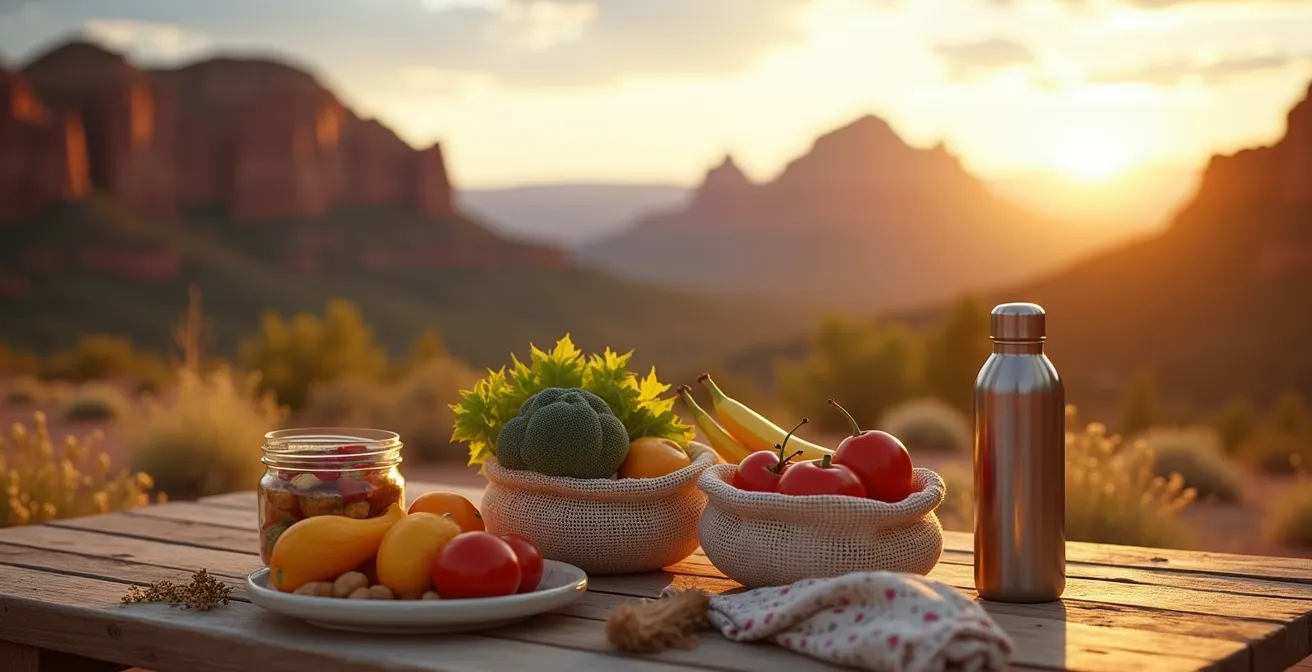
Sustainable road trip eating is less about achieving perfect zero-waste purity and more about mastering the unique food systems you travel through.
- Proactively map resources like food co-ops and water refill stations before you hit the road.
- Understand that the most sustainable choice is contextual; ‘local’ can sometimes be more impactful than ‘plant-based’.
- Use state-level plastic laws to your advantage by planning your stops in regions with stronger environmental regulations.
Recommendation: Shift from reactive, stressful searching to proactive “systems thinking” for a more impactful and enjoyable journey.
The quintessential American road trip evokes images of open highways, vast landscapes, and… a mountain of gas station snacks in crinkly plastic bags. For the eco-conscious traveler, this presents a frustrating dilemma. You’re armed with a reusable water bottle and a desire to do good, yet find yourself surrounded by fast-food chains and convenience stores where single-use plastic is the default. The struggle to find healthy, plastic-free options on the highway is real and can feel like a losing battle.
Common advice often feels disconnected from the reality of America’s sprawling infrastructure. We’re told to “pack reusables,” “avoid fast food,” and “shop at farmers’ markets.” While well-intentioned, this advice often crumbles at the first sight of a 200-mile stretch with nothing but a lone fast-food sign on the horizon. It places the burden of perfection squarely on the traveler, ignoring the systemic challenges of food deserts and a convenience-obsessed culture.
But what if the solution isn’t about achieving flawless zero-waste purity, but about becoming a smarter navigator of America’s complex and varied food systems? What if, instead of just reacting to the limited options in front of you, you could proactively plan a route that intersects with sustainability “hotspots”? This approach, rooted in a form of “food systems thinking,” transforms the challenge from a source of stress into an empowering part of the adventure.
This guide provides that strategic framework. We will explore the specific systems—from state-level waste laws to the true carbon footprint of local food—that dictate your options on the road. By understanding these systems, you can make informed, impactful choices that align with your values, without sacrificing your sanity or your appetite.
This article will break down the practical strategies you need to eat well and reduce your footprint on your next American adventure. The following sections offer a roadmap to navigating the challenges and opportunities of sustainable travel dining.
Summary: A Practical System for Eco-Friendly Road Trip Dining
- Why American Takeout Generates 3x More Waste Than European Dining?
- How to Find Filtered Water Stations in Airports and National Parks?
- Plant-Based vs. Local Meat: Which Has the Lower Carbon Footprint in Texas?
- The ‘All You Can Eat’ Error That Maximizes Food Waste
- How to Shop at Co-ops Instead of Superstores on Your Route?
- Why You Can Camp for Free on BLM Land for 14 Days?
- Local vs. Organic: Which Label Matters More for Flavor?
- How to See Yellowstone’s Geysers Safely Without Joining the Crowds?
Why American Takeout Generates 3x More Waste Than European Dining?
The stark difference in waste between American and European dining isn’t just perception; it’s rooted in culture and infrastructure. The American emphasis on speed, convenience, and car-centric living has created a massive demand for takeout and drive-thru services. This reliance generates a staggering amount of waste. To put it in perspective, the average American household spends around $3,000 annually on eating out, with a significant portion of that contributing to a mountain of single-use plastic containers, bags, and cutlery.
Unlike many European countries with robust public transit and walkable city centers that encourage sit-down meals, the US model often makes takeout the most practical option. This is compounded by a patchwork of inconsistent state and local regulations. While some states are taking a stand, many others have laws that actively prevent local governments from banning plastic bags or foam containers. This legislative landscape directly impacts your ability to eat sustainably on the road.
A savvy traveler can turn this challenge into a strategic advantage through “legislative navigation.” Before your trip, take a moment to research the plastic regulations of the states you’ll be driving through. A quick search on the National Conference of State Legislatures website reveals which states have strong single-use plastic bans (like California or Maine) and which have preemption laws that prohibit them (like Texas or Florida). Planning to stock up on groceries or enjoy a meal out in a state with stricter environmental laws can significantly reduce the amount of trash you accumulate.
Ultimately, understanding this system means acknowledging that your sustainable choices are easier in some places than others. It shifts the focus from personal failure to proactive planning, allowing you to align your route with regions that make it easier to uphold your values.
How to Find Filtered Water Stations in Airports and National Parks?
One of the easiest ways to reduce plastic waste on a road trip is to carry a reusable water bottle. The challenge, however, is finding reliable places to refill it, especially in the vast landscapes of the American West. Fortunately, a growing network of digital tools and on-the-ground infrastructure is making it easier than ever to ditch single-use plastic bottles for good. This is a core practice of resource hotspotting: identifying key infrastructure before you desperately need it.
In over 400 national parks, the official NPS App is your best friend. Its interactive maps often pinpoint the location of water fountains and bottle-refill stations, which are typically found at visitor centers, major trailheads, and developed campgrounds. For a broader reach covering urban and rural areas, apps like Tap App or the “Refill” layer in Google Maps can guide you to free, potable water sources. Don’t overlook low-tech options: ask for free water refills at fast-food chains (many use filtered water for their soda fountains) or check public libraries and bike shops in trail towns.
This shift is being actively supported by park management. For instance, the National Park Service recently began installing 14 new water bottle refill stations along the high-traffic George Washington Memorial Parkway. This project, funded by partnerships, replaces old fountains with modern, efficient fillers, demonstrating a commitment to reducing plastic waste while providing a crucial resource for visitors. It’s a tangible example of how the system is slowly evolving to support more sustainable choices.
For backcountry adventures, the strategy changes slightly. A reliable water filter like a Sawyer Squeeze or Katadyn BeFree becomes essential. Paired with an app like Gaia GPS with offline maps showing natural water sources, it gives you the freedom to safely drink from creeks and springs, completely disconnecting from the plastic-bottle economy.
Plant-Based vs. Local Meat: Which Has the Lower Carbon Footprint in Texas?
The “eat less meat” mantra is a cornerstone of sustainable eating, but on a US road trip, the answer isn’t always that simple. The concept of carbon context is crucial: the *how* and *where* of food production can matter as much as the *what*. In a state like Texas, with a massive cattle industry, a fascinating debate emerges: is it better to eat hyper-local, regeneratively-ranched beef or plant-based proteins shipped from hundreds of miles away?
The key difference lies in the production method. Conventional feedlot beef has an enormous environmental footprint due to high water usage, methane emissions, and the carbon cost of growing and transporting feed. However, a growing number of ranchers are adopting regenerative grazing practices. This method involves rotating cattle through pastures to mimic natural herd movements, which can improve soil health, enhance biodiversity, and even sequester carbon in the soil, partially offsetting the animals’ emissions.
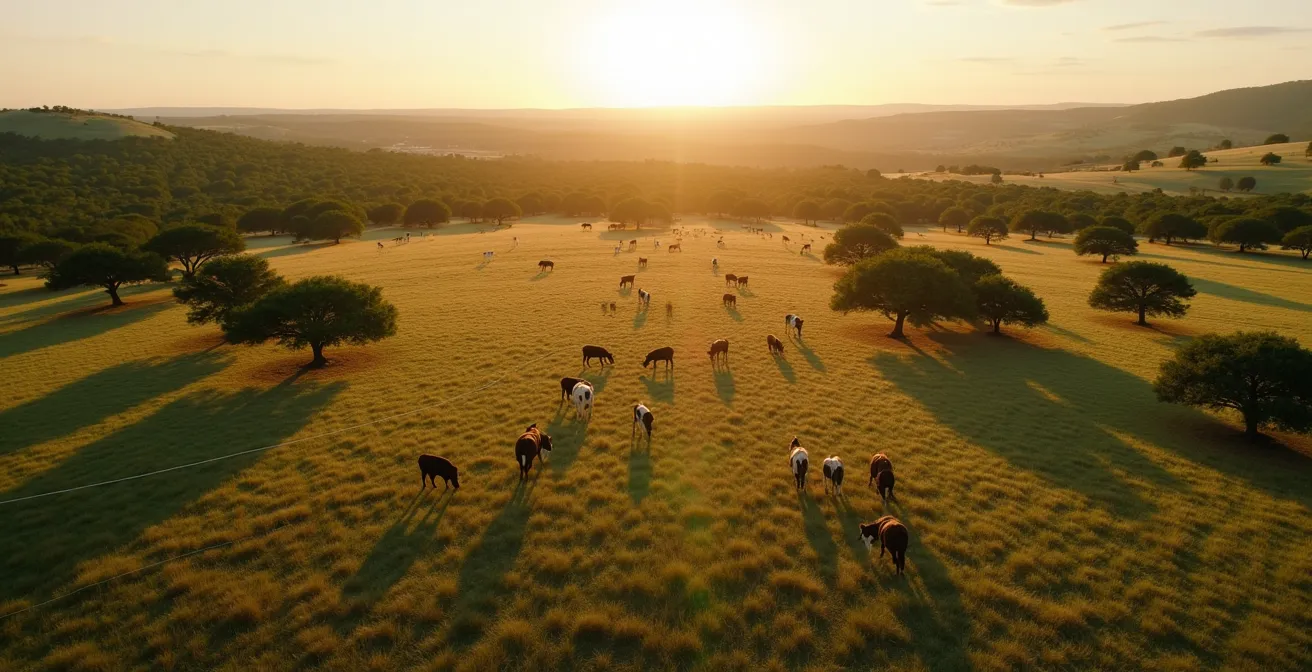
When you compare these options, the numbers can be surprising. A holistic analysis requires looking at water usage, transport miles, and total carbon dioxide equivalent (CO2e) emissions. While imported plant-based foods often look good on paper, their long-distance transportation adds to their footprint.
This table, based on data from agricultural extensions like Texas A&M AgriLife, illustrates the trade-offs:
| Food Source | Water Usage (gallons/lb) | Transport Miles | Total CO2e (kg/lb) |
|---|---|---|---|
| Regenerative Texas Ranch Beef | 450 | 50 (local) | 12.5 |
| Conventional Texas Feedlot Beef | 1,800 | 200 | 27.0 |
| California Avocados to Texas | 140 | 1,400 | 2.5 |
| Ohio Soybeans/Tofu to Texas | 260 | 1,200 | 2.0 |
The data shows that while soy or avocados from California have a lower absolute carbon footprint, regeneratively-raised local beef is a vastly superior choice to its conventional feedlot counterpart. For a traveler in Texas, choosing a burger from a known regenerative ranch over a tofu scramble made with soy from Ohio is a nuanced, but potentially impactful, sustainable decision. It’s a perfect example of imperfect sustainability—making the best possible choice within a specific regional food system.
The ‘All You Can Eat’ Error That Maximizes Food Waste
The roadside buffet, a classic feature of the American highway, seems like a great value proposition. But it represents a massive blind spot in our food system, contributing to an epic scale of waste. The psychology of the “all you can eat” model encourages overconsumption and, consequently, immense waste. In fact, ReFED’s 2024 food waste data reveals that a staggering 25% of all food in the US goes to waste, a problem to which buffets and restaurants are major contributors.
The core issue is a psychological trap known as the sunk cost fallacy. Having paid a fixed price, we feel compelled to eat as much as possible to “get our money’s worth,” even if it’s far more than we need. This leads to plates piled high with food that often ends up in the trash. This behavior isn’t just bad for our waistlines; it’s an environmental disaster, wasting the water, energy, and labor that went into producing every discarded bite.
However, navigating this doesn’t have to mean avoiding restaurants altogether. It’s about shifting your mindset and adopting strategies for mindful consumption. Instead of falling for the buffet trap, you can make smarter choices at regular restaurants. One of the most effective techniques is portion control. Don’t be afraid to make polite requests like, “Could I get a half-portion of the main course?” or “I’d like to have the appetizer as my main meal.” Most restaurants are happy to accommodate.
Furthermore, you can actively combat the problem of surplus food. Apps like Too Good To Go allow you to purchase unsold food from restaurants at the end of the day for a fraction of the price. And when you do have leftovers, always come prepared. Bringing your own reusable containers avoids the need for disposable Styrofoam or plastic boxes, closing one of the biggest loops of single-use waste in the restaurant industry.
How to Shop at Co-ops Instead of Superstores on Your Route?
For an eco-conscious road tripper, food co-ops are oases in a desert of superstores and convenience marts. They are fundamental hubs for practicing imperfect sustainability because they offer a “good, better, best” range of options all under one roof. Unlike conventional supermarkets, co-ops prioritize local producers, organic goods, and, most importantly, extensive bulk bin sections. This allows you to buy exactly the amount you need, dramatically reducing both food and packaging waste.
The first step is incorporating them into your plan. This is where “resource hotspotting” becomes a key skill. Before your trip, use the online locator for National Co+op Grocers (NCG) to map out co-ops along your intended route. Many travelers are surprised to learn that you don’t need to be a member to shop at most co-ops; they are open to the public. You can plot a cross-country journey that hops from one great co-op to another, like starting at PCC Community Markets in Seattle, stopping at the Bozeman Co-op in Montana, and continuing to Seward Co-op in Minneapolis.
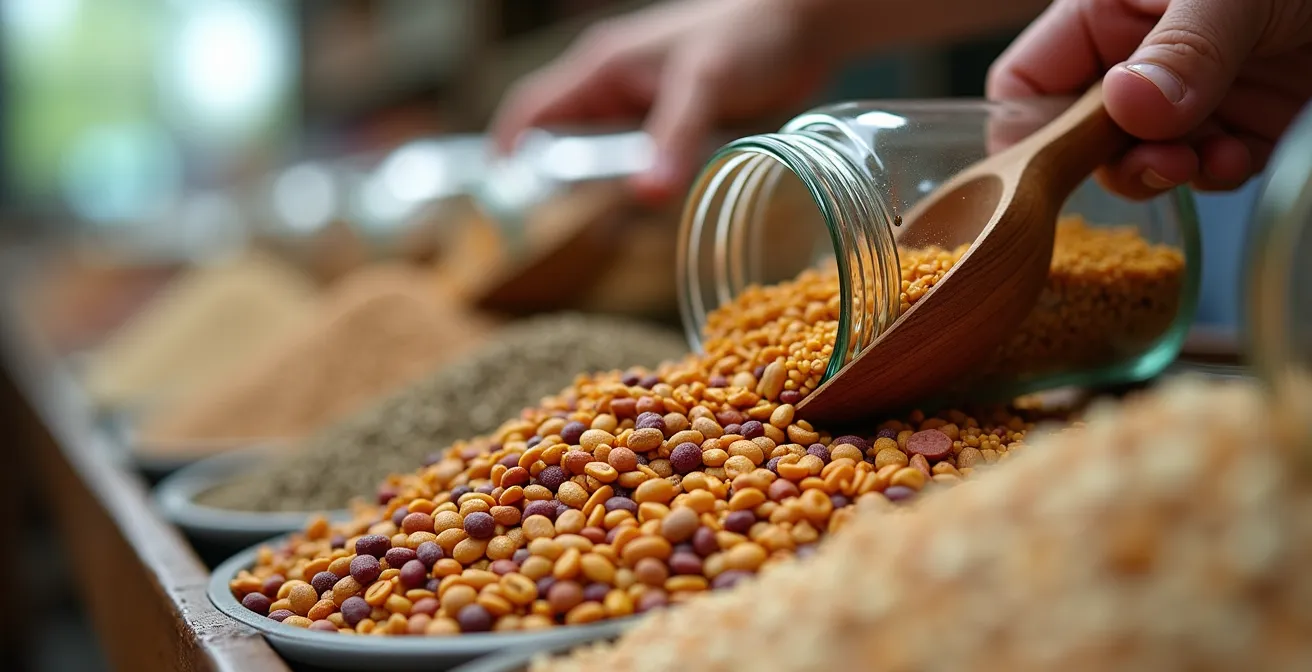
Shopping at a co-op is an experience in itself. It’s your chance to connect with a region’s unique food culture. Look for local cheeses, honey, and produce from small farms that you’ll never find in a national chain. Don’t hesitate to ask the staff for recommendations on seasonal specialties. And come prepared: bringing your own reusable bags, glass jars, and containers is not just accepted but encouraged. Using the bulk bins for everything from trail mix and pasta to spices and olive oil is the single most effective way to minimize your packaging footprint while on the move.
Your Action Plan: Auditing Your Route for Sustainable Food
- Map your route: Use a digital map to plot your primary driving route from start to finish.
- Locate co-ops & markets: Add a new layer to your map and use the NCG locator and LocalHarvest.org to pin all food co-ops and farmers’ markets within a 15-mile radius of your route.
- Identify water “hotspots”: Add another layer and pin known water refill stations using the Tap App and by noting visitor centers in national and state parks.
- Check state laws: Research the single-use plastic laws for each state you’ll pass through. Mark states with strong bans as “priority restocking zones.”
- Create a “bailout” list: For food desert areas, pre-identify the “best available” chain options that offer salads or healthier choices (e.g., Panera, Chipotle) to avoid last-minute fast-food desperation.
Why You Can Camp for Free on BLM Land for 14 Days?
A truly sustainable road trip involves minimizing your footprint not just in dining, but in accommodation as well. Dispersed camping—or camping for free outside of a designated campground—on public lands is a powerful way to reduce your impact and connect more deeply with the American landscape. The ability to do this is a unique privilege, particularly on lands managed by the Bureau of Land Management (BLM).
This right isn’t an accident; it’s codified in federal policy. As the agency itself notes, this practice is a cornerstone of public land access.
The Federal Land Policy and Management Act of 1976 established the framework for dispersed camping on BLM lands, allowing Americans to camp for free for up to 14 days within a 30-day period as a unique public land privilege.
– Bureau of Land Management, BLM Camping Guidelines
This “dispersed camping” rule generally allows you to camp anywhere on BLM land for up to 14 days before you must move at least 25 miles away. This is also common practice in most National Forests. However, this freedom comes with immense responsibility. The core principle is to follow Leave No Trace ethics rigorously: pack out everything you pack in, dispose of waste properly, and minimize your impact on the land. This includes following all local fire regulations, which can change rapidly depending on conditions.
Different types of public lands have different rules, and understanding them is key to responsible use. This table provides a quick overview:
| Land Type | Stay Limit | Fire Rules | Best For |
|---|---|---|---|
| BLM Land | 14 days/30 day period | Varies by region/fire danger | Desert camping, Western states |
| National Forests (USFS) | 14 days/30 day period | Often allowed in rings | Mountain/forest camping |
| Wildlife Management Areas | Varies by state | Usually restricted | Hunting seasons primarily |
| National Parks | 7-14 days (designated only) | Designated areas only | Scenic but regulated |
For road trippers, BLM and National Forest lands in the western US offer incredible opportunities to find beautiful, secluded campsites for free. Using apps like iOverlander or The Dyrt can help you locate established dispersed sites and check recent conditions, ensuring you camp responsibly and safely.
Local vs. Organic: Which Label Matters More for Flavor?
At a farmers’ market, you’re often faced with a choice: a stall selling vibrant, if imperfect-looking, produce from a small local farm, and another selling perfectly uniform produce with a “USDA Organic” sticker. For the sustainable traveler focused not just on environmental impact but also on taste, which label is the better guide? The answer often lies in understanding what these labels actually guarantee.
The USDA Organic certification is primarily a verification of process. It ensures that a farm avoids synthetic pesticides and fertilizers and follows a specific set of national standards. However, it doesn’t necessarily guarantee practices that enhance flavor, such as building rich soil biology or choosing varieties known for taste over transportability. As a case study on tomatoes reveals, this can lead to a significant flavor trade-off.
USDA Organic vs. Local Heirloom Tomatoes Comparison
A comparison between USDA Organic certified tomatoes from large California farms shipped to New York versus non-certified heirloom varieties from Hudson Valley farms reveals the flavor trade-off. The local heirloom tomatoes, picked the morning of sale, offer superior taste due to vine-ripening and minimal transport time. USDA Organic certification focuses on permissible inputs rather than soil health or biodiversity practices that enhance flavor. Alternative certifications like ‘Certified Naturally Grown’ often represent smaller farms with greater emphasis on taste-enhancing practices.
For flavor, “local” is often a more powerful indicator than “organic.” Freshness is paramount to taste. Produce that was picked just hours before you buy it simply tastes better. The best way to find it is to engage your senses and talk to the farmers directly. This is your chance to go beyond generic labels and discover true quality.
Instead of relying on a sticker, use a sensory approach to shopping. A ripe peach should be fragrant. A good melon should feel heavy for its size. Ask the farmer, “Which variety has the best flavor this week?” or “When were these picked?” Look for other labels like “Certified Naturally Grown” or “Real Organic Project,” which often signify smaller farms deeply committed to soil health—the true foundation of flavor.
Key Takeaways
- Sustainable road trip eating is a system of making informed, contextual choices, not a quest for zero-waste perfection.
- Proactively mapping your route to include co-ops, farmers’ markets, and water refill stations is the most effective strategy.
- Understanding the nuance between labels like ‘local’ vs. ‘organic’ and the carbon context of your food leads to more impactful decisions.
How to See Yellowstone’s Geysers Safely Without Joining the Crowds?
Applying a “systems thinking” approach extends beyond food to how you experience iconic destinations like Yellowstone National Park. The park’s main attractions, especially its world-famous geysers, operate on predictable systems of timing and crowd flow. By understanding these systems, you can experience their majesty in relative peace while ensuring your safety.
First and foremost, safety is non-negotiable. The geothermal areas are fragile and dangerous. Always stay on the designated boardwalks and trails. The ground can be a thin crust over boiling, acidic water. Respect wildlife from a distance—at least 100 yards from bears and wolves, and 25 yards from all other animals. Carry bear spray and know how to use it, as it’s the most effective deterrent in a surprise encounter.
To beat the crowds, you must work against the park’s primary rhythm. The vast majority of visitors are in the main geyser basins between 10 a.m. and 6 p.m. Your strategy is simple: go early or go late. Experiencing the Upper Geyser Basin (home to Old Faithful) at sunrise is a mystical experience, with steam catching the first rays of light and far fewer people. Similarly, an evening visit as the sun sets can offer a more personal connection to the landscape.
Beyond timing, explore the lesser-known basins. While thousands wait for Old Faithful, the Lone Star Geyser trail offers a pleasant 5-mile round-trip hike or bike ride to a predictable geyser with a fraction of the audience. The West Thumb Geyser Basin, on the shore of Yellowstone Lake, and the Black Sand Basin are often less congested but equally stunning. For Old Faithful itself, use the NPS app. It provides predicted eruption times, allowing you to arrive just before the show and avoid the long, crowded wait.
This entire framework—from navigating food systems to managing crowds—is about making smarter, more conscious choices. It transforms you from a passive consumer into an active, thoughtful traveler. The next step is to begin applying this systems-thinking approach to planning your very next adventure, creating a journey that is not only sustainable but also richer and more rewarding.