In summary:
- Analyze the menu for red flags like glossy photos, excessive length, and multiple languages, which signal a focus on volume over quality.
- Reframe your questions to locals, asking where *they* eat on a regular night, not for a generic recommendation.
- Triangulate online reviews by cross-referencing Google Maps, Yelp, and local food blogs, looking for reviews in the local language.
- Be wary of prime real estate; the best food is often found a 5-10 minute walk away from major tourist hubs and waterfronts.
–
There’s a specific, sinking feeling every traveler knows: paying $30 for a burger that tastes suspiciously like it came from a freezer, all while surrounded by the deafening noise of a dozen other disappointed tourists. You followed the generic advice—you stayed near the main square, you picked a place that looked busy—and you still ended up in a culinary dead end. The common wisdom tells you to “avoid places with hawkers” or “look for where the locals go,” but in today’s hyper-globalized tourist hubs, these platitudes are nearly useless. The line between a genuine local favorite and a cleverly disguised trap has become dangerously blurred.
The truth is, avoiding these establishments isn’t about following a simple rule; it’s about learning to read a complex set of signals. It’s about understanding the economic DNA of a restaurant before you even open the door. The real key isn’t just about *where* you look, but *how* you look, what you listen for, and most importantly, what you ask. Forget the vague tips. The ability to spot a tourist trap is a skill, a form of atmospheric forensics that allows you to deconstruct a restaurant’s entire business model in under a minute.
This guide will equip you with that skill. We will move beyond the obvious and dissect the subtle tells that separate authentic dining from mass-market mediocrity. From deciphering menu psychology to mastering the art of the right question, you will learn a systematic approach to ensure your next meal is memorable for the right reasons. It’s time to stop being a target and start eating like you belong there.
To help you master this essential travel skill, this guide is structured to walk you through the key signals, from the most obvious red flags to the more nuanced strategies for finding true hidden gems. Explore the topics below to sharpen your detection abilities.
Summary: How to Avoid Tourist Traps and Find Authentic Food
- Why Menus with Photos of Food Are Almost Always a Bad Sign?
- How to Ask ‘Where Do You Eat?’ Instead of ‘What Do You Recommend?’
- Yelp vs. Google Maps: Which Reviews Can You Actually Trust?
- The Waterfront Mistake That Doubles Your Bill for Mediocre Food
- How to Eat at High-End Restaurants for 50% Off During Lunch?
- Why City Passes Often Cost More Than Single Tickets for Casual Tourists?
- Why Times Square Is Just a Giant Outdoor Mall with Screens?
- How to Find Hidden Gem Small Towns That Aren’t on the Tourist Map?
Why Menus with Photos of Food Are Almost Always a Bad Sign?
The laminated menu, adorned with glossy, perfectly-lit photos of every dish, is the quintessential tourist trap signal. It’s not a helpful guide; it’s a marketing document designed to overcome language barriers and appeal to the lowest common denominator. A restaurant confident in its food, its reputation, and its local clientele doesn’t need to show you a picture of spaghetti. The food, and the words used to describe it, should be enough. These photo menus indicate a business model built on high-volume tourist turnover, not on repeat local customers who value quality.
This approach often correlates with higher prices for inferior products. The focus is on visual persuasion rather than culinary craft. According to some analyses, tourists can end up paying significantly more for this convenience. One report suggests that tourists might spend an average of 25% more at these types of establishments. Another major red flag is menu length. A menu boasting 50+ items, spanning multiple cuisines, is a screaming indicator of a kitchen relying on a freezer and a microwave. No fresh kitchen can support that much variety. A confident chef curates a tight, focused menu based on seasonal ingredients and what they do best. The photo menu is the first and most powerful clue to a restaurant’s economic DNA: it’s built for one-time visitors, not for connoisseurs.
Your 30-Second Menu Assessment
- Photo Check: Are there glossy, perfect photos? This is a primary sign of targeting tourists over locals.
- Language Count: Is the menu in four or more languages? This signals a business designed exclusively for international visitors.
- Item Count: Does the menu offer an sprawling list of over 50 dishes? This almost guarantees the use of frozen, pre-made ingredients.
- Seasonal Gaps: Is there a complete lack of daily specials or seasonal items? This points to a static, non-fresh inventory.
- Visual vs. Reality: If you can see food coming out, does it look identical to the picture? Mass-produced food often does.
Ultimately, a menu should be a statement of culinary intent, not a picture book. Treat it as the first piece of evidence in your investigation. If it fails this initial test, walk away without a second thought.
How to Ask ‘Where Do You Eat?’ Instead of ‘What Do You Recommend?’
Once you’ve learned to read menus, the next step is mastering human intelligence gathering. The platitude “ask a local” is fundamentally flawed because most travelers ask the wrong question. Asking a hotel concierge or a shopkeeper “What do you recommend?” will almost always get you a rehearsed, “safe” answer—a place that’s used to dealing with tourists, is probably getting a kickback, and is rarely where that person would actually spend their own money. This question invites a recommendation for *you*, the tourist, not a glimpse into their own life. This is where question framing becomes your most powerful tool.
The secret is to shift the context from a tourist recommendation to a personal insight. Travel expert Chelsea Dickenson champions this strategy, revealing she asks taxi drivers, hotel staff, and baristas “what their favorite place is that they’d visit with friends.” This reframing is subtle but critical. It bypasses the “tourist-friendly” filter and accesses their personal, curated list of trusted spots. The goal is to get them to think about their own dining habits, not yours. An even more specific and disarming approach is a question posed by travel experts in the HuffPost Travel Guide:
Where do you go for a casual weeknight dinner when you’re too tired to cook?
– Travel experts surveyed, HuffPost Travel Guide
This question is brilliant in its specificity. It implies affordability, comfort, and authenticity. It’s a question about routine, not special occasions. Target the right people for this intelligence: a barista at a third-wave coffee shop, the staff at an independent bookstore, or a vendor at a local market. These individuals are often cultural tastemakers and are less likely to have formal kickback arrangements with tourist traps. This human-to-human exchange is where you find the true gems.

This interaction, based on genuine curiosity, often yields recommendations for places just a few blocks off the main drag—places with no English menu, no glossy photos, and no other tourists. It’s the most reliable way to tap into the real culinary pulse of a city. The quality of your answer is directly proportional to the quality of your question.
Stop asking for recommendations and start asking for a window into someone’s life. The difference in the answers you receive will transform your travels.
Yelp vs. Google Maps: Which Reviews Can You Actually Trust?
In the digital age, your phone is a primary line of defense against tourist traps, but only if you know how to interpret the data. Relying blindly on a star rating is a rookie mistake. The real skill is in review triangulation—cross-referencing platforms and reading between the lines to find the ground truth. Not all review platforms are created equal, and each has its own set of green and red flags that reveal more than the reviews themselves.
Chef Hector Santiago has a brilliant method for this digital forensics. He looks for a linguistic mismatch: “If I’m going to Portugal, reviews that are all in English are a red flag.” The presence of reviews in the local language is a strong positive signal. He also performs atmospheric forensics on user-submitted photos, observing what people are wearing. “In Europe, you dress up to go out to dinner.” If the crowd in the photos looks like they just stepped off a tour bus, you likely have your answer. Furthermore, you should be skeptical of reviewers with only one or two reviews to their name, especially if they are overwhelmingly positive; these are often fake. A trustworthy review comes from an established profile with a history of balanced, specific critiques.
To navigate this landscape, it’s helpful to understand the strengths and weaknesses of each platform, as different sources serve different purposes in your investigation.
| Platform | Green Flags | Red Flags | Best For |
|---|---|---|---|
| Google Maps | Reviews in local language, detailed reviewer profiles, recent photos | All English reviews in non-English country, generic praise | Quick verification, photo checking |
| Yelp | Established reviewer profiles, specific dish mentions, balanced criticism | Single reviews from accounts, overly positive tone | Detailed food quality assessment |
| Local Food Blogs | In-depth coverage, insider knowledge, specific recommendations | Outdated information, sponsored content | Hidden gems, authentic local spots |
Your strategy should be to use Google Maps for a quick geographic and atmospheric check, dive into Yelp or a local blog for detailed food critique from credible reviewers, and always, always be skeptical of a place that seems universally loved by people who don’t speak the local language.
The Waterfront Mistake That Doubles Your Bill for Mediocre Food
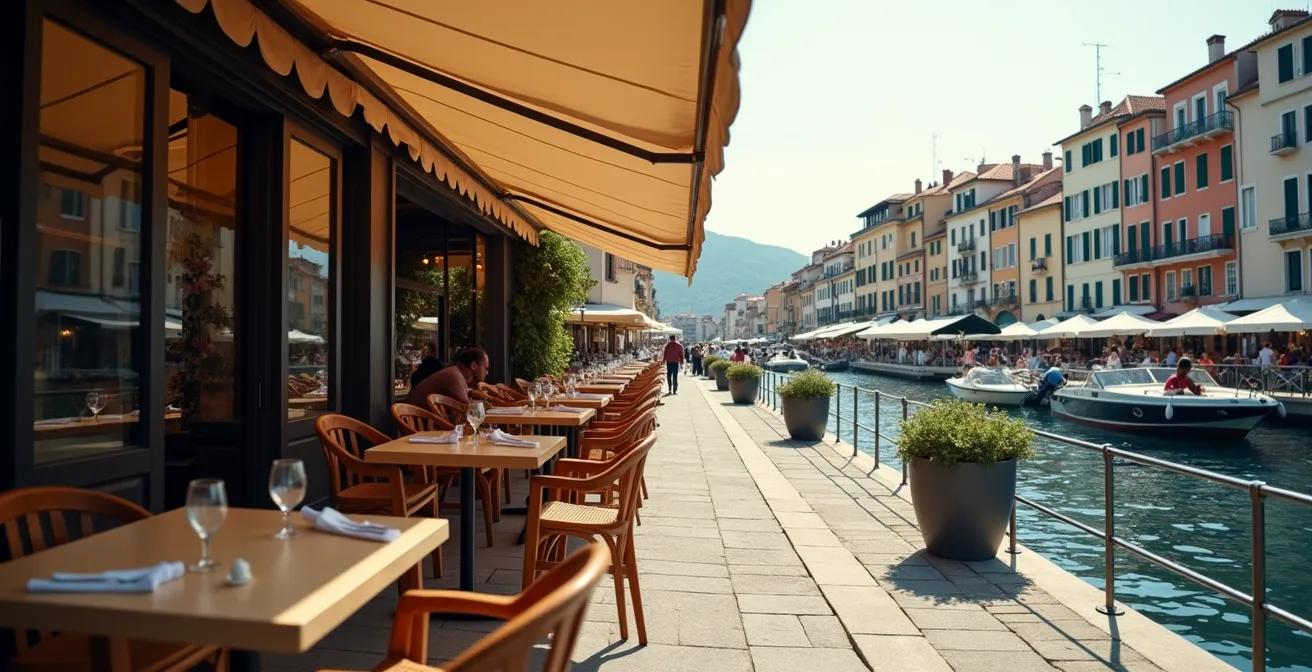
The allure of a meal with a view is powerful, but it’s one of the oldest and most effective traps in the tourism playbook. Restaurants occupying prime real estate—whether it’s a waterfront, a historic plaza, or directly opposite a world-famous monument—are often selling the location, not the food. Their economic DNA is built on a captive audience willing to pay a premium for ambiance. The rent for these locations is astronomical, and that cost is passed directly to you, the diner, often in exchange for a forgettable, mass-produced meal.
This isn’t an exaggeration; the price inflation can be staggering. It’s not uncommon to find that restaurants with prime waterfront views often charge $50+ for basic spaghetti that would cost a third of that price in a neighborhood trattoria just a few streets away. The quality of the ingredients and the care in preparation are secondary concerns when new customers are guaranteed to arrive every hour, mesmerized by the view. These establishments have little incentive to build a base of repeat customers through culinary excellence. They are in the real estate business as much as the food business.
The solution is deceptively simple: the 10-Minute Rule. In almost every major city, a five-to-ten-minute walk away from the epicenter of tourism will transport you to an entirely different culinary world. This is where real neighborhoods begin, and where restaurants must survive on reputation and repeat business from locals. A prime example is the area around Times Square in New York. A local dining guide astutely points out the alternative: “Walk 10 minutes west to 9th Avenue in Hell’s Kitchen for hundreds of authentic, diverse restaurant options.” This principle applies universally, from the canals of Venice to the promenades of Nice. The best meal is rarely the one with the most obvious view. It’s the one you earn with a short walk.
Next time you’re captivated by a stunning vista from a restaurant patio, pause and ask yourself: am I paying for the food, or am I paying rent on this chair? Then, start walking.
How to Eat at High-End Restaurants for 50% Off During Lunch?
Avoiding traps doesn’t always mean seeking out cheap, hidden holes-in-the-wall. Sometimes, the smartest move is to understand the economic DNA of high-end, even Michelin-starred, restaurants and use it to your advantage. These acclaimed establishments, often perceived as inaccessible, have a vulnerability you can exploit: the quiet lunch hour. While their dinner service is booked months in advance at premium prices, their lunch service often needs to attract a different crowd—local business professionals and savvy diners—with significant discounts.
This is where you can experience world-class cooking for a fraction of the cost. Many top-tier restaurants offer a prix-fixe lunch menu, a limited-choice menu featuring two or three courses for a set price that can be 40-60% cheaper than ordering a-la-carte at dinner. This isn’t a “lesser” experience. You’re often eating food prepared by the same chefs in the same kitchen, but the pricing is structured to fill seats during off-peak hours. It’s a win-win: the restaurant maintains its high-end dinner prestige while ensuring profitability during the day, and you get a taste of luxury without the exorbitant bill.
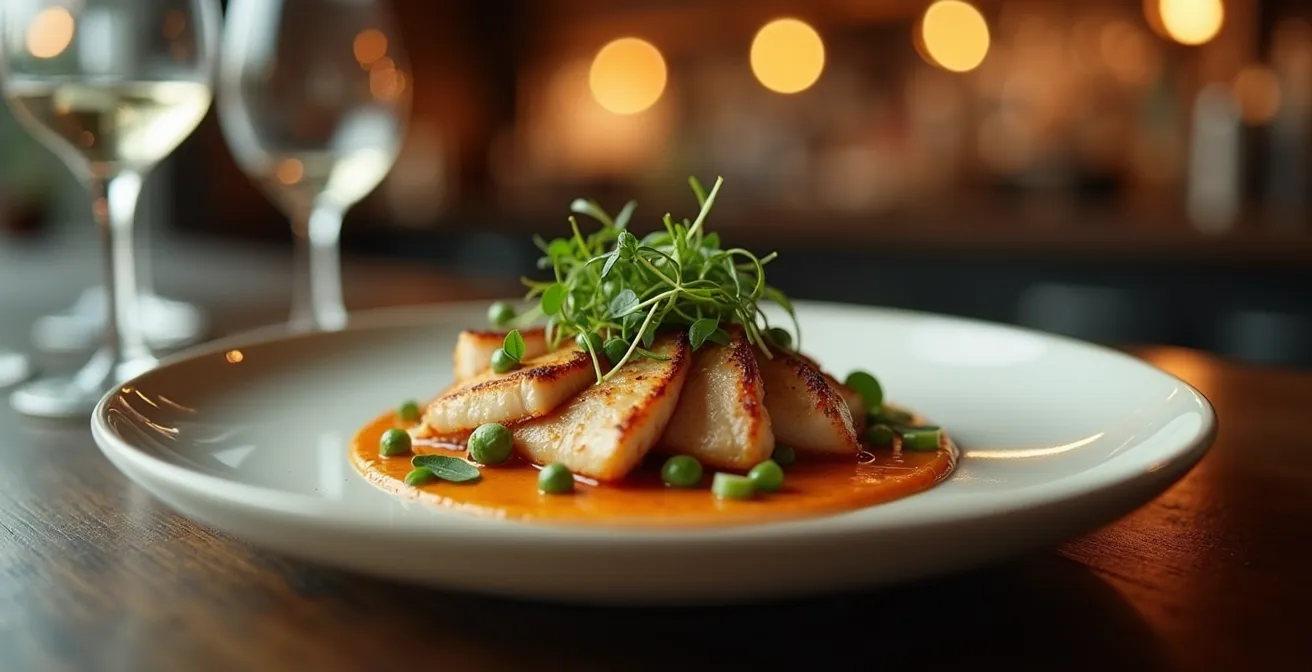
Another pro-tip is to dine at the bar. Many high-end restaurants have a separate, more casual bar menu that is available all day. It might not feature the grand tasting menu, but it will offer exquisitely prepared small plates, appetizers, and sometimes even a signature burger or pasta dish that gives you the essence of the chef’s style. This allows for flexibility and a lower entry price, giving you a high-end experience in a more relaxed setting. By targeting lunch hours or bar seating, you’re not falling into a trap; you’re hacking the system, getting the best of both worlds: premium quality at an accessible price.
This approach requires a bit of research—checking restaurant websites for lunch specials before your trip—but the payoff is immense, allowing you to elevate your culinary travels significantly.
Why City Passes Often Cost More Than Single Tickets for Casual Tourists?
The tourist trap isn’t just a restaurant; it’s any product that promises convenience and value but delivers a rushed, overpriced experience. Enter the city pass. Sold under the banner of “seeing it all for less,” these passes bundle entry to dozens of attractions for a single, hefty price. The marketing is brilliant, preying on a traveler’s fear of missing out. The reality, however, is that for the vast majority of casual tourists, these passes are a financial net-negative.
The business model of a city pass relies on a principle called breakage—the value of the services that customers pay for but don’t actually use. The advertised “savings” are calculated based on the most expensive gate prices, often for peak times, creating an inflated sense of value. To actually break even, a tourist must maintain a grueling pace of sightseeing. For example, analysis shows that even visiting two or three NYC attractions daily can easily cost $80+ per day if bought individually, but to get value from an all-inclusive pass, you often need to cram 3-4 expensive attractions into a single day. This turns a vacation into a frantic checklist, robbing you of the chance for spontaneous discovery and relaxation. You end up spending your time rushing between sights you’re only mildly interested in, just to “get your money’s worth.”
The trade-off between cost and flexibility is stark. While you might save a few dollars in a best-case scenario, you lose all control over your itinerary. As one family noted in an analysis of their NYC CityPASS experience, “we were locked into very specific attractions,” which prevented them from enjoying spontaneous discoveries. A careful comparison reveals the true cost of these passes.
| Pass Type | Cost | Required Daily Visits | Flexibility | Best For |
|---|---|---|---|---|
| 1-Day New York Pass | $164 | 3-4 expensive attractions | Any attraction, 1 day only | Intense sightseeing marathons |
| NYC CityPASS (5 attractions) | $138 | Visit all 5 over 9 days | Limited to specific attractions | First-timers wanting classics |
| Individual Tickets | Varies | Your choice | Complete freedom | Selective visitors, repeat travelers |
Unless you are a sightseeing marathoner with a military-style schedule, you are almost always better off identifying the 2-3 attractions you genuinely want to see and paying for them individually. The “freedom” a pass sells is often just the freedom to follow their pre-packaged itinerary.
Why Times Square Is Just a Giant Outdoor Mall with Screens?
Some tourist traps aren’t single restaurants or attractions, but entire districts. Times Square is the ultimate American example—a place so overwhelmingly geared towards tourists that it has lost any semblance of local character. It exists not as a neighborhood, but as a transient zone, a giant outdoor mall whose primary purpose is to separate visitors from their money as efficiently as possible. Falling for a trap at this scale can negatively impact your entire trip; indeed, according to PhotoAiD research, nearly 70% of travelers feel that visiting a tourist trap diminished their enjoyment of a vacation.
The establishments here—from the chain restaurants serving microwaved entrees to the massive souvenir shops selling identical t-shirts—share the same economic DNA. They pay exorbitant rent to be in a high-foot-traffic area and must therefore rely on high-volume, low-quality sales. There is no incentive for quality or authenticity, because the customer base is a constantly churning river of first-time visitors, not a community of discerning locals. As one urban planning analysis notes, “Times Square is a place designed for people passing through, with no resident population or community fabric.” It’s a stage set, not a city.
The key to navigating these macro-traps is the same as with micro-traps: the 10-Minute Rule. The experience you’re likely seeking—authentic food, unique shops, a real neighborhood feel—is almost always just a short walk away. From Times Square, a 10-minute walk west takes you to Hell’s Kitchen. From Fisherman’s Wharf in San Francisco, a brief stroll leads you to the genuine Italian restaurants of North Beach. From the Las Vegas Strip, a short drive lands you in Spring Valley, a hub of incredible Asian cuisine. Escaping the gravitational pull of these zones is essential for an authentic experience. Use the landmark as a point of orientation, take your photo, and then immediately walk in any direction for ten minutes. You will be rewarded.
Treat these zones as the spectacle they are, but never mistake them for the place itself. The real city always lies just beyond the glow of the giant screens.
Key takeaways
- The most reliable way to avoid tourist traps is not to follow a single rule, but to develop a critical eye for a restaurant’s underlying business model.
- Subtle signals in menus, review patterns, and location choices provide more accurate information than star ratings or generic recommendations.
- True authenticity is often found by applying the “10-Minute Rule”—walking just a short distance away from any major tourist hub to find where locals actually live and eat.
How to Find Hidden Gem Small Towns That Aren’t on the Tourist Map?
The ultimate strategy for avoiding tourist traps is to sidestep the main tourist map altogether. While big cities have their gems, some of the most authentic and memorable travel experiences are found in small towns that haven’t yet been overrun by mass tourism. The challenge is finding them. How do you locate a town that is vibrant and full of character, but not yet a caricature of itself? The secret lies in looking for indicators of a thriving local community, not just proximity to a major landmark.
A powerful technique is the “Trifecta Method.” When scanning a map, look for a town that has three specific things: a third-wave coffee shop, a craft brewery, and an independent bookstore. This combination is a strong signal of a town with a growing population of creative, engaged residents who value quality and local business. It suggests a community fabric that supports more than just basic services. You can verify this by using Google Street View to check for a preserved historic Main Street and searching for a local farmers market, which indicates an active community.
Another effective strategy is to look for “gateway towns” near major attractions like National Parks, but with a twist: look for the second or third closest town, not the main one. For example, while many visitors to Zion National Park stay in Springdale, exploring nearby towns can offer a more unique experience. Medora, North Dakota, near Theodore Roosevelt National Park, is a perfect example. It’s an incredibly walkable town with authentic charm, local coffee houses, and shops, but it sees a fraction of the traffic of more famous park-adjacent towns. This allows for a more relaxed and genuine connection to the place and its people, away from the pre-packaged experiences of the main tourist hubs.
This proactive approach shifts your mindset from simply avoiding the bad to actively seeking out the exceptional, ensuring your travels are filled with genuine discovery.