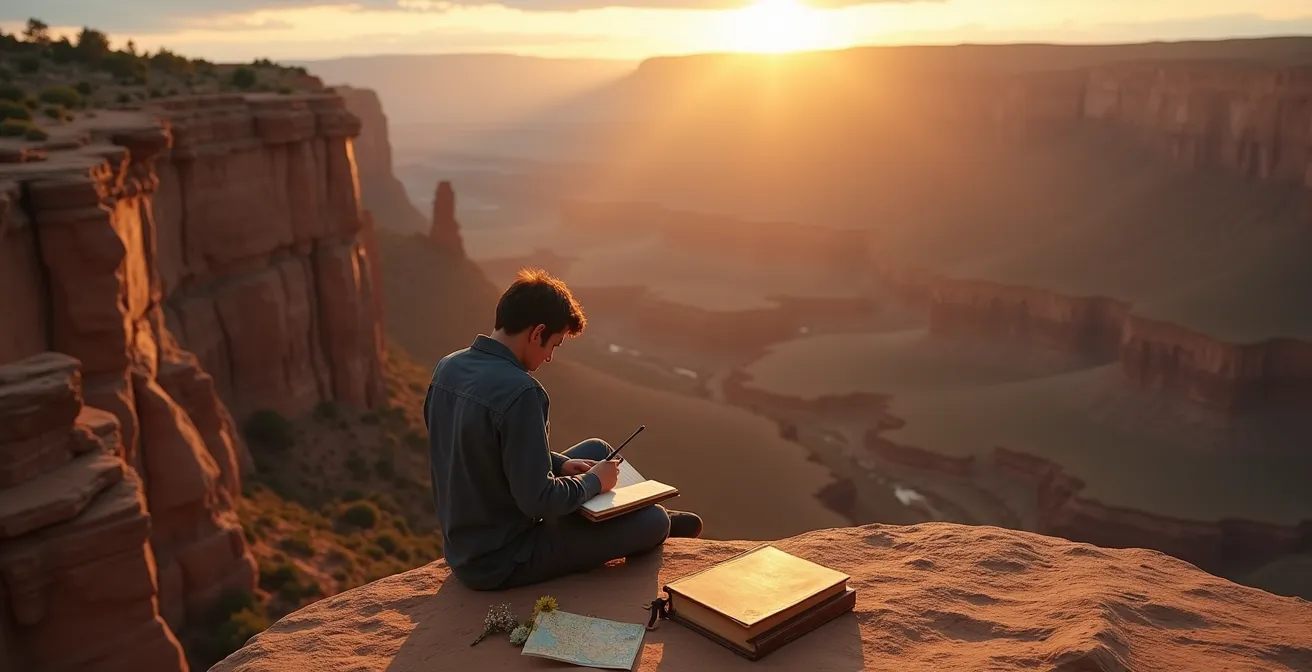
Most travel journals fail because they are treated as logbooks of events, not as psychological tools for encoding emotional and sensory experiences.
- Focus on a single “peak” sensory moment each day, not a full chronology of events.
- Prioritize capturing your authentic feelings over performing for an online audience.
- Combine writing with tangible ephemera like tickets and maps to create a multi-sensory anchor for your memories.
Recommendation: Before your next trip, shift your journaling mindset from “what did I do?” to “how did this make me feel?” This is the key to creating memories that last for decades.
A few weeks after you return from a transformative trip across the United States, a strange thing happens. The vibrant details begin to fade. The taste of that perfect roadside diner coffee, the specific shade of a New Mexico sunset, the sound of laughter in a Chicago jazz club—they all blur into a generic collage of “a good time.” You have hundreds of photos on your phone, but they feel like a silent film, disconnected from the lifeblood of the experience. The emotional core is missing.
Many people believe that keeping a travel journal is the solution, but they often fall into the trap of creating a simple logbook: “Today, we drove to the Grand Canyon. It was big.” This factual reporting does little to anchor the memory. The common advice to just “write more” or “take better photos” misses the fundamental point. It’s not the quantity of documentation that matters, but the psychological quality of what you choose to record.
What if the true secret to preserving your travels wasn’t in documenting every moment, but in deeply encoding the most meaningful ones? This guide moves beyond the platitudes. It offers a psychologist-informed approach to journaling, treating your notebook not as a record of events, but as a powerful tool for capturing the sensory and emotional essence of your experiences. We will explore the science of why we forget, the art of curating memories, and practical techniques to turn fleeting moments into a rich, internal narrative that will stay with you for the next 20 years.
This article will guide you through the psychological framework for creating a meaningful travel archive. We’ll cover everything from the cognitive biases that shape our memories to concrete methods for engaging your senses and connecting with the soul of a place, ensuring your American journey becomes a permanent part of who you are.
Summary: Your Guide to Crafting Unforgettable Travel Narratives
- Why We Forget 80% of Our Vacation Details Within Two Weeks?
- How to Curate a Travel Scrapbook That Isn’t Cluttered or Tacky?
- Helicopter Tour vs. Designer Bag: Which Brings More Lasting Happiness?
- The Instagram Mistake That Ruins Your Actual Experience of the Grand Canyon
- How to End Your Trip with a ‘Grand Finale’ Event for Maximum Impact?
- Why Crafting Vacations Reduce Cortisol More Than Beach Resorts?
- How to Start a Conversation at a Rural Diner Without Being Awkward?
- How to Use Local Libraries to Find Your Ellis Island Ancestors?
Why We Forget 80% of Our Vacation Details Within Two Weeks?
The human brain is not a hard drive; it’s a highly selective curator. It’s designed to remember what’s essential for survival and what’s emotionally significant, discarding the rest with startling efficiency. This is why, according to research on memory retention, we can forget up to 80% of the specific details of a vacation within just a couple of weeks. The chronological facts—the name of the highway, the time you left the hotel—are the first to go. They lack the emotional and sensory “hooks” that our memory needs to hold on.
To combat this “forgetting curve,” your journal must become a tool for emotional encoding. Instead of a dry log of activities, it should be a repository of feelings and sensations. As National Geographic points out, a social media post barely scratches the surface. It doesn’t capture the scent of prairie grass near Mount Rushmore or the specific echo in a canyon. These sensory details are the keys that unlock the entire experience years later. The goal isn’t to remember everything, but to remember what mattered.
A powerful technique to achieve this is the “Daily Peak” method. Rather than trying to document an entire day, which is overwhelming and unsustainable, you select one “peak” moment. It doesn’t have to be the most dramatic event, but rather a moment that delighted you, moved you, or made you think. It could be a conversation, a particular view, or the taste of a local pastry. By focusing on that single peak, you can dive deep into the sensory anchors and emotional responses that make the memory stick. This transforms journaling from a chore into a reflective practice of gratitude and presence.
How to Curate a Travel Scrapbook That Isn’t Cluttered or Tacky?
A travel scrapbook can be a powerful multi-sensory time capsule or a chaotic mess of fading receipts and blurry photos. The difference lies in one word: curation. A curated scrapbook is not about stuffing everything inside; it’s about making intentional choices that tell a cohesive story. The goal is to create an elegant, uncluttered narrative of your trip, where each element has a purpose and a place.
Start by thinking like a museum curator. Before you even leave, decide on a simple color theme. Choosing a palette of just a few colors gives the entire journal a cohesive look and limits the number of pens you need to pack. Throughout your trip, collect ephemera—ticket stubs, a pressed flower, a uniquely designed napkin, a local map—but be selective. You’re looking for items that evoke a specific memory or feeling, not just proof that you were there. For items that are too bulky, like a thick brochure, simply place them on a copier and shrink them down, adding the copy to your spread instead.
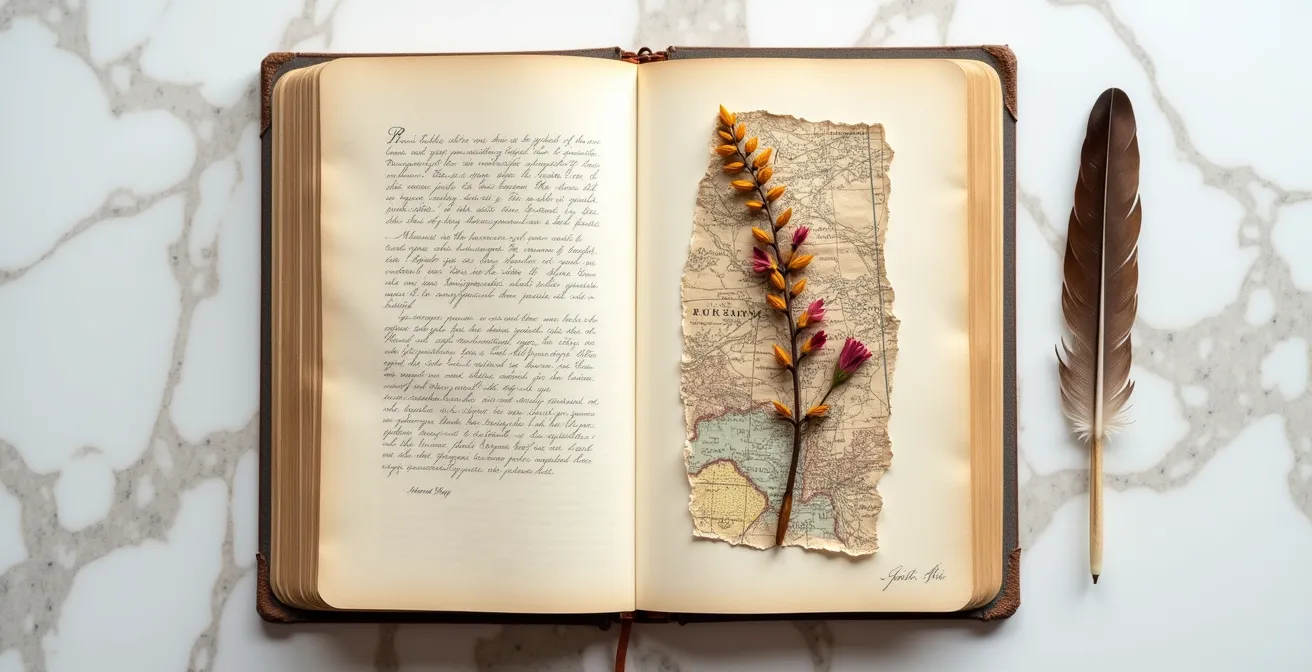
When arranging your pages, start with the bigger elements first and move them around until you find a balanced composition. Use washi tape for clean borders and to affix items without messy glue. Don’t be afraid to cut shapes from postcards or use only a fragment of a map. The key is to let your handwritten notes be the star, with the ephemera acting as a supporting cast that adds texture and visual interest. This transforms your journal from a cluttered box of souvenirs into a thoughtfully designed memory palace that you’ll be proud to revisit for years.
Helicopter Tour vs. Designer Bag: Which Brings More Lasting Happiness?
In a world of finite resources, travelers often face a choice: invest in a material possession or an ephemeral experience? Should you buy the designer bag you’ve been eyeing, a tangible status symbol, or book the once-in-a-lifetime helicopter tour over the Hawaiian coast? From a psychological perspective, the answer is clear. While both provide an initial spike of excitement, the path to long-term happiness is overwhelmingly paved with experiences, not things.
This phenomenon is rooted in a concept called “hedonic adaptation.” We quickly get used to new possessions. The thrill of a new bag or car fades as it becomes part of our daily life. Experiences, however, become part of our narrative identity. A helicopter tour isn’t just a 30-minute event; it becomes a story you tell, a memory you relive, and a part of who you are. These memories appreciate in value over time, while material goods depreciate. As National Geographic’s writers ponder, the ancient question of how to preserve our journeys is more pressing than ever in our digital age, and the answer lies in the stories we collect.
The following table, based on insights from research on hedonic adaptation, breaks down the long-term satisfaction derived from each type of purchase.
| Factor | Designer Bag | Helicopter Tour |
|---|---|---|
| Initial Excitement | High | High |
| Satisfaction After 1 Month | Moderate | High (story value) |
| Satisfaction After 1 Year | Low (normalized) | High (memory value) |
| Social Currency | Status symbol | Story capital |
| Memory Enhancement | Minimal | Creates lasting narrative |
Ultimately, a designer bag is just an object, but an experience like a helicopter tour provides “story capital.” It enriches your life with a narrative that you can share and revisit, contributing to a deeper and more enduring sense of well-being. When you journal about an experience, you are cementing that “story capital,” ensuring it pays emotional dividends for decades.
The Instagram Mistake That Ruins Your Actual Experience of the Grand Canyon
You’re standing at the edge of the Grand Canyon. The scale is incomprehensible, the colors shift with every passing cloud, and a profound silence hangs in the air. Your first instinct? To pull out your phone, find the perfect angle, choose a filter, and craft a caption. In that moment, your experience has been hijacked. You are no longer a participant in the sublime; you are a content creator performing for an external audience. This is the great Instagram mistake.
As National Geographic researchers have noted, our online profiles are curated highlight reels tailored to what we think others want to see. This performative pressure fundamentally alters our perception. We start looking for the “Instagrammable” shot rather than immersing ourselves in the authentic, messy, and deeply personal reality of the moment. A personal travel journal, by contrast, is a sanctuary for authentic reflection. It’s a space where you can record the awe, the unexpected feeling of smallness, or even the disappointment, without catering to an audience or chasing likes.
To reclaim your experiences from the clutches of social media, you need a conscious strategy for digital detox at key moments. This isn’t about abandoning photography, but about prioritizing your own sensory experience first. The following method ensures you are present before you start documenting.
Your Action Plan: The ‘First 15’ Digital Detox Method
- At any major viewpoint or new location, commit to keeping your phone or camera put away for the first 15 minutes.
- During this time, conduct a sensory inventory: consciously identify three distinct things you can see besides the main attraction (e.g., the texture of a rock, the shape of a cloud).
- Note two different sounds you can hear in the environment (e.g., the wind, a distant bird, the murmur of a crowd).
- Identify one specific smell in the air (e.g., pine, dust after rain, salt from the sea).
- Only after you have observed and mentally noted these details, open your journal and write them down before taking a single photo.
This practice forces you to connect with the place on a multi-sensory level. The photograph you take afterward will no longer be a disconnected image, but a visual trigger for a rich, fully encoded memory of what it actually felt like to be there.
How to End Your Trip with a ‘Grand Finale’ Event for Maximum Impact?
Psychologists have long understood a cognitive shortcut known as the “Peak-End Rule.” This principle states that we don’t remember experiences as an average of every moment. Instead, we disproportionately recall two key points: the most emotionally intense moment (the “peak”) and the very end. This means that how a trip concludes has a massive impact on your overall memory of it. A trip that fizzles out with a stressful airport experience will be remembered less fondly than one that concludes with a deliberate, meaningful “grand finale.”
Planning a grand finale isn’t about extravagance; it’s about intentionality. It’s about consciously crafting a final, positive memory anchor. This could be a special farewell dinner at a restaurant with a stunning view, a final walk on the beach at sunset, or a quiet hour spent in a beautiful park reflecting on the journey. The goal is to create a moment of closure and gratitude. This final entry in your journal becomes the capstone of your travel narrative, a punctuation mark that says, “This was meaningful.”
This conscious act of “memory weaving” transforms travel from a series of disconnected events into a cohesive story with a beginning, a middle, and a satisfying end. It is in these quiet, reflective moments that the true impact of travel solidifies. As the writer Miriam Beard so beautifully articulated, travel is about a deep and permanent change within us.
Travel is more than the seeing of sights; it is a change that goes on, deep and permanent, in the ideas of living. I wanted to hold proof of life in my hands, let it mark me, shift my being at the most fundamental levels.
– Miriam Beard, Realism in Romantic Japan
Your grand finale event is the moment you “hold proof of life in your hands,” consciously acknowledging the change the journey has wrought within you. Journaling about this final experience seals its significance, ensuring it becomes the powerful, positive memory that defines the entire trip.
Why Crafting Vacations Reduce Cortisol More Than Beach Resorts?
The traditional image of a relaxing vacation is often a passive one: lying on a beach, sipping a cool drink. While this can be restful, it often fails to engage the mind in a way that produces deep, restorative relaxation. A growing body of research suggests that “crafting vacations”—trips centered around learning a new, hands-on skill—can be far more effective at reducing stress. The secret lies in a psychological state known as “flow.”
Flow, a term coined by psychologist Mihaly Csikszentmihalyi, is a state of complete immersion in an activity. When you’re in flow, your sense of time distorts, self-consciousness disappears, and you are fully absorbed in the task at hand. According to psychological research on flow states, this active engagement in challenging but achievable tasks, like learning to shape silver or throw pottery, creates a deeper and more lasting form of relaxation than passive rest. It effectively pushes out anxious thoughts and lowers cortisol levels by focusing the mind completely.
The United States offers a rich tapestry of destinations for a crafting vacation. Instead of another beach resort, consider one of these immersive experiences:
- Visit quilting retreats in Pennsylvania’s Amish Country for a deep dive into traditional textile arts.
- Take silversmithing workshops in the vibrant artist colonies of Santa Fe, New Mexico.
- Join glass-blowing classes in the innovative and artistic districts of Seattle, Washington.
Journaling during such a trip takes on a new dimension. Instead of a “sightseeing journal,” you create a “Maker’s Journal.” You document the creative process: the initial frustration of learning a new skill, the “aha!” moment of a breakthrough, and the pride in your final creation. This creates a powerful memory of competence and growth, a far more potent souvenir than a simple tan.
How to Start a Conversation at a Rural Diner Without Being Awkward?
Some of the most profound travel memories aren’t found in guidebooks; they’re discovered over a cup of coffee in a small-town American diner. Connecting with local people provides access to the “soul” of a place, offering insights and stories that no tourist site can match. Yet, for many travelers, the fear of being awkward or intrusive is a powerful barrier. The key is to approach these interactions with genuine curiosity and a simple, repeatable framework.
Forget complex conversational strategies. A highly effective and natural method is the CQR approach: Compliment, Question, Relate. It’s a low-pressure way to open the door to conversation. Start by offering a genuine, specific compliment. Instead of a generic “nice town,” try something concrete: “This is honestly the best cup of coffee I’ve had on my entire road trip.” This shows you’re paying attention.
Follow the compliment with a simple, open-ended question. Building on the coffee example, you might ask, “Is it a local roast?” This invites a response beyond a simple “yes” or “no.” Finally, relate it back to them, showing respect for their local pride: “You all must be really proud of this place.” This three-step process turns a simple transaction into a moment of human connection. When you journal these conversations, you’re not just recording dialogue; you’re capturing the character, humor, and heart of a community, preserving memories that are rich with cultural and emotional context.
When you take the time to notice what makes you smile or frown in these interactions, you’re identifying the moments that truly matter. Documenting these small conversations is what gives your travel narrative its depth and authenticity, a truth echoed by seasoned travelers who find that learning to cook a local dish often brings back more vivid memories than any monument.
Key Takeaways
- Your brain is wired to forget; fight it by journaling emotions and senses, not just facts.
- Experiences provide more lasting happiness than material things because they become part of your identity.
- Authentic journaling requires disconnecting from the performative pressure of social media by prioritizing your present-moment experience.
How to Use Local Libraries to Find Your Ellis Island Ancestors?
For many Americans, travel is not just about discovering new places, but about discovering themselves. An “ancestral pilgrimage” to the towns, cities, or even the port of entry—like Ellis Island—where your family’s American story began is a uniquely powerful journey. A travel journal on such a trip becomes more than a memory keeper; it transforms into a research log, a detective’s notebook, and a space for profound personal reflection. This journey is about connecting your personal narrative to the grand, sweeping story of the nation.
While major online databases are a great starting point, the real discoveries often lie hidden in local archives. City and county libraries across the US hold unique, non-digitized records that can bring your family’s story to life. Your journal is the perfect place to document this “detective story,” noting the clues you find, the dead ends you hit, and the exhilarating moments of connection when you uncover a long-lost document or address. This process makes history tangible and deeply personal.
To begin your genealogical quest, consider visiting these key repositories:
- The Newberry Library in Chicago is an essential resource for tracing Midwest family history and migration patterns.
- The Sutro Library in San Francisco holds invaluable records for those with ancestors from the Gold Rush era.
- Don’t overlook small county historical societies; they often possess unique local documents like church records, old maps, and family papers that are unavailable anywhere else.
In your journal, go beyond just recording names and dates. Use prompts to explore the emotional landscape of your journey: “What did it feel like to stand on the land my great-grandparents farmed?” or “How does this piece of my family’s history connect to the larger American dream?” This kind of reflective writing transforms a genealogical search from a dry, academic exercise into a deeply meaningful exploration of your own identity.
Frequently Asked Questions About Travel Journaling
Should I use blank pages or guided journal prompts?
This is a matter of personal choice. Journals with prompts like ‘Most Interesting Thing I Saw Today’ can be helpful for beginners to get started. However, as you become a more experienced journaler, you may find that blank pages in a simple, lightweight notebook offer more freedom to follow your own thoughts without being constrained by prompts.
What supplies should I bring for documenting heritage trips?
Beyond a good pen and your journal, a glue stick is invaluable. It allows you to instantly post in the small, interesting bits and pieces you collect—museum tickets, business cards from a memorable restaurant, a beautifully designed label. These items add visual texture and serve as powerful memory triggers for places you might otherwise forget.
How can I make genealogical journaling meaningful?
To make it truly meaningful, combine factual discovery with emotional reflection. Include specific prompts in your journal before you leave, such as, “What did it feel like to stand on the land my ancestors owned?” and “How does this piece of family history connect to the larger American story?” Answering these questions connects your personal journey to a much bigger historical narrative.
Begin your next journey not just with a destination in mind, but with the intention to capture its essence. Pick up a notebook, embrace these psychological principles, and start writing the story only you can tell.