
The hotel industry’s star-rating system is a poor indicator of cleanliness and safety; a traveler’s real power comes from understanding and exploiting the hotel’s operational systems.
- Your booking method (direct vs. OTA) directly impacts your room assignment and service level.
- Hidden fees are a systematic part of hotel revenue, and objective user reviews are more telling than overall scores.
Recommendation: Stop being a passive guest; start acting like an inspector by using loyalty status, mobile check-in, and direct communication to control your stay.
The feeling is all too common. You book a “3-Star” hotel, expecting a baseline of quality, only to arrive and find stained carpets, a noisy air conditioner, and a final bill that bears little resemblance to the advertised price. The disconnect between a hotel’s star rating and the actual guest experience is one of the most frustrating aspects of modern travel in the USA. Most advice tells you to “read the reviews” or “look at recent photos,” but this is surface-level guidance that misses the fundamental point.
Star ratings, awarded by third-party organizations, primarily measure the quantity of amenities offered—is there a pool, a restaurant, 24-hour reception? They are not a reliable grade of cleanliness, safety, or service quality. User reviews, while more current, are often subjective or, worse, manipulated. The key to securing a good stay is not to try and decipher these flawed signals. The key is to think like a hotel inspector and understand the internal systems that govern everything from pricing and room allocation to how your complaints are handled.
This guide will not rehash generic tips. Instead, we will dissect the hotel’s operational playbook. We will explore the hidden fee structures, the hierarchy that determines who gets the quiet rooms, the risks of overbooking, and the strategies to get more value than you paid for. By understanding these systems, you shift from being a hopeful guest to an empowered traveler who can guarantee a better, safer, and more predictable stay, regardless of the number of stars next to the hotel’s name.
This article provides an inspector’s framework for navigating the complex world of hotel bookings. The following sections break down the critical operational systems you need to master to ensure your next stay meets your standards, not just the hotel’s amenity checklist.
Summary: An Inspector’s Guide to Vetting Your Hotel
- Why Your $100 Room Actually Costs $145 at Checkout?
- How to Ask for a Quiet Room Away from the Ice Machine?
- Direct Booking vs. Expedia: Which Gets You the Better Room Assignment?
- The Overbooking Mistake That Leaves You Without a Room at 10 PM
- How to Book a Flexible Rate That Drops if Prices Go Down?
- Yelp vs. Google Maps: Which Reviews Can You Actually Trust?
- Downtown vs. Suburbs: Where to Stay in LA to Avoid 2 Hours of Traffic?
- How to Get a Suite Upgrade at check-in Without Paying Extra?
Why Your $100 Room Actually Costs $145 at Checkout?
The most immediate and frustrating system is a hotel’s pricing structure. The advertised room rate is often a work of fiction, designed to lure you in before mandatory charges are applied. This practice, known as “drip pricing” or “fee obfuscation,” is a core part of the revenue strategy for many US hotels, particularly in resort destinations. The most common culprit is the “resort fee” or “destination fee,” a mandatory daily charge for amenities you may or may not use, such as Wi-Fi, pool access, or the fitness center.
From an operational standpoint, these fees are nearly pure profit. They allow the hotel to advertise a lower base rate to appear more competitive on online travel agencies (OTAs) while ensuring a higher total revenue per guest. The scale of this practice is significant; a recent analysis found that in the U.S., resort fees average $35 per night, adding a substantial, and often unexpected, cost to your stay. This isn’t an accident; it’s a calculated business model that preys on traveler confusion.
The federal government is beginning to crack down. The FTC’s Junk Fees Rule, set to take effect, aims to force hotels to display the all-in price upfront. However, until this is universally enforced, the burden is on you to be vigilant. Always proceed to the final checkout screen before committing to a booking to see the full price. If you feel a fee is unjust or was for amenities that were unavailable, you have recourse. You are not powerless against these charges.
Your Action Plan: Challenging Unjust Resort Fees
- Document Evidence: During your stay, take photos or notes of any advertised amenities covered by the fee that were closed, broken, or subpar (e.g., a closed pool, slow Wi-Fi).
- Confront at Checkout: Politely speak with the front desk manager. Clearly state that you did not use or were unable to use the amenities and request the fee be removed.
- Reference Regulations: Mention your awareness of transparency rules, like the FTC’s crackdown on junk fees, which require clear disclosure.
- Escalate if Necessary: If the front desk denies your request, ask for the general manager’s contact information or state your intention to dispute the charge with your credit card company.
- File Official Complaints: If the fee was not clearly disclosed at booking, file a complaint with your state’s Attorney General’s office to report the deceptive practice.
How to Ask for a Quiet Room Away from the Ice Machine?
Beyond price, the physical quality of your stay is determined by your room’s location within the hotel. A “3-Star” rating says nothing about whether you’ll be next to the elevator shaft, above the noisy bar, or near the 24/7 hum of the ice machine. Securing a quiet room requires understanding the hotel’s physical layout and the unspoken hierarchy of room allocation. Your goal is to request a room in a designated “quiet zone.”
As an inspector, I look at floor plans to identify operational weak points. The best rooms are typically “corner rooms” at the end of a hallway, as they have fewer adjoining walls and less foot traffic. Rooms on higher floors are generally quieter, away from street noise and lobby activity. The absolute worst locations are rooms adjacent to elevators, ice/vending machines, and housekeeping closets, which are sources of constant mechanical and human noise. The illustration below highlights these strategic and problematic zones.

The building’s age is another critical, yet invisible, factor. Analysis of guest complaints reveals that U.S. properties constructed before 1990 receive three times more noise-related complaints than modern buildings, especially concerning “paper-thin walls.” Hotels built after 2010 generally adhere to stricter building codes that mandate specific Sound Transmission Class (STC) ratings for walls and floors, significantly reducing noise transfer. When booking a hotel in an older building, the need to secure a room in a quiet zone becomes even more critical.
When making your request, be specific. Instead of asking for “a quiet room,” ask for “a room on a high floor, at the end of the hall, away from the elevator.” This signals to the front desk agent that you are an experienced traveler who understands hotel layouts, increasing the likelihood they will honor your request. Make this request both in the “special requests” field during online booking and by calling the hotel directly the day before your arrival.
Direct Booking vs. Expedia: Which Gets You the Better Room Assignment?
The channel through which you book your room is arguably the single most important factor in the quality of your stay. Hotels operate on a clear and unforgiving “Room Allocation Hierarchy.” Guests are not treated equally; those who provide the most profit and loyalty are prioritized. At the top of this hierarchy are elite members of the hotel’s loyalty program who book directly. At the very bottom are anonymous, one-time guests who book through third-party sites like Expedia or Booking.com.
Operationally, a direct booking is far more profitable for the hotel, as it avoids the hefty commissions (often 15-25%) paid to OTAs. In return for this loyalty, hotels reward direct bookers with better treatment. This includes a higher likelihood of receiving room upgrades, having requests (like for a quiet room) honored, and being prioritized for better-located rooms. As a general rule, the guests who book via OTAs are the first to be assigned less desirable rooms—those near the ice machine, with an obstructed view, or the last to be renovated. This isn’t personal; it’s a business decision.
As contributors on a Bogleheads.org forum discussion noted, the issue extends beyond just room quality. A user explained the core problem from a loyalty perspective:
When you book through an OTA you most likely cannot attach your loyalty number to the reservation so you generally don’t get any of the benefits or points
– Bogleheads Forum Contributors, Bogleheads.org Discussion on Hotel Loyalty Programs
This means no points, no elite night credits, and no recognition of your status. You become an anonymous, low-priority reservation. The following table, based on an analysis of booking channel benefits, starkly illustrates this operational hierarchy.
| Booking Method | Room Assignment Priority | Elite Benefits | Points Earned | Upgrade Potential |
|---|---|---|---|---|
| Direct with Status | Highest Priority | Full Benefits | Yes + Elite Bonus | High |
| Direct without Status | Standard Priority | Member Rates | Yes | Medium |
| OTA with Status | Low Priority | Usually None | No | Very Low |
| OTA without Status | Lowest Priority | None | No | None |
The Overbooking Mistake That Leaves You Without a Room at 10 PM
Perhaps the most stressful system failure a traveler can face is arriving late at night, exhausted, only to be told the hotel is sold out and your room is gone. This practice, known as “walking a guest,” is a direct result of a hotel’s overbooking strategy. Hotels intentionally sell more rooms than they have, banking on a certain percentage of no-shows and last-minute cancellations. It’s a calculated gamble to maximize occupancy. When the gamble fails and everyone shows up, someone has to be “walked”—sent to another hotel, often of lesser quality.
Who gets walked is not random. It follows the same operational hierarchy we’ve already discussed. The first guests on the chopping block are those who booked through an OTA at a low rate, have no loyalty status, and are arriving late without having checked in. A reservation guaranteed with a credit card is not a guarantee of a room; it’s a guarantee that you will either get a room or the hotel will (in theory) find you a comparable one elsewhere and cover the first night’s cost. But at 10 PM in a sold-out city, “comparable” is a very loose term.
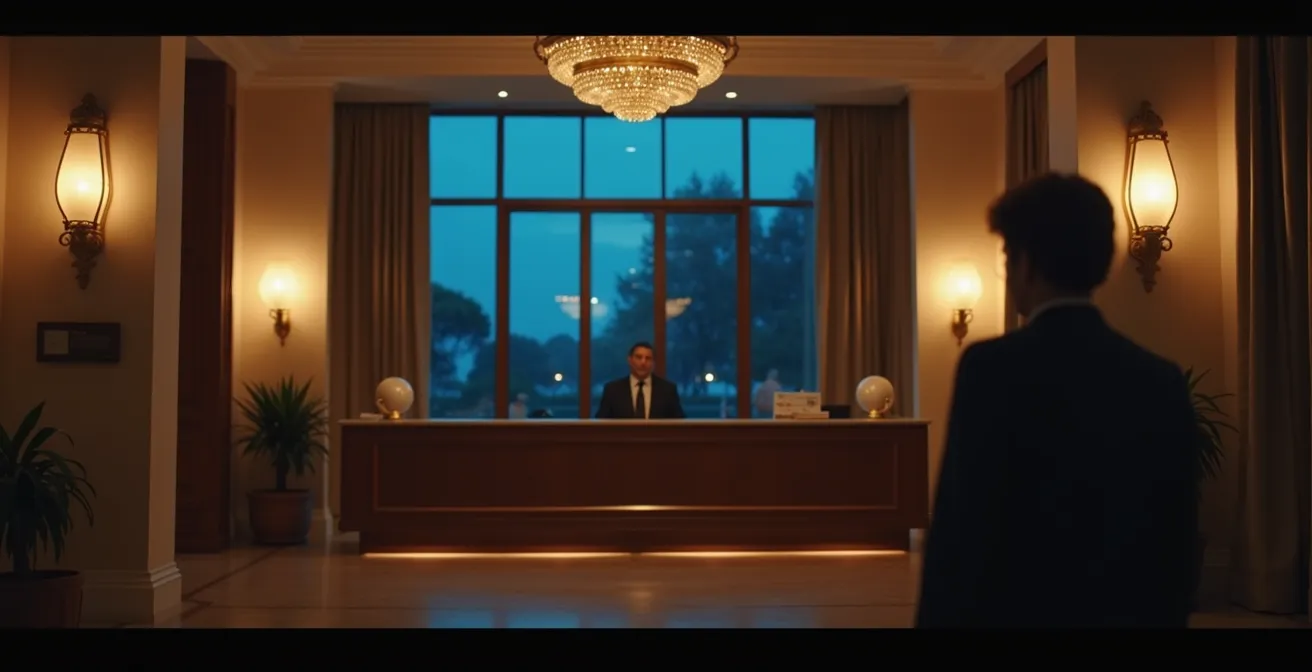
To “walk-proof” your reservation, you must make yourself a high-priority guest. This involves creating a digital and verbal paper trail that signals you are a confirmed, definite arrival. The advent of mobile apps has made this easier than ever. Using the hotel’s app to check in on the morning of your arrival is the single best defense against being walked. It moves you from the “potential no-show” list to the “confirmed guest” list in the hotel’s property management system. This simple action dramatically increases your leverage and protects your reservation.
Combine mobile check-in with other protective measures to make your reservation virtually untouchable:
- Guarantee with a credit card during booking. This is the minimum requirement.
- Use the hotel’s app to check in on the morning of arrival, even if you won’t be there until late.
- Send a message through the app or call the hotel directly around 6 PM to re-confirm your late arrival time.
- Join the hotel’s free loyalty program. Even entry-level status gives you more standing than a non-member.
How to Book a Flexible Rate That Drops if Prices Go Down?
Advanced travelers know that booking a hotel isn’t a one-time event; it’s a process. Hotel pricing is dynamic, fluctuating based on occupancy, events, and demand. While an upward trend in hotel prices is expected to continue, short-term dips are common. Locking in a non-refundable rate months in advance might seem savvy, but it often means you miss out on last-minute price drops. The key is to leverage flexible rates to your advantage.
A flexible rate allows you to cancel without penalty, usually up to 24 or 48 hours before arrival. This optionality is your most powerful tool for cost savings. The strategy is simple: book a flexible rate as soon as you know your travel dates. Then, periodically check the price of your room as your arrival date approaches. If the price drops, you can cancel your original booking and rebook at the lower rate. Many travelers neglect this simple step and leave significant money on the table.
For longer stays, an even more sophisticated technique is the “split-booking” strategy. Hotel revenue managers rarely adjust the rate for the first night of a multi-night stay, but they frequently alter rates for subsequent nights to fill rooms. An analysis of booking patterns shows this can be a powerful tactic.
Case Study: The Split-Booking Strategy
By booking the first night of a week-long stay on a secure, non-refundable rate and the following six nights on a separate, flexible-rate reservation, a traveler accomplishes two goals. First, they secure their arrival and avoid any risk of being walked. Second, they retain the ability to rebook the bulk of their stay if prices for those later dates drop. This hybrid approach offers both security and flexibility, with travelers potentially saving 15-30% on the total cost of an extended stay by rebooking the flexible portion at a lower rate.
This method requires more active management, but it allows you to play the hotel’s dynamic pricing game on your own terms. It transforms you from a price-taker into a price-maker, which is the ultimate goal of thinking like an inspector.
Yelp vs. Google Maps: Which Reviews Can You Actually Trust?
If star ratings are unreliable, then user reviews must be the answer, right? Not exactly. Navigating the world of online reviews on platforms like Google, Yelp, and TripAdvisor requires a critical, inspector’s eye. A 4.5/5 score is meaningless without understanding the biases of the platform and the nature of the reviews themselves. Your task is not to read reviews, but to perform “Review Triangulation”—a method of analyzing feedback across platforms to filter out noise and identify objective truths.
First, you must learn to distinguish between subjective and objective complaints. As travel safety experts advise, you should always
Focus on objective complaints like ‘The A/C was broken’ or ‘visible mold in the shower’ versus subjective ones like ‘The decor was dated’
– Travel Safety Experts, Corporate Travel Safety Guidelines
An objective complaint points to a failure in standard operating procedure or maintenance—a red flag for any inspector. Subjective comments about decor, vibe, or the quality of the breakfast are personal opinions and should be largely ignored. Look for patterns of objective complaints across multiple recent reviews. One mention of a broken A/C could be a one-off; five mentions in the last month indicates a systemic maintenance issue.
Second, understand the inherent bias of each platform. Industry analysis shows that different sites attract different types of reviewers:
- Booking.com: Tends to have more verified guest reviews, as only those who have completed a stay can leave feedback. The feedback is often more detailed about facilities and room specifics.
- Google Maps: The Local Guides program can incentivize quantity over quality, leading to many low-effort, less-detailed reviews. However, its sheer volume makes it useful for spotting major, recurring problems.
- Yelp: Known for its aggressive and controversial filtering algorithm, which may hide legitimate reviews (both positive and negative). It’s often more useful for hotel restaurants and bars than for the rooms themselves.
- FlyerTalk / Travel Forums: These niche forums offer the most detailed and unbiased reviews from highly experienced travelers who understand brand standards. They can spot property-specific issues (e.g., a hotel not honoring elite benefits) that a casual traveler would miss.
The best strategy is to cross-reference. Find a hotel, then read the recent negative reviews on Booking.com for objective data, scan Google for high-level patterns, and if you have time, search for the property on FlyerTalk for an expert opinion.
Downtown vs. Suburbs: Where to Stay in LA to Avoid 2 Hours of Traffic?
A hotel’s rating is irrelevant if you spend half your vacation stuck in traffic. In a sprawling, decentralized metropolis like Los Angeles, location isn’t just a factor; it’s everything. Choosing between a hotel in Downtown LA (DTLA), Santa Monica, or a more affordable suburb is a strategic decision that will define your entire trip. The common mistake is to book a “central” hotel, believing it provides easy access to everything. In LA, there is no true “center,” and this approach often leads to maximum time spent on the freeway.
The inspector’s approach is to apply the “Stay Where You Play” rule. Instead of trying to be central to everything, anchor your hotel to your primary activity zone. If your trip is focused on beaches and coastal activities, stay in Santa Monica or Venice. If you’re there for business meetings in DTLA, stay in DTLA or a reverse-commute location like Pasadena. If it’s a theme park trip, stay in Anaheim or near Universal Studios. Budget for one or two longer trips to secondary destinations rather than compromising your location every single day.
Transportation infrastructure is your next filter. LA’s Metro Rail system, while not as comprehensive as New York’s, is a powerful tool for bypassing traffic. Prioritizing hotels within a 10-minute walk of a Metro station that serves your key destinations can save you hours and hundreds of dollars on rideshares. For example, staying along the E Line (Expo) gives you direct, traffic-free access from DTLA all the way to Santa Monica. When evaluating a location, don’t just look at its distance from an attraction; look at its proximity to a transit solution.
Use this framework to make a logistical, not emotional, decision about your LA hotel location:
- Map Your Anchors: List your 2-3 primary destinations (e.g., Getty Center, Hollywood Walk of Fame, Disneyland).
- Apply “Stay Where You Play”: Choose a neighborhood that serves as the home base for your main activities.
- Check Transit Proximity: Filter hotels to those within a 10-minute walk of a relevant Metro Rail station.
- Consider Reverse Commutes: If you have meetings downtown, staying in Pasadena or the San Gabriel Valley can offer a surprisingly easy morning commute against traffic.
- Factor in Airport Logistics: Don’t book a hotel in Santa Monica if you have a 7 AM flight out of LAX. The morning drive can be brutal. Choose an airport-adjacent hotel for your last night.
Key Takeaways
- Your booking channel is paramount: Direct booking with loyalty status puts you at the top of the priority list for better rooms and service.
- Read reviews like an inspector: Focus on recent, objective complaints about operational failures (broken A/C, mold, noise) and ignore subjective opinions on decor.
- Anticipate and challenge fees: Understand that resort fees are a systematic charge and be prepared to document and dispute them if amenities are not provided.
How to Get a Suite Upgrade at check-in Without Paying Extra?
The final frontier of leveraging hotel systems is securing a benefit you didn’t pay for: a complimentary suite upgrade. While many believe this is a matter of luck or “asking nicely,” the reality is that upgrades, like everything else in a hotel, follow a system. From an inspector’s perspective, securing an upgrade is about positioning yourself as the lowest-risk, highest-value candidate for a hotel manager looking to reward a guest.
The upgrade hierarchy mirrors the room allocation hierarchy. The top candidates are always high-tier elite members of the hotel’s loyalty program who booked directly. These are the hotel’s most valuable customers. The next group includes guests who booked through premium credit card programs. For example, analysis of travel benefits shows that programs like Amex Fine Hotels + Resorts often include a space-available upgrade as a published benefit. Likewise, holding a premium co-branded credit card like the Hilton Aspire or Marriott Bonvoy Brilliant grants you automatic high-level status, placing you near the top of the upgrade list without needing to earn it through stays.
The hotel’s own inventory is another critical factor. Hotels with a high percentage of “junior suites” or other premium room types (e.g., 15% or more of total room count) have more flexibility to offer upgrades. Research shows these properties offer upgrade rates up to three times higher than hotels with very few suites. Timing also matters. Checking in later in the afternoon (around 4-6 PM) is often the sweet spot. By this time, the hotel has a clear picture of its remaining inventory for the night and knows which premium rooms are still available after most guests have arrived.
Finally, your approach matters, but not in the way most people think. Don’t ask “Can I have a free upgrade?” Instead, show your knowledge of the system. A phrase like, “I’m a Platinum member and was hoping a complimentary suite upgrade might be available tonight” is far more effective. It is polite, direct, and reminds the agent of your high-priority status. It frames the request not as begging, but as inquiring about an earned benefit of your loyalty.
Now that you have the inspector’s toolkit, your next hotel booking should be approached not with hope, but with strategy. Apply these principles to take control of your stay, mitigate risks, and maximize value. Your travel experience will be better for it.