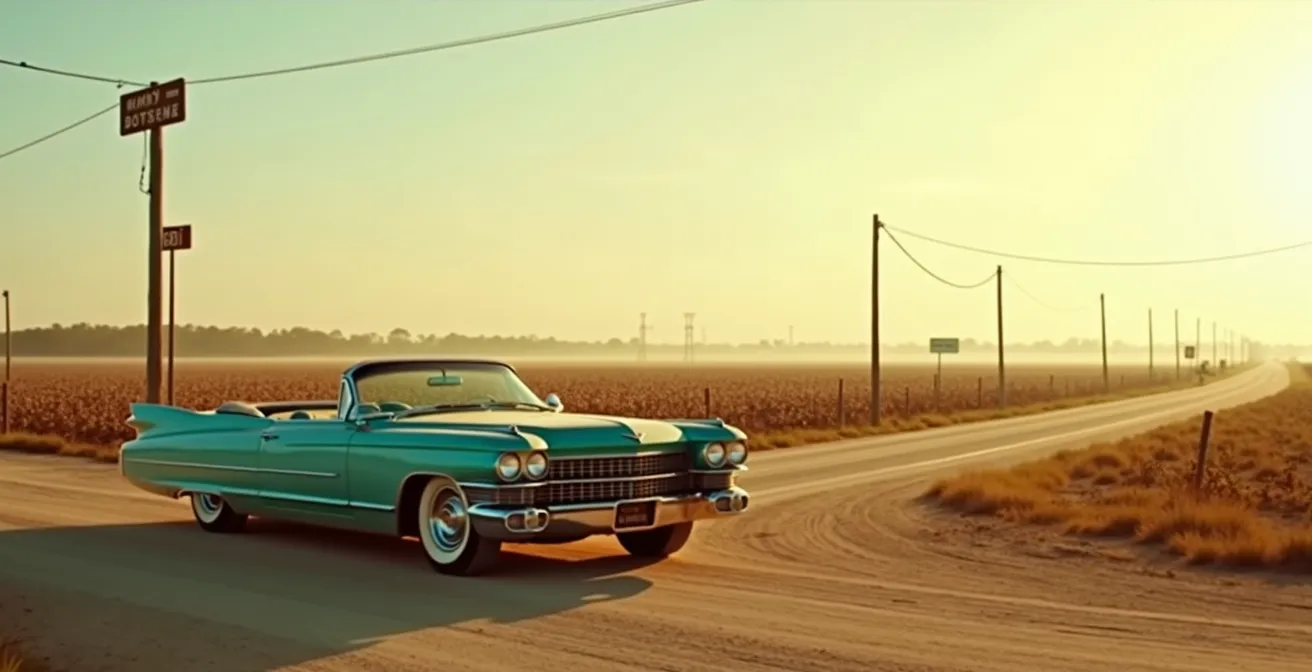
Most guides treat the Blues Trail as a simple drive down Highway 61, but the real journey is a deep-dive into the landscape that created the music.
- Authentic juke joints are vanishing, requiring a focused effort to find the real heart of the blues before it’s gone.
- The music’s soul is inseparable from the region’s history of sharecropping and its unique culinary traditions, born from the same soil.
Recommendation: Approach your road trip not as a tourist, but as a musicologist. Learn to read the landscape, from the architecture of old plantations to the ingredients in your food, to truly understand the origins of the blues.
For the music purist, the journey from Memphis into the Mississippi Delta is a pilgrimage to the hallowed ground of American sound. It’s a trip that promises the ghosts of Robert Johnson, the growl of Howlin’ Wolf, and the genesis of everything from rock and roll to soul. Yet, many travelers return with little more than a photo at a tourist-heavy crossroads and a meal at a polished, modern “blues” cafe. They follow the highway signs but miss the story, hearing the notes but not the echoes of the history that forged them. The common advice is to simply drive Highway 61, but this approach often leads to a sanitized, surface-level experience.
This journey can be so much more. The conventional path focuses on a handful of well-marketed sites, but the real soul of the Delta lies off the beaten path, in places and stories the casual tourist overlooks. This guide rejects the simple checklist approach. Our angle is that of a musicologist: the landscape itself is the score. The true trip isn’t about finding famous gravesites; it’s about learning to connect the sound of a slide guitar to the vast, flat expanse of a cotton field, to understand how the “Holy Trinity” of Southern cooking tells the same story as a 12-bar blues progression, and to witness the economic forces that both birthed this music and now threaten its most authentic venues.
We will move beyond the platitudes to build an itinerary rooted in this deeper understanding. We will explore why the real juke joints are a critically endangered species and how to find them. We’ll decode the landscape to find the remnants of the sharecropping system, uncover the culinary DNA of the region, and learn to sidestep the tourist traps for a truly profound connection to the roots of American music. This is not just a road trip; it’s an act of cultural and historical archaeology.
This article provides a structured path for the dedicated explorer. The following sections will guide you through the critical elements of planning a trip that uncovers the authentic spirit of the blues, from its fragile modern-day outposts to its deep historical roots.
Summary: A Musicologist’s Itinerary for the Blues Trail
- Why Authentic Juke Joints Are Disappearing from the American South?
- How to Find a Bluegrass Jam Session in Appalachia That Isn’t for Tourists?
- Nashville vs. Austin: Which City Truly Owns the Title of Music City?
- The Bourbon Street Mistake That Ends in a Stolen Wallet
- When to Visit New Orleans to Catch Jazz Fest Instead of Mardi Gras?
- Why Onions, Celery, and Peppers Are the Foundation of Every Pot?
- How to Drive the Mississippi Delta to Understand the Economic Roots of the Movement?
- How to Drive Route 66 Today Without Getting Lost in Dead Ends?
Why Authentic Juke Joints Are Disappearing from the American South?
The juke joint is the original crucible of the blues—a raw, informal space born from the need for release within the oppressive sharecropping system. These were not commercial venues but community living rooms, often set up in rural shacks where farm workers could gather, drink, and dance away the hardships of the week. Today, these vital institutions are on the verge of extinction. The pressures of modernization, economic shifts, and generational change are rapidly erasing them from the landscape. In fact, the situation is critical; research shows that only 5 authentic juke joints remain in the core three-state region of the Delta, a stark testament to their decline.
Several factors are driving this disappearance. The death of original owners without succession plans is a primary cause, as these were deeply personal, family-run operations. Furthermore, the migration of younger generations to urban areas and the draw of nearby casino entertainment in places like Tunica have decimated the local customer base. For some, there’s also a generational rejection of the blues, which they associate with a painful era of segregation and poverty they wish to move beyond. Finally, modern business regulations make the informal, cash-based model of the traditional juke joint nearly impossible to sustain, while competition from polished, tourist-focused venues like Morgan Freeman’s Ground Zero Blues Club in Clarksdale concentrates visitor traffic away from these fragile, authentic spots.
Case Study: The Closure of Po’ Monkey’s Lounge
The story of Po’ Monkey’s Lounge is a perfect elegy for the juke joint. Located in a renovated sharecropper’s shack near Merigold, Mississippi, it was one of the last and most famous rural jukes. According to historical accounts, Po’ Monkey’s closed its doors for good in 2016 following the death of its charismatic owner, Willie “Po’ Monkey” Seaberry. Having operated for over 50 years, its closure wasn’t due to a lack of business—it was an international icon—but because its existence was inextricably tied to one man. When he passed, the soul of the place went with him, leaving a void that typifies the succession crisis facing the Delta’s most historic venues.
For the music purist, this decline means a trip to the Delta is not just a visit, but a race against time. Seeking out the surviving juke joints—like Red’s Lounge in Clarksdale or Blue Front Cafe in Bentonia—is an act of cultural preservation. It’s an opportunity to experience the blues in its natural habitat before that habitat vanishes completely.
How to Find a Bluegrass Jam Session in Appalachia That Isn’t for Tourists?
While our journey is focused on the Delta blues, the musicologist’s quest for authenticity is a universal one. The principles for finding a real, unvarnished musical experience apply equally to the banjo-driven hollers of Appalachia. Just as the Delta has its tourist traps, the mountains are filled with polished “oprys” that present a sanitized version of bluegrass. Finding a genuine jam session—where music is played for participation, not for performance—requires looking beyond the obvious.
The key is to seek out the places where community, not commerce, is the driving force. Forget the venues with large “Live Music” signs and slick advertising. The real sessions happen in unexpected places. Your search should focus on local community centers, VFW halls, and small-town instrument shops. These are the places where locals gather on weeknights, far from the weekend tourist crowds. Monitoring the calendars of non-commercial local radio stations, like the legendary WDVX in Knoxville, can also unearth events that fly under the tourism radar. The most authentic spots rely on word-of-mouth, so the best tool is often a simple, respectful conversation with a local musician or shop owner.
This search for authenticity mirrors the quest for a true juke joint. As the late Clarksdale bluesman Wesley “Junebug” Jefferson said about the atmosphere of a genuine venue:
A juke joint doesn’t have any special rules like a club would. Some people want to hear something that’s way back there.
– Wesley ‘Junebug’ Jefferson, Late Clarksdale bluesman on authentic venue atmosphere
That spirit of “no special rules” is the hallmark of an authentic session, whether it’s blues, bluegrass, or any other folk tradition. It’s about tapping into “something that’s way back there”—a sound that is lived, not just performed.
Nashville vs. Austin: Which City Truly Owns the Title of Music City?
Before descending into the Delta, many blues pilgrims start their journey in a major music hub. For decades, a rivalry has simmered between Nashville and Austin for the title of “Music City, USA.” From a musicologist’s perspective, the question is not who wins, but what distinct role each city played in the evolution of American sound, particularly in relation to the blues. Each city offers a different portal into the Southern soundscape.
Nashville’s legacy is rooted in the industry of music. It was a recording and songwriting powerhouse where the raw, rural blues brought up from the Delta was polished, arranged, and transformed into commercial R&B and, eventually, the foundations of country and soul. A visit to Nashville is about exploring the architecture of the music business: the historic studios on Music Row, the R&B history of Jefferson Street, and the hallowed stage of the Ryman. It’s the city where sound became a product.
Austin, by contrast, built its reputation on live performance. Its identity as the “Live Music Capital of the World” is built on a vibrant ecosystem of clubs and venues. The blues in Austin, epitomized by venues like Antone’s, merged with rock and roll to create a uniquely Texan sound, championed by artists like Stevie Ray Vaughan. A visit to Austin is about experiencing the energy of nightly performances, a city where music is a constant, living presence on its streets.
The following table breaks down their distinct contributions to the blues tradition, helping you decide which starting point best aligns with your pilgrimage.
| Aspect | Nashville | Austin |
|---|---|---|
| Blues Legacy | Jefferson Street R&B history, recording hub where Delta blues was polished | Antone’s blues-rock scene, live performance focus |
| Industry Role | Songwriting and studio recording center | Live music capital with nightly performances |
| Key Venues | B.B. Kings Blues Club, historic studios | Antone’s Nightclub, 6th Street venues |
| Musical Evolution | Blues transformed into country and commercial soul | Blues merged with rock creating unique Texas sound |
For a Blues Trail trip focused on origins, Nashville provides the more logical starting point, as it represents the first stop for many Delta musicians on their journey north. From there, Memphis serves as the true gateway to the Delta, where the sounds of Stax and Sun Studio mark the transition from rural blues to urban soul.
The Bourbon Street Mistake That Ends in a Stolen Wallet
As your journey takes you through iconic music cities like Memphis and potentially down to New Orleans, it’s easy to be drawn to the bright lights of their most famous streets: Beale Street and Bourbon Street. However, these areas, while historically significant, are often the epicenters of tourist traps and petty crime. The “Bourbon Street mistake” is falling for the manufactured party atmosphere while letting your guard down, a scenario that can just as easily happen on Beale Street. For the music purist, the goal is to find authenticity, and that rarely lives in the most crowded, commercialized zones.
Navigating these urban hubs requires a strategy. A common scam on both streets is the “bet I can tell you where you got your shoes” hustle—a distraction designed to separate you from your wallet. The real key, however, is not just to be vigilant but to know where to go instead. The locals’ alternative is often just a few blocks away. In Memphis, for example, the South Main Arts District offers a more authentic vibe with genuine galleries and venues, away from the aggressive promoters and cover-band saturation of Beale Street. Ask a local where they go on a Tuesday night, not a Saturday, to find the real heart of the city’s music scene.
While it’s important to keep your valuables secure in these dense urban areas, you can relax your vigilance once you are on the rural backroads of Highway 61. The rhythm and risks of the city are very different from the slow, watchful pace of the deep Delta.

The moody glow of historic streets like Beale is undeniable, but their modern reality is complex. They are living museums, but also highly commercialized entertainment districts. A musicologist’s approach is to appreciate the history these streets represent while actively seeking the living music culture that now thrives in less obvious corners of the city.
When to Visit New Orleans to Catch Jazz Fest Instead of Mardi Gras?
Timing your pilgrimage is as important as planning your route. The character of a city can change dramatically depending on the festival calendar. New Orleans is a prime example: visiting during Mardi Gras is an immersion in bacchanalian street parties, while visiting during the New Orleans Jazz & Heritage Festival is a world-class musical experience. For a music purist, the choice is clear, but Jazz Fest itself, with its massive crowds and high ticket prices, may not be the most authentic experience you’re seeking.
The savvy musicologist looks at the broader festival calendar to find events that offer a deeper, more community-focused connection to the music. While Jazz Fest (late April/early May) is an incredible spectacle, consider timing your trip around smaller, more specialized festivals in the heart of the Delta. The Juke Joint Festival in Clarksdale, Mississippi, held every April, is arguably the most important event on the modern blues calendar. It features over 100 blues acts spread across more than a dozen stages, from formal venues to street corners and front porches. It’s a grassroots celebration that transforms the entire town into a living juke joint.
The festival’s appeal is a testament to the power of authentic blues tourism. It’s not a small local secret; data shows the festival draws attendees from 48 U.S. states and 14+ countries, proving a global appetite for the real thing. This table compares several key festivals to help you plan:
| Festival | Location | Time | Scale & Character |
|---|---|---|---|
| New Orleans Jazz Fest | New Orleans, LA | Late April/Early May | Massive international event, high ticket prices |
| Juke Joint Festival | Clarksdale, MS | April | Community-focused, 100+ acts, authentic Delta experience |
| King Biscuit Blues Festival | Helena, AR | October | Historic festival on the Mississippi River |
| Mississippi Blues Marathon | Jackson, MS | January | Music + running event combo |
Planning your trip around an event like the Juke Joint Festival or the King Biscuit Blues Festival in Helena, Arkansas (October), places you directly in the cultural context of the music, surrounded by people who share your passion for its raw, unpolished form.
Why Onions, Celery, and Peppers Are the Foundation of Every Pot?
To truly understand the Delta, you must taste it. The music and the food of this region are born from the exact same soil, shaped by the same history of hardship and resilience. Just as the 12-bar progression is the foundation of a blues song, the “Holy Trinity”—diced onions, celery, and bell peppers—is the starting point for nearly every pot of gumbo, étouffée, and jambalaya. This culinary base is not just a recipe; it’s the sonic and aromatic signature of the region’s Creole and Cajun heritage, a tradition that deeply influenced Delta cooking.
Your culinary mission in the Delta is to trace the evolution of this foundation. The journey will take you from the classic Southern comfort food of roadside diners to the legendary tamales that tell a story of migrant worker influence. This is culinary terroir at its most profound. Exploring how cotton field agriculture shaped food traditions is just as important as understanding how it shaped the blues. For example, catfish, once a staple of the rural poor, has been elevated in countless preparations, showing the evolution of the region’s palate.
Field Stop: The Blue & White Restaurant in Tunica
There is perhaps no better place to experience this intersection of food and music than the Blue & White Restaurant. Established in 1924 and situated directly on Highway 61, this historic diner has served generations of blues musicians traveling between Memphis and the Delta. Its legendary noon buffet, laden with country ham, fried chicken, and fresh vegetables, is a living taste of Southern history. Eating at the Blue & White isn’t just a meal; it’s a communion with the past, sitting in the same booths where the architects of American music once sat.
Tasting the Delta is an essential part of the musicologist’s journey. It connects you to the land and its history in a visceral, unforgettable way. Each dish tells a story of survival, creativity, and the blending of cultures that defines the soul of the South.
Your Culinary Mission: A Checklist for Tasting the Delta
- Stop at Blue & White Restaurant in Tunica for its historic noon buffet.
- Visit Doe’s Eat Place in Greenville to try the legendary tamales, a testament to Mexican influence on Delta cuisine.
- Experience an upscale take on traditional fare at the Crystal Grill in Greenwood.
- Sample multiple catfish preparations to understand its evolution from a simple staple to a regional delicacy.
- Connect the dots between the food you eat and the agricultural landscape you drive through.
How to Drive the Mississippi Delta to Understand the Economic Roots of the Movement?
The most profound act on a Blues Trail road trip is learning to read the landscape as a historical text. The sound of the blues—its themes of hardship, its yearning for freedom, its resilient spirit—is a direct response to the economic and social system of sharecropping that dominated the Delta for a century. To understand the music, you must see the world that created it. This requires an act of economic archaeology, looking past the endless fields of modern agriculture to find the ruins of that former world.
As you drive the backroads off Highway 61, your field guide is the architecture of the past. You’ll learn to spot the decaying wooden shacks with tin roofs, often set far back from the road—the former homes of sharecropper families. You’ll identify the ghostly ruins of abandoned cotton gins by their tall metal structures and weathered, corrugated buildings. You can even trace the layouts of former plantations by the symmetrical rows of trees or structures that once led to a main house that is now long gone.
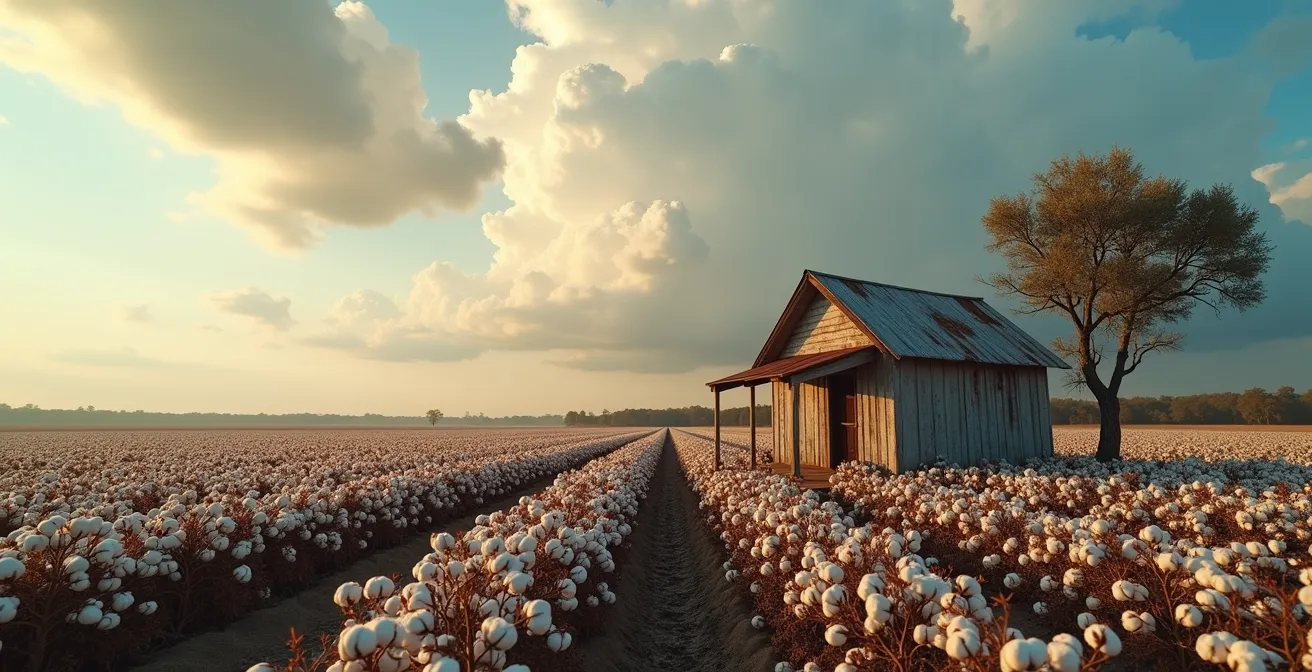
The ultimate destination for this kind of exploration is the former Dockery Plantation outside of Cleveland, Mississippi. This 25,600-acre cotton farm was a world unto itself, employing thousands of African American workers. It was here that pioneers like Charley Patton lived and worked, developing the distinctive style that would define the Delta blues. As B.B. King and others have said, Dockery Farms is where the blues was born. Standing on that land, surrounded by the ghosts of its past, is to stand at the very epicenter of American music.
That’s where the blues was born, after all.
– Barry Bays, Delta State University music professor on Dockery Farms’ significance
This is the heart of the pilgrimage. By connecting the historical markers of the Mississippi Freedom Trail with the sites on the Blues Trail, you begin to see the full, interwoven story of music, labor, and the fight for civil rights. The landscape is not just a backdrop; it is the source code of the blues.
Key Takeaways
- An authentic Blues Trail trip requires moving beyond tourist hubs to seek out the vanishing juke joints and community-based music scenes.
- The music is inseparable from its context; understanding the history of sharecropping and the region’s culinary traditions is key to a deep appreciation.
- Effective navigation requires more than GPS, relying on local knowledge, physical maps, and a willingness to explore unmarked backroads.
How to Drive Route 66 Today Without Getting Lost in Dead Ends?
The title of this section mentions Route 66, another iconic American road trip. While our focus is the Blues Trail, the central challenge of navigating Route 66 today offers a powerful metaphor for our journey. Much of the original Route 66 has been bypassed by interstates, leaving it a fragmented series of “dead ends,” historic loops, and unmarked segments. To drive it properly requires more than just Google Maps; it demands a historian’s dedication. The same is true for the Mississippi Blues Trail.
While Highway 61 is the main artery, the true heart of the blues is found in the capillaries—the unmarked county roads and gravel tracks leading to forgotten plantations, remote juke joints, and lonely gravesites. Relying solely on a GPS will cause you to miss these essential sites. A successful pilgrimage requires a dedicated Blues Highway Navigation Kit. This starts with downloading the official Mississippi Blues Trail app, which provides GPS coordinates for the historical markers, but it doesn’t end there. A high-quality physical state map is indispensable for visualizing the unpaved and minor county roads that digital maps often ignore.
Furthermore, one of the best sources for finding “dead end” historic sites are the free guides and maps available at local visitor centers in towns like Clarksdale and Greenwood. And critically, since cell coverage is notoriously spotty in the rural Delta, you must save offline maps before leaving urban areas. The Mississippi Blues Trail has grown from just a few markers to a network that now includes over 200 historical markers since its inception in 2006. Navigating this vast, scattered museum requires preparation.
Just like a seasoned Route 66 traveler, the blues pilgrim must become a detective, piecing together a route from a combination of modern tech, old-fashioned paper maps, and local lore. This active approach to navigation is not a chore; it is part of the adventure, turning the drive itself into an act of discovery.
By approaching this journey with a musicologist’s curiosity, a historian’s eye for detail, and an explorer’s navigational savvy, your trip to the Delta will transform from a simple vacation into a profound encounter with the soul of American music. To begin charting your own course, start by evaluating your priorities and mapping out the essential historical and cultural stops that will define your pilgrimage.