
Conquering Magic Kingdom in one day is not about luck; it’s a logistical operation of exploiting time, energy, and data.
- Success hinges on “stacking” Lightning Lanes for the afternoon while using the morning for low-wait attractions.
- Physical endurance is non-negotiable; your footwear is as critical as your park ticket.
Recommendation: Treat your park day as a mission. Plan your primary targets (attractions), manage your resources (energy and time), and execute with precision from the moment you arrive.
The quintessential Magic Kingdom dream often crashes against a harsh reality: the endless, snaking queue. Families arrive with high hopes, only to find themselves defeated by the sheer number of people and the daunting wait times posted above each attraction entrance. The common advice is predictable: arrive early, use the app, stay late. But this is like telling a soldier to “be brave” without handing them a map or a strategy. It’s well-intentioned but ultimately hollow, leaving you to fend for yourself in a sea of strollers and matching T-shirts.
Most guides focus on what to do, but they miss the most critical element: the *why* and the *how*. They don’t explain the psychology of a queue that makes an hour feel like three, nor do they detail the logistical ballet required to manipulate the Genie+ system to your advantage. This isn’t just about being in the park; it’s about mastering its internal rhythms and turning its own systems into your greatest asset. It’s about understanding the arbitrage opportunities hidden in plain sight.
But what if the key wasn’t just working harder, but working smarter? What if you could treat your day not as a frantic scramble, but as a calculated, military-grade operation? This guide is built on that premise. We will move beyond the platitudes and into the realm of obsessive, strategic planning. We will deconstruct the park day into a series of logistical challenges—from managing crowd psychology and energy levels to executing a flawless arrival and stacking Lightning Lanes like a seasoned pro. This is your operational blueprint for total park domination, ensuring maximum magic with minimal wasted time.
This comprehensive guide provides the strategic framework needed to navigate the park with expert precision. Below, you will find a detailed breakdown covering every critical phase of your mission, from pre-planning to in-park execution.
Table of Contents: A Logistical Blueprint for Your Perfect Magic Kingdom Day
- Why Standing in a 60-Minute Line Feels Longer Than It Is?
- How to Stack Lightning Lanes to Avoid Waiting All Afternoon?
- Universal vs. Disney: Which Resort Is Better for Teenagers?
- The Footwear Mistake That Ruins Your Epcot Walk
- When to Arrive at the Gates to Be the First on Rise of the Resistance?
- When to Visit Disney World to Avoid the ’10/10′ Crowd Level Days?
- How to Structure the Day to End Before the ‘Meltdown Hour’?
- How to Plan a Trip That Satisfies Both Toddlers and Grandparents?
Why Standing in a 60-Minute Line Feels Longer Than It Is?
The first step in defeating your enemy is understanding it. A 60-minute wait is not just a block of time; it’s a psychological battlefield. Your perception of time warps in a queue due to a lack of progress, uncertainty, and physical discomfort. The feeling of being stationary while surrounded by a moving mass of people triggers anxiety and impatience. While the official numbers show that the average wait time across all Disney World parks is 38 minutes, a poorly managed line can feel double that length. Disney Imagineers are masters of this, designing queues that twist and turn to create the illusion of progress, a concept known as a “switchback.”
These queues are filled with thematic elements and pre-show details not just for entertainment, but to provide micro-goals and distractions that break the wait into manageable chunks. This is the principle of wait time arbitrage: understanding that an engaged, moving wait feels shorter than a static, boring one. Your mission is to weaponize this knowledge.
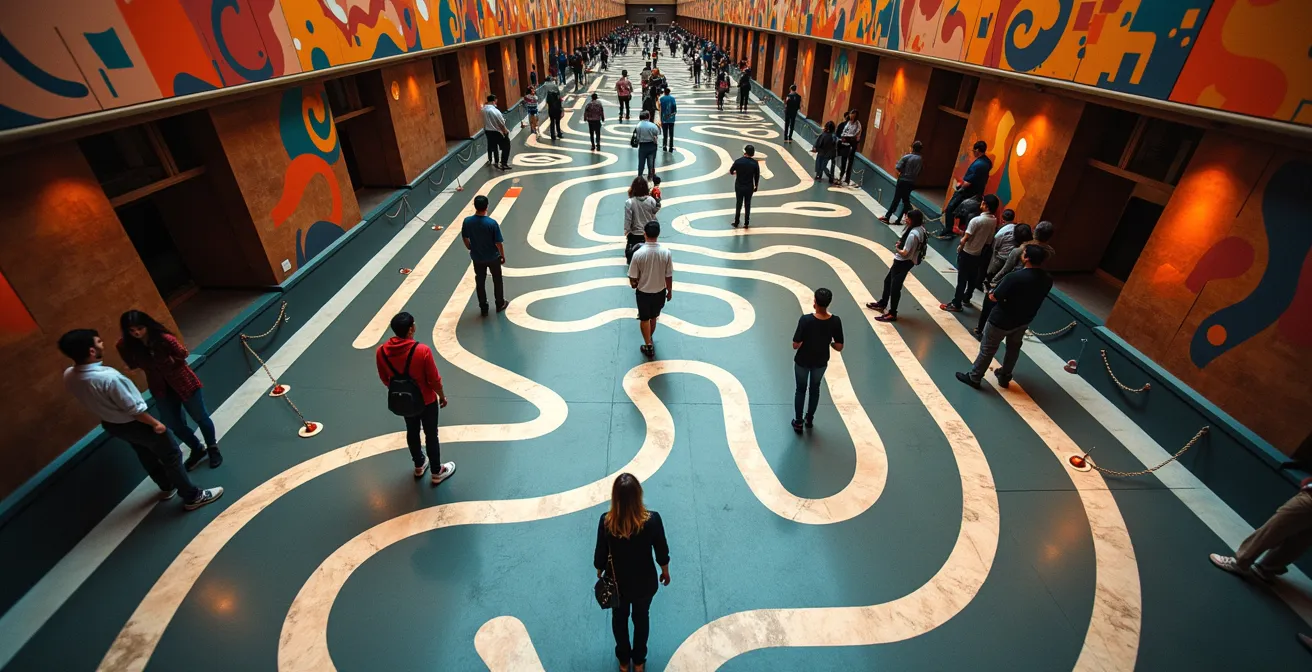
As the image demonstrates, the winding path creates visual interest and a constant sense of forward momentum, even when overall progress is slow. You can further manipulate your perception of time by creating your own engagement. Instead of passively waiting, actively manage your time. This means planning your next move, engaging your party in a game, or simply being mindful of the physical effects of standing. By taking control of the ‘in-between’ moments, you reclaim your time and morale, turning a draining wait into a strategic pause. The line is no longer a prison, but an operational base for planning your next conquest.
How to Stack Lightning Lanes to Avoid Waiting All Afternoon?
Genie+ is not a magic wand; it’s a complex trading floor where time is the currency. Casual users book one ride at a time, leaving them with long gaps and minimal value. The elite strategist, however, uses a technique called “stacking.” This involves accumulating multiple Lightning Lane (LL) return times for the afternoon, creating a chain of back-to-back, no-wait experiences. The day is thus split into two strategic halves: a morning of standby lines for low-wait attractions, and an afternoon of pure, unadulterated LL efficiency.
The process begins at 7:00 AM sharp. Your first selection should not be for the morning, but for a popular attraction with a return time of 12:00 PM or later. Once you tap into your first ride (or after the 120-minute rule kicks in), you immediately book another for the afternoon, and another, and another. You are effectively building a powerful “hand” of reservations that will allow you to bypass every major queue when the park is at its most crowded.
Case Study: The EarScouts Peak Crowd Domination
The team at Ear Scouts put this theory into practice, documenting a day at Magic Kingdom during a peak 10/10 crowd level. Their strategy, detailed in their Magic Kingdom guide, involved booking a less popular “burner” attraction at 7 AM to start the 120-minute clock, then continuously modifying and stacking LLs for major rides in the same park area. The result was a staggering 15+ Lightning Lane attractions completed, proving that strategic stacking can overcome even the most daunting crowds.
Executing this requires knowing which attractions run out of LL availability first. This data is your strategic asset map, guiding your 7 AM decision and subsequent choices throughout the morning. Prioritizing correctly is the difference between a successful stack and a day of missed opportunities.
| Attraction | 7 AM Booking | Typical Sell-Out Time | Alternative Strategy |
|---|---|---|---|
| Seven Dwarfs Mine Train | Priority #1 | 7:05 AM | Buy Individual LL |
| Peter Pan’s Flight | Priority #2 | 10:30 AM | Rope drop instead |
| Jungle Cruise | Priority #3 | 2:00 PM | Stack for afternoon |
| Space Mountain | Priority #4 | 3:30 PM | Evening return time |
Universal vs. Disney: Which Resort Is Better for Teenagers?
Before deploying a military-grade plan for Magic Kingdom, the first strategic question must be asked: are you fighting on the right battlefield? For families with teenagers, this is not a trivial concern. While Magic Kingdom is the quintessential family park, its appeal can wane for a demographic raised on high-octane thrills and modern pop culture. Universal Orlando often emerges as the superior choice for this group, prioritizing intense roller coasters and intellectual properties like Harry Potter and Marvel.
The difference is logistical as much as it is thematic. Universal’s two parks are compact and connected by the vibrant CityWalk, fostering a sense of independence that teenagers crave. They can move between parks and entertainment options on foot, without relying on a complex bus, boat, and monorail system. Disney World, by contrast, is a sprawling empire. Its scale, while magical, can feel restrictive. While Magic Kingdom remains the world’s most visited theme park, with 17.1 million annual visitors in 2022 according to Thrill Data, its dominance doesn’t automatically make it the best fit for every group.
A successful family mission requires satisfying all members of the unit. A bored or resentful teenager can sabotage the morale of the entire group, turning a dream vacation into a slog. The following comparison breaks down the key factors to consider before committing your resources to a single resort.
| Factor | Universal Orlando | Disney World | Teen Winner |
|---|---|---|---|
| Thrill Rides | VelociCoaster, Hagrid’s, Hulk | TRON, Guardians, Space Mountain | Universal |
| Pop Culture Relevance | Harry Potter, Marvel | Star Wars, Disney classics | Universal |
| Park Layout | Compact, walkable | Sprawling, requires transport | Universal |
| Independence Factor | CityWalk connection | Multiple parks, complex | Universal |
| Photo Opportunities | Diagon Alley, Hogwarts | Castle, character meets | Tie |
The Footwear Mistake That Ruins Your Epcot Walk
Let’s be clear: your feet are the single most critical piece of equipment for a park-conquering mission. Every year, countless vacations are derailed not by crowds or wait times, but by a catastrophic failure of footwear. The common mistake is choosing fashion over function or, even worse, wearing brand-new shoes. A typical day at a park like Epcot can easily exceed 20,000 steps (over 10 miles). Your shoes are not an accessory; they are your transport system, and they must be treated with the seriousness of a military-grade vehicle.
The solution is not a single pair of shoes, but a complete footwear system. This starts with socks. Cotton is your enemy; it traps moisture, leading directly to blisters. High-performance, moisture-wicking socks are a non-negotiable investment. The shoes themselves should be well-cushioned, broken-in athletic sneakers. Think of brands like Hoka, On Cloud, or Brooks, which are engineered for high-mileage running. They provide the support and shock absorption needed to withstand a full day on concrete.

The technology inside modern athletic shoes, with its layered foam and ergonomic design, is a force multiplier for your endurance. But even the best single pair of shoes has a weakness: consistent pressure points. The pro-level move is to bring a second, different pair of shoes into the park and switch them out mid-day. This simple action redistributes pressure on your feet, dramatically reducing fatigue and the risk of blisters. Proactive care—applying anti-chafe balm or moleskin to known hot spots *before* you even feel pain—is the final layer of your defense. Do not wait for the problem to announce itself; neutralize the threat before it materializes.
Your Pre-Battle Footwear Audit
- Choose moisture-wicking socks from brands like Bombas, Feetures, or Balega – avoid cotton completely.
- Select broken-in athletic shoes with cushioning: Hoka One One, On Cloud, or Brooks Ghost series.
- Pack a second pair of different shoes to switch at lunch – this redistributes pressure points.
- Apply Body Glide or moleskin preemptively to known hot spots before leaving the hotel.
- Bring blister bandages and keep them in your park bag – don’t wait until pain starts.
When to Arrive at the Gates to Be the First on Rise of the Resistance?
While *Rise of the Resistance* at Hollywood Studios sets the gold standard for a popular attraction, Magic Kingdom’s equivalent challenge is the Seven Dwarfs Mine Train. The principle for being first in line is identical: a precisely timed arrival known as “rope drop.” This isn’t about simply arriving before the park opens; it’s about positioning yourself at the absolute front of the crowd to gain a massive time advantage. The difference between being in the first wave of guests and being just five minutes behind can mean a 15-minute wait versus a 75-minute one. This is the Rope Drop Delta, the single biggest time-saving opportunity of your day.
Your arrival time is determined by your mode of transport. This is a logistical calculation, not a guess. Guests staying at a monorail resort have a significant tactical advantage. For everyone else, the journey through the Transportation and Ticket Center (TTC) is the primary hurdle. You must account for parking, security screening, and the monorail or ferry ride to the main gate. Arriving at the park gates at opening time means you are already hopelessly behind.
Case Study: The Mouse Hacking Rope Drop Timing Analysis
A detailed analysis from Mouse Hacking on Magic Kingdom rope drop strategies quantifies this precisely. To be at the front, guests driving to the TTC should arrive 75 minutes before the official park opening. This allows enough buffer to catch the very first monorail or ferry. In contrast, guests at the Contemporary or Grand Floridian only need a 45-minute lead time. The study confirmed that guests in the front 10% of the rope drop crowd for Seven Dwarfs Mine Train experienced a wait of just 15 minutes, while the wait ballooned to 75 minutes for those arriving shortly after.
This is not an area for casual estimation. Your goal is to be through the turnstiles and holding at the rope leading to Fantasyland before the official park opening announcement. Being there, ready to walk with purpose (never run!), is the first major victory of your day. It sets a tone of efficiency and guarantees you will conquer one of the park’s biggest attractions before the majority of guests have even finished their morning coffee.
When to Visit Disney World to Avoid the ’10/10′ Crowd Level Days?
The most sophisticated in-park strategy can be overwhelmed by a poor macro-level decision: your travel dates. Choosing when to visit Walt Disney World is the highest-leverage decision you will make. Fighting a 10/10 crowd is an uphill battle, no matter how good your plan. The goal is to select a time when crowd levels are manageable, turning your strategic plan from a necessity into an overwhelming advantage. The common wisdom—avoiding summer and major holidays—is a starting point, but it’s dangerously incomplete.
The true strategist looks for the hidden high-crowd periods that trap unsuspecting families. These are often driven by regional school holidays, obscure three-day weekends, or large-scale events at the resort that fly under the national radar. For example, “Jersey Week” in early November sees a massive influx of visitors from New Jersey when their schools close for a teacher’s convention, creating holiday-level crowds on what should be a quiet weekday.
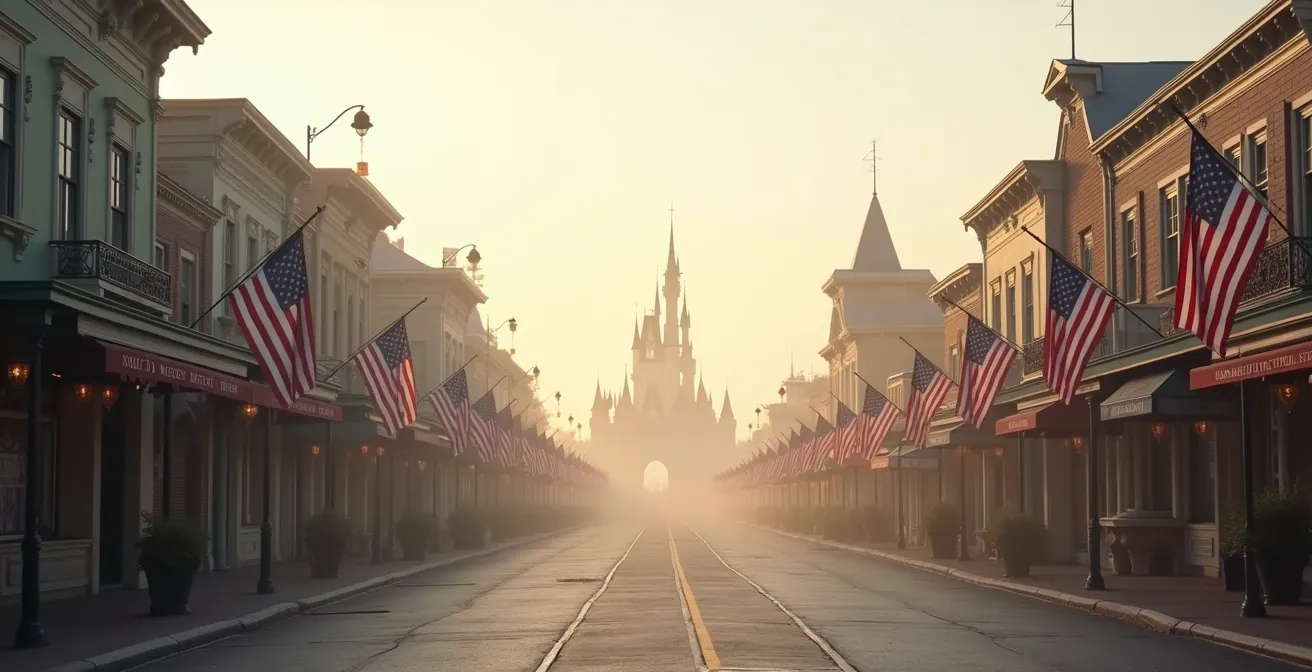
The dream of a peaceful Main Street is achievable, but it requires diligent research. Consulting a reliable, data-driven crowd calendar is essential. These resources track historical data, school schedules, and resort event calendars to predict crowd levels with surprising accuracy. As detailed by planning sites like WDW Prep School, many of these surge periods are predictable and avoidable if you know where to look.
Below are some of the most common “trap” weeks that should be avoided at all costs:
- Jersey Week (first full week of November): A massive, unexpected surge from New Jersey schools.
- Presidents’ Day Weekend: This three-day weekend in February consistently creates higher-than-expected crowds.
- Orange/Osceola County Breaks: When local Florida school districts are out, weekdays become as crowded as weekends.
- runDisney Marathon Weekends: Held in January, February, April, and November, these events flood the entire resort.
- Mardi Gras Week: A popular time for school breaks throughout the southern United States.
How to Structure the Day to End Before the ‘Meltdown Hour’?
Around 3:00 PM, a predictable phenomenon occurs across Magic Kingdom: the “Meltdown Hour.” It’s the point of critical failure where heat, fatigue, and overstimulation converge. Children cry, parents argue, and carefully laid plans disintegrate. A successful park day isn’t a sprint; it’s an ultramarathon that requires deliberate energy management. The key to surviving past the Meltdown Hour is to proactively plan for recovery, not just push through until collapse.
The most effective strategy is the mid-day break. This is not a sign of weakness; it is a tactical retreat to regroup and recharge. Forcing your family to stay in the park from open to close is a rookie mistake. The professional move is to exit the park entirely between 1:00 PM and 3:00 PM, the hottest and most crowded part of the day. A swim at your resort pool or even just a quiet hour in a hotel room can completely reset your family’s stamina for the evening.
Case Study: The Monorail Resort Reset
Families utilizing the “Monorail Resort Reset” demonstrate the power of this strategy. One family’s documented plan involved a morning rope drop, conquering four major rides by noon, then taking the monorail to the Contemporary Resort for a leisurely lunch and pool break from 1-3 PM. Upon returning to the park, they were refreshed and able to enjoy the afternoon and evening, completing another eight attractions with minimal fatigue. The break wasn’t lost time; it was an investment that prevented the 4 PM crash and extended their operational window by hours.
If leaving the park is not feasible, the same principle can be applied through logistical pacing. This involves alternating high-stress, outdoor attractions with low-stress, indoor “recovery” attractions. Pairing a ride on Big Thunder Mountain with a 21-minute seated experience at the Carousel of Progress isn’t just about variety; it’s a calculated move to manage physical and mental energy reserves. Planning these recovery blocks into your itinerary is as important as planning your Lightning Lanes.
| Time Slot | High-Stress Attraction | Recovery Attraction | Energy Impact |
|---|---|---|---|
| Morning | Space Mountain | PeopleMover | Balanced start |
| Mid-Morning | Seven Dwarfs | Mickey’s PhilharMagic | AC break included |
| Afternoon | Big Thunder | Carousel of Progress | 21-min seated rest |
| Evening | TRON | Haunted Mansion | Dark, cool recovery |
Key Takeaways
- Strategic planning is a force multiplier; a good plan defeats crowds more effectively than a bigger budget.
- Your physical endurance is a finite resource. Manage it proactively through footwear, breaks, and pacing.
- Master the systems. Genie+, rope drop, and crowd calendars are tools to be exploited, not just used.
How to Plan a Trip That Satisfies Both Toddlers and Grandparents?
A multi-generational trip to Magic Kingdom presents the ultimate logistical challenge. You are no longer managing a single unit, but a coalition with vastly different needs, stamina levels, and interests. The goal is not to force everyone to do everything together. The goal is to create a flexible, interlocking plan that allows for both shared memories and individual satisfaction. Success requires leveraging park services and a “divide and conquer” mentality.
The Rider Switch service is your most powerful tool for thrill rides. It allows one adult to wait with a non-riding child (or grandparent) while the rest of the party rides. Then, they can switch with the waiting adult without having to go through the entire queue again. This ensures no one misses out on the park’s signature attractions. For the youngest members, establishing the Baby Care Center as a “home base” provides a quiet, air-conditioned sanctuary for nursing, changing, or simply decompressing from the sensory overload.
The most effective strategy, however, is to plan deliberate “split sessions.” Instead of trying to keep the entire group together for eight hours, break the day into focused blocks. From 10 AM to 12 PM, perhaps the grandparents take the toddler for a gentle tour of Fantasyland while the parents conquer Space and Big Thunder Mountain. Everyone can then regroup for a shared experience, like a character dining meal at The Crystal Palace, which provides a seated, climate-controlled break that appeals to all ages. As a source like Undercovertourist highlights, using the Walt Disney World Railroad is another key tactic, serving as relaxing transportation between lands and saving valuable steps for those with limited mobility.
Here are some core tactics for a successful multi-generational mission:
- Use Rider Switch for all height-restricted attractions.
- Establish the Baby Care Center near the Crystal Palace as your operational base.
- Plan ‘split sessions’ to cater to different energy levels and interests.
- Book a character dining meal for a guaranteed seated rest that satisfies everyone.
- Identify shaded rest zones in advance, like the path behind the castle or Tomorrowland Terrace.
- Utilize the park’s train as a low-energy mode of transport between Fantasyland and Frontierland.
Now that you are armed with the strategic framework for planning, timing, and execution, the final step is to put it all into practice. Begin building your personalized operational blueprint today to transform your next Disney vacation from a stressful ordeal into a triumphant, magical conquest.