Forget what you’ve heard about endless lines; getting affordable Broadway tickets isn’t about luck, it’s about outsmarting the system.
- The high price of a ticket is a deliberate calculation of demand, not just a reflection of quality.
- Insider methods like digital lotteries and direct box office negotiation consistently outperform tourist-focused passes.
Recommendation: Focus your energy on daily digital lottery entries and learning the specific language to use at the box office on a weekday morning—this is the most effective path to sub-$50 premium seats.
The glowing marquees of Broadway are a siren call for culture enthusiasts, but the price tag can feel like a velvet rope keeping you out. For students and discerning fans in New York or Chicago, the dream of seeing a top-tier show often clashes with the reality of a budget. You’ve heard the conventional wisdom: wake up at dawn for rush tickets, sacrifice an afternoon to the TKTS line in Times Square, or resign yourself to the nosebleed seats where the actors are mere specks.
Let’s be frank: this advice is for tourists. It’s based on hope, not strategy. The persistent myth is that cheap tickets are a reward for patience, for enduring the elements. But what if the true key isn’t waiting in the rain, but understanding the intricate, hidden choreography of theatrical economics? What if you could approach the box office not as a hopeful outsider, but as a savvy insider who speaks the language of the house?
This guide demystifies that very system. We will move beyond the generic tips and deconstruct the pricing psychology, seating politics, and strategic timing that govern the world of Broadway ticketing. We will explore why a Saturday night seat costs a fortune, how to decode the true value of a seat beyond its price, and master the art of acquiring premium tickets for a fraction of their cost. This is your playbook for turning the elite theater ecosystem into an accessible art form.
This article unpacks the strategies that separate the casual attendee from the true theater insider. Below is a summary of the tactics and insights we’ll explore to transform your approach to buying Broadway tickets.
Summary: A Strategic Guide to Conquering Broadway’s Ticket System
- Why a Saturday Night Hamilton Ticket Costs More Than Your Flight?
- Orchestra vs. Mezzanine: Which View Is Worth the Extra $100?
- Broadway vs. National Tour: Is the Experience Really Different?
- The Phone Mistake That Will Get You Ejected from the Theater
- Why City Passes Often Cost More Than Single Tickets for Casual Tourists?
- How to Snag Acela Business Class Seats at Coach Prices?
- How to Get Front Row Seats at a Vegas Show for Half Price?
- When to Buy Tickets to Catch a Show Before It Closes Forever?
Why a Saturday Night Hamilton Ticket Costs More Than Your Flight?
The staggering price of a prime-time ticket for a blockbuster like Hamilton isn’t arbitrary; it’s the result of a sophisticated financial ballet known as dynamic pricing. Theaters, much like airlines, adjust prices based on a myriad of real-time factors: demand, day of the week, time of day, and even the public’s perception of a show’s cultural relevance. A Saturday 8 PM performance represents the peak of this demand curve, a time when tourists and locals are most willing to splurge, effectively subsidizing the less-popular Tuesday evening show.
Production costs also play a leading role. A major Broadway musical is a multi-million dollar enterprise with staggering weekly running costs—covering everything from cast and orchestra salaries to theater rental and intricate set mechanics. The price you pay isn’t just for two hours of entertainment; it’s your contribution to a massive, complex machine. According to Broadway League data, even with these high prices, the average Broadway ticket price was $128.50 in the 2022/2023 season, a figure that is dramatically skewed by the ultra-expensive premium seats.
Understanding this theatrical economy is the first step toward beating it. The high price of a weekend show isn’t a barrier; it’s a signal. It signals that the theater needs to fill seats on other nights, creating the very pricing weaknesses that a strategic buyer can exploit. Your goal isn’t to afford the Saturday night ticket; it’s to leverage its existence to find value elsewhere in the week.
Orchestra vs. Mezzanine: Which View Is Worth the Extra $100?
The great debate for any theatergoer is where to sit. The box office presents a simple hierarchy: Orchestra is best, Mezzanine is second-best, and Balcony is for the budget-conscious. As an insider, you must learn to reject this simplistic view and embrace the concept of psychological seating. The “best” seat is entirely dependent on the production itself. A premium front-row orchestra seat for a large-scale dance musical like MJ the Musical might leave you with a neck ache and an incomplete view of the choreography, while a front mezzanine seat would offer a breathtaking panorama of the entire stage tapestry.
This is a game of sightlines and sound design. For an intimate, dialogue-driven play, being close enough to see the actors’ subtlest facial expressions in the front orchestra is paramount. But for a visual spectacle with grand set pieces, distance provides perspective. The rear orchestra can often provide a more balanced sound experience than the very front rows, which might be too close to the pit orchestra. The key is to match the seat to the show’s artistic DNA.
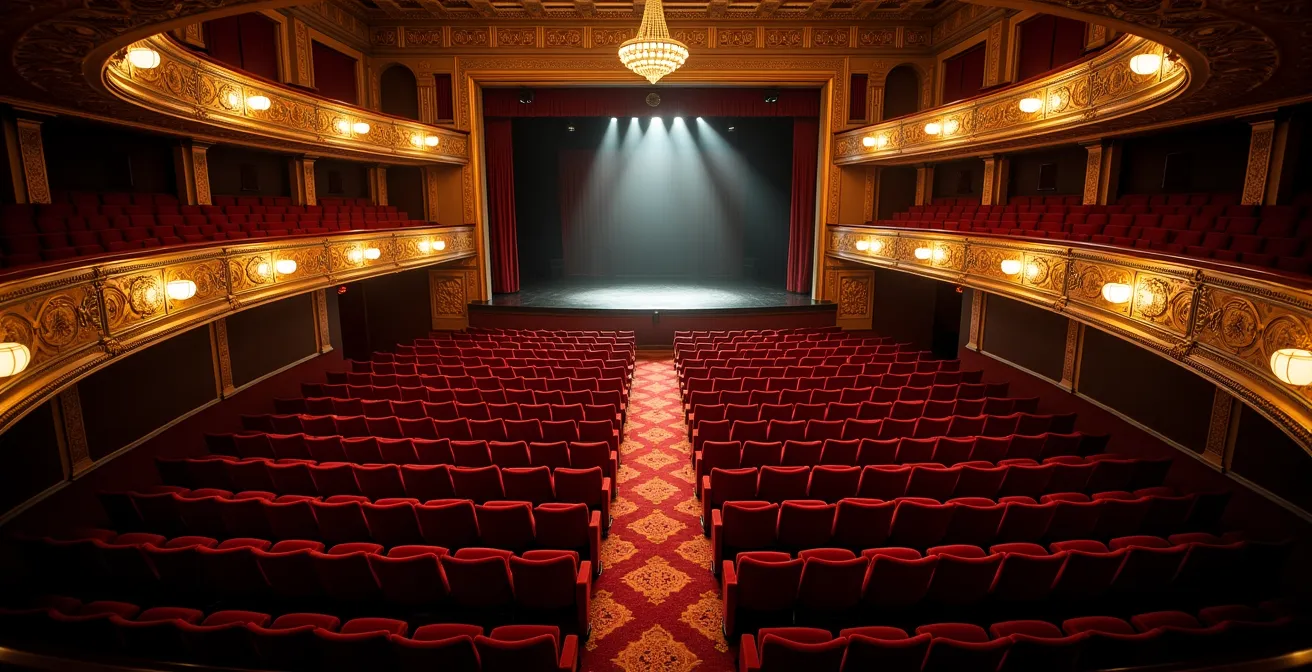
Before you purchase, do your research. Websites like “A View From My Seat” offer photos from nearly every seat in every Broadway house, allowing you to assess the actual sightlines, potential obstructions, and distance from the proscenium. Don’t pay a premium for a location; pay for the experience you want to have.
This table breaks down the trade-offs, helping you decide where your money is best spent.
| Seat Type | Average Price | Best For | Drawbacks |
|---|---|---|---|
| Orchestra Front | $200-$400 | Intimate dramas, facial expressions | Neck strain for high stages |
| Orchestra Rear | $100-$200 | Full stage view, balanced sound | Less intimate connection |
| Mezzanine Front | $150-$250 | Dance musicals, choreographic patterns | Further from action |
| Mezzanine Rear | $50-$100 | Budget-conscious viewers | May miss details |
Broadway vs. National Tour: Is the Experience Really Different?
When a hit show announces a national tour, a question invariably arises for those in cities like Chicago: is it the “real” thing, or a watered-down imitation? The answer, like so much in theater, is nuanced. From a technical standpoint, there are often differences. A Broadway production has the luxury of a permanent home, allowing for more elaborate and permanent stage mechanics. A touring production, by contrast, must be designed to be broken down, transported, and reassembled in different theaters every few weeks.
Case Study: The Hamilton Experience, Broadway vs. Tour
The original Broadway production of Hamilton at the Richard Rodgers Theatre features its famous double-turntable rotating stage, a key element of the show’s fluid choreography. Many national tour productions use a simplified set with a single turntable or modified mechanics to facilitate easier transport. Furthermore, the Broadway version boasts a full 40-piece orchestra, while touring productions often utilize a smaller, 28-piece arrangement. These changes are subtle but can impact the grandeur of the experience for a discerning aficionado.
However, what a tour might lack in scenic complexity, it often makes up for in raw energy. Tour casts are frequently composed of brilliant young actors eager to make their mark in iconic roles. Their performances can be imbued with a hunger and freshness that can sometimes be more electrifying than a long-running Broadway cast. With Broadway attendance reaching approximately 95% of pre-pandemic levels, the demand for the New York experience is immense. Yet, a national tour offers 99% of the show’s dramaturgy and heart, often at a lower price point and with greater accessibility. For many, this trade-off is more than worth it.
The Phone Mistake That Will Get You Ejected from the Theater
Once you’ve navigated the complex world of ticketing and secured your seat, you’ve entered a sacred space. A theater is not a movie multiplex; it’s a live, ephemeral contract between the performers on stage and the audience. Your role in this contract is to be present and respectful, and nothing shatters this contract faster than the glow of a cell phone screen. Ushers and house managers are not being overly dramatic when they enforce a strict no-phone policy; they are protecting the integrity of the performance for everyone.
The light from a single screen can destroy the carefully crafted lighting design, pull fellow audience members out of the story, and, most critically, distract the actors on stage. A performer who catches a glowing screen in their sightline is immediately ripped from their character. This is why theaters have a zero-tolerance policy. A warning is a courtesy; a repeat offense is grounds for ejection without a refund. It is the cardinal sin of theatergoing.
To be a true insider, you must be a model audience member. This means embracing the rules not as restrictions, but as part of the shared ritual of live performance. Adhering to proper etiquette is a sign of respect for the art form, the artists, and your fellow patrons.
- Turn off phones completely. Do not trust “silent” or “vibrate” mode. The vibration can be heard in a quiet theater, and screens can light up with notifications.
- Remove smartwatches or set them to theater mode. The “raise to wake” feature is as disruptive as a phone screen.
- Arrive 30 minutes early. Late seating is disruptive and often not permitted until a suitable break in the performance, meaning you could miss the first 15-20 minutes of the show.
- Unwrap any candy or cough drops before the show begins. The crinkling of a wrapper during a quiet monologue is infuriatingly loud.
- Wait for appropriate applause moments. Applaud after a song concludes or at the end of a scene, not during a powerful moment that is still unfolding.
- Never record any part of the show. This includes photos and audio. It is a violation of copyright law and the contracts with the Actors’ Equity Association.
Why City Passes Often Cost More Than Single Tickets for Casual Tourists?
For the first-time visitor to New York City, bundled attraction packages like the NYC City Pass seem like a fantastic deal. They promise access to multiple landmarks and a Broadway show for a single, seemingly discounted price. However, for the savvy culture enthusiast whose primary goal is theater, these passes are often a financial trap. The “one Broadway show” included is typically from a limited selection of long-running, less in-demand productions. You’re paying for convenience, not choice or value.
A casual tourist trying to see five attractions in three days might find value in a pass. But your goal is different. You are a strategic operator looking for the best possible theatrical experience at the best price. The methods available to a single-ticket buyer—TKTS, lotteries, rush—offer far greater savings and a vastly wider selection of shows, including the hottest tickets in town. Paying $146 for a pass to see a show you can get for $50 at the TKTS booth, while also paying for attractions you may not have time for, is a false economy.
The smarter play is to unbundle your activities. Treat your theater-going as a separate, specialized mission. This allows you to deploy the targeted tactics that yield the deepest discounts, putting you in control of what you see and how much you pay. The following comparison illustrates the stark difference in value.
| Option | Cost | What You Get | Best For |
|---|---|---|---|
| NYC City Pass | $146 | One Broadway show + 5 attractions | First-time tourists seeing everything |
| TKTS Same-Day | $40-$80 | Up to 50% off face value | Flexible schedules |
| Digital Lottery | $10-$49 | Premium seats if you win | Lucky risk-takers |
| Rush Tickets | $40-$50 | Day-of tickets at box office | Early morning people |
How to Snag Acela Business Class Seats at Coach Prices?
This title isn’t about trains. It’s a metaphor for value hacking. Just as a savvy traveler knows the tricks to get upgrades, a savvy theatergoer knows the language to unlock better seats for less money at the box office. Forget the passive, often fruitless, online search. The physical box office, especially on a quiet Tuesday or Wednesday morning, is a stage for a subtle negotiation, and knowing your lines is critical.
Walking up and asking “Do you have any cheap tickets?” marks you as an amateur. It invites a simple “no” or a point toward the most expensive seats. Instead, you must use the insider’s lexicon. You are not asking for a handout; you are inquiring about available inventory in a way that signals you understand how a theater operates. You are opening a conversation with a fellow professional—the box office agent—who often has discretion over a small number of “house seats” or last-minute releases.
For instance, asking about “partial view seats” is a classic insider move. Many of these seats are nearly perfect, perhaps missing the first 30 seconds of an actor’s entrance from the far side of the stage, but are sold at a 50-70% discount. Inquiring about “single seats” is another powerful tactic. A single open seat in the middle of a sold-out orchestra section is often difficult to sell and may be released at a steep discount to fill the house. Another option for eligible individuals is joining a program like TDF (Theatre Development Fund), where members can access Broadway tickets ranging from $11-$60.
These are the phrases that change the game:
- Instead of asking for “cheap tickets,” ask, “What’s your best value for today’s performance?”
- Inquire specifically about “partial view seats that don’t miss much of the main action.”
- Ask if there are any “single seats available in the orchestra or front mezzanine.”
- Politely ask if any “house seats have been released for today.” These are seats held for industry members that are sold to the public if unclaimed.
- If you’re celebrating a special occasion, mention it. Kindness and a personal connection can sometimes lead to an unexpected upgrade.
How to Get Front Row Seats at a Vegas Show for Half Price?
The ultimate Broadway “jackpot”—the equivalent of hitting a Vegas slot machine for a life-changing payout—is the digital lottery. This is, without question, the single best way to score premium, often front-row, seats for a pittance. We’re not talking about half-price; we’re talking about paying $10 to $49 for a seat that sells for $300-$500. While winning requires luck, a disciplined strategy dramatically increases your odds over time. This is your most powerful tool for accessing shows that never appear at TKTS or offer rush tickets.
Case Study: The $10 Hamilton Lottery Jackpot
The digital lottery for Hamilton is legendary. The show offers 46 seats for every performance for just $10 each. These aren’t obscure balcony seats; they are frequently located in the first two rows of the orchestra. Winners consistently report obtaining seats with a face value of over $500, making it the greatest value arbitrage in all of live entertainment. Despite the competitive odds, the sheer value of a win makes daily entry a non-negotiable for the serious budget-conscious connoisseur.
Success in the lottery game is about consistency and organization. Most lotteries open the day before or the morning of the performance and close in the early afternoon. Winners are notified via email and typically have only 60 minutes to purchase their tickets online. Missing this window means forfeiting your win. Therefore, a systematic approach is essential. Don’t just enter sporadically; make it a daily ritual.

Your Action Plan: Mastering the Digital Lottery
- Diversify Your Platforms: Enter lotteries daily across all major platforms: Telecharge, Broadway Direct, and Lucky Seat.
- Leverage Lucky Seat: Use the Lucky Seat platform to enter lotteries for a full week of performances at once, typically opening every Sunday or Monday.
- Set Calendar Reminders: Create daily recurring reminders on your phone for lottery entry windows (usually 9 AM – 3 PM ET) and for checking your email around drawing time.
- Be Payment-Ready: Keep your credit card information handy or saved in your browser. Winners often have only one or two hours to complete the purchase.
- Target Midweek Shows: Your odds of winning are significantly better for Tuesday, Wednesday, and Thursday performances compared to weekends. Don’t give up—persistence is key.
Key Takeaways
- Stop thinking like a tourist waiting in line; start thinking like an insider who understands the system of theatrical economics.
- The “best” seat is not the most expensive one; it’s the one with the best sightlines for the specific show you’re seeing.
- Your most powerful tools for sub-$50 tickets are the disciplined, daily entry of digital lotteries and the confident use of insider language at the box office.
When to Buy Tickets to Catch a Show Before It Closes Forever?
There’s a unique urgency that comes with a show’s closing announcement. It creates a sudden, final rush of demand from lifelong fans and curious newcomers wanting to catch a piece of theatrical history before it vanishes. This environment creates a fascinating and volatile micro-economy where timing is everything. The common assumption is to buy immediately, but strategic patience can often yield better prices. The key is to understand the emotional arc of a closing run.
When a long-running show announces its final performance weeks or months in advance, there is an initial surge of panic-buying. However, this is often followed by a brief, counterintuitive lull. This “post-announcement dip” is your golden window. It typically occurs one to three weeks after the news breaks, once the initial wave of buyers has secured their tickets but before the final-week hysteria kicks in.
Case Study: The Final Act of The Phantom of the Opera
When The Phantom of the Opera announced its historic closing after 35 years, the market dynamics were a perfect illustration of this principle. According to an analysis of the show’s closing run, ticket prices on the secondary market initially dipped by roughly 15% for a two-week period following the announcement. Then, as the final performance drew near, they surged to over 300% of their normal price. The optimal buying window was that brief 10-14 day period after the announcement, where availability was still high and prices were at their lowest point before the final, dramatic climb.
Monitoring a show’s weekly capacity rates can also provide clues. If a struggling show is consistently playing to houses less than 70% full, it may be at risk of closing. Watching these trends can help you anticipate an announcement and be ready to act—or to simply snag great seats for a show that is desperate to fill the house before the final curtain falls. In this high-stakes final act, timing isn’t just important; it’s the entire performance.
By shifting your mindset from a passive consumer to a strategic player, you can consistently access the world’s best theater without paying a fortune. The next logical step is to put these strategies into practice and begin tracking the shows you want to see.