Contrary to popular belief, the secret to a crowd-free experience with the Art Institute’s Impressionists isn’t just about timing your visit. The true strategy lies in changing *how* you see the art. By adopting an art historian’s mindset—understanding the collection’s unique history, following a strategic path, and engaging in contemplative viewing—you can transform a busy museum into a space for personal connection with the masterpieces.
The scene is all too familiar: you’ve traveled to Chicago, eager to stand before a Monet, only to find yourself jostling for a view amidst a sea of smartphones. The typical advice is to buy tickets online or visit on a weekday, but these are merely logistical tweaks. They might save you ten minutes in line, but they won’t save your experience from the overwhelming feeling of a gallery rush, where you’re moved along by the crowd before you can truly connect with a piece. What if the solution wasn’t about finding a mythical “empty” day, but about fundamentally altering your approach to the visit?
This guide abandons the generic tips. Instead, it offers a strategic framework built on the principles an art historian uses for a meaningful visit. We will delve into the specific DNA of this world-class collection, revealing why these masterpieces are in Chicago in the first place. You will learn not just where to go, but *how to look*—transforming your visit from a passive checklist of famous works into an active, contemplative dialogue with the art itself. This is your plan for turning one of the world’s most popular art destinations into your own private gallery.
This article provides a complete roadmap for your visit. You’ll discover the unique history of the collection, learn specific techniques for viewing and navigating the galleries, and find strategies to uncover hidden gems. Explore the sections below to master the art of the strategic museum visit.
Summary: A Strategic Guide to the Art Institute’s Impressionist Collection
- Why So Many European Masterpieces Are in American Rust Belt Cities?
- The ‘Everything at Once’ Mistake That Ruins Your Visit to the Louvre equivalent
- When to Ditch the Headset and Just Look at the Art?
- How to Look at a Pollock for 5 Minutes and Actually Understand It?
- The Flash Mistake That Gets You Ejected from the Gallery
- The Met vs. The National Gallery: Which Has the Better Renaissance Wing?
- How to Spot the Next Big Artist in the ‘Positions’ Sector?
- How to Buy Art at Art Basel Miami Without Being a Millionaire?
Why So Many European Masterpieces Are in American Rust Belt Cities?
The magnificent Impressionist collection at the Art Institute of Chicago exists not because of a monarch’s decree or a government initiative, but because of the radical taste of a handful of Gilded Age Chicagoans. To truly appreciate the collection, you must first understand its DNA. This isn’t a random assortment of famous paintings; it’s a curated legacy of personal passion. While the museum saw over 1.3 million visitors in 2024, few realize the intimate story behind its crown jewels.
Case Study: The Trailblazing Taste of Bertha Palmer
In the late 19th century, when Impressionism was still scorned by the Paris Salon, Chicago collectors like Bertha and Potter Palmer, Martin A. Ryerson, and Annie Swan Coburn were acquiring these works with incredible foresight. As detailed by the Smithsonian, they bought Monets, Renoirs, and Degas directly from the artists or their primary dealers. This private patronage model, driven by individual taste rather than state approval, is why the Art Institute’s collection feels so personal and focused. They weren’t just buying art; they were championing a revolution.
This history is your first tool against the crowds. Knowing that the collection was built on personal relationships, you can approach it with a similar intimacy. While general advice suggests avoiding weekends, the quietest times are often more specific, such as Monday afternoons from 4-6 PM or the first hour after opening on a Wednesday morning. Thinking like a collector means seeking the quiet moments for a personal connection, away from the peak-hour rush.
The ‘Everything at Once’ Mistake That Ruins Your Visit to the Louvre equivalent
The most common mistake visitors make is treating the museum like a buffet, trying to sample everything at once. This “see-it-all” approach leads to visual fatigue and guarantees you spend your time in the most congested areas, like the “La Grande Jatte Black Hole” in Gallery 240. The art historian’s secret is to reject this impulse. Instead of a marathon, plan a series of focused sprints. The Art Institute’s own data shows that even dedicated members typically visit for short, focused periods, returning throughout the year.
Embrace the philosophy of a limited, strategic itinerary. A micro-visit of 60-90 minutes focused on a specific theme or a handful of works is far more rewarding than a four-hour-long, exhausting wander. Here are three proven paths to structure your visit:
- The 60-Minute Masterpiece Sprint: Enter through the Modern Wing and work your way backward. This counter-intuitive path moves you against the main flow of traffic, allowing you to see major works like Caillebotte’s “Paris Street; Rainy Day” when the galleries begin to thin out.
- The Quiet Corner Tour: Intentionally bypass the most famous works at first. Focus on the adjacent galleries to discover masterpieces by artists like Eva Gonzalès. These quieter spaces offer a more contemplative viewing experience.
- The Art History Major Path: Trace the evolution of the movement by starting with the Post-Impressionists and moving chronologically backward to the origins of Impressionism. This narrative approach turns your visit into a story.
Before you even arrive, use the museum’s own JourneyMaker tool online to build a custom tour of just five or six pieces. This act of pre-curation commits you to a plan and frees you from the pressure of seeing it all.
When to Ditch the Headset and Just Look at the Art?
Audio guides can provide valuable context, but they can also become a crutch, mediating your experience and preventing a direct, personal connection with the art. The true art lover knows when to turn off the narrator and enter into a visual dialogue with the painting itself. This is especially critical in the Impressionist wing, where so much of the genius lies in the comparison and interplay between works.
As the image above suggests, some of the most profound moments in a museum are silent ones. The key is to have a strategy for when to listen and when to look. The goal isn’t to absorb every fact but to have a rich visual experience. Consider this on/off approach:
- HEADSET OFF in the Monet rooms (Galleries 241-243). His series paintings, like the Haystacks or Water Lilies, were designed to be seen together. Your eyes, comparing the shifting light and color across multiple canvases, will teach you more than any audio track.
- HEADSET ON for complex narrative paintings. For a work like Caillebotte’s “Paris Street; Rainy Day,” the audio guide can illuminate the social and historical details you might otherwise miss.
- HEADSET OFF for any series of works by a single artist. When you see multiple Degas sculptures or Renoir portraits together, focus on the evolution of their technique and subject matter on your own.
- ALTERNATIVE: For a quick dose of storytelling, pause near a docent-led tour for a few minutes. They often share the most compelling anecdotes that aren’t on the official audio guide.
Use the museum app for navigation to find your way from room to room, but resist the urge to have a continuous audio stream. Give yourself the gift of quiet, uninterrupted looking. It is in that silence that the art truly begins to speak.
How to Look at a Pollock for 5 Minutes and Actually Understand It?
The title is a misnomer for our purpose; the real question for this collection is, how do you look at a Monet for five minutes and see something new? In a crowded gallery, the average visitor spends less than 30 seconds on a painting. To have a truly crowd-free experience, you must learn the art of contemplative viewing. This means slowing down and looking with intention, which naturally allows the fleeting crowds to pass you by. It’s a simple act of resistance that yields immense rewards.
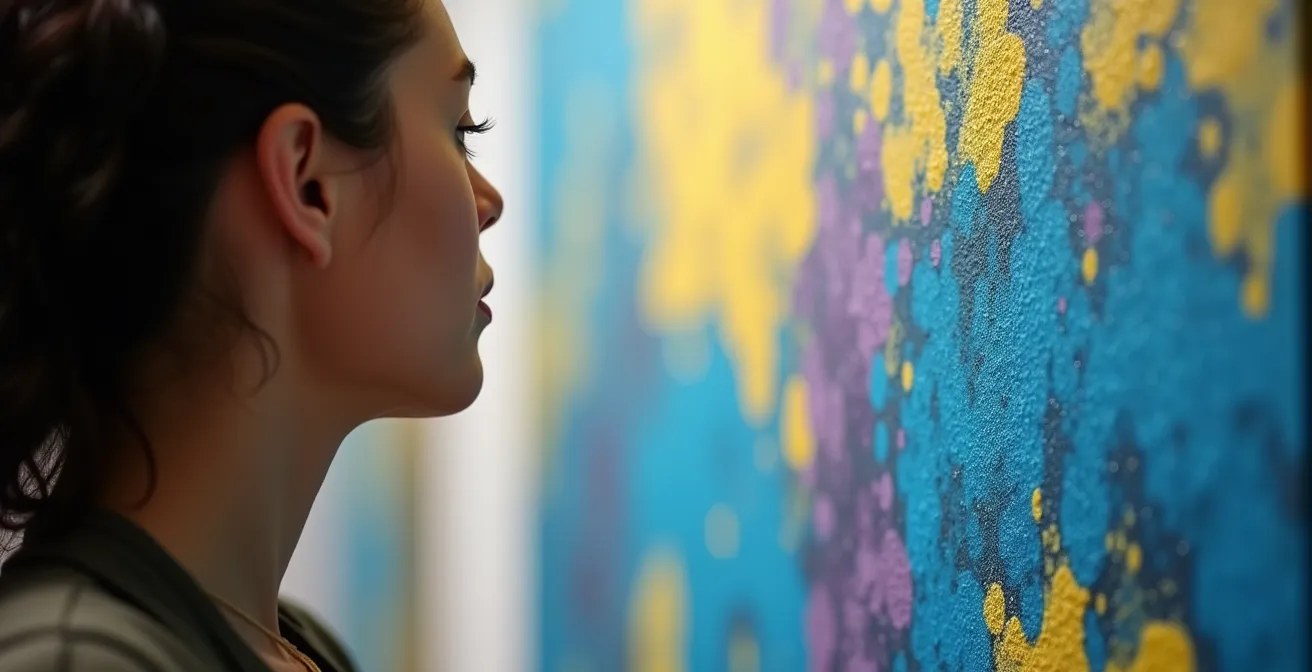
The secret is a structured method of looking that deepens your appreciation with each step. Instead of a quick glance, you engage the painting from multiple perspectives, unlocking details that a passing look would never reveal. This deliberate process not only enhances your understanding but also creates a personal bubble of focus, insulating you from the surrounding bustle.
Your Action Plan: The 3-Step Impressionist Viewing Method
- Step 1 (20 ft back): Begin by observing the painting from a distance. Take in the overall effect of light, color, and composition. See the scene as the artist first intended it: a unified whole. How does the light create a mood? What is the first thing your eye is drawn to?
- Step 2 (5 ft back): Move closer to focus on distinct blocks of color and form. Notice how shapes are built not with lines, but with patches of color. Observe how adjacent colors vibrate and influence one another. This is where the structure of the painting reveals itself.
- Step 3 (as close as allowed): Finally, get close enough to study the surface. Examine the individual brushstrokes. Are they thick or thin, long or short? See the texture of the paint, the artist’s physical gesture frozen in time. This is the artist’s handwriting.
Apply this method to a single Monet “Haystack.” From afar, you see a hay bale at sunset. At five feet, you see the distinct blues of the shadows and oranges of the light. Up close, you see a flurry of individual, textured strokes that are abstract on their own but coalesce into a masterpiece from a distance. You will have spent five minutes and seen more than anyone else in the room.
The Flash Mistake That Gets You Ejected from the Gallery
Nothing shatters the contemplative atmosphere of a gallery faster than a camera flash or a visitor casting a shadow over a painting. Beyond being disruptive, these actions can cause real harm. The pigments used by Impressionist painters are famously sensitive to light, and the cumulative effect of thousands of flashes can cause irreversible fading over time. Mastering gallery etiquette, or “gallery choreography,” is not just about being polite; it’s about being a responsible steward of the art.
Navigating a gallery gracefully is a skill. It allows you to see the art better while ensuring others can do the same. Following these unspoken rules will vastly improve your experience and that of everyone around you:
- Master Your Position: To view the glass-protected “Paris Street; Rainy Day” without glare, don’t stand directly in front of it. The best spot is ten feet back and to the far left, which mitigates the reflection from overhead lights.
- No Flash, Ever: This is the cardinal rule. Your phone’s flash is your enemy and the art’s. Double-check that it is turned off before you even enter the gallery.
- Mind Your Shadow: Be aware of the gallery lighting and where your body is in relation to it. Maintain a distance of at least 3-4 feet from paintings to avoid casting a distracting shadow on the canvas.
- Travel Light: The museum requires bags larger than 13 x 17 x 4 inches to be stored in the free checkrooms. Use this to your advantage. A smaller bag or no bag at all makes you more nimble and less likely to bump into others or the art.
- Use the Back Door: The Modern Wing entrance at 159 East Monroe Street is often less crowded than the main Michigan Avenue entrance, getting you into the galleries faster.
By moving through the space with intention and awareness, you become part of the calm, not the chaos. You get better views and contribute to a respectful atmosphere that benefits every art lover.
The Met vs. The National Gallery: Which Has the Better Renaissance Wing?
While the title poses a question about the Renaissance, for an Impressionist lover, the more relevant comparison is how the Art Institute’s collection stacks up against other American giants like New York’s Metropolitan Museum of Art. Understanding Chicago’s unique strength is key to appreciating your visit. As the Art Institute’s own publications state, it holds “one of the largest and finest holdings of late-nineteenth-century French art in the world.”
The key differentiator is not size, but focus. While other museums may have broader collections spanning more eras, the Art Institute provides an unparalleled, in-depth narrative of the Impressionist and Post-Impressionist movements. It’s a collection that tells a complete story. This distinction is highlighted when comparing it to its peers, a comparison recently analyzed in a catalog on French Impressionism.
| Museum | Collection Strength | Signature Works | Viewing Experience |
|---|---|---|---|
| Art Institute Chicago | 30+ Monets, comprehensive movement arc | La Grande Jatte, Paris Street; Rainy Day | Less crowded than European counterparts |
| Metropolitan Museum NYC | Broader but less focused | Diverse period representation | Higher crowds, larger spaces |
| MFA Boston | Strong in American Impressionism | Monet’s Japanese Bridge series | Moderate crowds, intimate galleries |
What this shows is that the Art Institute is the ideal destination for someone who wants to deeply understand the Impressionist movement from start to finish. Its comprehensive arc, from the early innovators to the Post-Impressionist masters, is its defining feature. You aren’t just seeing famous paintings; you are walking through a chapter of art history, presented with a clarity and depth that is rare in the world.
How to Spot the Next Big Artist in the ‘Positions’ Sector?
In the context of a historical collection, this question becomes: “How do you spot the masterpieces hidden in plain sight?” While crowds swarm around the most famous Monets and Renoirs, some of the most fascinating stories and brilliant paintings are just a few feet away, waiting to be discovered. Learning to look beyond the “greatest hits” is the final step in moving from a tourist to a true connoisseur.
These “hidden gems” often reveal more about the Impressionist movement as a whole. They show the diversity of the artists involved, including many brilliant female painters who were central to the movement but are often overlooked. As the Art Institute notes in its collection highlights, Berthe Morisot was a pivotal figure. They explain:
Morisot exhibited in seven of the eight Impressionist group shows; this painting was included in the fifth exhibition, in 1880, where her work received great acclaim.
– Art Institute of Chicago, Impressionism Collection Highlights
Finding these works is a treasure hunt that enriches your understanding. Here’s how to spot them:
- Hunt for the Women: While crowds mob the male artists, actively seek out works by Berthe Morisot and Eva Gonzalès. Their technique and perspective are essential to the Impressionist story.
- Read the Labels: Look for the small but thrilling text: “Exhibited in the [X] Impressionist Exhibition of [Year].” This tells you the painting was part of the original, radical shows in Paris.
- Trace the Provenance: Check if a piece was part of one of the foundational Chicago collections (Palmer, Ryerson). This connects the work directly back to the museum’s origin story.
- Look for the Contemporaries: Find paintings by artists like Gustave Loiseau, whose works are often positioned near more famous Monets, offering a fascinating dialogue between artists.
By seeking out these works, you are curating your own, more sophisticated experience, uncovering the richer, more complex story of Impressionism.
Key Takeaways
- The Art Institute’s collection is the result of visionary private collectors, giving it a unique, personal character.
- A strategic, themed micro-visit is more rewarding than attempting to see everything at once.
- The 3-step viewing method (distant, mid-range, close-up) is the key to a deeper connection and avoiding the rush.
How to Buy Art at Art Basel Miami Without Being a Millionaire?
You have learned the collection’s history, mastered how to navigate the galleries, and developed a method for looking deeply at art. Now it’s time to put it all together with the ultimate viewing challenge: become a collector for a day. This final exercise synthesizes every skill you’ve acquired. You won’t be spending millions, but you’ll be using a millionaire’s eye—the same discerning perspective used by Bertha Palmer herself.
This isn’t about buying; it’s about curating. The goal is to build your own fantasy collection based on the principles and stories you’ve uncovered. This active engagement forces you to look with purpose, to make choices, and to articulate *why* you are drawn to a particular piece over another. It’s the most immersive way to experience the museum.
Here is your challenge for your next visit:
- Set Your Budget: Imagine you have a $5 million budget in 1890 dollars. Your mission is to “acquire” five Impressionist works for your Chicago mansion.
- Role-Play the Collector: As you walk the galleries, embody the spirit of Bertha Palmer. Are you looking for a bold statement piece for the ballroom, or an intimate work for a private study?
- Justify Your Choices: For each piece you “select,” articulate why. Is it the artist’s groundbreaking technique? Its historical significance? Or its emotional resonance? Read the museum labels to understand the work’s provenance and history.
- “Acquire” a Souvenir: To make the experience tangible, focus your real-world budget on a print or a book in the gift shop. A book about the great Chicago collectors can be a more meaningful souvenir than a generic postcard.
This challenge transforms you from a passive spectator into an active participant in the collection’s legacy. You are no longer just looking at what someone else collected; you are engaging in the very act of curation that brought this incredible collection into being.
Now, you are equipped with more than just a map. You have a strategy. Plan your own “collector’s challenge” for your next visit and experience the Art Institute of Chicago not as a tourist, but as a true art lover.