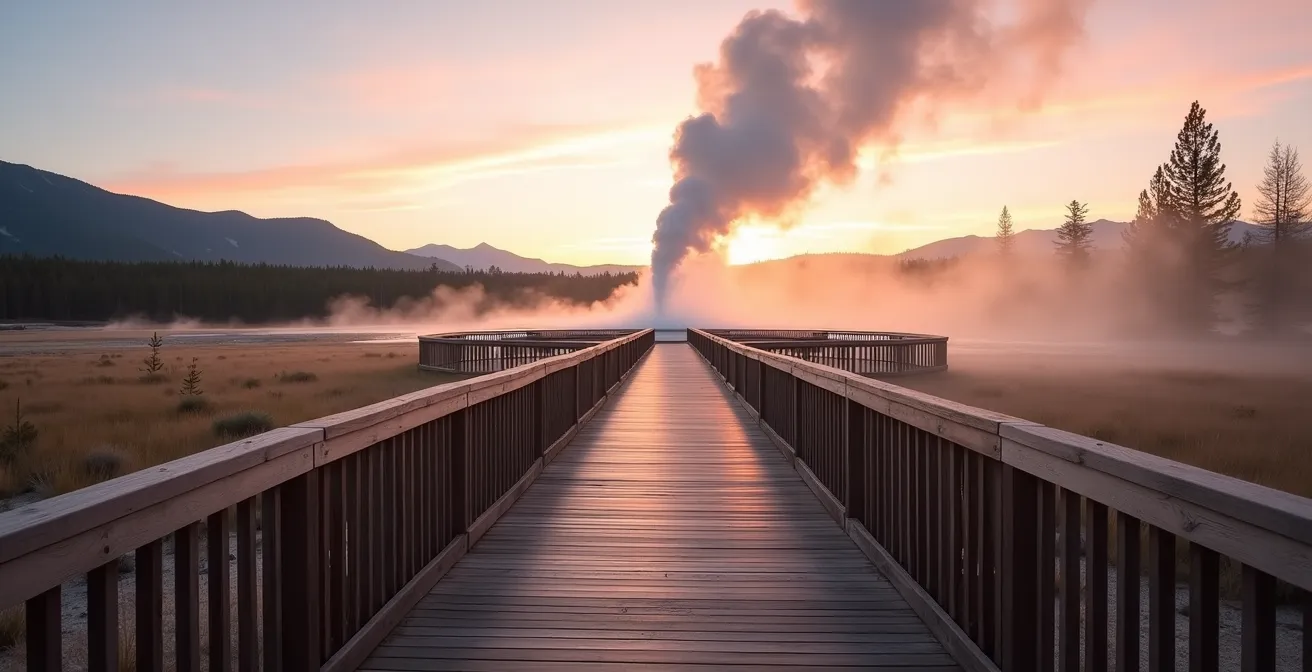
In summary:
- The greatest danger in Yellowstone is not wildlife, but the unstable ground of thermal areas. Treat every inch off the boardwalk as a potentially fatal hazard.
- To avoid crowds, plan lodging 13 months in advance to secure in-park rooms with private, crowd-free views of geysers.
- Effective wildlife safety means zero “scent contamination.” All scented items, not just food, must be stored in certified containers.
- Prioritize the Lower Loop for geysers and visit key sites at dawn or dusk to bypass the dense midday crowds.
Every year, millions are drawn to the otherworldly landscapes of Yellowstone, eager to witness the spectacle of geysers erupting and wildlife roaming free. This desire is often coupled with a tangible fear: fear of a dangerous encounter with a grizzly, a burn from a boiling hot spring, or simply being lost in a sea of tourists. For nature-loving families, the challenge is balancing this awe-inspiring experience with a genuine need for safety.
Most guides will offer the standard advice: stay on the boardwalks, keep your distance from animals, and book your trip well in advance. While correct, this advice only scratches the surface. It tells you the ‘what,’ but not the ‘why.’ As a ranger, I can tell you that true safety in an environment this wild doesn’t come from a checklist of rules you follow blindly. It comes from a deep, fundamental understanding of the forces at play here—the unforgiving physics of the park’s geothermal systems and the predictable biology of its inhabitants.
This guide is designed to give you that deeper knowledge. We will go beyond the platitudes to explain the hidden dangers, provide concrete strategies for securing the best lodging, and show you how to read the landscape and the clock to find moments of solitude. By understanding the ‘why’ behind the rules, you will be empowered to make smarter, safer decisions for you and your family, transforming your visit from a stressful rush into a respectful, unforgettable communion with nature.
To navigate this unique environment effectively, this article breaks down the essential knowledge you’ll need. The following sections cover everything from the unseen dangers of thermal basins to the precise strategies for booking and planning your visit to maximize safety and solitude.
Summary: A Ranger’s Manual to Safely Navigating Yellowstone’s Wonders
- Why Yellowstone’s Geothermal Features Are More Dangerous Than They Look?
- How to Book a Lodge in Yellowstone 12 Months in Advance?
- Upper Loop vs. Lower Loop: Which to Prioritize for a 2-Day Trip?
- The Food Storage Error That Attracts Grizzlies to Your Campsite
- When to Visit Lamar Valley to Guarantee Wolf Sightings?
- How to Dig for Real Fossils in Wyoming Legal Sites?
- Why the Old Faithful Inn Is the Largest Log Structure in the World?
- How to Book a Room at El Tovar on the Grand Canyon Rim?
Why Yellowstone’s Geothermal Features Are More Dangerous Than They Look?
Yellowstone’s geothermal areas are more dangerous than they appear because the ground is a deceptive, paper-thin crust over boiling, acidic water. This thermal instability means that what looks like solid earth can break under the weight of a person, leading to immediate and severe trauma. The danger is not abstract; it is the single greatest threat to visitor safety in the park.
The tragic case of Colin Scott in 2016 at Norris Geyser Basin is a stark reminder of this reality. He left the designated boardwalk, and the fragile ground gave way, leading to a fatal fall into a superheated, acidic spring. His story is a grim illustration of why the boardwalks are not suggestions; they are your only guaranteed safe passage. The numbers confirm this threat: according to USGS data, thermal features have caused more than 22 deaths since 1872, far exceeding the number of fatalities from bear encounters.
To truly grasp the danger, you must understand the geology beneath your feet. The ground here is a delicate layer of mineral deposit called sinter crust. It is formed over centuries as silica from the hot water precipitates at the surface. This crust can be as fragile as a pane of glass.
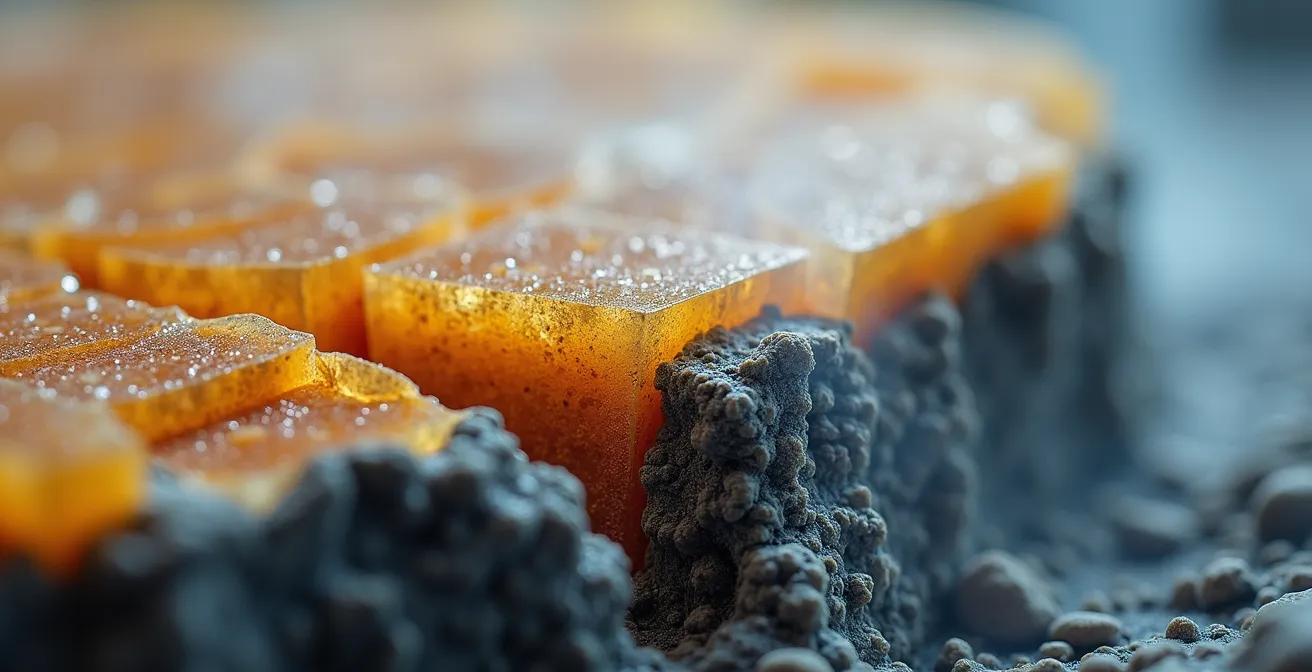
As this image illustrates, there is no solid earth just below the surface—only scalding water and steam. Stepping off the boardwalk is a gamble with physics, and the odds are not in your favor. This is the Zone of Danger. Respect it without exception.
How to Book a Lodge in Yellowstone 12 Months in Advance?
Securing a room inside Yellowstone, especially at sought-after locations like the Old Faithful Inn, is a competitive process that begins over a year in advance. The booking window opens on a rolling basis 13 months out. Specifically, on the 5th of each month, reservations for the entire same month of the following year become available. For example, on May 5, 2024, you can book any dates in May 2025.
Success requires a precise and timely strategy. The most coveted rooms are often booked within minutes of becoming available. Follow these steps to maximize your chances:
- Set a Calendar Reminder: Mark your calendar for the 5th of the month, 13 months before your desired travel month.
- Book Online at Midnight: The fastest method is booking online. Be ready to go on the Yellowstone National Park Lodges website precisely at 12:00 a.m. Mountain Time when the inventory is released.
- Call in the Morning: If you prefer to book by phone or missed the online window, phone lines open at 7:00 a.m. Mountain Time. The number is 888-297-2757.
- Utilize the “14th Month” Trick: If your stay begins in the 13th month, you are allowed to book up to four additional consecutive nights that extend into the 14th month, giving you a slight edge for longer stays.
- Check for Last-Minute Openings: Cancellations happen. It’s always worth calling the same-day reservation line at 307-344-7901, as rooms can become available unexpectedly.
This disciplined approach is not just about getting a room; it’s about securing a strategic advantage. A well-placed room can be your private sanctuary away from the crowds, offering unique viewing opportunities that day-trippers will never experience.
Upper Loop vs. Lower Loop: Which to Prioritize for a 2-Day Trip?
For any visitor with limited time, especially those focused on geysers, the answer is unequivocal: prioritize the Lower Loop. This southern portion of the park’s Grand Loop Road contains the highest concentration of geothermal features on the planet. If your goal is to see iconic geysers, vibrant hot springs, and bubbling mudpots, the Lower Loop is non-negotiable.
The numbers speak for themselves. Yellowstone Forever reports that the park contains more than 10,000 geothermal features, including over 500 geysers. The vast majority of these, including Old Faithful, Grand Prismatic Spring, and the Norris Geyser Basin, are located along the Lower Loop. The Upper Loop’s geothermal activity is primarily concentrated at Mammoth Hot Springs, which features travertine terraces rather than geysers.
This table breaks down the key differences to help guide your two-day plan:
| Feature | Lower Loop | Upper Loop |
|---|---|---|
| Geothermal Density | 90%+ of major features | Mammoth Hot Springs only |
| Key Attractions | Old Faithful, Grand Prismatic, Norris | Lamar Valley wildlife, Tower Falls |
| Crowd Levels | High (especially midday) | Moderate to Low |
| Best Time to Visit | Dawn/Dusk counter-flow | Any time of day |
| 2-Day Priority | Essential for geysers | Optional for wildlife |
Your strategy for a short trip should be to dedicate the entirety of your time to the Lower Loop. To beat the crowds, adopt a “counter-flow” approach: visit the most popular attractions like Old Faithful and Grand Prismatic at dawn or dusk. You will experience these wonders with a fraction of the midday visitors, allowing for a more profound and personal connection to the landscape.
The Food Storage Error That Attracts Grizzlies to Your Campsite
The most common and dangerous food storage error is assuming that “food storage” only applies to food. In reality, a grizzly bear’s sense of smell is so acute that it is attracted to *any* scented item. The critical mistake is leaving items like toothpaste, deodorant, sunscreen, or even chapstick unsecured. This creates scent contamination in your campsite, which acts as a powerful attractant for bears and other wildlife.
It’s important to understand that bears that become habituated to human food and scents often become aggressive and must be relocated or, in worst-case scenarios, euthanized. Proper storage is as much for their safety as it is for yours. While bears are a concern, it’s worth noting that other animals pose a risk; since 1872, two people have died from bison encounters in the park. Maintaining a safe distance from all wildlife is mandatory.
A 2021 incident where a loose dog jumped into a thermal feature highlights how even non-food events can attract wildlife due to commotion and unfamiliar smells. The principle is clear: minimize your sensory footprint. Anything with a smell, whether it’s a granola bar or a tube of lip balm, must be stored correctly.
Action Plan: IGBC-Compliant Bear-Proofing Your Campsite
- Use only Interagency Grizzly Bear Committee (IGBC)-certified bear-resistant containers. Standard coolers, plastic bins, or bags are not compliant and are easily defeated by bears.
- Store all scented items without exception. This includes all food, beverages, cooking utensils, toiletries (toothpaste, soap), and trash.
- Never leave food or scented items in your vehicle overnight. Bears can and do break car windows to get to a perceived food source.
- Position your food storage container, cooking area, and sleeping area in a triangle, with each point at least 100 feet from the others.
- If you see a bear in or near your campsite, do not confront it. Report the activity to a park ranger immediately by calling 307-344-2109.
Following these regulations is not optional. It is a strict requirement for camping in Yellowstone and is essential for preventing dangerous human-wildlife encounters. Your diligence protects you, the bears, and future visitors.
When to Visit Lamar Valley to Guarantee Wolf Sightings?
First, a critical point of clarification from a ranger’s perspective: there is absolutely no way to “guarantee” a wolf sighting. These are wild animals in a vast landscape. However, you can significantly maximize your probability by understanding their predictable patterns and behaviors. The key is timing and location.
Wolves are crepuscular, meaning they are most active during the low-light hours of dawn and dusk. This is when they hunt and travel. Midday is typically a time for rest, often in locations far from the road and out of sight. Therefore, your best chance for a sighting is to be in position in Lamar Valley at first light (around 5:30-7:30 a.m.) or as the sun sets (around 6:00-8:00 p.m.).
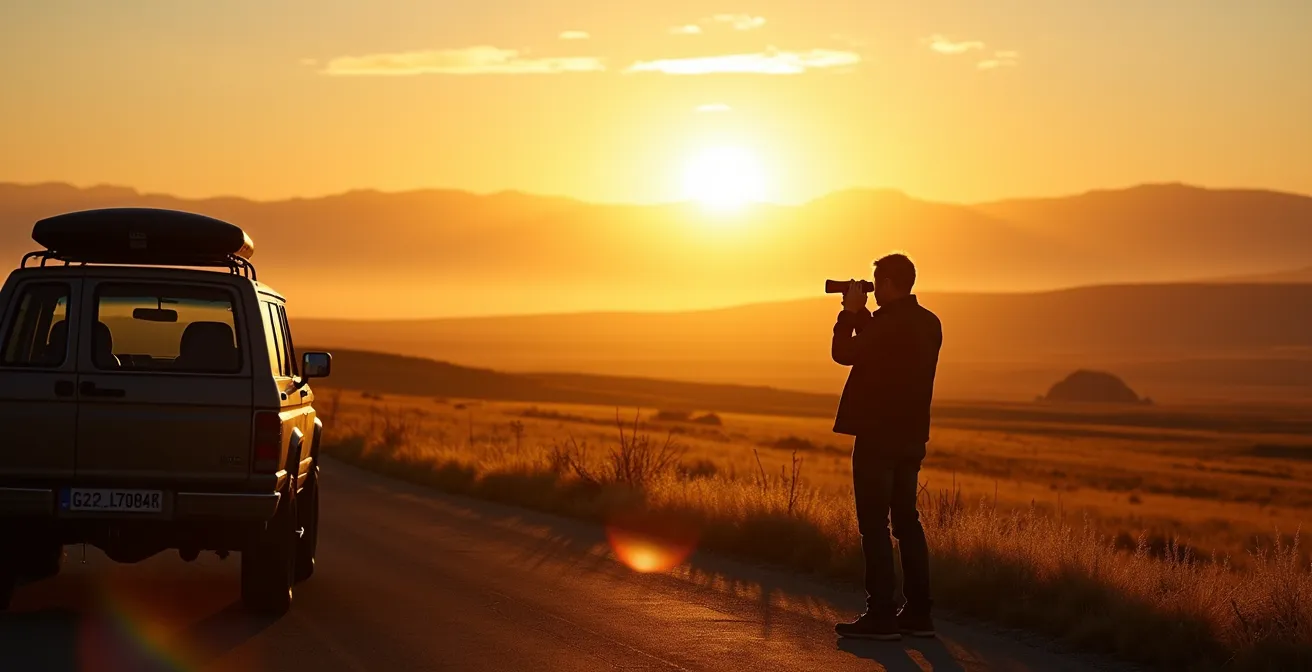
To further increase your odds, follow a professional strategy:
- Focus your search on the northern Lamar Valley, a known territory of the Junction Butte pack.
- Bring high-powered binoculars or a spotting scope. The mandatory distance for viewing wolves and bears is 100 yards. Good optics are essential to get a clear view without disturbing the animals.
- Check for recent sighting reports. The Lamar Buffalo Ranch Field Campus often has up-to-date information shared by researchers and other wolf-watchers.
- Consider hiring a local wildlife guide from Gardiner or Cooke City, Montana. These guides are in constant radio communication with each other and have an unparalleled understanding of the packs’ current movements.
Patience is your greatest asset. Find a safe pullout, turn off your engine, and scan the landscape. Watching wildlife is not a drive-thru experience; it is a waiting game that rewards those who are quiet, observant, and respectful.
How to Dig for Real Fossils in Wyoming Legal Sites?
A common question from visitors inspired by the region’s rich prehistory is whether they can hunt for fossils. It is critical to understand the legal distinction between park land and other areas. Inside Yellowstone National Park, the collection of any natural or archeological resource—including rocks, plants, and fossils—is strictly prohibited under federal law.
However, the state of Wyoming offers incredible opportunities for legal fossil digging on private land. The area around Kemmerer, Wyoming, is home to the world-renowned Green River Formation. This ancient lake bed from the Eocene epoch contains beautifully preserved fossils.
Several private quarries in this region operate as “fee-dig” sites, where you can pay a fee to spend the day splitting shale and discovering your own authentic fossils. This is a fantastic and educational activity for families, providing a hands-on connection to a deep history that long predates the park itself. The questions and answers in the FAQ section at the end of this guide provide more specific details on this activity.
Why the Old Faithful Inn Is the Largest Log Structure in the World?
The Old Faithful Inn holds the title of the world’s largest log structure due to the monumental scale of its original 1903-1904 construction. Designed by architect Robert Reamer, the Inn was conceived as a rustic yet grand hotel that would blend seamlessly with its wilderness setting. Its defining feature is the massive, seven-story lobby, built using local lodgepole pine logs and rhyolite stone.
The sheer volume of timber required, combined with the soaring height of the gabled roof and the intricate network of log railings and supports, established its status as a marvel of “parkitecture.” This was not just a building; it was a statement about creating man-made structures in harmony with nature. According to Xanterra, the park’s concessioner, its status as the largest log structure is a cornerstone of its National Historic Landmark designation.
Beyond its architectural significance, the Inn offers a powerful strategic advantage for visitors looking to escape the crowds. The Inn’s second-floor viewing deck provides what is arguably the best vantage point for watching Old Faithful erupt. This platform is positioned safely above and away from the packed boardwalks below. While hundreds gather at ground level for midday eruptions, guests of the Inn can often enjoy the spectacle from the balcony in relative peace, especially during the early morning or evening hours. Booking a room here is not just about convenience; it’s a tactic for a superior, crowd-free viewing experience.
Key Takeaways
- The number one threat to your safety is the fragile, boiling ground in thermal areas, not wildlife. Stay on the boardwalks without exception.
- True wildlife safety is about total scent control. All scented products, not just food, must be stored in IGBC-approved containers 100 feet from your tent.
- Strategic planning is everything. Booking lodges 13 months in advance and visiting popular sites at dawn or dusk are the keys to avoiding crowds.
How to Book a Room at El Tovar on the Grand Canyon Rim?
Booking a room at an iconic National Park lodge like El Tovar at the Grand Canyon follows the same disciplined, advance-planning strategy required for Yellowstone’s Old Faithful Inn. Xanterra confirms that iconic properties like both of these lodges can be booked up to 13 months in advance, and demand consistently outstrips supply. Understanding this system is key to staying at any premier park property.
The process is nearly identical, demonstrating a standardized approach for high-demand park lodging. Reservations open on the 5th of each month for the corresponding month of the following year. Success depends on being online or on the phone at the exact moment the inventory becomes available.
While the booking mechanics are the same, the experience you are reserving is different. The following table compares the two legendary lodges to help you understand what you are planning for:
| Feature | El Tovar (Grand Canyon) | Old Faithful Inn (Yellowstone) |
|---|---|---|
| Reservation Window | 13 months rolling | 13 months rolling |
| Booking Opens | 5th of each month | 5th of each month |
| Phone Number | 888-297-2757 | 888-297-2757 |
| View Type | Static canyon rim | Dynamic geyser activity |
| Peak Season | May-September | June-August |
Whether you’re aiming for a room overlooking the Grand Canyon’s majestic expanse or one with a view of an erupting geyser, the core lesson is universal: planning, precision, and punctuality are the tools you need. These are not typical hotel stays; they are reservations for a piece of history in the heart of America’s most treasured landscapes.
Now that you are equipped with the knowledge to plan a safe and rewarding visit, the final step is to put that plan into action. Begin by marking your calendar for the booking windows and preparing your itinerary today.
Frequently Asked Questions about Fossil Digging in Wyoming
Is fossil hunting legal in Yellowstone National Park?
No, collecting any natural objects including fossils is strictly prohibited in all national parks under the Paleontological Resources Preservation Act.
Where can I legally dig for fossils near Yellowstone?
Private fee-dig quarries in the Kemmerer area of Wyoming offer legal fossil hunting in the Green River Formation, located about 200 miles south of Yellowstone. This region contains 50 million year old Eocene-era fossils preserved in ancient lake bed shale.
What types of fossils are found in Wyoming’s Green River Formation?
The Eocene-era lake bed contains perfectly preserved fish fossils (most commonly Knightia and Diplomystus), insects, and a wide variety of plant specimens from approximately 50 million years ago.