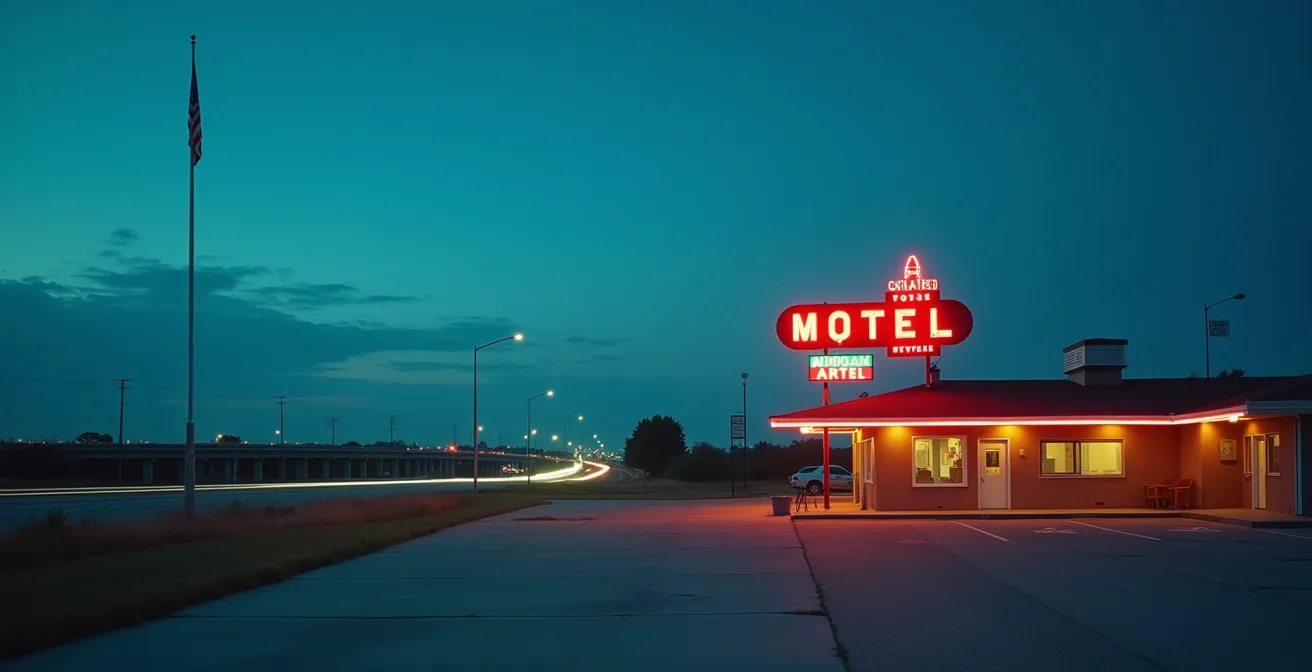
The key to finding a safe motel isn’t in the online reviews; it’s in learning to read the building’s story from the roadside in under five minutes.
- A well-maintained franchise often signals a safer, though less unique, stay due to the high cost of brand standards.
- The parking lot tells you everything: the types of vehicles, the pattern of oil stains, and the people present reveal the motel’s true clientele.
Recommendation: Before you even turn off the engine, perform a ‘vibe check’ on the parking lot. If you see more project cars than traveler cars, keep driving.
The glow of the digital dashboard reads 10 PM. You’ve been driving for eight hours, and the caffeine is wearing off. Up ahead, a lonely interstate exit sign promises “LODGING.” You pull off and see two options: a familiar, sterile-looking franchise and a flickering neon sign beckoning you toward “The Starlight Inn.” Your phone shows 3.5 stars for both. What do you do? Most travelers will scroll through vague online reviews. But a veteran road-tripper knows the truth isn’t on your screen; it’s right in front of you, written in the language of cracked pavement and fading paint.
The common advice is to stick to chains or trust your gut. But that misses the entire point of a road trip—the discovery, the character, the story. It also ignores a crucial skill: motel forensics. This is the art of reading the subtle, real-world clues that tell you whether a place is a hidden gem or a disaster waiting to happen. It’s about understanding the economic DNA of a property, from its corporate ownership down to the seams on its mattresses.
Forget the generic advice. This guide is built on decades of nights spent in places just like this. We’re going to bypass the noise of online ratings and focus on the signals that matter. You’ll learn the five-minute vibe check that can save you from a terrible night, how to dissect a room for safety, and when to splurge on nostalgia versus when to play it safe. This is how you find a good night’s sleep on the American road, the smart way.
This article breaks down the essential skills for any road warrior. From understanding the big picture of the motel industry to the micro-details of a room inspection, you’ll find a complete toolkit to travel with confidence. The following sections will guide you through this street-smart process.
Table of Contents: A Roadside Safety Manual
- Why Franchise Motels Are Replacing the Iconic Neon Signs?
- How to Inspect the Mattress Seams in Under 2 Minutes?
- Motel 6 vs. Super 8:How to Journal Your US Trip to Keep Memories Alive for 20 Years?
- The Parking Lot Mistake That Tells You to Keep Driving
- When to Start Looking for a Motel Before the ‘No Vacancy’ Signs Lit Up?
- Wigwam Motel vs. Blue Swallow: Where to Sleep for Peak Nostalgia?
- Downtown vs. Suburbs: Where to Stay in LA to Avoid 2 Hours of Traffic?
- How to Know if a ‘3-Star’ Hotel Is Actually Clean and Safe?
Why Franchise Motels Are Replacing the Iconic Neon Signs?
The first step in motel forensics is understanding the battlefield. Why do so many exits look the same, with a row of cookie-cutter franchises instead of unique, family-owned motor courts? The answer is simple: money. The economic DNA of a franchise motel is built on standardization, and that standardization is incredibly expensive. Major chains require owners to perform regular, costly renovations known as Property Improvement Plans (PIPs).
These aren’t just a new coat of paint. A PIP can mandate everything from the specific brand of mattress to the style of the lobby furniture. The costs are staggering and have been rising sharply. According to hotel industry analysis, there has been a more than 30% increase in PIP costs since pre-COVID levels. For example, the “Formula Blue” renovation for a Holiday Inn Express can cost an owner anywhere from $10,000 to $25,000 per room.
This financial pressure is what’s killing the iconic neon-lit independent motel. An independent owner, faced with a leaking roof and a broken ice machine, may not have the capital for a full aesthetic overhaul. A franchise owner, however, is contractually obligated to keep the property up to brand standards. While this often leads to a less soulful experience, it also acts as a baseline guarantee of investment. A freshly renovated franchise motel is a sign that money is flowing, which often correlates with better maintenance, security, and cleanliness. The classic neon sign might be pure Americana, but the boring corporate logo often signals a safer bet for a tired traveler.
How to Inspect the Mattress Seams in Under 2 Minutes?
You’ve chosen a motel, you’ve got the key, and you’ve walked into the room. Before you drop your bags and collapse, the most critical part of your motel forensics begins: the bed bug inspection. It takes less than two minutes and can save you from a trip-ruining nightmare. The rookie mistake is just pulling back the comforter. A veteran knows to go straight for the seams.
Bed bugs are a real and persistent problem on the road; in fact, industry data shows that nearly 68 percent of pest professionals report finding bed bugs in hotels and motels. Don’t be part of that statistic. Start by placing your luggage in the bathroom, on the tile floor or in the tub—the safest place until you’ve cleared the room. Then, head to the bed.
Using your phone’s flashlight, systematically pull back the sheets and blankets at each corner of the bed. Your target is the mattress itself. Look for tiny, ink-colored stains on the mattress seams, the tags, and along the box spring. These are the tell-tale signs. You should also lift the mattress at the corners and check the box spring underneath. Take a quick look behind the headboard if it’s not bolted to the wall. If you see anything suspicious—or any live bugs—walk out immediately and demand a different room or a full refund. This two-minute drill should be a non-negotiable ritual at every single stop.
Motel 6 vs. Super 8: How to Journal Your US Trip to Keep Memories Alive for 20 Years?
Let’s be honest: many nights on a long road trip won’t be spent in a charming, historic motor lodge. They’ll be in a functional but forgettable Motel 6 or Super 8 off the highway. But “forgettable” is a choice. A true road warrior knows that even the most mundane stop is part of the journey’s fabric. The key is not just to sleep there, but to *see* it. This is where journaling comes in—not as a diary of your feelings, but as a forensic record of your journey.
The goal is to capture the specific, tangible details that make each place unique, even in its uniformity. This practice transforms a generic stay into a textured memory. Instead of just writing “Stayed at a motel in Nebraska,” you create a rich snapshot. Think of it as collecting evidence of your time there. This isn’t about writing prose; it’s about observation.

Start a small collection of ephemera: the paper wrapper from the plastic cup, the “Do Not Disturb” sign, a matchbook, or the local pizza place’s menu that was slipped under your door. In your journal, make specific notes. What was the design of the plastic room key? What was the brand of the terrible in-room coffee? What were the specific sounds—the hum of the ice machine, the rhythm of trucks on the interstate, the clank of the pool filter? Sketch the shape of the building or the layout of the room. Twenty years from now, these sensory details will transport you back far more powerfully than a generic photo ever could.
The Parking Lot Mistake That Tells You to Keep Driving
This is the most important lesson a road-tripper can learn: the story of a motel is written in its parking lot. Before you even think about getting a room, perform the 5-Minute Vibe Check from the driver’s seat. Your goal is to differentiate between the signal and the noise. The “noise” is the star rating on your app; the “signal” is the reality on the asphalt.
The biggest mistake is assuming a full parking lot is a good sign. You need to look at the *type* of vehicles. A healthy motel has a mix of cars with out-of-state plates, a few rental cars, and maybe a family minivan. It shows a high turnover of actual travelers. The warning sign is a lot full of local plates, unmarked work vans, and cars that clearly haven’t moved in weeks—some with flat tires, covered in tarps, or sitting in pools of old oil. This indicates the motel is functioning more as a temporary residence or low-income housing, which can sometimes bring a different set of safety concerns. A Nevada motel that was once a crime hotspot had its problems drastically reduced after a change in management, but before that, a look at the lot would have told the whole story, with data showing a staggering 303 crime reports filed over a ten-year period when it was a magnet for trouble.
The following table, based on advice from seasoned travelers, breaks down what to look for. This is your cheat sheet for reading the parking lot like a pro.
| Safety Indicator | Good Signs | Warning Signs |
|---|---|---|
| Vehicle Types | Mix of out-of-state tourist plates, newer vehicles, semi-trucks at truck stops | Concentration of unmarked work vans, vehicles with flat tires or covered by tarps |
| Parking Lot Occupancy | 30-75% full after 8pm | Nearly empty or completely full with same vehicles daily |
| Oil Stains | Fresh, varied stains across different spots (high turnover) | Old, concentrated stains in same spots (low turnover/abandoned vehicles) |
| People Present | Travelers loading/unloading luggage, families | Groups loitering without purpose, long-term residents visible |
When to Start Looking for a Motel Before the ‘No Vacancy’ Signs Lit Up?
Knowing *what* to look for is half the battle; knowing *when* to look is the other half. Pulling off the interstate at 11 PM to find every motel booked is a rookie mistake that can lead to sleeping in your car or settling for a truly questionable establishment. The right time to start your search depends entirely on where you are in the United States.
The density of lodging varies dramatically by region. In the densely populated Northeast Corridor (I-95 between Boston and D.C.), you can often wait until you’re hungry for dinner to start looking. Options are plentiful, and competition keeps prices reasonable. But apply that same logic to the great American West, and you’re in for a rough night. On long, lonely stretches of I-80 in Wyoming or I-10 in West Texas, towns with motels can be 50 to 100 miles apart. Here, the rule is to start actively searching at least two hours before sundown. This gives you time to assess your options and backtrack to a better one if your first choice doesn’t pass the parking lot test.
Another critical factor is local events. Always do a quick search for the “chamber of commerce” or “events calendar” for the counties you’ll be passing through. A small-town county fair, a regional sports tournament, or a high school graduation can book every room within a 50-mile radius. Finally, if you’re aiming for a specific retro or independent motel that doesn’t have online booking, the best time to call for availability is between 3 PM and 4 PM. This is usually after check-out is complete and before the evening check-in rush, giving you the clearest picture of what’s available.
Wigwam Motel vs. Blue Swallow: Where to Sleep for Peak Nostalgia?
Sometimes, you’re not just looking for a safe place to sleep; you’re hunting for an experience. Along historic roads like Route 66, some motels are destinations in themselves. But even here, “nostalgia” isn’t a monolith. Two of the most famous stops, the Wigwam Motel and the Blue Swallow Motel, offer radically different versions of the past. Choosing between them means deciding what kind of nostalgia you’re paying for—what I call the “Nostalgia Tax.”
These places are the survivors of a bygone era. The golden age of the American motel has long passed; Smithsonian magazine reports a drastic decline from 61,000 motels operating in 1964 to just 16,000 in 2012. The ones that remain, especially the icons, have to be labors of love. The Wigwam Motel in Holbrook, Arizona, is all about architectural novelty. You sleep in a concrete teepee. It’s a fantastic photo opportunity and a unique experience, but the interiors are relatively simple. You’re paying the nostalgia tax for the structure itself.
The Blue Swallow in Tucumcari, New Mexico, is different. It offers a complete time-capsule immersion. Here, the experience is about authenticity. The rooms are filled with period-correct furnishings, the classic neon sign is a work of art, and each room has its own attached garage, a classic feature of 1940s motor courts. The owners often act as historians, preserving not just a building but an entire way of traveling. The choice between them comes down to your personal travel style.
| Feature | Wigwam Motel (Holbrook, AZ) | Blue Swallow (Tucumcari, NM) |
|---|---|---|
| Experience Type | Architectural novelty – sleep in iconic teepee structure | Complete 1940s motor court time capsule |
| Key Appeal | Unique structure, Instagram-worthy exterior | Authentic period furnishings, attached garages |
| Neon Sign | Simple repeating ‘Wigwam Motel’ emphasizing form | Elaborate script with ‘100% Refrigerated Air’ tagline |
| Ownership Style | Preserved landmark | Passionate long-term owners act as historians |
| Best For | Novelty seekers, architecture enthusiasts | History buffs, authentic vintage experience |
Downtown vs. Suburbs: Where to Stay in LA to Avoid 2 Hours of Traffic?
The principles of motel forensics don’t just apply to lonely highways; they are crucial in complex urban jungles like Los Angeles. Choosing where to stay in LA isn’t about finding the ‘best’ neighborhood; it’s a strategic calculation to defeat the city’s number one enemy: traffic. A cheap motel in the “wrong” suburb can cost you hours of your day and a fortune in gas, completely negating the savings.
The key is to think in terms of “reverse commutes” and “hub locations.” If your trip is focused on beach activities, staying downtown is a logistical nightmare. Instead, choose a motel on the west side, in a place like Santa Monica or Culver City. If your plans are centered around Hollywood or downtown museums, plan those excursions for the middle of the day (roughly 10 AM to 3 PM), avoiding the brutal 8 AM and 5 PM rush hours that can turn a 10-mile drive into a 90-minute ordeal.
A smart road-tripper calculates the true cost of their lodging. Don’t just compare the nightly rates. Your formula should be: (Suburban Motel Price + Daily Gas Cost + ($20 x Hours Spent in Traffic)) vs. (Pricier but Central Motel Price). Often, the more expensive, better-located option is actually cheaper. Consider using suburbs as strategic hubs: Burbank is great for exploring studio tours and the Valley, while Torrance offers a less-crowded base for accessing the South Bay beaches. When in doubt about traffic patterns, book multiple refundable options across the city and make your final decision a day or two before you arrive, once your daily itinerary is clearer.
Key Takeaways
- Trust the Parking Lot: The types of cars, their condition, and the people present are the most reliable indicators of a motel’s true character.
- Master the 2-Minute Room Check: Always inspect mattress seams and behind the headboard for signs of bed bugs before bringing your luggage in.
- Understand the Economics: A clean, modern franchise is often a safer bet than a run-down independent simply because of the high cost of brand standards.
How to Know if a ‘3-Star’ Hotel Is Actually Clean and Safe?
The star system is one of the most misleading metrics in the travel industry. A “3-star” rating can mean anything from a sparkling clean, well-managed property to a place that hasn’t been properly updated since the 1990s. To truly know if a hotel is clean and safe, you need to combine your on-site forensic skills with some savvy digital detective work. This is the final step where you synthesize everything you’ve learned.
Before you even book, go beyond the star rating. Your first stop should be the hotel’s recent traveler photos on Google Maps or TripAdvisor. Compare these candid shots with the hotel’s own glossy professional photos. Are the carpets worn? Is the furniture chipped? This gives you the ground truth. Next, read the reviews, but do it like a pro: ignore the 5-star raves and the 1-star rants. The most useful information is in the 3-star reviews, where people tend to be more balanced. Crucially, focus on management’s responses to negative reviews. A generic, copied-and-pasted apology is a red flag. A specific response that says “We have addressed the issue with the leaky faucet in Room 204” shows they are engaged and accountable.
Bed bugs are a major financial liability for hotels—according to Orkin’s hospitality industry report, bed bug incidents cost an average of $6,383 per incident, a figure that incentivizes reputable places to be vigilant. You can leverage this by checking public health records. Many counties, like Los Angeles and New York City, have public online databases where you can look up health inspection reports for hotels. This is an indisputable source of information on cleanliness and safety violations.
Action Plan: Your Final Safety Verification
- Public Records Check: Search for the hotel’s name in county health department databases (e.g., LA County’s ‘EH E-Lookup’ or NYC’s letter grades) for official violations.
- Review Analysis: Read 3-star reviews and focus specifically on how management responds to complaints. Specific actions are a good sign; generic apologies are not.
- Photo Comparison: Compare the hotel’s professional website photos with recent traveler-submitted photos on Google Maps to spot discrepancies in condition and cleanliness.
- Floor Request: When checking in, request a room on a floor between 2 and 5. This avoids the higher theft risk of the ground floor and potential fire ladder access issues of floors higher than the 6th.
- In-Room Physical Audit: Perform the 2-minute mattress seam inspection for bed bugs and check that all locks (door and window) are functional before unpacking.
By learning to read the signs—from the economics of the industry to the oil stains in the parking lot—you transform from a hopeful tourist into a savvy, confident traveler. You’re no longer at the mercy of misleading reviews or a roll of the dice. You have the tools to make smart, safe decisions and ensure that every night on the great American road is a good one. Now, get out there and explore.