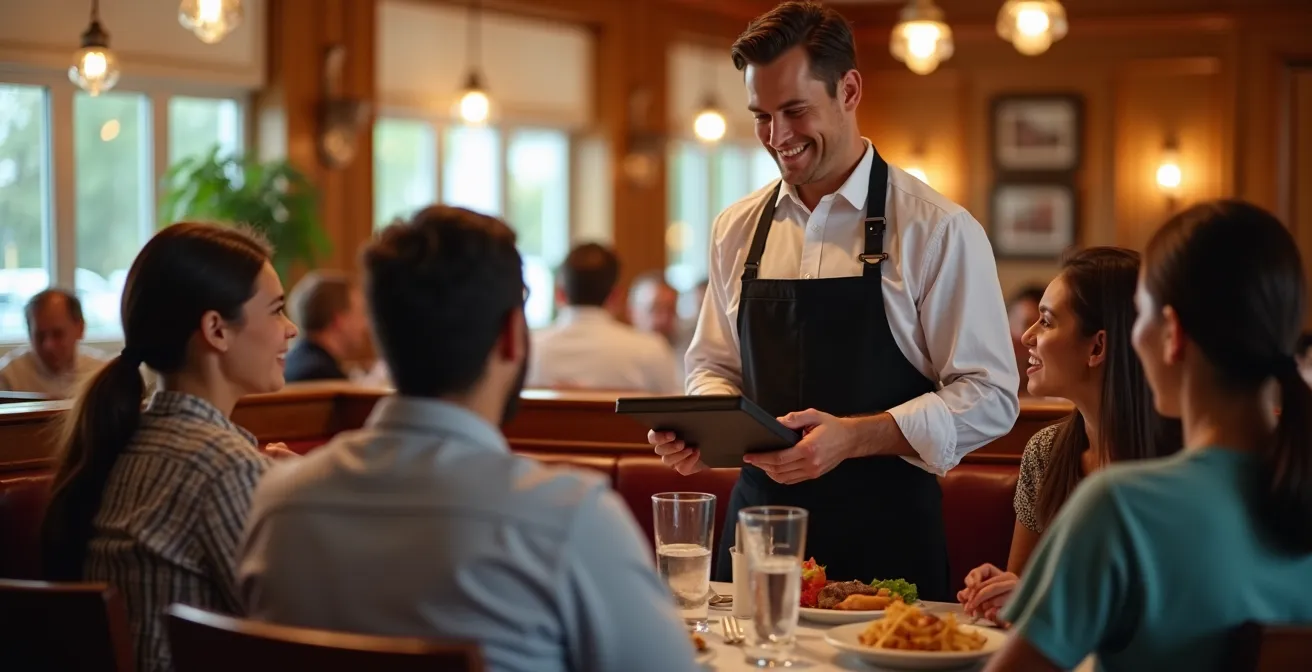
The core mistake visitors make is treating a tip as a ‘bonus’; in the US, it’s a direct wage payment that makes up the bulk of a server’s income.
- The federal minimum wage for tipped workers is just $2.13/hour, and your tip makes up the rest of their salary.
- Defaulting to the 20% option on a payment tablet for simple counter service is an unnecessary expense; tipping is not required in these situations.
- Confusing “service charges” with tips can lead to you either not tipping your server at all or tipping twice.
Recommendation: Always calculate your tip based on the pre-tax subtotal of the bill, and when in doubt about a fee, ask your server directly: “Does this charge go to you?”
For international visitors, the American tipping system feels like a chaotic minefield of unwritten rules, social anxiety, and financial uncertainty. You’re handed a bill, and suddenly you’re faced with a dozen questions. Do I tip on the tax? Is 15% an insult? What does this “service charge” mean? The fear of offending your server is matched only by the fear of accidentally overpaying by a huge margin. Most guides give you the same generic advice: “tip 15-20%.” This is unhelpful. It tells you the ‘what’ but ignores the crucial ‘why’ and ‘how’.
But what if the key wasn’t memorizing a hundred different rules, but understanding one single principle? The American tip is not a simple ‘thank you’ for good service. It is the primary component of the service worker’s salary. Once you internalize this financial reality, every decision becomes clearer. This isn’t just an etiquette guide; it’s a financial playbook from a service industry veteran to help you navigate the US service economy with confidence. You’ll learn how to pay your server fairly, identify and avoid hidden “tip traps,” and know exactly when it’s appropriate to tip—and when it’s not.
This article will break down the essential scenarios you’ll encounter. We’ll start by explaining the economic system that makes tipping mandatory, then move to practical calculations at restaurants, decoding service styles, navigating coffee shop payment screens, and tipping protocols for hotels and even food trucks. Get ready to finally master American tipping.
Summary: Your Guide to American Tipping Etiquette
- Why Your Waiter Makes $2.13 an Hour Before Tips?
- How to Tip on Tax and Alcohol vs. the Subtotal?
- American ‘Hovering’ vs. European ‘Privacy’: Which Service Style Is Better?
- The Tablet Mistake at Coffee Shops That Costs You 20% Extra
- When and How Much to Tip Housekeeping for a 3-Night Stay?
- The Tipping Mistake That Will Offend Your Waiter Immediately
- The ‘Service Charge’ Trap That Adds 30% to Your Ticket Price
- How to Order from a Food Truck Like a Pro in a 20-Person Line?
Why Your Waiter Makes $2.13 an Hour Before Tips?
The most important concept for any visitor to understand is the “tip credit” system. In many parts of the United States, employers are legally allowed to pay their tipped employees a sub-minimum wage, with the expectation that tips will bring their total earnings up to at least the standard minimum wage. The reality is that the federal tipped minimum wage of $2.13 per hour hasn’t changed since 1991. Your tip isn’t a bonus; it’s the server’s salary for the work they just did.
Case Study: The Tale of Two Servers
The system creates huge income disparities. In Arizona, a state with strong worker protections, a server might earn a base wage of $10.85 per hour before tips. Meanwhile, a server doing the exact same job in Virginia could be earning just the federal minimum of $2.13 per hour, with their employer claiming a “tip credit” of nearly $10 to meet the state’s minimum wage. This means the Virginia server is almost entirely dependent on your gratuity to make a living wage.
This system isn’t uniform across the country, which adds to the confusion. Some states mandate a higher tipped wage, and a handful of states have eliminated the tip credit system altogether, requiring employers to pay all staff the full state minimum wage before tips. This patchwork of laws is why a universal “tipping rule” is impossible.
To help you understand this landscape, here’s a breakdown of how different states approach tipped wages, based on data from the Pew Research Center.
| State Category | Number of States | Minimum Cash Wage | Example States |
|---|---|---|---|
| Federal Standard ($2.13) | 14 states | $2.13/hour | Texas, Tennessee, Georgia |
| Higher than Federal | 17 states + DC | $2.13-$10.85 | New York ($10.85), Illinois ($7.80) |
| No Tip Credit Allowed | 7 states | Full minimum wage | California, Washington, Oregon |
Ultimately, unless you’re in one of the seven states that guarantee a full minimum wage, you must assume your server relies on your tip to live.
How to Tip on Tax and Alcohol vs. the Subtotal?
Now for the practical math at the dinner table. The rule is simple: you tip on the service provided, not on the tax collected by the government. On your bill, you will see a “subtotal” (the cost of your food and drinks) and a “total” (the subtotal plus sales tax). You should always calculate your tip based on the pre-tax subtotal. Tipping on the final total means you’re giving a percentage of the sales tax back to the server, which is unnecessary.
Here is a quick method for calculating a standard 20% tip, which is considered a good tip for good service in most US cities:
- Find the pre-tax subtotal on your receipt.
- Move the decimal point one place to the left. This gives you 10%.
- Double that amount. That’s your 20% tip.
For example, if your subtotal is $84.00, moving the decimal gives you $8.40 (10%). Doubling that gives you a $16.80 tip (20%). In major cities like New York or Los Angeles where sales tax is high (around 9-10%), a common shortcut is to simply find the tax amount on the bill and double it. This will get you to an 18-20% tip very quickly.
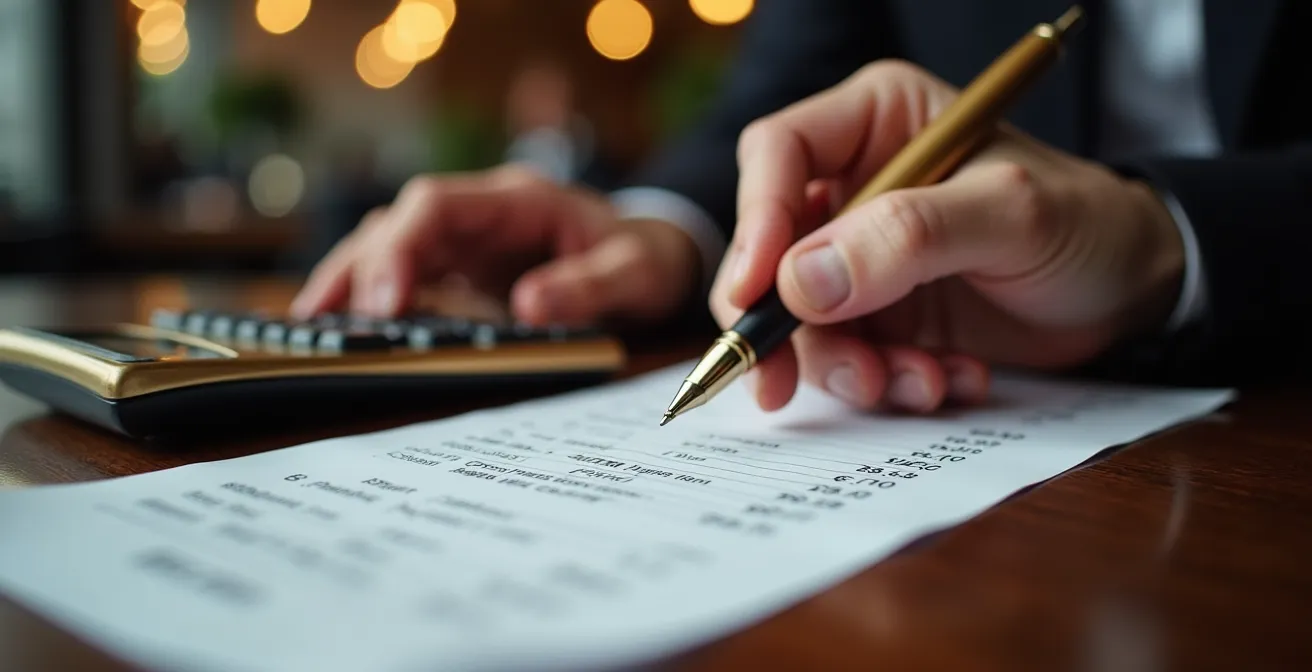
The one exception to this rule involves very expensive alcohol. If you order a $500 bottle of wine, the server provides the same service (opening and pouring) as they would for a $50 bottle. In this scenario, it’s customary to tip 18-20% on the food portion of the bill but a lower percentage, perhaps 5-10%, on the expensive bottle of wine.
By following this method, you ensure you’re paying the server fairly for their work without unnecessarily inflating the cost.
American ‘Hovering’ vs. European ‘Privacy’: Which Service Style Is Better?
Many European visitors are taken aback by what they perceive as “hovering” from American servers. Your waiter may check on you frequently, refill water glasses obsessively, and present the bill sooner than you’d expect. In contrast, in many European restaurants, diners must actively flag down a server for service. Neither style is inherently “better”; they are the direct results of two different economic models.
In Europe, most servers are salaried employees. Their income is stable and not directly tied to the number of tables they serve in a night. The incentive is to provide a pleasant, leisurely experience. They give you privacy because there is no economic pressure to do otherwise.
The Economics of ‘Table Turns’
In the United States, a server’s income is almost entirely dependent on tips. Therefore, their goal is to maximize their earnings per shift. This is achieved through “table turns”—serving as many different parties (tables) as possible. As an analysis of restaurant economics shows, more table turns directly translate to higher income. The “hovering” you experience is a server’s strategy to be attentive, anticipate your needs, and efficiently move you through the dining process so they can seat the next paying customers. It’s not rudeness; it’s a business calculation.
Understanding this removes the cultural friction. The American server isn’t trying to rush you out of personal impatience. They are operating under a system that financially incentivizes speed and efficiency. When you see their attentiveness through this economic lens, you can appreciate it as part of the service you are tipping for, rather than an intrusion on your privacy.
So, the next time a server asks “how is everything?” for the third time, you’ll know it’s not just a cultural quirk—it’s a key part of how they earn their living.
The Tablet Mistake at Coffee Shops That Costs You 20% Extra
One of the most awkward modern tipping scenarios is the checkout tablet at a coffee shop or counter-service eatery. The barista turns a screen towards you with large, pre-selected tip options: 18%, 20%, 25%. With a line of people behind you, the pressure to quickly tap a button—any button—is immense. This phenomenon, often called “tip-flation” or “guilt tipping,” is widespread; a 2023 Pew Research survey found that 72% of Americans report being asked to tip more frequently, often through these digital prompts.
Here’s the veteran’s advice: tipping is not required for standard counter service. If you order a simple drip coffee or a pastry, and the only service is the cashier taking your payment, you are not obligated to tip. The pre-selected 20% option is a nudge from the payment software, not a reflection of social expectation.
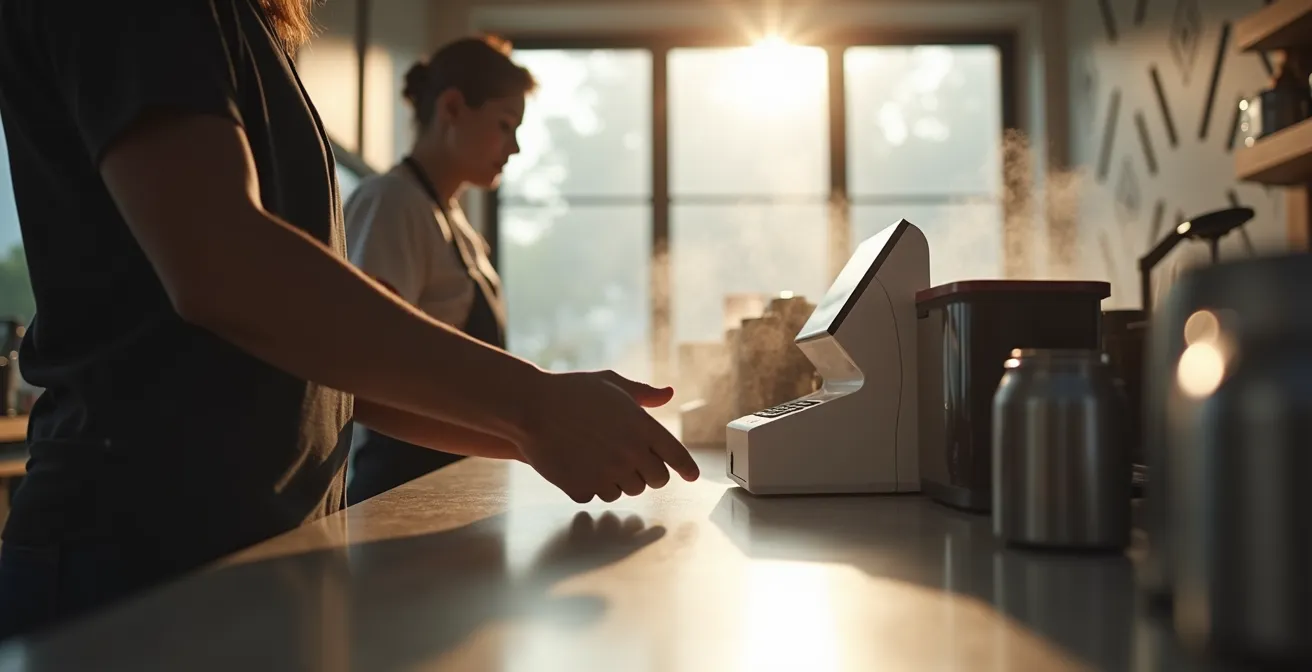
Your best tool is the “Custom Amount” button. Get comfortable using it to enter “$0” or “$1” with confidence. A dollar is a perfectly acceptable and appreciated tip for a well-made specialty drink like a complex latte that requires multiple steps. Defaulting to 20% on a $5 coffee is the mistake that costs you extra. Tipping should be reserved for service that goes beyond the basic transaction, such as a barista who makes a complicated drink, handles a large group order, or provides helpful recommendations.
Don’t let social pressure dictate your spending. For a simple transaction, a tip is a kind gesture, not an obligation, no matter what the tablet suggests.
When and How Much to Tip Housekeeping for a 3-Night Stay?
Housekeepers are the least tipped service providers and arguably work the hardest
– Jaunty Everywhere, Travel Guide to Tipping in the USA
Unlike a server, your hotel housekeeper is an almost invisible service provider, making them easy to forget. However, their work is physically demanding, and they are among the lowest-paid workers in the hospitality industry. Tipping them is a crucial part of American travel etiquette.
The most common mistake travelers make is leaving a single tip at the end of their stay. Housekeeping staff often work in shifts and may change daily. The person who cleaned your room on Monday might not be the same person working on Wednesday. To ensure your gratuity goes to the person who did the work, you must tip daily.
The standard amount is $3-5 per day for a standard hotel room. Leave the cash in an obvious place each morning, such as on the pillow or the nightstand. It’s a good practice to use the envelope provided by the hotel or leave a short note that says “Thank you, Housekeeping” with the cash. This prevents any confusion and ensures the staff knows the money is for them. If your room requires extra work—for instance, if you have messy children, hosted a small get-together, or requested multiple extra towels—it is appropriate to increase the tip to $10 for that day to compensate for the additional labor.
A few dollars a day is a small cost for you but makes a significant difference to the hardworking staff cleaning your room.
The Tipping Mistake That Will Offend Your Waiter Immediately
In the US service culture, a tip is a direct financial signal. A good tip (20%+) signals “great job.” An average tip (15%) signals “everything was fine.” But a low tip (5-10%) or a zero tip sends a powerful, and often offensive, message: “you failed at your job.” Leaving a very low or zero tip without any explanation is the single fastest way to cause an awkward, and sometimes confrontational, situation.
Because servers depend on tips for their income, they interpret a near-zero tip not as a sign of a frugal customer, but as a direct personal and financial insult. In some cases, a server may even approach your table and ask if something was wrong with the service. For an international visitor, this can be a mortifying experience. You are not just being “cheap”; you are actively withholding someone’s expected salary.
So, what do you do if the service was genuinely terrible? The culturally appropriate way to handle it is not to leave nothing. A zero tip is ambiguous—were you unhappy, or did you just forget or not understand the custom? The correct approach involves communication and a deliberate, but not insulting, tip reduction.
Action Plan: Handling Poor Service
- Address Issues Immediately: If your food is cold or your order is wrong, politely bring it to your server’s attention during the meal. This gives them a chance to fix it.
- Escalate to a Manager: If the server is unresponsive or rude, ask to speak with a manager while you are still at the table. Explain the situation calmly and professionally.
- Reduce, Don’t Eliminate: For poor service, the accepted signal is to reduce the tip to 10-12%. This clearly communicates dissatisfaction without being a complete financial blow.
- The Deliberate Signal: For truly abysmal service where management was also unhelpful, leaving a single dollar or two in cash is a deliberate and unmistakable signal of extreme displeasure.
- Provide Context: When you reduce a tip significantly, it is best practice to have already explained your reasoning to a manager. This directs the feedback to the person who can address it systemically.
Remember, your tip is a form of communication. A silent, zero tip is the equivalent of a loud, public insult.
The ‘Service Charge’ Trap That Adds 30% to Your Ticket Price
As if tipping wasn’t confusing enough, many restaurants now add various extra fees to the bottom of the bill. These can be labeled “Service Charge,” “Living Wage Fee,” or “Kitchen Appreciation.” The critical mistake is assuming these fees are a tip for your server. In most cases, they are not.
This is a trap that can cause you to either undertip your server (thinking you’ve already tipped) or overpay significantly (tipping 20% on top of an 18% charge). The names are intentionally vague. A “Living Wage Fee” might go towards higher back-of-house pay, and a “Service Charge” could be used by the restaurant to cover credit card processing fees. Your server may see none of it.
The only way to navigate this is to ask. When you see an unfamiliar charge on your bill, call your server over and ask the key question: “Does this service charge go directly to you?” Their answer will tell you exactly what to do next. An “automatic gratuity,” common for large parties of 6 or more, is usually the tip, and no additional gratuity is needed unless service was truly exceptional.
This table breaks down the common charges you might see and how to handle them.
| Charge Type | Typical Amount | Goes to Server? | Additional Tip Needed? |
|---|---|---|---|
| Automatic Gratuity | 18-20% | Yes | No (unless exceptional service) |
| Service Charge | 3-5% | Maybe | Ask – usually yes, add 15-20% |
| Living Wage Fee | 3-5% | No (goes to kitchen/benefits) | Yes, full 15-20% tip expected |
| Kitchen Appreciation | 2-3% | No | Yes, full tip for server |
Never assume a fee is a tip. Always verify with your server to ensure they are being compensated for their work.
Key Takeaways
- Tipping in the US is not a bonus; it’s a wage system. Your tip is the server’s primary income.
- Always calculate your tip on the pre-tax subtotal. A quick method is to double the tax amount for an ~18-20% tip.
- Never leave a zero tip for poor service without speaking to a manager. A 10-12% tip is the correct signal for dissatisfaction.
How to Order from a Food Truck Like a Pro in a 20-Person Line?
Food trucks represent a more casual dining experience, but they come with their own fast-paced etiquette, especially when there’s a long line. The entire system is built for speed and efficiency. The key to ordering like a pro is to be prepared. Most food trucks post their menus on their social media pages, like Instagram. Your first step is to decide what you want while you’re waiting in line, not when you get to the window.
When you reach the order window, the protocol is simple: state your order clearly, pay as quickly as possible, and then immediately step aside. Many trucks operate on a two-window system: one for ordering and one for pickup. Lingering at the order window after paying holds up the entire line and disrupts the flow. Find the designated waiting area for pickups and listen for your name or number to be called.
Tipping at food trucks is expected but the standard is different from sit-down restaurants. A full 15-20% is not necessary. The norm is to drop $1-2 in the tip jar or round up your payment to the nearest dollar. This acknowledges the work of the person taking your order and preparing your food. However, if you have a large or complicated order for a group, tipping closer to 10% is a good rule of thumb. For simple takeout or pickup orders where minimal service is provided, a tip is a nice gesture but generally not required.
By mastering this financial playbook, you can move beyond the anxiety of tipping and simply enjoy your travels, confident that you are navigating the system fairly and correctly.
Frequently Asked Questions About US Tipping
Should I tip for a simple black coffee at the counter?
No tip is required for counter service where you order and pick up yourself. However, a dollar or spare change is appreciated if service was exceptional.
When should I tip more at a coffee shop?
Tip $1-2 for complex drinks requiring multiple steps (specialty lattes), when ordering for a group, or if the barista provides recommendations and remembers your usual order.
How do I handle the tablet pressure with people behind me?
Use the ‘Custom Amount’ button confidently. For counter service, entering $0 or $1 is completely acceptable despite the 18%, 20%, or 25% default options shown on the screen.
Is tipping expected at food trucks?
Yes, but less than at sit-down restaurants. The norm is $1-2 per order or rounding up your total to the nearest dollar, not the standard 15-20%.
What if there’s a tip jar but no table service?
For food trucks and counter service stands, tipping around 10% is an accepted practice for any food service that goes beyond a simple fast-food chain transaction.
Should I tip more for specialty food trucks?
Yes, for gourmet or specialty food trucks that involve complex food preparation, it’s considerate to tip closer to 15% to acknowledge the skill and effort involved.