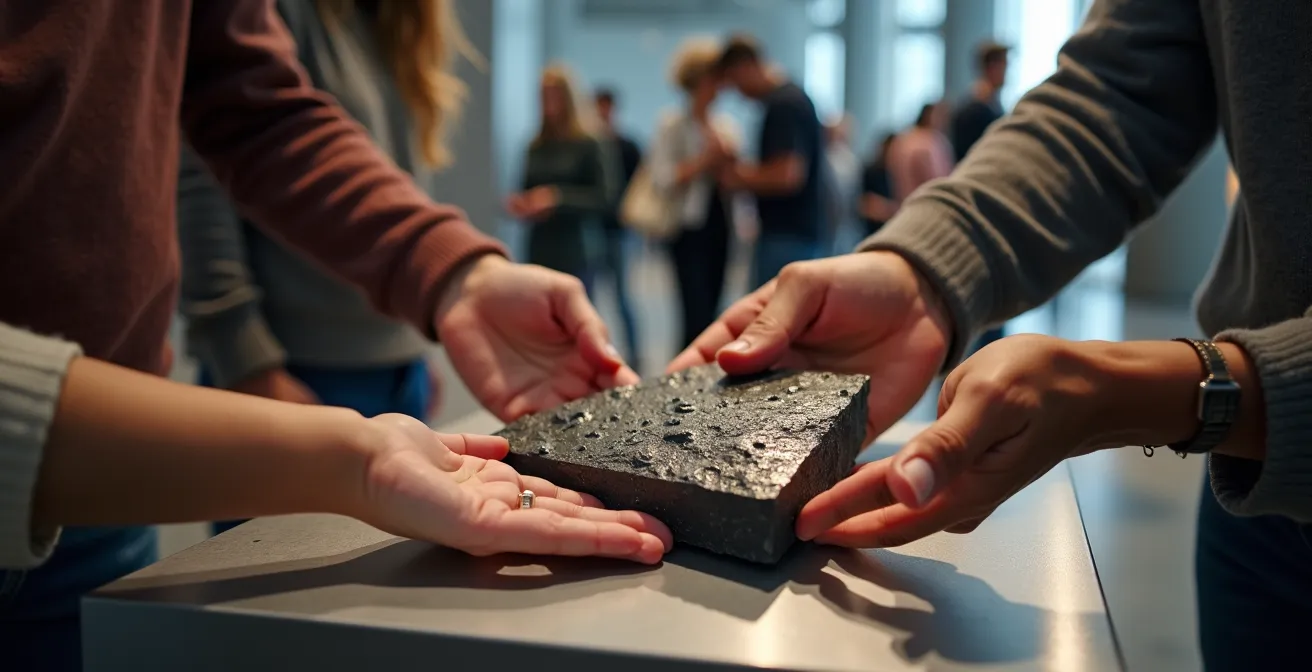
The secret to touching the Moon Rock without a long wait isn’t just about timing; it’s about adopting a strategic enthusiast’s mindset that transforms your entire visit from a checklist into a mission.
- Treating your visit like a planned expedition, with the Moon Rock as a key objective, allows you to bypass crowds and see more.
- This strategic approach extends beyond one museum, helping you identify authentic artifacts, stack high-value experiences, and even discover real fossils in the wild.
Recommendation: Instead of just showing up, design a narrative for your day. Decide what story you want to uncover—from the dawn of Earth to the edge of space—and let that guide your path.
For any space enthusiast, the pilgrimage to the Smithsonian National Air and Space Museum in Washington, D.C. has one sacred moment: touching the Moon rock. It’s a tangible link to the cosmos, a piece of another world right at your fingertips. But this moment often comes with a very terrestrial problem—a long, shuffling line of visitors all seeking the same connection. The common advice is predictable: arrive at dawn, rush to the exhibit, and check it off your list. But what if the goal wasn’t just to “get it done”? What if avoiding the wait was a byproduct of a much richer, more intentional way to experience history?
This guide reframes that challenge. We won’t just give you a logistical shortcut. We will equip you with an enthusiast’s mindset, turning a simple museum trip into a curated mission. The true art of a great visit isn’t about seeing everything; it’s about connecting the dots between the right things to tell a powerful story. Touching the lunar sample isn’t the finish line; it’s the launchpad. It’s the pivotal moment in a narrative you design, one that can span from the origins of life at the Natural History Museum to the colossal scale of the Space Shuttle Discovery.
By learning to think like a curator of your own experience, you’ll not only touch the Moon rock without the crowd but also unlock a deeper appreciation for the marvels of science and exploration, whether you’re in a world-class museum or out in the wild. This strategic approach will change how you see every artifact and plan every trip.
This article will guide you through this powerful mindset. We’ll start with specific strategies for the Air and Space Museum, then expand to show how this approach can unlock authentic and awe-inspiring science experiences across the country, from telling real from replica to planning an epic two-museum day.
Summary: Your Mission Guide to a Deeper Science & Space Experience
- Why the Space Shuttle Look So Much Bigger in Person?
- How to Dig for Real Fossils in Wyoming Legal Sites?
- Kennedy Space Center vs. Houston: Which Mission Control Experience is Better?
- The ‘Replica’ Trap in Small Town Science Museums
- How to Do the Natural History Museum and Air & Space in One Day?
- Why Yellowstone’s Geothermal Features Are More Dangerous Than They Look?
- How to Arrive at 8 PM and Still See the Fireworks in NYC?
- How to Access Top Museums for Free Without Breaking the Rules?
Why the Space Shuttle Look So Much Bigger in Person?
Standing beneath the Space Shuttle Discovery at the Udvar-Hazy Center (or Atlantis at Kennedy Space Center) is a humbling experience that photos can never capture. The reason for this overwhelming sense of scale isn’t just its 122-foot length; it’s the sheer volume and function it represents. You’re not just looking at a vehicle; you’re looking at a reusable, winged spacecraft that was also a workhorse cargo truck. The immense payload bay, for instance, was large enough to hold an entire Greyhound bus. That single fact reframes the vehicle from a sleek orbiter into a colossal piece of industrial hardware that just happened to fly in space.
This feeling of scale is often lost in pictures, which flatten depth and remove the human reference point. To truly grasp its size, you must experience it spatially. The visible scorch marks and weathered thermal tiles aren’t imperfections; they are scars from its 33 journeys through Earth’s atmosphere, each telling a story of extreme heat and pressure. It’s a battle-worn veteran, not a pristine model. Seeing the subtle patchwork of repaired tiles gives you a visceral understanding of the incredible challenge of maintaining this complex machine.
To fully appreciate this, you need a plan that forces you to engage with its scale. Instead of a quick glance, make a full circumnavigation of the orbiter a priority.

As this image demonstrates, human figures are completely dwarfed by the vehicle. The most impactful viewpoint is often directly underneath the open payload bay doors. From this perspective, you’re standing inside the volume that carried satellites, laboratory modules, and the Hubble Space Telescope into orbit. You realize it’s less an “airplane” and more a flying building, a piece of architecture designed for the vacuum of space. This contextual understanding is the difference between simply seeing an exhibit and truly comprehending an engineering marvel.
This shift in perspective—from passive viewing to active, contextual observation—is the first step in the enthusiast’s mindset. It’s about asking “why” it looks the way it does, not just “what” it is.
How to Dig for Real Fossils in Wyoming Legal Sites?
The enthusiast’s quest for authenticity doesn’t have to end at the museum door. For a truly hands-on connection to Earth’s deep past, few experiences rival digging for your own fossils. Wyoming, particularly the area around the Green River Formation, is one of the best places in the world to do this legally. Here, 50-million-year-old layers of shale hold exquisitely preserved fish fossils, and several private quarries allow the public to participate in their discovery.
Unlike collecting on most public lands, these “pay-to-dig” sites let you keep what you find, transforming you from a tourist into an amateur paleontologist for a day. At locations like Fossil Safari, visitors regularly find between three to ten fish fossils. The quarry operators do the heavy lifting, removing tens of feet of overburden each year to expose the productive fossil layers. Your job is the thrill of the final reveal: carefully splitting layers of shale to uncover the skeleton of a fish that swam in a prehistoric lake. It’s a direct, tangible link to an ancient ecosystem.
However, if you prefer to explore on your own, it’s crucial to understand the rules. Fossil hunting on public lands managed by the Bureau of Land Management (BLM) is permitted, but it’s strictly for personal collection, not commercial sale. The regulations are clear: you are generally limited to collecting 25 pounds per day, not to exceed 250 pounds per year, and only hand tools are allowed. This ensures that these non-renewable resources are protected for future generations. Before heading out, following a clear checklist is essential for a successful and lawful expedition.
Your Checklist for Legal Fossil Hunting on Wyoming’s Public Lands
- Contact the local BLM field office to verify that the area is open for collection and to check for any specific restrictions.
- Remember the personal use limits: collect no more than 25 pounds of common invertebrate or plant fossils per day.
- Never engage in selling, trading, or bartering any fossils you collect from public lands; they are for your personal enjoyment only.
- Use only hand tools like rock hammers and chisels. Power tools, heavy equipment, or explosives are strictly forbidden.
- Ensure you are not on private land, a designated wilderness area, or an active mining claim, where collection is prohibited without permission.
- If you believe you have found a scientifically significant fossil (like a vertebrate skeleton), leave it in place and report it immediately to the nearest BLM office.
This kind of adventure is the ultimate expression of the enthusiast’s mindset: moving beyond curated exhibits to engage directly with the raw material of history and science.
Kennedy Space Center vs. Houston: Which Mission Control Experience is Better?
For any Apollo program aficionado, visiting Mission Control is a pilgrimage. It’s the nerve center where humanity’s journey to the Moon was orchestrated. Both Kennedy Space Center (KSC) in Florida and Space Center Houston in Texas offer a Mission Control experience, but they are fundamentally different, and choosing between them comes down to a critical question of authenticity versus immersion.
Space Center Houston is home to the real deal: the fully restored historic Apollo Mission Control Center. This is the actual room, a designated National Historic Landmark, where flight directors like Gene Kranz and their teams held their breath during the Apollo 11 landing and battled the crisis of Apollo 13. The consoles, the chairs, the buttons—they are the original artifacts, painstakingly preserved to look exactly as they did in July 1969. The experience is one of historical reverence. You are standing in a protected time capsule, observing a sacred space from a viewing gallery. It’s about quiet contemplation and connection to a specific, monumental moment in history.
Kennedy Space Center, on the other hand, offers a different kind of experience. Instead of the actual Mission Control, KSC presents a theatrical, immersive recreation. As the National Air and Space Museum’s visitor guide clarifies, the choice is clear.
Houston offers the original, perfectly restored Apollo Mission Control, a designated National Historic Landmark. KSC offers a recreation of the Apollo-era firing room
– National Air and Space Museum, Smithsonian Institution visitor guide
At KSC’s Apollo/Saturn V Center, you enter a detailed recreation of the firing room from which the Saturn V rockets were launched. The experience culminates in a dramatic, simulated launch sequence of Apollo 8, complete with shaking walls, rumbling audio, and the authentic mission audio. It’s not about historical preservation in the same way as Houston; it’s about visceral immersion. It aims to make you *feel* the tension and thrill of a launch, using technology and showmanship to bring the past to life. It’s an emotional experience, while Houston’s is more intellectual and historical.
Ultimately, there is no “better” choice, only the one that best aligns with your personal mission as an enthusiast. Do you want to bear witness to history, or do you want to feel like you’re a part of it? The answer reveals what you truly seek in your explorations.
The ‘Replica’ Trap in Small Town Science Museums
The quest for authenticity is a guiding principle for any serious enthusiast. While major institutions like the Smithsonian are treasure troves of genuine artifacts, many smaller regional museums rely heavily on replicas, casts, and models to tell their stories. Falling into the “replica trap”—believing you’re looking at a genuine piece of history when it’s actually a copy—can be disappointing. Learning to distinguish the real from the replica is a crucial skill for any museum-goer.
Replicas are not inherently bad; they are essential educational tools that make rare or fragile objects accessible. However, transparency is key. A good museum will always be clear about what is a cast and what is an original. Your job as a discerning visitor is to learn how to read the signs. This “authenticity filter” sharpens your eye and deepens your appreciation for the genuine articles when you find them. There are several tells:
- Check the Labeling: Reputable museums will explicitly state if an item is a cast or replica. Look for phrases like “Cast from original at…” or “Replica of…”
- Examine the Material: Plaster and resin are common materials for fossil casts. They often lack the fine, granular texture of real stone and may feel lighter or warmer to the touch if the museum allows contact.
- Look for Seams: Casts are often made from molds, which can leave a faint seam line along the edges. Original artifacts, especially fossils, will have natural, irregular fracture lines.
- Ask a Docent: Museum staff and volunteers are usually passionate and knowledgeable. A simple question like, “Is this the original fossil or a cast?” will almost always get you a direct and informative answer.
Applying this filter doesn’t mean you should dismiss smaller museums. In fact, some of them are home to world-class, authentic collections that are all the more impressive for their unexpected location. This proves that incredible history is not confined to major metropolitan areas.
Case Study: Small Museums with World-Class Authentic Collections
Despite their smaller size, several regional US museums house surprisingly authentic collections that rival major institutions. The Cosmosphere in Hutchinson, Kansas, holds the largest collection of Russian space artifacts outside Moscow, including authentic flown Vostok and Voshkod spacecraft. Similarly, the Evergreen Aviation & Space Museum in Oregon displays the original Hughes H-4 Hercules (the “Spruce Goose”) and an authentic SR-71 Blackbird, one of the fastest aircraft ever built. These museums prove that authentic, awe-inspiring artifacts aren’t limited to major cities, offering genuine encounters with history in unexpected locations across America.
This skill transforms you from a passive consumer of exhibits into an active, critical explorer, capable of appreciating the immense effort and rarity behind every genuine piece of history you encounter.
How to Do the Natural History Museum and Air & Space in One Day?
For an enthusiast visiting Washington, D.C., the proximity of the National Museum of Natural History and the National Air and Space Museum is both a blessing and a curse. They are right next to each other on the National Mall, offering a tantalizing opportunity to trace the story of existence from the first life on Earth to humanity’s first steps on the Moon. But with the Smithsonian welcoming over 30 million annual visitors across its institutions, attempting both in a single day without a solid plan is a recipe for exhaustion and frustration.
The key is to abandon the idea of “seeing everything.” Instead, adopt a mission-based itinerary that focuses on a specific narrative. Let’s call it the “From Earth to Stars” route. This plan is designed for maximum impact, connecting the most iconic and relevant halls of both museums into a cohesive story of our planet and our ambition to leave it. It’s a strategic strike, not a meandering stroll. The goal is to hit the highlights that tell this grand story while cleverly avoiding the worst of the crowds and bottlenecks.
This plan relies on a few key strategies: starting early at the less-crowded entrance of the Natural History Museum, having lunch outside the museum to avoid long cafeteria lines, and using the underground connection to move between buildings efficiently. It’s a logistical puzzle solved by thinking like a strategist.
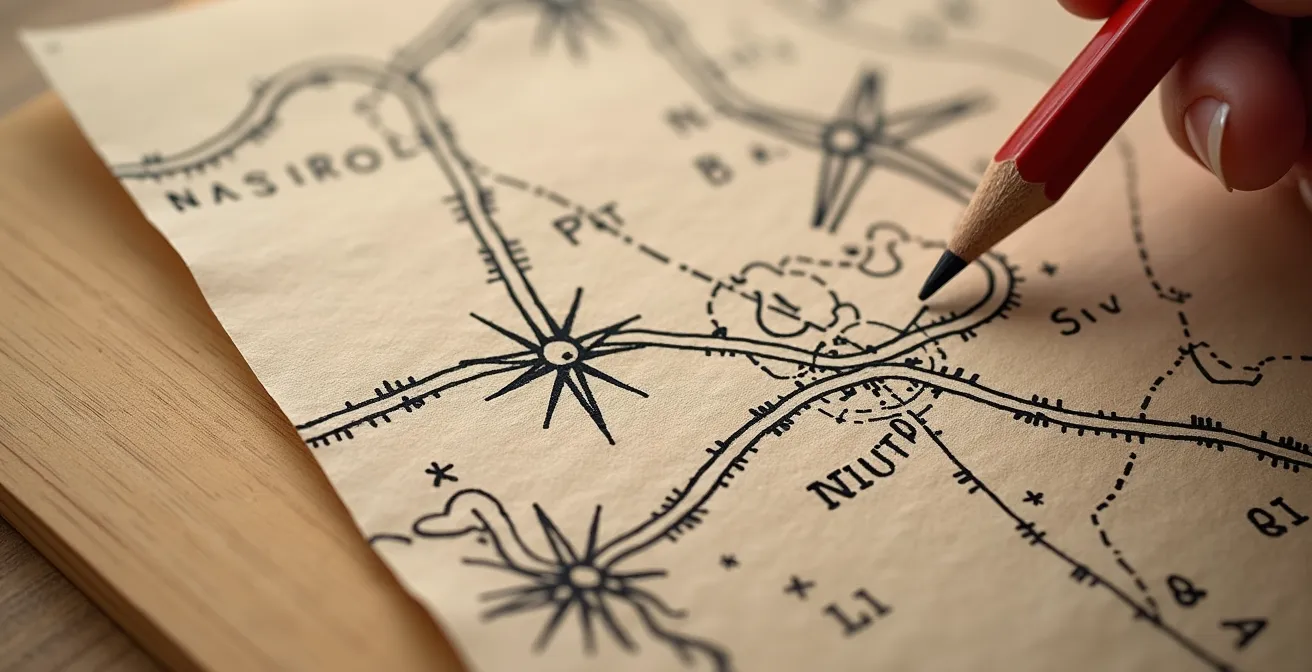
A hand-drawn map, even a mental one, is your best tool. The “From Earth to Stars” route is a perfect example of experience stacking—a core tenet of the enthusiast mindset. Here’s a timed plan to make it happen:
- 9:00 AM: Start at the National Museum of Natural History. Use the Constitution Avenue entrance, which is typically less congested than the main Mall entrance.
- 9:15 AM – 11:00 AM: Go directly to the David H. Koch Hall of Fossils (“Deep Time”) to see the evolution of life, then proceed to the Geology, Gems, and Minerals Hall to understand the raw materials of our planet.
- 11:00 AM – 12:00 PM: Make your pilgrimage to the Hope Diamond before the peak crowds arrive.
- 12:00 PM – 1:00 PM: Exit the museum for lunch. The food trucks often found along 7th Street SW offer faster and more varied options than the crowded museum cafes.
- 1:00 PM – 1:30 PM: Walk over to the Air and Space Museum. On hot or rainy days, consider using the underground walkway that connects through the National Gallery of Art for a more comfortable transition.
- 1:30 PM – 3:30 PM: Enter the Air and Space Museum and head straight for the Apollo 11 Command Module “Columbia” and, of course, the lunar touchstone.
- 3:30 PM – 5:00 PM: Finish your day exploring the Milestones of Flight gallery and the Space Shuttle Discovery (at the Udvar-Hazy Center, if you have a car and extra time) or other key exhibits.
By executing this mission, you don’t just “do” two museums; you experience a single, epic story that you’ve curated for yourself.
Why Yellowstone’s Geothermal Features Are More Dangerous Than They Look?
The enthusiast’s journey often leads to places of immense natural power, and few places on Earth are as geologically dynamic as Yellowstone National Park. Its geysers, hot springs, and mud pots are mesmerizingly beautiful, with vibrant colors and steaming waters that seem otherworldly. But this beauty masks an extreme and immediate danger. The single most important rule in Yellowstone is to stay on the boardwalks, because the ground itself is a thin, fragile crust separating you from boiling, acidic water.
The danger is twofold: temperature and acidity. The water in many of Yellowstone’s thermal features is at or near boiling point. According to monitoring from the U.S. Geological Survey, many Yellowstone pools reach 200°F with pH levels as low as 1-2, which is the same strength as battery acid. A fall into one of these springs would be instantly catastrophic, causing severe burns and rapid dissolution of organic material. The ground around these features can look solid but may be only a few inches of brittle mineral sinter covering a scalding cavern.
This isn’t an abstract risk; it’s a constant, monitored reality. The entire park is a “supervolcano,” a living geological entity. The National Park Service isn’t being overly cautious with its warnings; it is communicating a deadly reality. As their safety guidelines emphasize, this is a landscape in constant flux.
The entire Yellowstone landscape is a living, breathing geological anomaly, constantly monitored by the USGS, with paper-thin ground crust that can collapse under weight
– National Park Service, Yellowstone Safety Guidelines
Respecting this power is part of the enthusiast’s mindset. The thrill comes not from taking risks but from understanding the immense forces at play and observing them safely. The boardwalks aren’t a limitation; they are front-row seats to one of the planet’s greatest geological shows. They allow you to get incredibly close to a phenomenon that would otherwise be inaccessible, placing you just feet away from raw, untamable planetary energy. To step off the path is not brave; it is to fundamentally misunderstand and disrespect the very nature of what makes Yellowstone so special.
Your experience is enhanced not by ignoring the danger, but by fully appreciating its scale from the safety of the designated path. It is a powerful lesson in the humility required to truly connect with the natural world.
How to Arrive at 8 PM and Still See the Fireworks in NYC?
The enthusiast’s mindset of strategic planning isn’t just for museums or national parks; it’s a versatile tool for tackling any popular, crowd-drawing event. Take, for example, the Macy’s 4th of July Fireworks in New York City. The conventional wisdom is that you must camp out for hours, packed into a crowded Manhattan viewing area, to get a decent spot. But what if you have other plans and can only arrive late? It’s still possible to get a fantastic view, provided you trade traditional thinking for strategic positioning.
The secret is to avoid Manhattan’s designated viewing areas entirely. These are the first places to fill up and are often at capacity by early evening. Instead, think like a local and leverage the geography of the outer boroughs. The fireworks are launched from barges on the East River, meaning any location with a clear sightline to the river can be a prime spot. The best late-arrival options are often in Brooklyn and Queens.
Here are some proven strategies for the latecomer:
- Head for Brooklyn Heights: The Brooklyn Heights Promenade offers an elevated, panoramic view of the lower Manhattan skyline and the river. While popular, it’s far less dense than the Manhattan side and has spots available much later in the evening.
- Try Gantry Plaza State Park: Located in Long Island City, Queens, this park offers incredible, sweeping views of the Midtown skyline. Its multiple piers and open spaces mean you can often find a good spot even if you arrive after 8 PM.
- Consider a Rooftop Bar: Many rooftop venues in Williamsburg, Greenpoint, and even Jersey City offer ticketed events with guaranteed views, food, and drinks. It’s a trade-off of cost for comfort and a guaranteed sightline.
- Use the NYC Ferry: For a truly unique perspective, the NYC Ferry’s East River route effectively becomes a mobile viewing platform. Timing your ride to coincide with the 9:20 PM show start can give you an unforgettable view from the water.
The most critical step is to check the official Macy’s website 48 hours before the event. They release a map showing the exact locations of the fireworks barges. With this intelligence, you can use a map app on your phone to draw a direct line of sight from the barges to any public park or open space along the waterfront, discovering your own “secret” spot away from the main crowds.
This approach transforms a potentially stressful experience into a clever urban adventure, proving once again that the best experiences often lie just off the beaten path.
Key Takeaways
- True appreciation of an artifact like the Space Shuttle comes from understanding its scale and function, not just its shape.
- Authentic, hands-on science experiences, like digging for fossils, are accessible but require strict adherence to legal and safety guidelines.
- The best experience (e.g., Mission Control) depends on your goal: choose historical authenticity for contemplation or immersive recreation for thrill.
How to Access Top Museums for Free Without Breaking the Rules?
A core part of the enthusiast’s mindset is maximizing every opportunity. For the avid museum-goer, this often means figuring out how to visit more incredible institutions without breaking the bank. While many people believe that free museum access involves sneaking in or bending rules, the reality is that there are numerous legitimate, established programs across the USA designed to make culture and science more accessible. Knowing how to use them is the ultimate travel hack.
The most straightforward method, of course, is to visit institutions that are always free. The Smithsonian in Washington, D.C., is the gold standard, offering free admission to all its museums, including the National Air and Space Museum and the National Museum of Natural History. This commitment to accessibility is a cornerstone of its mission to be a resource for all Americans. But this model extends beyond the capital.
Across the country, a web of reciprocal memberships and targeted programs opens the doors to hundreds of museums. These are not loopholes; they are official partnerships designed to encourage broad cultural engagement. For the price of a single membership or by holding the right card, you can unlock a year’s worth of exploration. Here are some of the most effective, legitimate ways to gain free or reduced admission:
- Bank of America’s “Museums on Us”: If you have a Bank of America or Merrill Lynch credit or debit card, you get free general admission to over 225 participating museums on the first full weekend of every month.
- Museums for All: Cardholders of EBT (Electronic Benefit Transfer) can receive free or significantly reduced admission to more than 750 museums nationwide, including top-tier science centers and art museums.
- Library Passes: Many local public libraries have a collection of museum passes that cardholders can borrow for free admission to institutions in their area.
- Reciprocal Memberships (NARM & ROAM): Purchasing a membership at a participating museum, often for around $100-$150, can grant you free access to hundreds of other institutions through the North American Reciprocal Museum (NARM) and Reciprocal Organization of Associated Museums (ROAM) networks.
Start by checking the websites of these programs and the museums on your wish list. A few minutes of research before your trip can save you hundreds of dollars in admission fees, allowing you to channel your resources into more experiences, more travel, and deeper engagement with the subjects you love.