The most crucial family history breakthroughs happen when you step away from the screen and travel to the locations where your ancestors lived, worked, and were recorded.
- Digital databases are incomplete; fires, floods, and simple human error mean up to 40% of vital records are only available offline in local courthouses and archives.
- On-the-ground research allows you to resolve name spelling errors, understand geographical context, and uncover stories that DNA tests alone cannot tell.
Recommendation: Use online tools to build a solid research framework, but plan a targeted trip to physical archives to find the primary source documents that tell the real story.
For any family historian, the journey often begins online. You build a tree, search census data, and perhaps even find a ship manifest with a familiar surname from Ellis Island. But then, you hit the inevitable “brick wall.” The digital trail goes cold, and the story of your ancestors feels incomplete, like a book with missing chapters. The common advice is to simply try another database or a different search term, but this often leads to more frustration.
This approach overlooks a fundamental truth known to every seasoned genealogist: the richest, most accurate information isn’t always digitized. It resides in dusty courthouse basements, within the handwritten pages of parish ledgers, and in the very landscape your ancestors inhabited. Tracing your family tree isn’t just an online scavenger hunt; it’s a form of historical travel that connects you directly to the on-the-ground truth of your past. The key is to shift your mindset from a simple record search to that of a genealogical detective building a case file.
But what if the real key wasn’t just finding more records, but understanding the complete historical tapestry of your family’s American experience? This guide proposes a more holistic method. We’ll show you how to meticulously prepare for a research trip, how to navigate the pitfalls of physical archives, and how to connect your personal family history to the broader American narrative—from the halls of a county courthouse to the cultural footprints left in food and historical movements.
This article provides a methodical framework for your genealogical journey. We will explore why physical records are irreplaceable, how to prepare for your research trip, and how to interpret the clues you find on the ground, connecting your personal story to the wider fabric of American history.
Summary: How to Find Your Ancestors by Combining Digital and Physical Research
- Why Digital Databases Miss 40% of Local Town Records?
- How to Organize Your Family Tree Data Before Booking a Flight?
- DNA Kit vs. Parish Records: Which Tells the Real Story of Your Origin?
- The Name Spelling Mistake That Leads You to the Wrong Cemetery
- How to Visit Three County Courthouses in One Day?
- How to Teach Your Kids American History Through a 3-Day DC Itinerary?
- Why the ‘California Roll’ Is an American Invention, Not Japanese?
- How to Travel the Civil Rights Trail from Selma to Montgomery?
Why Digital Databases Miss 40% of Local Town Records?
The convenience of massive online databases has revolutionized genealogy, but it has also created a dangerous illusion of completeness. Many researchers assume that if a record isn’t on a major website, it simply doesn’t exist. This is a critical error. The reality is that a significant portion of America’s historical documents have never been digitized and may never be. The reasons are numerous: budget limitations, fragility of the documents, and, most dramatically, catastrophic loss.
These “burned counties” are a well-known challenge for genealogists. Fires, floods, and wartime destruction have wiped out entire collections of vital records. For instance, courthouse fires are so common that more than 20 Virginia counties alone suffered major record losses, a pattern repeated across the United States. When a courthouse burned, it often took with it the only existing copies of birth certificates, marriage licenses, deeds, and wills for entire generations. These are gaps that no digital database can ever fill.
Even when records survive, they often remain inaccessible online. Until recently, researchers seeking Maryland vital records had to travel to the state archives in Annapolis. It was only through the dedicated work of projects like Reclaim The Records that more than a century of Maryland’s birth, marriage, and death certificates became available online in 2023. This highlights a crucial point: countless records are still sitting on shelves in local repositories, waiting to be discovered by a researcher willing to make the trip. Your ancestor’s story might just be in one of those yet-to-be-digitized files, making a physical visit not just helpful, but essential.
How to Organize Your Family Tree Data Before Booking a Flight?
Embarking on a genealogical research trip without a clear plan is like setting sail without a map. The sheer volume of information and the limited time available at archives can be overwhelming. To be an effective genealogical detective, you must organize your existing data and formulate a precise research question. Before you even think about booking a flight, your goal is to transform your broad curiosity (“I want to find my ancestors”) into a specific, answerable query (“I need to find the 1880 land deed for John Smith in Appomattox County, Virginia, to identify his neighbors and potential relatives”).
Start by consolidating all your known information into a single system. This can be a genealogy software program (like RootsMagic or Family Tree Maker) or even a well-organized system of digital folders and spreadsheets. For each ancestor you plan to research, create a timeline of known events: birth, marriage, census appearances, and death. Next to each event, cite your source. This process will immediately highlight the gaps in your knowledge and form the basis of your research goals for the trip. The visual organization of these materials is key to seeing the bigger picture of your investigation.
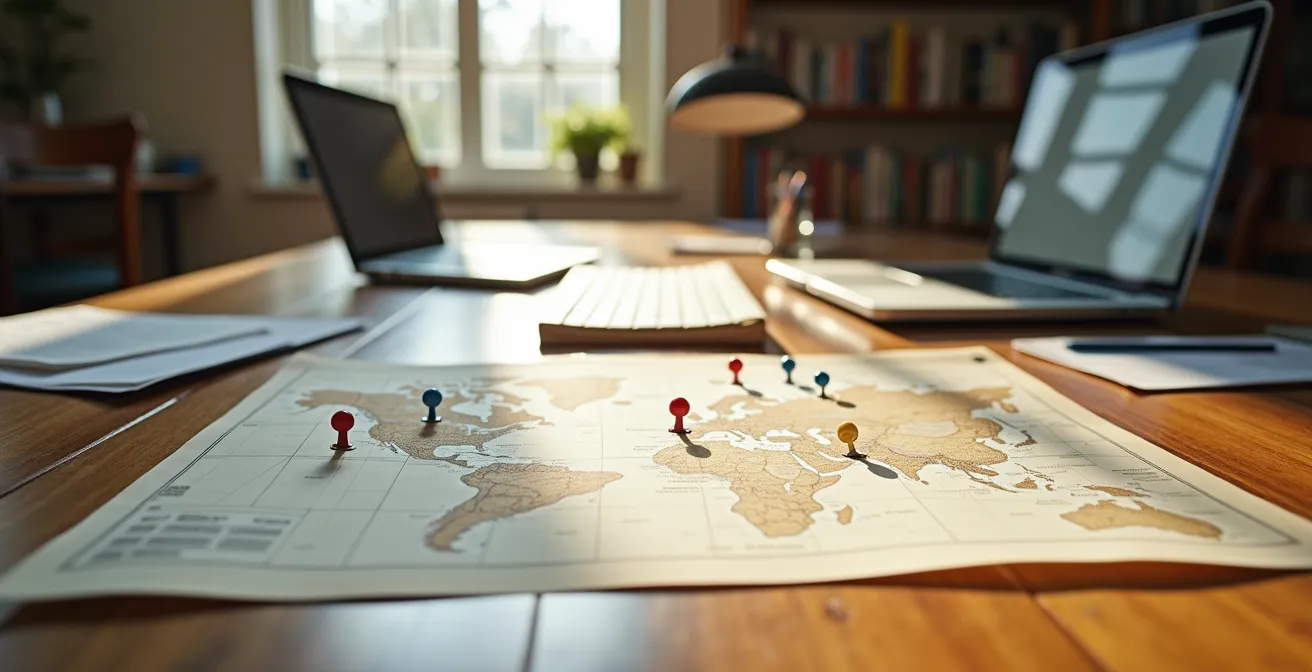
As the image above illustrates, this preparatory phase involves bringing together different strands of evidence—maps, documents, and digital trees. Your pre-trip work should culminate in a research binder or digital equivalent for each location you plan to visit. This file should contain your research question, a summary of known facts, a list of specific records you intend to search (e.g., “Probate Book 3, pages 150-200”), and copies of key documents you’ve already found. A well-prepared researcher can accomplish in a single day what an unprepared one might not find in a week.
Action plan: Your pre-visit courthouse audit
- Points of Contact: Identify and contact the clerk of court to verify on-site vs. off-site storage for 19th-century records and confirm who the current record keeper is.
- Logistical Audit: Collect all practical details: business hours, copy fees (and whether cash or cards are accepted), and any appointment requirements for microfilm readers or research rooms.
- Record Type Inventory: Inventory the specific record formats available by asking about both bound docket books and loose paper case files to ensure you can access all relevant materials.
- Digitization Policy Check: Assess the courthouse’s policy on personal digital photography (using a smartphone or camera) versus their in-house copy services to plan your workflow and budget.
- Visit Plan Integration: Consolidate all gathered information into a prioritized, location-specific visit plan, outlining which records to request first to maximize your time.
DNA Kit vs. Parish Records: Which Tells the Real Story of Your Origin?
In the last decade, at-home DNA tests have become a popular first step in exploring one’s heritage. They offer an exciting, seemingly simple answer to the question, “Where do I come from?” With claims of high precision, these tests can connect you with living relatives and provide broad ethnic estimates. However, a DNA test is a single tool, not a complete solution. It provides the “what”—a genetic blueprint—but rarely the “who,” “when,” or “why.” The real, detailed story of your origin is almost always found in traditional paper records.
A DNA test can be an invaluable asset for a genealogical detective, especially for breaking through “brick walls” caused by burned counties or adoptions. It can confirm relationships and point you toward a previously unknown branch of the family. The limitation lies in the science of inheritance; you don’t inherit DNA from all of your ancestors, and the amount you inherit from any one of them decreases by half with each generation. Your ethnicity estimate is just that—an estimate based on a reference panel of modern populations, not a definitive record of your ancestors’ lives.
Parish and civil records, on the other hand, provide the specific, tangible details that bring an ancestor’s story to life. A baptismal record gives you a name, a date, a place, and often the names of parents and godparents. A marriage license documents a new family unit. A will reveals relationships, possessions, and social standing. These documents provide the on-the-ground truth that DNA cannot. The following table compares the strengths and weaknesses of each approach.
This side-by-side analysis, based on information from a comprehensive overview of genealogical DNA testing, clarifies the distinct roles these two methods play in your research.
| Method | Strengths | Limitations |
|---|---|---|
| DNA Testing | Can identify relationships within 3-4 cousin range accurately; Helps break through ‘burned county’ brick walls | Results vary between companies; Cannot detect large portions of distant ancestors’ DNA |
| Parish/Civil Records | Provides exact names, dates, and locations; Documents specific life events | Records may be lost or damaged; Limited by literacy and accuracy of record keepers |
The Name Spelling Mistake That Leads You to the Wrong Cemetery
One of the most persistent myths in American genealogy is that names were changed by clerks at Ellis Island. The reality is that passenger manifests were created at the port of departure, and the clerks at Ellis Island were generally multilingual and worked with interpreters. The spelling variations that plague researchers almost always existed long before an ancestor reached American shores. Surnames were often spelled phonetically, and literacy was not universal. An ancestor might have spelled their own name differently at various points in their life, or it could have been written down differently by each clerk, priest, or census taker they encountered.
This is where the work of a genealogical detective becomes critical. You must learn to think of names not as fixed labels but as fluid identifiers with multiple variants. The key is to search for your ancestor using wildcards, phonetic spellings, and even just their first name within a specific location and timeframe. As a historical case study, the digitization of the Ellis Island passenger lists is illuminating. Before the index was created, finding an ancestor without knowing the exact ship and arrival date was nearly impossible. The indexing project revealed countless spelling variations and transcription errors that had effectively hidden people’s records in plain sight for decades.
Ignoring these variations can send your research in the completely wrong direction, leading you to a different family, the wrong town, or an incorrect cemetery plot. The accuracy of any record is entirely dependent on the person providing the information and the person writing it down. As a genealogical principle states:
The civil records are always only as accurate as the individuals having provided or written the information.
– Wikipedia contributors, Genealogical DNA test
This means you must be methodical and patient, collecting multiple documents for the same individual to see how their name was recorded over time. A single document is a clue; a collection of documents is evidence. By embracing the creative and flexible nature of historical naming conventions, you dramatically increase your chances of finding the correct person and, ultimately, the right final resting place.
How to Visit Three County Courthouses in One Day?
A research trip is an investment of time and money, so efficiency is paramount. For a genealogist focusing on a specific region of the United States, it’s common for a family to have lived across several adjacent counties over the decades. The ability to visit multiple repositories in a single day can be the difference between a minor update and a major breakthrough. This requires a strategic “hub and spoke” approach to your travel planning.
Instead of booking lodging in each small town, establish a base of operations in a central city that is within a reasonable driving distance of your target counties. For example, a researcher working on Indiana families might stay in Indianapolis, which provides easy access to numerous surrounding county seats. The first step is to map out the courthouses, libraries, and historical societies you need to visit. Group them by geographical proximity and check their hours of operation, which can be notoriously limited. Call ahead to confirm that the records you need are on-site and accessible.
On the day of your research, start with the furthest courthouse first thing in the morning. This allows you to work your way back toward your home base, avoiding rush hour traffic at the end of the day. Be prepared to work quickly. Use a smartphone scanning app (like Adobe Scan or Microsoft Lens) to create digital copies of documents instead of waiting for the clerk’s photocopier. Have a standardized file naming system ready (e.g., County_Date_RecordType_Surname.pdf) to stay organized. This method allows you to focus on an investigative hunt for information, not a logistical scramble. Remember, however, that some records have legal access restrictions, such as the famous 72-year rule that restricts access to U.S. Federal Census records until 72 years after the census was taken, a privacy regulation you must respect for more recent documents.
Key Takeaways
- Genealogical breakthroughs require moving from digital-only research to targeted physical travel.
- Meticulous pre-trip organization is essential for maximizing your limited time in archives and courthouses.
- Connect your personal family story to the broader American historical narrative for a richer understanding of your roots.
How to Teach Your Kids American History Through a 3-Day DC Itinerary?
Genealogy is not just about looking backward; it’s about building a bridge to the future. A powerful way to make your family’s history meaningful is to share it with the next generation. A research trip can easily be combined with a family vacation that transforms abstract historical facts into a tangible, exciting experience for children. There is no better place to do this than Washington, D.C., a city that serves as a living archive of the American story.
The key to engaging kids is to move beyond passive museum visits and create interactive experiences. Instead of just looking at the Constitution, create a scavenger hunt at the National Archives to find the check that paid for Alaska or a petition signed by a famous figure. Frame the trip as a historical adventure. By connecting the grand national narrative to your own family’s journey, you give your children a personal stake in the past. Did your ancestors arrive in the 19th century? Visit the National Museum of American History to see what their daily lives might have looked like.
A successful itinerary balances famous landmarks with lesser-known sites that tell a more nuanced story. For example, you can visit Fort Stevens, where President Lincoln himself came under enemy fire during the Civil War, or explore the U Street corridor, once known as “Black Broadway,” to understand the vibrant cultural history of the city. Even meal times can be a history lesson by dining at historic establishments like Old Ebbitt Grill, which has been operating since 1856. Here are a few ideas to make the trip interactive:
- Create scavenger hunts at the National Archives to find specific documents.
- Visit Fort Stevens to see where President Lincoln came under enemy fire during the Civil War.
- Explore the U Street corridor to learn about “Black Broadway” and the Harlem Renaissance.
- Schedule meals at historic restaurants like Old Ebbitt Grill (operating since 1856).
- Use primary source documents displayed in museums as hands-on learning tools to connect with the past.
Why the ‘California Roll’ Is an American Invention, Not Japanese?
A crucial, yet often overlooked, part of the historical tapestry is the culture your ancestors experienced. Understanding their world goes beyond names and dates; it includes the food they ate, the music they heard, and the social changes they witnessed. Sometimes, things we assume are from an “old country” are actually unique products of the American experience. The California Roll is a perfect example of one of these cultural footprints.
While sushi is an ancient Japanese culinary art, the California Roll as we know it was born in Los Angeles in the 1960s. At the time, American palates were not accustomed to the idea of raw fish or seaweed. A pioneering Los Angeles sushi chef, Ichiro Mashita, ingeniously adapted the traditional form to appeal to his local clientele. He replaced the seasonal fatty tuna with creamy avocado and, most famously, hid the dark nori (seaweed) by rolling the rice on the outside—an “inside-out” roll.

This culinary invention was a stroke of genius. It was familiar enough to be approachable but exotic enough to be exciting. As you can see in the close-up, the textures and colors were appealing and non-threatening. The California Roll became a sensation in Southern California and, by the 1980s, had spread across the United States, acting as a “gateway” for millions of Americans to the world of sushi. This story isn’t just about food; it’s a case study in cultural adaptation, innovation, and assimilation. It reflects the dynamic way immigrant cultures have shaped and been shaped by America. For a genealogist, it’s a reminder that an ancestor’s story is deeply intertwined with the popular culture of their time and place.
How to Travel the Civil Rights Trail from Selma to Montgomery?
For many Americans, the search for family history is inextricably linked to the nation’s defining struggles and movements. The journey to understand one’s roots is not always about crossing an ocean; sometimes, it is about traveling a 54-mile stretch of highway in Alabama. The Selma to Montgomery National Historic Trail is more than a series of landmarks; it is a sacred route and a living archive of the fight for voting rights and equality in the United States. Traveling this trail provides a profound and essential context for any family historian seeking to understand the 20th-century American experience.
For African American families, this trail may be a direct part of their personal history, a place where parents, grandparents, or community members fought for their fundamental rights. For other researchers, it provides a crucial chapter in the historical tapestry of the country their ancestors helped build. To travel the trail is to bear witness to the courage of the foot soldiers of the movement. A trip should be planned methodically, combining key sites with moments of reflection. Essential stops include the Lowndes County Interpretive Center, which tells the story of the rural struggle for voting rights, and the City of St. Jude, where thousands of marchers camped before their final approach to the state capitol.
A meaningful visit requires logistical planning and a willingness to engage deeply with the history. To make the most of the journey, consider the following practical steps:
- Visit the Lowndes County Interpretive Center to learn about “Tent City” and the rural voting rights struggles.
- Stop at the City of St. Jude, the final campsite for marchers before they reached Montgomery.
- Plan safe parking spots to walk portions of the trail that have pedestrian paths.
- Bring adequate water and sun protection, especially in the Alabama heat.
- Book tours with local guides, some of whom may have participated in the original 1965 march.
- Conclude your trip at the Equal Justice Initiative’s Legacy Museum in Montgomery to connect this history to its modern-day implications.
By traveling the Civil Rights Trail, the genealogical researcher does more than gather facts. You connect your family’s story, regardless of its origin, to the ongoing American journey toward a more perfect union. This act of bearing witness enriches your understanding of the past and provides a powerful legacy to pass on.
Your genealogical quest is a puzzle with pieces scattered across time and geography. By combining meticulous digital preparation with purposeful travel, you transform from a record collector into a true family historian. You uncover not just the names and dates, but the rich, complex, and uniquely American story that is your exclusive inheritance.