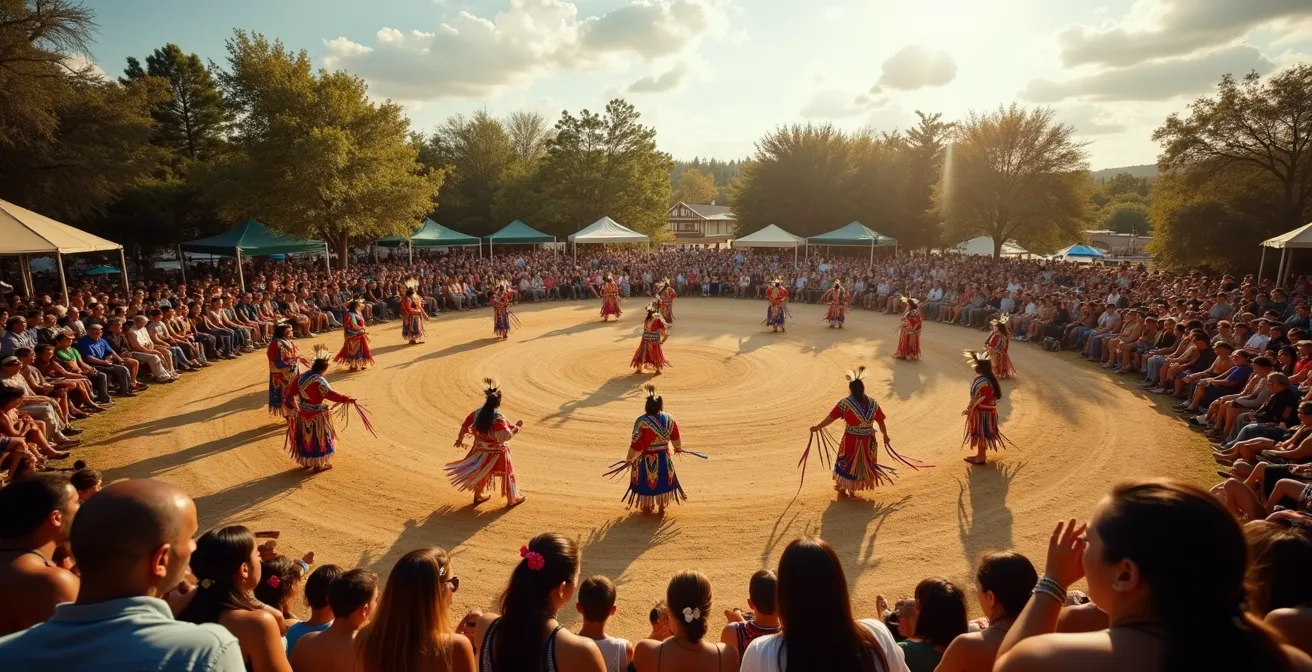
Attending a powwow as a non-Native visitor can feel intimidating, filled with the fear of accidentally causing offense. The key to respectful attendance isn’t memorizing a long list of rules, but understanding the foundational principles that give those rules meaning. By grasping the concepts of tribal sovereignty, the sacredness of the space and regalia, and your role as a welcome guest, you can move from a place of anxiety to one of genuine, informed participation and appreciation.
The desire to connect with authentic cultural experiences is a powerful part of travel. For many in the United States, that leads to a powwow—a vibrant, powerful gathering of Native American people to celebrate their heritage through dance, song, and community. Yet, this desire is often paired with a deep-seated anxiety: “How do I attend without being disrespectful?” Many guides will offer basic tips like “ask before taking a photo” or “listen to the Master of Ceremonies.” While correct, this advice only scratches the surface and can lead to a checklist mentality rather than true understanding.
The real path to being a respectful guest lies not in a list of dos and don’ts, but in a fundamental shift in perspective. It requires recognizing that you are entering a space governed by different norms, rooted in concepts of sovereignty, sacredness, and living tradition. This guide is built on that principle. We will explore why a reservation functions like a sovereign nation, what makes an item or a space sacred, and how your presence is not just that of a spectator, but of a witness to a resilient, thriving culture. By understanding the ‘why’ behind the etiquette, your actions will naturally become more respectful, allowing you to fully and honorably experience the profound beauty of a powwow.
This article will walk you through the core concepts that transform a visitor from a simple tourist into a welcome and respectful guest. We’ll explore the legal and cultural landscape, learn to distinguish authentic art from appropriation, and understand the deep significance behind the ceremonies you will witness.
Summary: A Guide to Respectful Powwow Attendance
- Why Entering a Reservation Is Like Entering a Foreign Country?
- How to Verify if Jewelry is ‘Native Made’ Under the Indian Arts and Crafts Act?
- Powwow vs. Potlatch: What Is the Difference in Purpose and Region?
- The Photo Mistake During the Grand Entry That Is Considered Rude
- How to Talk to Dancers After the Competition Without Interrupting?
- The ‘Replica’ Trap in Small Town Science Museums
- Why Yellowstone’s Geothermal Features Are More Dangerous Than They Look?
- How to Travel the Civil Rights Trail from Selma to Montgomery?
Why Entering a Reservation Is Like Entering a Foreign Country?
The first and most critical concept to grasp is tribal sovereignty. When you enter a federally recognized reservation, you are not just in another part of the state; you are on lands governed by a distinct tribal nation with its own laws, government, and jurisdiction. This isn’t a metaphor; it’s a legal reality upheld by treaties and the U.S. Constitution. For non-Native visitors, this means the rules of the road—both literally and culturally—are set by the host tribe. Ignoring this is the root of many unintentional but serious acts of disrespect.
The legal framework can be complex. For example, a landmark Supreme Court ruling affirmed that nearly 45% of Oklahoma’s land remains reservation territory. Within these lands, state governments often have limited or no authority over tribal members. Criminal jurisdiction is primarily handled by tribal and federal governments, each with its own distinct laws and penalties based on federal Indian law and the Indian Civil Rights Act. This is why you may see tribal police cars and tribal courthouses; they are pillars of a functioning, self-governing nation.
As a visitor, this means you must be proactive. Before you go, check the host tribe’s official website for specific visitor information. Many reservations, for instance, are “dry” and prohibit alcohol. Activities like hiking, fishing, or camping almost always require a tribal permit, separate from any state license. Acknowledging and respecting these laws is the first step in showing you understand that you are a guest in another nation.
How to Verify if Jewelry is ‘Native Made’ Under the Indian Arts and Crafts Act?
One of the most meaningful ways to engage with a powwow is to support the artists. The vibrant marketplace is a cornerstone of the event, but it’s also where visitors must be most vigilant. The Indian Arts and Crafts Act of 1990 is a federal law that makes it illegal to falsely market and sell art as “Native American” if it is not made by a member of a state or federally recognized tribe. Buying authentic supports artists and their families directly, ensuring the continuation of cultural traditions. This act of purchasing is a form of reciprocity—a respectful exchange, not just a transaction.
So, how can you be sure what you’re buying is authentic? The best method is always to buy directly from the artist at their booth. This allows you to meet the person who created the piece and hear its story. Many artists will have a Certificate of Authenticity, and it is standard and respectful to ask for their tribal enrollment or census number. This is not a rude question; it is a sign that you are a serious and informed buyer who wishes to comply with the law and honor their work.
This photograph captures the intricate detail and skill that goes into authentic, handmade Native American beadwork, a stark contrast to mass-produced imitations.
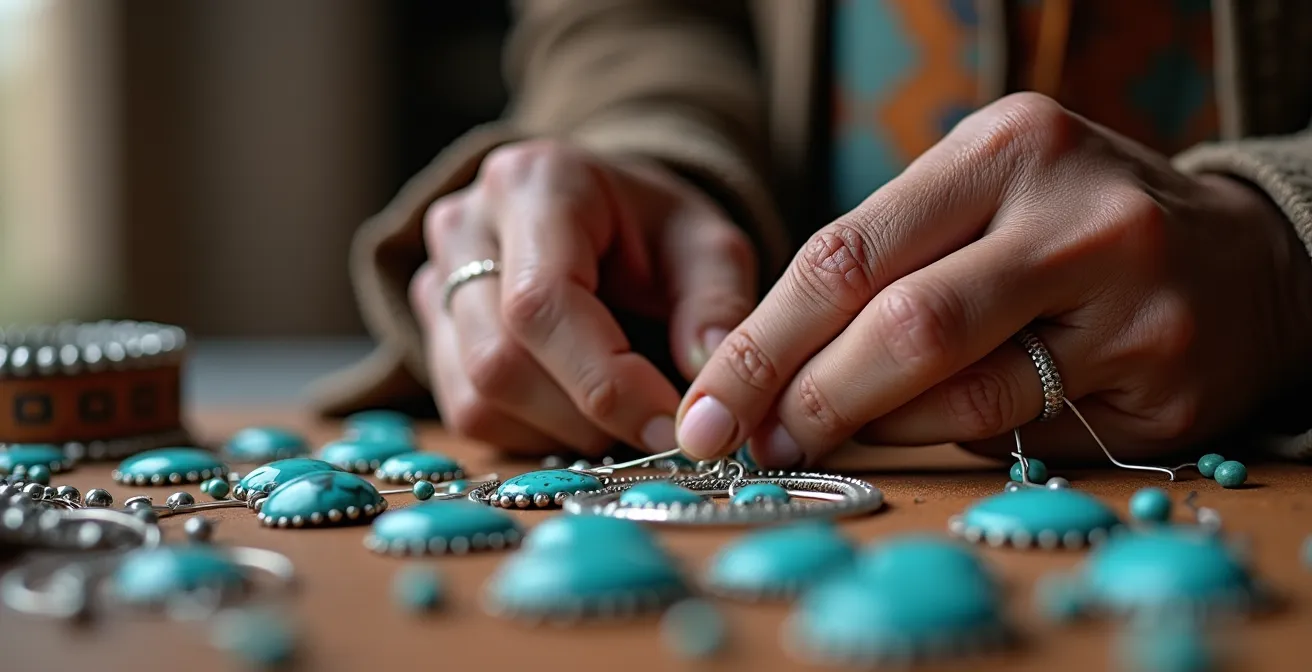
As you can see, the craftsmanship is a testament to generations of tradition. When you purchase such a piece, you are not just acquiring an object; you are becoming a custodian of a small piece of a living culture. A practical tip: while some vendors now accept cards, many smaller, family-run booths operate on a cash-only basis. Bringing enough cash ensures you won’t miss out on a unique piece and makes the transaction smoother for the artist.
Powwow vs. Potlatch: What Is the Difference in Purpose and Region?
Not all large Native gatherings are powwows, and understanding the distinctions is another layer of respect. The term “powwow” is most associated with the inter-tribal social gatherings that emerged on the Great Plains in the 1800s as a way to preserve culture when tribes were forced onto reservations. Today, they are often large public events with dance competitions. The largest, the Gathering of Nations in Albuquerque, New Mexico, is a prime example, attracting over 3,000 dancers and 80,000 spectators annually. These events are generally open to the public, and non-Native guests are welcome as spectators.
In contrast, a Potlatch is a completely different type of ceremony, traditionally practiced by the peoples of the Pacific Northwest Coast, such as the Tlingit and Haida in Washington and Alaska. The following table highlights the key differences between these two important cultural events.
| Aspect | Powwow | Potlatch |
|---|---|---|
| Geographic Region | Great Plains, Southwest, Great Lakes (e.g., Crow Fair in Montana) | Pacific Northwest coast (Tlingit, Haida in Washington/Alaska) |
| Primary Purpose | Inter-tribal social gathering with dance competitions, attracting 3,000+ dancers at events like Gathering of Nations | Ceremonial feast to validate status, mark life events, redistribute wealth |
| Visitor Access | Public events, non-natives welcome as spectators | By invitation only, guests serve as official witnesses |
| Historical Context | Emerged in the Plains during the 1800s when tribes were forced onto reservations, preserved languages and dances despite federal bans | Once banned by US government, represents cultural resilience |
The most critical distinction for a visitor is access. A powwow is an open invitation to witness a public celebration of culture. A Potlatch, on the other hand, is a private, ceremonial event to which one must be formally invited. The guests at a Potlatch are not spectators; they are official witnesses to the proceedings. Attempting to attend a Potlatch uninvited would be a profound and severe breach of protocol. Recognizing this difference demonstrates a sophisticated level of cultural awareness.
The Photo Mistake During the Grand Entry That Is Considered Rude
The powwow begins with the Grand Entry, one of the most sacred parts of the entire event. This is when dignitaries, elders, veterans, and all the dancers enter the arena, led by flag bearers carrying the Eagle Staff, American flag, tribal flags, and POW/MIA flag. This is not a parade; it is a ceremony that sets the spiritual tone for the day. During this time, the Master of Ceremonies will ask everyone to stand, and men to remove their hats, as a sign of respect. This protocol is not optional.
This is also when one of the most common mistakes is made: taking photos. Certain moments of a powwow are ceremonial and should be witnessed with your own eyes and heart, not through a lens. As the Council of Three Rivers American Indian Center advises:
During the Grand Entry, Flag Songs, Invocation, Memorial, Veterans Songs, and the Closing Song, you should stand and men should remove their hats.
– Council of Three Rivers American Indian Center, Pow Wow Etiquette Guidelines
This rule extends to photography. The MC will announce when photography is prohibited. These moments are not for documentation; they are for prayer and reflection. Taking photos during a Flag Song, a Veterans Song, or a prayer is considered deeply rude. If you want to photograph a dancer, always ask for their permission first, especially if the photo might be used commercially. And a crucial point of vocabulary: refer to their intricate, handmade attire as “regalia,” never a “costume.” A costume is for a performance; regalia is a part of a person’s identity and spirit.
How to Talk to Dancers After the Competition Without Interrupting?
The dancers are the heart of the powwow, and their energy and skill are breathtaking. It’s natural to want to speak with them, ask questions, or compliment their regalia. However, timing and approach are everything. Dancers are often competing, which is physically and mentally demanding. Interrupting a dancer who is preparing to compete or is just coming out of the arena, breathless and focused, is a common faux pas.
The best time to approach a dancer is when they are clearly at rest—sitting with their family, rehydrating, or relaxing by their chairs away from the main dance arbor. This shows you are considerate of their needs. When you do approach, be respectful of their regalia. Each piece is often handmade, holds deep personal or spiritual significance, and can be very fragile. Always ask permission before taking a photo, and never, ever touch any part of a dancer’s regalia without their explicit invitation. This is their personal, and often sacred, attire.
This image illustrates the ideal time to approach—when dancers are relaxed and taking a break between sessions, open to respectful conversation.
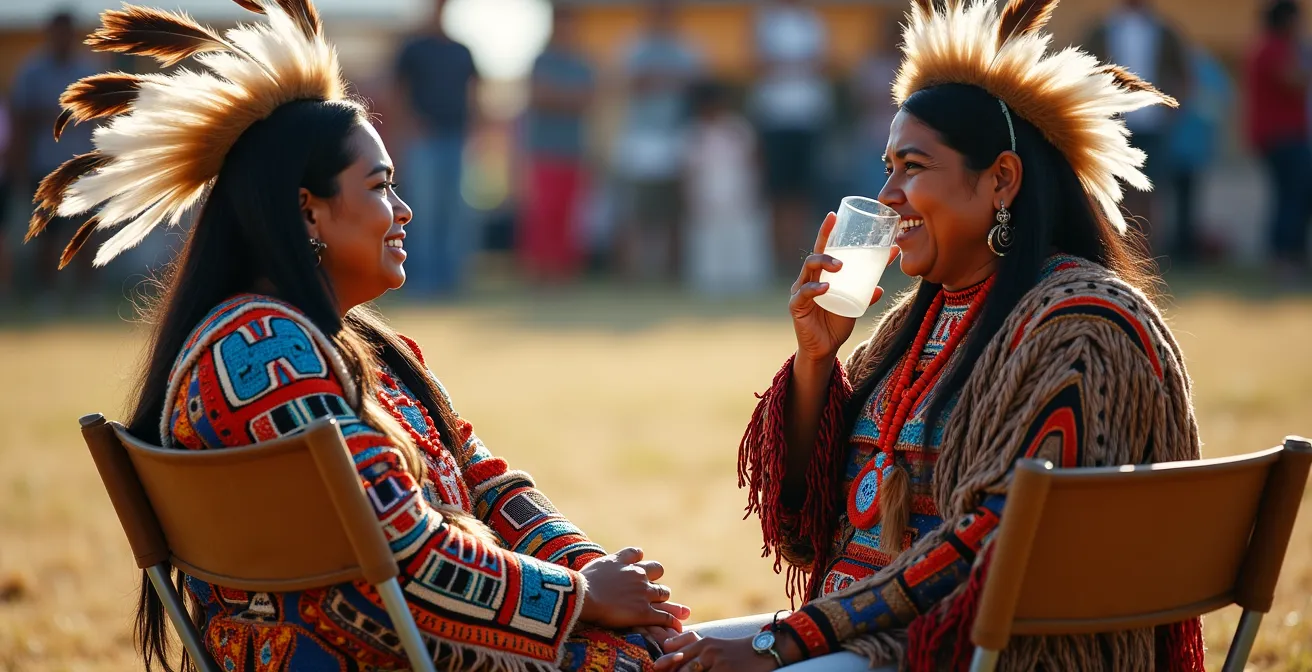
When starting a conversation, focus on appreciation. Instead of a generic “I love your costume,” try something specific and respectful like, “Your regalia is beautiful. Could you tell me about the beadwork?” This opens the door for a genuine exchange rather than a simple compliment. For some, it is also a sign of deep respect to offer a small gift, such as tobacco or a modest cash offering, when asking for a photo or a significant amount of their time. This should be done quietly, humbly, and without expectation.
The ‘Replica’ Trap in Small Town Science Museums
The concept of authenticity extends beyond the marketplace and into the very way we think about culture. For decades, museums treated Native American cultural items—including sacred objects and human remains—as scientific specimens to be studied. This mindset is what leads to the “replica trap,” where non-Native companies produce and sell imitations of sacred objects like pipes, headdresses, or ceremonial items, framing them as educational or decorative. This is a form of cultural appropriation.
The passage of the Native American Graves Protection and Repatriation Act (NAGPRA) in 1990 forced a reckoning in the museum world. It legally required institutions to inventory their collections and, upon request, return sacred items and ancestral remains to their tribal communities. This marked a monumental shift from viewing these items as artifacts to recognizing them as essential parts of a living culture that needed to be returned home. This principle is vital for a powwow visitor to understand: you are there to witness a living culture, not to consume a collection of artifacts or their replicas.
Buying a “replica” sacred item is not a tribute; it is a violation that trivializes the spiritual significance of the object. Authentic culture is not a product that can be duplicated. It is embodied in the artists and community members themselves. The only respectful way to acquire a piece of that culture is to purchase an authentic, non-ceremonial craft directly from a Native artist who has the right to create and sell it.
Your Action Plan: Purchasing with Respect
- Identify the source: Is this item being sold by a Native artist at a powwow or a non-Native business online? Prioritize buying directly from the creator.
- Distinguish the item’s nature: Is this a piece of art like jewelry or a blanket, or is it a replica of a sacred or ceremonial object like a pipe or headdress? Never purchase replicas of sacred items.
- Frame your purpose: Are you seeking to support a living culture by purchasing an artist’s authentic work, or are you trying to acquire a symbol of “Indianness”? Focus on the former.
- Ask questions: Engage with the artist about their work. This act of communication is a form of respect and helps confirm authenticity.
- Support beyond the powwow: Follow artists you meet on social media and purchase from their online shops later. This continues the relationship of reciprocity.
Why Yellowstone’s Geothermal Features Are More Dangerous Than They Look?
In Yellowstone National Park, visitors are warned to stay on the boardwalks. The ground around the geothermal features looks solid, but just beneath the surface, boiling, acidic water can cause severe injury or death. The danger is real, even if it is invisible. This provides a perfect analogy for understanding sacred space at a powwow. The most important boundaries are often the ones you cannot see.
The central dance area, known as the arbor, is the most prominent example. Before the powwow begins, the arbor is blessed, setting it apart as a sacred space for the duration of the event. To a visitor, it might just look like a circle of grass or dirt, but crossing it to get to the other side is a major breach of etiquette. It is equivalent to walking across the altar in a church during a service. You must walk around the circle. The only time guests may enter the arbor is when the MC explicitly invites everyone for an inter-tribal dance, a round dance, or a special honoring dance.
This principle of invisible but absolute boundaries applies elsewhere. The drum circle, for example, is the heartbeat of the powwow. The drum is considered a sacred entity, and only those with permission from the Lead Singer may sit at the drum. It is not a place for spectators or curious children. Similarly, if an eagle feather falls from a dancer’s regalia, you must not touch it or pick it up. An eagle feather is profoundly sacred. You should notify the MC or an arena director immediately, as a special ceremony is required to retrieve it. In all these instances, like at Yellowstone, you are being asked to respect boundaries that protect something sacred, powerful, and not immediately visible.
Key Takeaways
- Respect begins with recognizing tribal sovereignty; you are a guest in a self-governing nation with its own laws and customs.
- Authenticity is paramount. Support living culture by purchasing art directly from Native artists and never buying replicas of sacred items.
- The powwow grounds contain sacred spaces, like the dance arbor and the drum, with invisible but absolute boundaries that must be respected at all times.
How to Travel the Civil Rights Trail from Selma to Montgomery?
At first glance, the Civil Rights Trail from Selma to Montgomery and a Native American powwow may seem unrelated. But both are powerful American stories about the fight for self-determination, justice, and the right to exist. The struggle for civil rights is a struggle for sovereignty, whether it’s the right to vote or the right to govern one’s own nation. Viewing your powwow visit through this lens transforms it from a simple cultural event into a chance to witness the living legacy of that ongoing fight.
Tribal sovereignty is not a historical artifact; it is a dynamic, contemporary reality. After the McGirt decision reaffirmed reservation boundaries, tribal nations like the Choctaw had to rapidly expand their justice systems to handle new caseloads. In just a few years, the Choctaw Nation’s court system saw a staggering 957% increase in cases since 2020, demonstrating an immense capacity for self-governance. This is sovereignty in action. When you attend a powwow, you are being welcomed by a nation that has fought for and continues to exercise its right to self-rule, much like the activists on the Civil Rights Trail fought for their fundamental rights.
This understanding should shape your actions after you leave. Being a respectful guest evolves into being a good ally. Learn about the specific history and contemporary issues of the host tribe. Support Native-owned businesses, follow Native activists and artists online, and correct misinformation when you encounter it. Most participants are glad to share their culture with those who are genuinely interested. Your journey as a respectful guest doesn’t end when the last song is sung; it continues in how you carry that experience and understanding back into your own community.
Your visit to a powwow is an opportunity for profound connection. By applying these principles of respect for sovereignty, sacredness, and living culture, you can ensure your experience is one of honor, learning, and genuine exchange, and become an informed ally in the continued story of Native American resilience.
Frequently Asked Questions about Powwow Etiquette
Why can’t I cross through the dance arena to get to the other side?
The dance arena, or arbor, is a blessed and sacred space. Crossing through it is disrespectful, similar to walking across an altar during a church service. The MC coordinates all activity within the arbor, and you must walk around the outside unless specifically invited in for an inter-tribal dance.
What happens if an eagle feather falls during dancing?
If you see a feather fall from a dancer’s regalia, do not touch or pick it up. Eagle feathers are considered extremely sacred. You should find the MC, an arena director, or the Powwow Host as soon as possible and discreetly point it out. A special ceremony is required to retrieve the feather.
Are there physical areas that are completely off-limits?
Yes. The drum circle is a key sacred area. The drum is considered the heartbeat of the powwow, and only those who have been given permission by the Lead Singer may sit at the drum. It is especially important to ensure children do not wander into this area.