The key to a rewarding visit to a historic site isn’t just skipping the line, but adopting a curator’s mindset to actively engage with its purpose.
- This shift transforms you from a passive tourist checking a box to an active participant in the site’s story.
- It connects your visit—and your wallet—directly to the crucial work of preservation and education.
Recommendation: Before your next trip, research one site’s primary mission. Then, plan your visit not just to see it, but to consciously honor that mission.
We’ve all felt it: the crushing disappointment of arriving at a site of profound historical importance, like the Liberty Bell, only to be met with a three-hour queue, a sea of selfie sticks, and an atmosphere more akin to a theme park than a place of reflection. The standard advice is predictable: go early, visit in the off-season, buy tickets online. These are logistical tricks that might save you time, but they fail to address the core problem—a disconnect from the very meaning we came to find.
This guide is not about simple crowd-avoidance tactics. It’s about a fundamental shift in perspective. For families and history buffs tired of superficial experiences, the solution is not to be a more efficient tourist, but to become a more thoughtful one. It’s about adopting a curator’s mindset: understanding that these places are not mere backdrops for our vacation photos, but fragile artifacts and sacred spaces, each with a story that demands more than a passing glance. This means learning to see our role not just as consumers of history, but as its temporary stewards.
But what if the real secret to a profound visit wasn’t found in a shorter line, but in understanding why your ticket matters, how to frame a photo with dignity, or when to choose a human guide over a recording? By exploring the purpose behind these sites, we can unlock a deeper, more meaningful connection to American history, transforming a frustrating trip into an unforgettable educational journey. This article will guide you through that transformation, showing you how to engage with the nation’s most important places with the respect and insight they deserve.
text
To help you navigate these principles, this article is structured to build your ‘curator’s mindset’ step by step, from understanding the economics of preservation to the ethics of witnessing history. Here is a look at the path we will travel together.
Summary: A New Approach to Experiencing American History
- Why Your $20 Ticket to Mount Vernon Is Crucial for Preservation?
- How to Teach Your Kids American History Through a 3-Day DC Itinerary?
- Audio Guide vs. Live Ranger: Which Offers the Best Insight into Alcatraz?
- The Selfie Mistake That Got a Tourist Banned from the Alamo
- When to Visit Gettysburg to Experience the True Solemnity of the Battlefield?
- Why American Museums Have Names on Every Hall and Bench?
- The Selfie Mistake at the Lorraine Motel Balcony
- How to Travel the Civil Rights Trail from Selma to Montgomery?
Why Your $20 Ticket to Mount Vernon Is Crucial for Preservation?
It’s easy to view a $20 entrance fee to a site like Mount Vernon as just another travel expense. However, this transaction is one of the most direct ways a visitor can shift from a passive consumer to an active participant in preservation. Historic sites are not static monuments; they are incredibly complex and expensive operations facing constant threats from time, weather, and the environmental impact of millions of visitors. Your ticket is not just for access; it is a vital act of economic stewardship that funds everything from roof repairs to archival conservation.
The financial reality for many of America’s treasured places is precarious. Even federally managed sites are not immune; the National Park Service faces a staggering $12.5 billion in deferred maintenance across its properties. For privately-run historic homes like Mount Vernon, which receives no government funding, visitor revenue is the primary lifeline. This money pays for the specialized labor of historians, archeologists, and conservationists who work to keep the story of the site alive and accurate. Without this steady stream of support, these irreplaceable pieces of history would deteriorate and their stories would fade.
Therefore, when you choose to visit and pay for entry, you are casting a vote for that site’s continued existence. This principle extends beyond the ticket booth. Every purchase from an official gift shop, every donation dropped in a box, and every membership to a site’s foundation directly contributes to its mission. Seeing your spending as a form of support transforms the visit from a simple transaction into a meaningful contribution to our collective heritage.
How to Teach Your Kids American History Through a 3-Day DC Itinerary?
Visiting Washington, D.C. with children can feel like a frantic race to check off monuments. The key to transforming this from a history-themed scavenger hunt into a meaningful educational experience is to build a narrative. Instead of just seeing places, you can guide them through the *ideas* that built the nation. A thematic itinerary helps connect disparate locations into a coherent story, making history feel less like a collection of facts and more like a compelling drama they can step into.
A successful trip requires focusing on a core theme each day. This approach helps children process complex ideas by breaking them down into digestible chapters. Consider this three-day structure for exploring the American story:
- Day 1 – The Idea of a Nation: Start at the National Archives to see the founding documents—the Declaration of Independence and the Constitution. This isn’t just old paper; it’s the “why” of America. Then, move to the U.S. Capitol to see where those ideas are debated and turned into law, understanding democracy in action.
- Day 2 – The Struggle for Freedom: This day confronts the nation’s contradictions. Begin at the National Museum of African American History and Culture to understand the centuries-long fight for freedom and equality. In the late afternoon, visit the Lincoln Memorial for quiet reflection at sunset, connecting the words on the wall to the struggles explored earlier.
- Day 3 – The Price of Liberty: History is also about sacrifice. A morning visit to Arlington National Cemetery offers a solemn understanding of this cost. In the afternoon, exploring the World War II and Vietnam Veterans Memorials brings that sacrifice into a more personal, tangible focus.
To enhance the journey, prepare before you go with age-appropriate documentaries or books. Afterward, spark discussion with questions like, “If you could build a monument today, who or what would it honor, and why?” This transforms them from passive observers into active thinkers about history and their place in it.
Audio Guide vs. Live Ranger: Which Offers the Best Insight into Alcatraz?
Upon arriving at a site like Alcatraz, visitors are faced with a choice that fundamentally shapes their experience: the self-paced, immersive audio tour or the scheduled, interactive talk led by a National Park Service Ranger. While both have merits, understanding their distinct purposes is key to making a choice that aligns with your goal for the visit. It’s a decision between a personal, cinematic narrative and a shared, educational dialogue.
The “Doing Time” audio guide is a masterclass in storytelling. Featuring the voices of former inmates and guards, it provides an emotionally resonant, first-person perspective on life inside the prison. For a first-time visitor, it’s often the best way to get a comprehensive and atmospheric overview of the main cellhouse. However, it is a closed loop—a pre-recorded script that cannot answer your specific questions or adapt to your interests.
| Aspect | Audio Guide ‘Doing Time’ | Live Ranger Talk |
|---|---|---|
| Narrative Style | First-person accounts from inmates and guards | Expert historical context and analysis |
| Flexibility | Self-paced, pause and replay available | Fixed schedule, group experience |
| Interactivity | None – pre-recorded content | Q&A opportunity with expert |
| Emotional Impact | Immersive personal stories | Educational with broader context |
| Best For | First-time visitors wanting full experience | Return visitors seeking deeper knowledge |
In contrast, a live Ranger talk offers something an audio guide never can: direct human connection and expertise. As the National Park Service itself notes in its guides, the value of a ranger is their ability to provide unique context. In the Independence National Historical Park Guide, an expert from the National Park Service highlights this difference, explaining how live interpretation brings history to life in a way a recording cannot.
Rangers can read a group’s interest, share unscripted anecdotes, and provide a direct link to the National Park Service’s educational mission.
– National Park Service, Independence National Historical Park Guide
For return visitors or those with specific interests—like the island’s military history or its native activism—a Ranger talk is invaluable. It provides an opportunity to ask nuanced questions and hear stories that aren’t on the official recording. The ideal visit, if time allows, involves both: using the audio guide for the core narrative and attending a Ranger program to deepen your understanding.
The Selfie Mistake That Got a Tourist Banned from the Alamo
The impulse to document our travels is natural, but at solemn historic sites, a photograph can cross the line from respectful documentation to offensive behavior. The story of a tourist being asked to leave—or in some cases, banned—from a site like the Alamo for inappropriate photography is not an urban legend; it’s a recurring issue that highlights a critical misunderstanding of place. These locations are not simply tourist attractions; many are considered sacred spaces, active memorials, or even tombs. The “selfie mistake” is treating a site of sacrifice as a personal photo backdrop.
An analysis of visitor policies at America’s most solemn sites reveals a shared principle: the need to balance public access with profound respect. Each site enforces this differently, but the underlying ethic is the same. As a comparative study of visitor conduct policies shows, there’s a clear distinction between documentation and performance. For example, the Alamo requires men to remove their hats inside the Chapel, treating it as a shrine. The USS Arizona Memorial at Pearl Harbor, which sits above the remains of over 1,100 crewmen, explicitly prohibits posed or “happy” photos in the shrine room. Similarly, while the 9/11 Memorial allows respectful photography of the site, it bans celebratory poses and commercial use, reinforcing its primary role as a place of remembrance.
The core of the issue is a failure to see the site as the subject. Appropriate photography focuses on the architecture, the names on a memorial wall, or the landscape itself. Inappropriate photography makes the visitor the subject, with the site of tragedy reduced to a prop. This shift in focus, from “Here I am at this place” to “This is the place and this is what it represents,” is the essence of what can be called dignified witnessing. It is an acknowledgment that your presence is secondary to the history and the memory the site is meant to preserve.
When to Visit Gettysburg to Experience the True Solemnity of the Battlefield?
Gettysburg is more than a park; it is a vast, open-air cemetery where the course of American history was altered. While any visit is educational, experiencing its profound solemnity requires a deliberate choice of timing that goes beyond simply avoiding the summer crowds. The goal is not just to see the monuments, but to feel the weight of the landscape where 7,000 men died. The “when” of your visit directly impacts the “what” you experience, trading the energy of a bustling park for the quiet gravity of a hallowed ground.
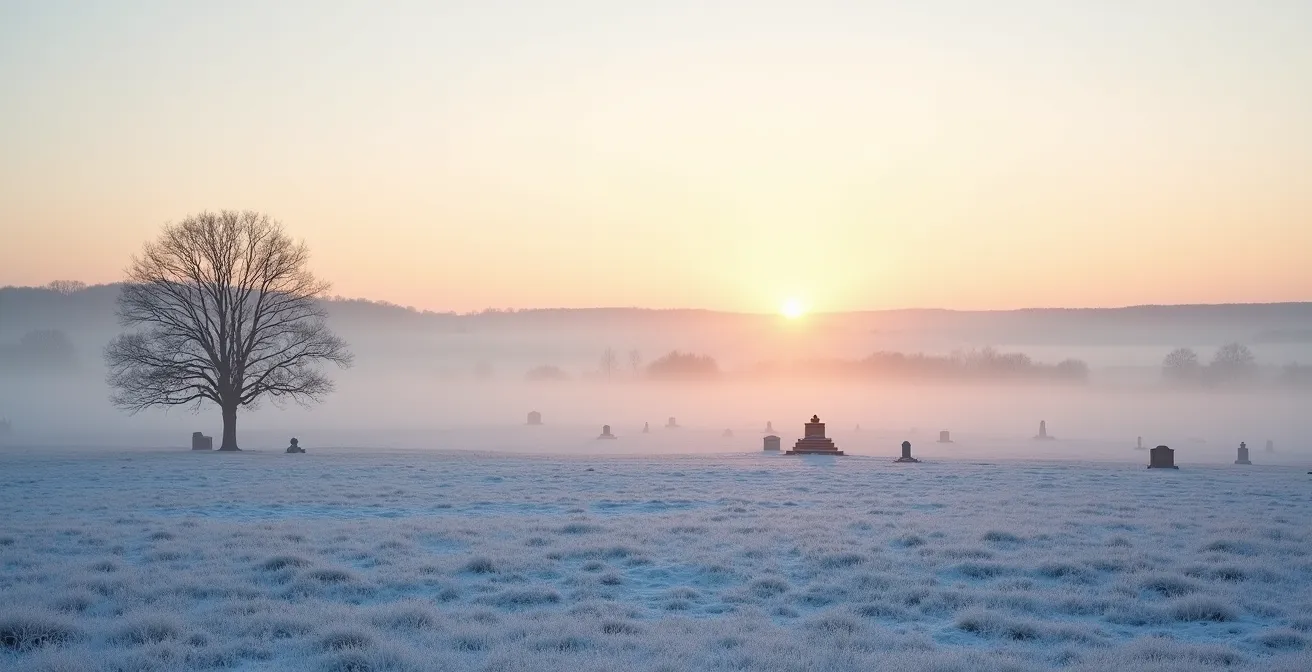
To connect with the true spirit of the place, timing is everything. The massive crowds that gather for the battle’s anniversary in July, while historically significant, can create an atmosphere that feels more like a festival than a memorial. For personal reflection, a different approach is needed. Consider a visit during the off-season, particularly on a winter weekday morning. The battlefield under a blanket of snow, shrouded in mist, offers a stark and powerful solitude that allows for profound contemplation. The bare trees and quiet fields make it easier to imagine the landscape as the soldiers saw it.
Beyond the season, the time of day can transform the experience. The “golden hours” of dawn and dusk are not just for photographers; the long shadows cast by the rising or setting sun emphasize the scale of the monuments and the rolling terrain of areas like Little Round Top and the Devil’s Den. This light creates a natural sense of drama and reverence. Furthermore, exploring lesser-known but equally significant areas, such as Culp’s Hill or the East Cavalry Field, offers a chance to escape the main tour routes and find a quiet corner to reflect on the battle’s immense scope and human cost.
Your Guide to a Contemplative Gettysburg Visit
- Attend the November Remembrance Day: Witness the powerful candlelight illumination ceremony, where a candle is lit for each of the 3,512 Union casualties.
- Choose Winter Weekday Mornings: Experience the battlefield’s profound solitude under a blanket of snow, ideal for personal reflection.
- Utilize Dawn or Dusk: In any season, the low light of the golden hour accentuates the scale of monuments and the lay of the land.
- Explore Lesser-Known Areas: Visit Culp’s Hill and the East Cavalry Field, which hold equal significance but attract fewer crowds.
- Avoid Peak Anniversary Crowds: For a more personal connection, opt for quieter commemoration times outside of the main July events.
Why American Museums Have Names on Every Hall and Bench?
Walking through a major American museum, you will inevitably see them: names etched onto walls, plaques on benches, and entire wings dedicated to a single family. To a visitor from a country with state-funded arts, this can seem odd. But these names are not just for show; they are the visible evidence of a uniquely American model of cultural funding built on private philanthropy. Understanding this model is key to understanding the institutions themselves. Unlike many of their European counterparts, which are considered state responsibilities, American museums are largely community-supported charities.
The numbers are telling. In the United States, it’s common for major museums to rely on private philanthropy for 60% to 80% of their annual operating budgets. This includes individual donations, corporate sponsorships, and income from endowments established by wealthy patrons. This funding model has deep historical roots, reflecting a long-standing American cultural attitude that favors private initiative over government intervention in the arts. It creates a system where the health and growth of a museum are directly tied to its ability to cultivate relationships with its community and donors.
A tale of two museums perfectly illustrates this difference. The Metropolitan Museum of Art in New York operates on a massive annual budget, the majority of which comes from private sources. The famous American Wing, for example, exists almost entirely thanks to the generosity of donors whose names are inscribed throughout its galleries. In contrast, the Louvre in Paris receives about half of its budget directly from the French government. Its galleries are named not for donors, but for historical figures or the contents within. The names on the walls of the MET are, therefore, a public acknowledgment of the social contract that sustains it: in exchange for financial support, donors receive recognition and a legacy intertwined with the institution they helped build.
The Selfie Mistake at the Lorraine Motel Balcony
The balcony of the Lorraine Motel in Memphis, now the centerpiece of the National Civil Rights Museum, is one of the most sacred and somber places in America. It is the exact spot where Dr. Martin Luther King Jr. was assassinated. Yet, it is also a site where visitors, caught up in the moment of being there, sometimes make a profound error in judgment: posing for a smiling selfie. This act, however unintentional, treats a site of martyrdom as a tourist backdrop and represents a deep failure of historical empathy. It stems from forgetting a simple but powerful truth.
The National Civil Rights Museum’s own guidelines offer the most succinct and powerful explanation. As they state, the goal is to see the location for what it truly is. Their perspective is clear and direct, framing the motel not as a setting for the museum’s exhibits, but as the most important exhibit itself.
The location isn’t a backdrop for the museum; it IS the primary artifact.
– National Civil Rights Museum, Museum Visitor Guidelines
This single idea—the site as artifact—is the key to behaving appropriately. You wouldn’t pose grinning on top of the Declaration of Independence, and the same principle applies here. The balcony is not a replica; it is the physical object at the center of a world-changing historical event. To treat it with the respect it deserves requires a conscious shift from being a tourist to being a witness. Your role is not to insert yourself into the scene, but to observe it, reflect on its meaning, and honor the memory of what happened there.
Checklist for Dignified Digital Witnessing
- Photograph the Memorial, Not Yourself: Focus your camera on the memorial wreath, the historical plaque, or the architecture itself rather than posing at the site.
- Share Reflections, Not Just Photos: On social media, accompany your image with written reflections about the visit’s impact or a quote from Dr. King.
- Tell the Broader Story: Capture photos of the educational displays and exhibits inside the museum that provide crucial historical context.
- Use Geotags for Education: Tag the location to help your followers discover the site and encourage them to learn about its history.
- Post Context, Not Selfies: Share historical facts or relevant quotes instead of images that place you at the center of the narrative.
Key Takeaways
- The most rewarding historic site visits come from a mindset shift—from passive tourist to active, respectful participant.
- Your financial contributions, from tickets to gift shop purchases, are a vital form of economic stewardship that directly funds preservation.
- Dignified witnessing means treating solemn sites as the primary artifact, not a backdrop, and using photography to honor their story, not your presence.
How to Travel the Civil Rights Trail from Selma to Montgomery?
Traveling the 54-mile route from Selma to Montgomery is not a simple road trip; it is a pilgrimage along one of the most important corridors of American history. To experience its full power, one must approach it not as a series of stops, but as a three-act-play that unfolds across the Alabama landscape. This journey requires applying all the principles of a curator’s mindset: understanding the context, engaging with the narrative, and bearing witness with dignity. The trail traces the arc of a pivotal struggle, from violent confrontation to a triumphant march for justice.
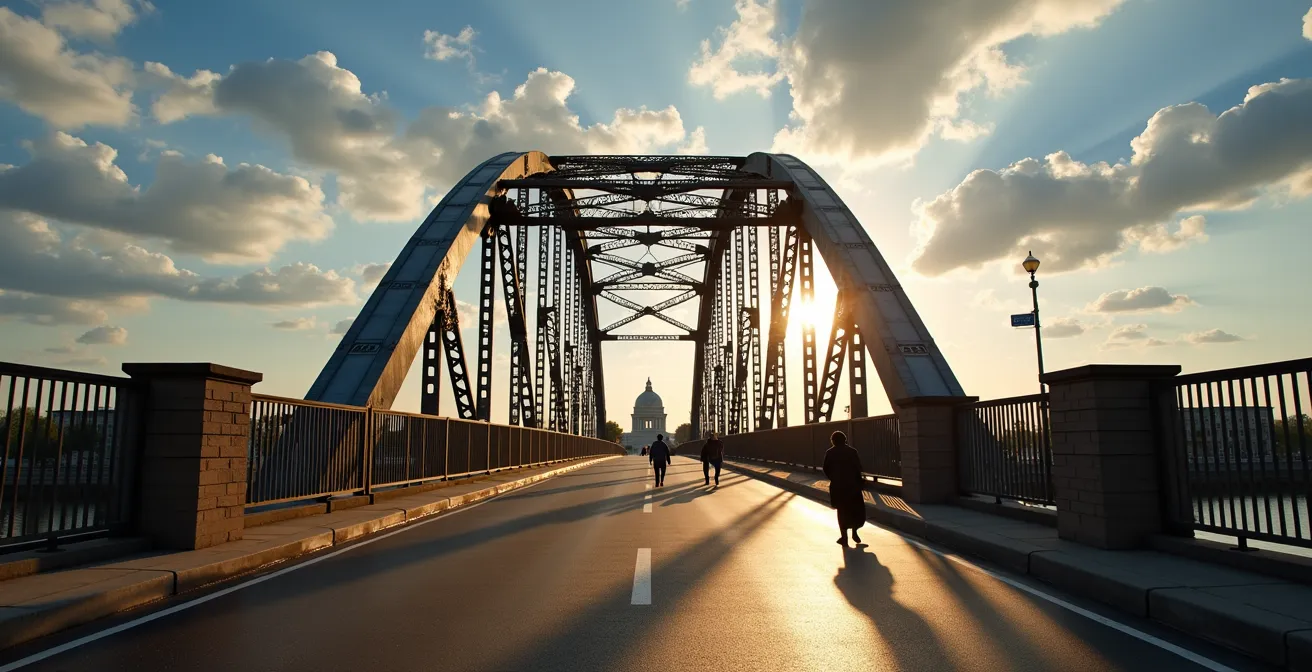
The journey’s narrative integrity is best understood through its geographic and emotional progression. According to the National Park Service, which interprets the route, the trip can be structured into three distinct acts, each centered on a key location and theme.
- Act I: Confrontation in Selma. The journey begins at the Edmund Pettus Bridge, the site of “Bloody Sunday.” Standing on this bridge is a visceral experience. It is a place of brutal confrontation, a symbol of the violent resistance to the fight for voting rights. Your role here is one of solemn witness to the courage it took to cross this bridge in the face of hate.
- Act II: The March on U.S. Route 80. The second act follows the historic march route itself. This stretch of highway is dotted with markers, including the memorial for Viola Liuzzo, a white activist murdered for her involvement. This part of the journey is about understanding the sacrifice and solidarity required to sustain the movement. It is a time for reflection on the road’s physical and metaphorical length.
- Act III: Culmination in Montgomery. The pilgrimage culminates at the Alabama State Capitol steps, where Dr. King delivered his powerful “How Long, Not Long” speech. This is the act of arrival and resolution. The journey is then contextualized by a visit to the nearby Legacy Museum and the National Memorial for Peace and Justice, which connect the history of the Civil Rights Movement to the ongoing struggles for racial justice today.
Traveling the Selma to Montgomery National Historic Trail with this narrative structure in mind transforms it from a drive into a profound educational experience. It allows you to move through the story as the activists did, understanding the escalating stakes and the ultimate triumph of their cause.
Now, armed with this new perspective, plan your next historical journey not as a trip, but as an act of engagement. Choose a site, learn its true purpose, and visit it with the respect and curiosity of a curator. You won’t just see history—you will connect with it.
Frequently Asked Questions about Visiting Historic Sites
Why are photography rules stricter at memorial sites than other tourist attractions?
Memorial sites commemorate loss of life and sacrifice, requiring visitors to balance the desire for documentation with respect for the deceased and their families. The primary purpose is remembrance, not tourism, so rules are in place to maintain a solemn and dignified atmosphere.
What constitutes appropriate photography at solemn historical sites?
Appropriate photography focuses on the architecture, landscape, and memorial elements themselves. It avoids celebratory or casual poses (like smiling selfies or “thumbs-up” gestures) and is done in a way that maintains a quiet, respectful demeanor, without disrupting others’ reflections.
How can social media posts honor rather than trivialize historic sites?
To honor a site, your post should aim to educate. Share historical context you learned during your visit, post a meaningful quote related to the site’s history, or write a personal reflection on its impact. This treats the location as a place of significance rather than just a visually interesting backdrop.