
Despite popular belief, saving money in big US cities isn’t about buying passes or skipping experiences—it’s about decoding the city’s hidden systems.
- City passes often fail to reach their “breakeven point” for the average visitor, costing you more.
- The “cheapest” suburban hotel becomes expensive when you factor in lost time and transportation costs.
Recommendation: Adopt a local mindset by calculating the “true cost” of every decision, from where you stay to what you eat, to unlock a more authentic and affordable trip.
That magnetic pull of New York’s skyline, Chicago’s architectural canyons, or LA’s sprawling energy is undeniable. You want to dive in, see the icons, and feel the pulse of the city. So you start planning, and the conventional wisdom floods in: grab a city pass to “save” on attractions, book a cheaper hotel outside downtown, and stick to the well-trodden tourist path. It’s the standard playbook, the one that promises efficiency but often delivers a generic, overpriced, and frustrating experience.
What if that playbook is designed for tourists, not for savvy travelers? The real secret to conquering a major American city on a budget isn’t about skipping the good stuff; it’s about learning to see the hidden systems that locals navigate every day. It’s about understanding the psychology of a street scam, the real math behind a transit pass, and the economic power of choosing a local diner over a global chain. This isn’t just about saving money; it’s about trading a superficial visit for an authentic urban adventure.
This guide throws out the old rules. We’re going to break down the strategies that separate the tourists from the travelers. Forget generic advice. We’ll dive into specific, actionable tactics for mastering transit, finding real-deal cheap eats, and spotting the value traps that drain your wallet. Prepare to stop visiting and start experiencing the city on your own terms.
Here, we’ll break down the essential rules of the road, using real-world examples from America’s greatest cities to build your street-smart travel strategy. Consider this your playbook for navigating the urban jungle like you were born there.
Summary: The Savvy Local’s Playbook: Conquering Major US Cities on a Budget
- Why City Passes Often Cost More Than Single Tickets for Casual Tourists?
- How to Master the Chicago ‘L’ System Like a Local in 2 Days?
- Downtown vs. Suburbs: Where to Stay in LA to Avoid 2 Hours of Traffic?
- The Times Square Photo Scam That Costs Tourists $20 in Seconds
- How to Find Authentic Cheap Eats in San Francisco’s Tourist Districts?
- How to Snag Acela Business Class Seats at Coach Prices?
- Why Your $15 Burger Supports a Small Business Owner Directly?
- How to Read the History of Chicago Through Its Skyscrapers?
Why City Passes Often Cost More Than Single Tickets for Casual Tourists?
The city attraction pass is the ultimate tourist carrot, dangled with the promise of savings and convenience. But for the casual visitor—someone who wants to see the icons without running a marathon—it’s often a financial trap. The business model relies on a simple bet: that you won’t use it enough to hit the breakeven point. This is the first hidden system you need to decode. It’s not about the potential savings; it’s about the realistic cost.
Take New York City as a prime example. A one-day New York Pass can cost $146. A ticket to the Empire State Building is about $64, and entry to the Museum of Modern Art (MoMA) is $25. If you visit both, your individual cost is $89. You’re already $57 in the hole with the pass. To make it “worth it,” you’d need to cram in at least two or three more major, high-priced attractions in a single day, turning your trip into a frantic checklist rather than an experience.
The math gets even worse when you factor in logistics. Many top-tier attractions like the Empire State Building now require advance reservations, even for pass holders, eliminating the “skip the line” benefit. Furthermore, a detailed NYC pass comparison analysis shows that many passes operate on consecutive days, forcing a relentless pace that burns you out. Before buying any pass, do the simple math: list your must-sees, add up the individual ticket prices, and compare it to the pass cost. More often than not, paying as you go offers more freedom and is surprisingly cheaper.
How to Master the Chicago ‘L’ System Like a Local in 2 Days?
Every great city has a circulatory system: its public transit. Tourists see a confusing map of colored lines; locals see a grid of possibilities. Mastering this hidden system isn’t just about saving money on ride-shares; it’s about reclaiming hours of your day and gaining the freedom to explore spontaneously. In Chicago, that system is the ‘L’—the elevated train network that defines the city’s rhythm.
Forget trying to memorize the entire map on day one. Your strategy is to learn the loop and your line. The ‘L’ Loop is the central nervous system, a rectangle of elevated tracks circling Downtown (The Loop) that most lines run through. If you can navigate this hub, you can get almost anywhere. Identify the line closest to where you’re staying (e.g., the Brown Line for Lincoln Park, the Blue Line for Wicker Park or the airport) and understand how it connects to the Loop. That’s 90% of the battle.
This perspective transforms the train from a mere vehicle into a viewing platform. The ride itself becomes part of the experience, offering glimpses of the city’s architectural layers and neighborhood vibes that you’d miss underground or in a car.
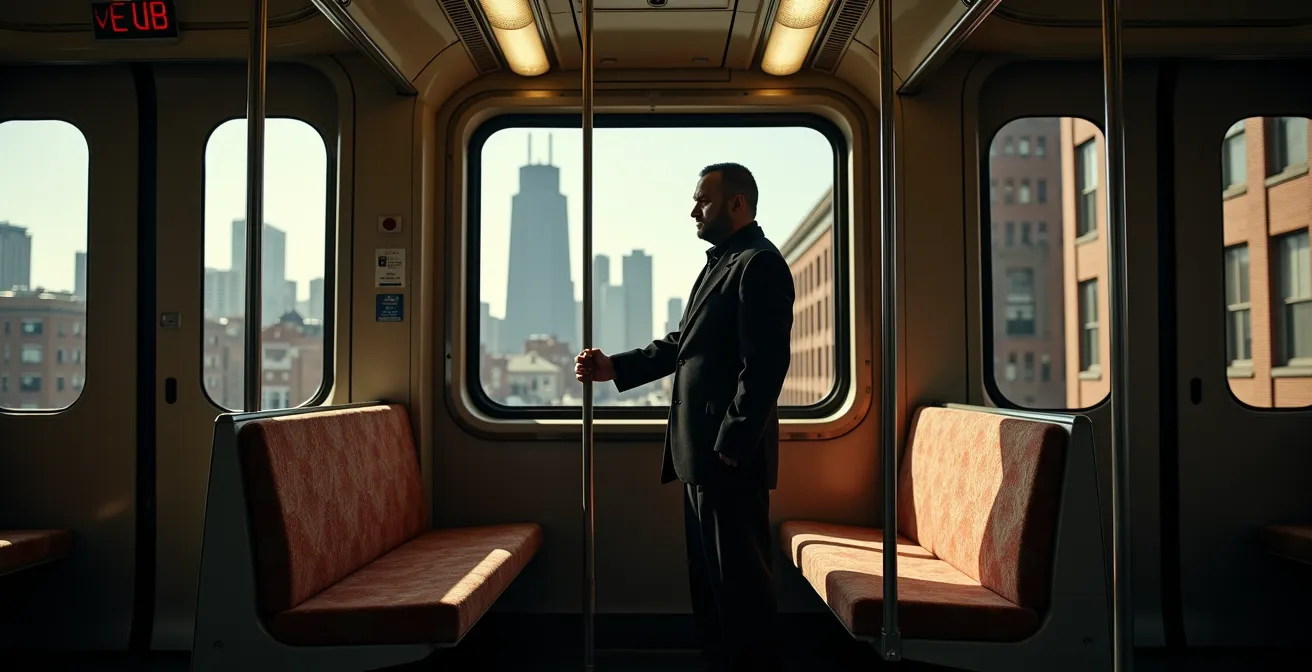
As this view from a Brown Line car shows, the ‘L’ offers a unique vantage point on the city’s famous architecture. Locals know the etiquette: let people off before you get on, move to the center of the car to make room, and have your Ventra card or contactless payment ready at the turnstile. Within two days of focusing on just your line and its connection to the Loop, you’ll be navigating with a confidence that makes you feel less like a visitor and more like a resident.
Downtown vs. Suburbs: Where to Stay in LA to Avoid 2 Hours of Traffic?
When booking accommodation, the sticker price is a liar. A $90-per-night hotel 30 miles outside of Los Angeles looks like a steal compared to a $180 room downtown. But this is where you must apply “True Cost Accounting”—a core principle of the savvy traveler. The real price isn’t just the room rate; it’s the rate plus the cost of transportation, parking, gas, and most importantly, your time.
That “cheap” suburban hotel quickly becomes a budget nightmare in a city like LA. You’ll need a rental car (add $45+/day), you’ll pay for parking at your hotel and at every attraction ($25+/day), and you’ll burn gas sitting in soul-crushing traffic ($15+/day). Suddenly, your $90 room actually costs you $175. And that’s before pricing the two to three hours of your life you’ll lose on the freeway each day—valuable time that could have been spent exploring.
The table below breaks down this hidden financial drain. It compares the “sticker price” with the “true daily cost” of staying in different locations, exposing why a centrally located option is often the smarter financial move, even with a higher nightly rate.
| Location | Nightly Rate | Car Rental/Day | Parking/Day | Gas/Day | Time in Traffic | True Daily Cost |
|---|---|---|---|---|---|---|
| Downtown LA | $180 | $0 (walkable) | $0 | $0 | 0 hours | $180 |
| Santa Monica | $160 | $0 (local transit) | $0 | $0 | 0.5 hours | $160 |
| Suburban (30mi out) | $90 | $45 | $25 | $15 | 2+ hours | $175+ |
By choosing a walkable neighborhood like Downtown LA or a transit-friendly area like Santa Monica, you eliminate the need for a car. You might pay more upfront for the room, but you save on all the ancillary costs and, crucially, you gain back hours of your day. The true bargain is the one that places you in the heart of the action, not miles away from it.
The Times Square Photo Scam That Costs Tourists $20 in Seconds
Times Square is a dazzling spectacle of light and energy, but it’s also an ecosystem of street hustles designed to separate you from your money. The most pervasive is the costumed character photo scam. It’s a masterclass in psychological manipulation that works because tourists don’t understand the unwritten rules of the street. It seems harmless: someone dressed as a popular character waves, high-fives your kid, and poses for a “free” photo. Seconds later, they’re aggressively demanding a $20 “tip.”
This isn’t a friendly street performance; it’s a calculated hustle. The following case study breaks down the tactics they use.
Case Study: Times Square Costumed Character Aggressive Tactics
A documented pattern shows costumed characters in Times Square using forced reciprocity tactics: approaching tourists for ‘free’ photos, then aggressively demanding $20-40 tips. The psychological trap works through ambiguity (no stated price upfront), social pressure (group intimidation), and surprise timing (demand comes after photo is taken). The key difference from legitimate performers, as noted by tourism safety analysts, is that aggressive characters initiate contact without consent and demand specific amounts, while genuine street performers display clear tip containers and accept voluntary donations.
The key to avoiding this is to recognize the script and have your own counter-script ready. Legitimate street performers create a stage and let you approach them; hustlers invade your personal space. Your defense is polite, firm disengagement. Never accept anything handed to you, and don’t stop moving. If you’re caught off guard, a firm “No, thank you” while walking away is usually enough. Knowing how to react is crucial, as hesitation is what they prey on.
Your Action Plan: The Polite Disengagement Script for NYC Street Hustlers
- No Eye Contact: Make no eye contact and keep walking at a steady pace. Acknowledgment is an invitation.
- Firm Verbal Cue: Use a firm “No, thank you” while continuing your movement. Don’t break your stride.
- The Hand Gesture: Hold up your hand in a clear “stop” gesture without slowing down. It’s a universal sign of non-interest.
- Sidestep and State: If an individual physically blocks your path, step sideways and clearly state, “Not interested.”
- Refuse and Return: Never accept anything placed in your hands (like a “free” CD). Immediately hand it back and walk away.
How to Find Authentic Cheap Eats in San Francisco’s Tourist Districts?
Finding affordable, authentic food in a tourist hotspot like San Francisco’s Fisherman’s Wharf or Chinatown can feel impossible. You’re surrounded by generic, overpriced restaurants with laminated menus and bland food. The secret isn’t to flee these districts entirely, but to learn how to read the visual cues that signal a real, family-owned gem hiding in plain sight.
First, ignore the hawkers. Anyone trying to lure you into their restaurant from the street is a red flag. Second, look for the opposite of polished. A truly beloved local spot often has worn signage, a menu taped to the window that’s only in one language (or has hand-written additions), and a steady stream of locals, not just tourists. Look for the small, unassuming storefronts squeezed between the flashy souvenir shops. These are the places that have survived for decades not on tourist traffic, but on the loyalty of the community.
In San Francisco’s Chinatown, for example, the best dim sum or noodle shops are often down a side alley, with a simple sign and a line of neighborhood residents waiting patiently. These are the places where a $15 meal is not just a transaction but an experience—a taste of the city’s true flavor, prepared with generations of pride.

The texture and atmosphere of a place tell a story. Weathered chopsticks, steaming bowls, and the hum of a local dialect are all signs you’re in the right spot. Train your eye to look for these details of authenticity. Instead of asking “What’s popular?” ask “What looks real?” By shifting your focus from the polished facade to the lived-in character, you’ll uncover the culinary soul of the city, and your wallet will thank you for it.
How to Snag Acela Business Class Seats at Coach Prices?
Your street-smart strategy doesn’t end at the city limits. If you’re traveling between major hubs on the East Coast, like from NYC to Boston or D.C., you’ll likely encounter the Amtrak Acela. It’s the fastest train option, but a standard Business Class ticket can be prohibitively expensive. However, another hidden system exists here for the savvy traveler: the Amtrak BidUp program. It’s an auction-style system that allows you to upgrade your cheap coach seat for a fraction of the cost.
The program isn’t heavily advertised, but it can be a game-changer for your budget and comfort. It allows you to bid a small amount for a potential upgrade to a spacious Business Class seat with free drinks and at-seat service. The key is bidding strategically, not emotionally. Winning bids are often surprisingly low, especially if you’re traveling at the right time.
This approach turns a standard transit leg into a luxurious experience without the luxury price tag. Here’s how it works in practice:
Case Study: The Amtrak BidUp Program Success Strategy
The Amtrak BidUp program allows coach ticket holders to bid for Business Class upgrades in the days leading up to departure. As seasoned travelers have documented, strategic minimum bids ($35-50) on “shoulder” trains (midday departures between 10 am and 2 pm) often succeed. This can effectively upgrade a $99 coach seat to a Business Class experience that would normally cost $199 or more. The keys to success are bidding as soon as the upgrade window opens (usually 72 hours before departure), targeting mid-week travel days (Tuesday-Thursday), and avoiding peak commuter hours for the highest probability of a winning bid.
By understanding this system, you’re not just buying a ticket; you’re playing the odds in your favor. A small, smart bid can transform a cramped coach ride into a relaxing, productive journey, proving that luxury travel is sometimes just a matter of knowing when and how to ask for it.
Why Your $15 Burger Supports a Small Business Owner Directly?
Every dollar you spend on a trip is a vote. You’re either voting for a multinational corporation or for a local family. That $15 you spend on a burger at a chain restaurant in Times Square mostly funnels out of the city to a corporate headquarters. But that same $15 spent at a family-owned diner in Brooklyn or Queens enters what economists call the local economic loop. It’s a powerful force for maintaining the unique character of the neighborhoods you came to see.
When you eat locally, your money pays the salary of a local cook, supports the neighborhood bakery that supplies their buns, and helps the owner pay rent to a local landlord. This “multiplier effect” is significant. For example, in New York City, visitor spending on food is substantial, and a large portion of it can be retained within the community when directed properly. In fact, while the $87 average daily food spending per visitor is high, an estimated 65% of revenue from local independent restaurants stays in the community.
This isn’t an abstract economic theory; it has a real human impact. It’s the difference between a neighborhood feeling like an authentic, living place and a soulless corporate strip mall. The personal stories behind these businesses highlight the importance of conscious spending.
When tourists choose our $15 burger over a chain, they’re not just buying food – they’re supporting three generations of our family, our local suppliers in Queens, and helping us maintain the authentic neighborhood character that makes NYC special. Every dollar stays here and circulates through the community.
– A family-owned diner owner in Brooklyn
Choosing the local spot is an investment in the very authenticity you seek. It ensures that the unique, vibrant neighborhoods you love will still be there for your next visit. So next time you’re deciding where to eat, remember that your choice matters far beyond your own table.
Key Takeaways
- Always question the value of “deals” like city passes by calculating the real breakeven point for your personal itinerary.
- Embrace “True Cost Accounting” for accommodation: a cheap room with a long commute is often more expensive than a central one.
- Your spending is a vote. Prioritize independent, family-owned businesses to support the local economic loop and preserve neighborhood character.
How to Read the History of Chicago Through Its Skyscrapers?
The best things in a city are often free. The ultimate budget travel hack is learning to engage with your environment in a deeper way. Instead of just seeing skyscrapers as tall buildings, you can learn to read them like a history book. Chicago, the birthplace of the modern skyscraper, offers the perfect classroom for this kind of architectural storytelling. A walk along the Chicago River is a free, world-class museum tour if you know what to look for.
Each building tells a story about the era in which it was built—its ambitions, its technology, and its aesthetics. You can see a century of architectural evolution just by turning your head. The ornate, gothic spires of the 1920s Tribune Tower speak of a reverence for European history, while the minimalist, glass-and-steel structures of Mies van der Rohe from the 1950s champion a new, stark modernism. You don’t need a paid tour to appreciate this; you just need a little context and a clear path.
The Chicago Riverwalk provides the perfect self-guided route to trace this history. By following a simple timeline, you can witness the city’s story unfold from stone to steel to shimmering, gravity-defying glass. This approach transforms a simple walk into an active, engaging lesson in history and art.
- Start at the Michigan Avenue Bridge: Look east to the 1920s Wrigley Building, a classic example of ornate terra-cotta Art Deco, and contrast it with the 1929 Tribune Tower, a masterpiece of Neo-Gothic design.
- Walk West to Marina City: Here you’ll find the iconic 1960s “corn cob” towers. These buildings represent Bertrand Goldberg’s vision of organic architecture, a city within a city designed to combat urban sprawl.
- Continue to 333 West Wacker Drive: This 1983 building is famous for its shimmering, curved green glass facade that masterfully follows the bend of the Chicago River, reflecting the water and sky.
- Stop at the Willis Tower (Sears Tower) Vista Point: From a distance, you can identify the revolutionary 1973 “bundled tube” design by Fazlur Rahman Khan, a structural innovation that allowed skyscrapers to reach new heights.
- End at Wolf Point: Here, you can compare the ultra-modern St. Regis Chicago (2020) with the historic buildings across the river, witnessing a full 100-year evolution of skyscraper design in a single glance.
By learning to read the language of the buildings, you gain a profound connection to the city. This is the essence of savvy travel: finding immense value where others see nothing, and turning a simple walk into an unforgettable experience.
Stop being a tourist and start being a traveler. Use these rules, trust your gut, and arm yourself with a little local knowledge. The most authentic and affordable version of the city is waiting for you to discover it. Go own it on your next trip.