In summary:
- Mega-events like Mardi Gras aren’t random chaos; they are governed by predictable systems of economics, crowd flow, and logistics.
- Success depends on strategic pre-planning, treating your visit like a mission with clear objectives, intel, and extraction routes.
- Instead of just surviving the crowds, you can use an understanding of these systems to gain a tactical advantage and master your environment.
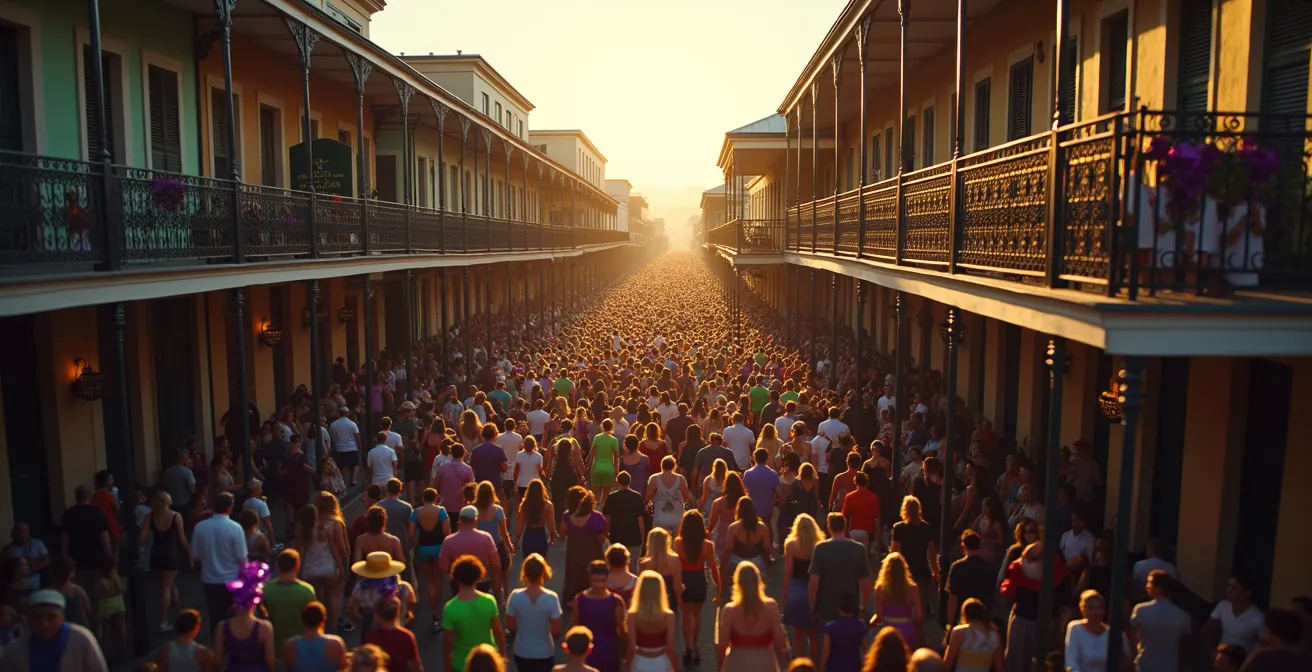
The thought of Mardi Gras conjures images of overwhelming crowds, a sea of people so dense that movement feels impossible. Most advice centers on generic tips: “stay hydrated,” “watch your wallet,” “have a meeting spot.” While well-intentioned, this is survival-level thinking. It treats you like a passive victim of chaos. But what if you could approach it like a professional? As an event safety coordinator, I don’t see chaos; I see systems. I see predictable patterns in crowd dynamics, economic pressures, and logistical chokepoints. The real key to experiencing massive US events safely and enjoyably isn’t about enduring the crush—it’s about understanding the underlying logistics to outsmart it.
This guide is your mission briefing. We will deconstruct the operational mechanics of America’s largest gatherings, from New Orleans to Pasadena. Forget vague warnings. We are going to analyze the economic forces that dictate costs, the legal frameworks you must navigate, the physics of crowd movement, and the tactical decisions that separate a stressful ordeal from a masterfully executed experience. You will learn to think like a planner, turning overwhelming challenges into strategic advantages. This is your playbook for navigating the human currents of Mardi Gras and beyond, ensuring you leave with great memories, not a sense of relief.
This article breaks down the core logistical systems you need to master. Follow this table of contents to navigate the key strategies for conquering any mega-event.
Contents: A Strategic Breakdown of Mega-Events
- Why Hotel Prices Triple During the Rose Bowl Parade?
- How to Rent a Balcony on Bourbon Street Legally?
- Macy’s Parade vs. Rose Parade: Which Is Better for Families?
- The Scalper Trap That Ruins Your Super Bowl Weekend
- When to Leave the French Quarter to Beat the Post-Parade Gridlock?
- How to Leave the Esplanade After the Show Without Getting Stuck for 2 Hours?
- When to Visit New Orleans to Catch Jazz Fest Instead of Mardi Gras?
- How to Watch the DC Fireworks from the National Mall Safely?
Why Hotel Prices Triple During the Rose Bowl Parade?
The first system you must understand is the harsh reality of event economics. The sticker shock from a hotel bill during a major event isn’t arbitrary; it’s a predictable outcome of extreme demand overwhelming a fixed supply. Events like the Rose Bowl or Super Bowl create what industry insiders call “compression nights,” where hotel occupancy pushes past 95%. This scarcity gives hotels immense pricing power. For example, research shows a 38% price increase nine days before the Super Bowl in Las Vegas, a pattern that holds true for nearly every mega-event. Understanding the mechanics behind this is your first step to mitigating costs.
Several factors contribute to these spikes. First is the limited inventory itself. A city has a finite number of rooms. Second is the “shadow inventory,” where event partners and corporations block-book thousands of rooms for packages, removing them from the public market and tightening supply even further. Price curves often peak around 110 days before the event, so last-minute booking is rarely a winning strategy. Single-day, high-intensity events like the Rose Bowl or the Super Bowl final often create even sharper, more dramatic price spikes than multi-week festivals, with luxury and upper-upscale hotels seeing the highest multipliers. By understanding these drivers, you shift from being a price-taker to a strategic planner who can book outside the peak curve or choose alternative locations.
This isn’t just about parades; it’s a universal principle. The same forces that triple a hotel price in Pasadena for the Rose Bowl are at play for a Mardi Gras booking in the French Quarter. Recognizing this pattern is the first step toward financial control.
How to Rent a Balcony on Bourbon Street Legally?
In the theater of Mardi Gras, a Bourbon Street balcony is the ultimate VIP box. It offers a prime vantage point above the crush, a place to see and be seen. However, this micro-economy is rife with risks, from outright scams to illegal rentals that can get you evicted mid-parade. Securing a balcony isn’t a simple transaction; it’s a legal and logistical process that requires due diligence. Treating this rental like a formal business agreement is crucial for protecting your investment and ensuring your safety. You must verify the legitimacy of the provider and the compliance of the space itself.
The city of New Orleans has specific regulations for these rentals, and ignoring them can lead to a ruined experience. An illegitimate rental may not have the required liability insurance, putting you at risk. Furthermore, they may violate strict fire department occupancy limits, creating a dangerous overcrowding situation. To avoid these traps, you must conduct your own reconnaissance. Simple verification steps can mean the difference between a memorable view and a costly mistake. If the price seems too good to be true, or if the “landlord” pressures you into using non-reversible payment methods, consider these major red flags.
Your Pre-Rental Intelligence Checklist: Bourbon Street Balconies
- Verify legitimacy: Cross-reference the owner’s name with City of New Orleans public records to confirm ownership.
- Check permits: Ask for and verify the required Occupational License and Mayoralty Permit numbers for the property.
- Confirm insurance: Ensure the provider can show proof of proper liability insurance documentation.
- Demand a contract: A formal contract outlining liability, rules, and precise occupancy limits is non-negotiable.
- Use safe payment: Avoid non-reversible payment methods like wire transfers or Zelle, which are favored by scammers.
Case Study: The Free Balcony Alternative
Local experts prove that an elevated view doesn’t have to come with a high price tag or legal risk. Several bars on Bourbon Street offer free-access public balconies on their second floors. Venues like Cat’s Meow (701 Bourbon St), Tropical Isle (721 Bourbon St), and Tickler’s Dueling Piano Bar (635 Bourbon St) provide a safer and fully legal option. While you might need to buy a drink, it’s a small price for securing the balcony experience without the risk of a rental scam.
Ultimately, navigating this system is about risk mitigation. By applying a layer of verification, you take control and ensure your prime viewing spot is secure, safe, and legal.
Macy’s Parade vs. Rose Parade: Which Is Better for Families?
A core principle of event strategy is “mission profiling”—choosing the right operation for your team’s capabilities and objectives. Not all mega-events are created equal, especially when your “team” is your family. The Macy’s Thanksgiving Day Parade in New York City and the Rose Parade in Pasadena, California, are both iconic American traditions, but they offer vastly different logistical experiences. Selecting the right one depends on a careful analysis of factors like transportation, crowd control, and setup requirements. What works for a group of adults may be a logistical nightmare for a family with young children.
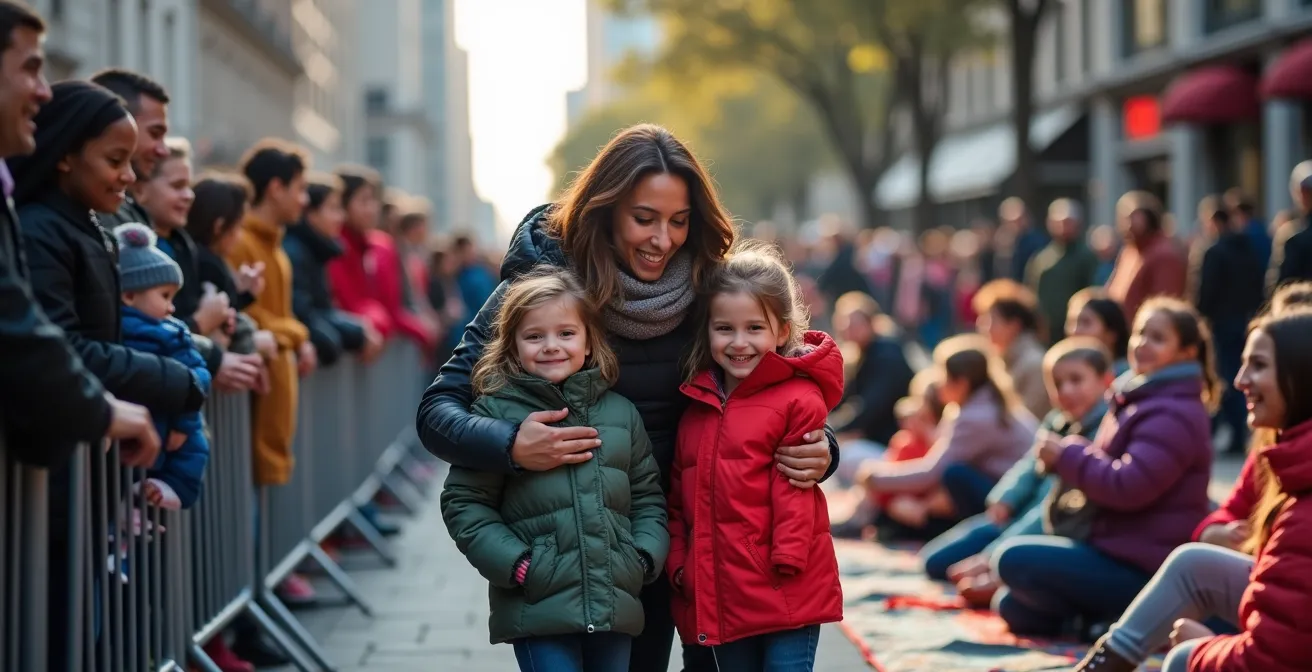
The environment dictates the strategy. New York City’s dense urban grid and robust public transit (the MTA subway) provide multiple access points and high-capacity movement. However, the crowd experience is highly structured, with the NYPD enforcing a rigid pen system that can feel confining. In contrast, Pasadena is more car-dependent with fragmented public transit, making arrival and departure a greater challenge. Yet, its curbside culture is more relaxed, allowing families the freedom to spread out on blankets. This freedom comes at the cost of time: securing a good spot can mean camping out for hours overnight, a difficult task with children. Choosing the right parade is a strategic trade-off between structure and freedom, comfort and convenience.
This comparative analysis highlights the key logistical differences that impact a family’s experience. As the data shows, each event presents a unique set of challenges and advantages.
| Factor | Macy’s Parade (NYC) | Rose Parade (Pasadena) |
|---|---|---|
| Transportation | NYC MTA subway – high capacity, multiple access points | Car-dependent, fragmented public transit |
| Crowd Control | NYPD pen system – structured but confined | Relaxed curbside culture – more freedom |
| Family Setup Time | 2-3 hours early for good spot | 4+ hours (camp out tradition) |
| Weather Factor | Cold November – layers needed | Mild January – more predictable |
| Viewing Duration | 3 hours locked-in viewing | 2.5 hours more flexible |
The lesson here is universal: before you even think about tactics for a specific event, you must first ensure the event’s strategic profile aligns with your goals. A mismatched mission is doomed before it begins.
The Scalper Trap That Ruins Your Super Bowl Weekend
Beyond accommodation, the secondary ticket market represents another significant financial and logistical trap. For premier events like the Super Bowl, the “scalper trap” extends far beyond a simple inflated ticket price. It’s an entire ecosystem of hidden costs and fraudulent listings designed to exploit high demand. The face value of a ticket is merely the starting point. To accurately budget for an event, you must account for the 30-40% in additional fees that resellers add on, including service charges, dynamic processing fees, and currency conversion costs. Failing to calculate this “true cost” can derail your entire weekend budget.
The economic pressure is immense. For example, STR data shows a 216% RevPAR increase during Super Bowl weekend, illustrating how every aspect of the local economy, not just tickets, is super-heated. Scalpers leverage this environment. A particularly dangerous tactic is the “speculative listing,” where sellers offer tickets they do not yet own, gambling that they can acquire them later at a lower price. If they fail, the buyer is left with no ticket and a scramble for a refund. The only way to mitigate this risk is to purchase exclusively through official exchanges, like the NFL Ticket Exchange, which authenticates sellers and guarantees the ticket’s existence.
To protect yourself, you must adopt a defensive, verification-first mindset. Here are the key tactics to avoid fraud and hidden costs:
- Calculate True Cost: Always add 30-40% to the listed ticket price to account for hidden service charges and dynamic fees.
- Verify the Source: Only use official league-sanctioned exchanges (e.g., NFL Ticket Exchange) to guarantee ticket authenticity.
- Check Local Laws: Be aware of state-specific anti-scalping laws, as they vary widely and affect the legality of a purchase.
- Avoid “Speculative” Listings: If a listing seems vague or the seller cannot prove they possess the tickets, it is likely a fraudulent speculative sale.
- Factor in Package Deals: Be wary of mandatory hotel/ticket packages, which often inflate the total cost far beyond buying each component separately.
- Anticipate Surge Pricing: Budget for extreme surge pricing on rideshares, parking, and even restaurants within the designated event zone.
This system of secondary markets and hidden fees applies to everything from Super Bowl tickets to exclusive Mardi Gras balls. Understanding its mechanics is a crucial piece of your logistical armor.
When to Leave the French Quarter to Beat the Post-Parade Gridlock?
This is the central tactical challenge of Mardi Gras: egress. When the last float passes, hundreds of thousands of people attempt to exit a confined area simultaneously. The French Quarter’s narrow streets become chokepoints, and a 10-minute walk can turn into an hour-long struggle. However, this gridlock is a predictable system, and like any system, it can be navigated with the right intelligence. The key is not to leave *after* the crowd, but to move *before* or *through* it using a pre-planned strategy. Relying on your phone for navigation is a rookie mistake; cell service often fails in peak crowds, making offline maps and physical meeting points essential.
The most effective strategy is timing. Local experts and NOPD veterans point to a critical window for a clean exit: the “Golden 15 Minutes.” This is the brief period between when the last float of a major parade passes your position and when the bulk of the crowd begins its mass exodus. By initiating your exit during the final float, you get ahead of the human wave. The second part of the strategy is route selection. The main arteries like Bourbon Street and Canal Street will be impassable. Instead, your primary escape corridors should be the parallel streets on the edge of the Quarter: Decatur Street (towards the river) and Rampart Street (towards the interstate). These routes are less congested and offer a clear path out of the densest zones.
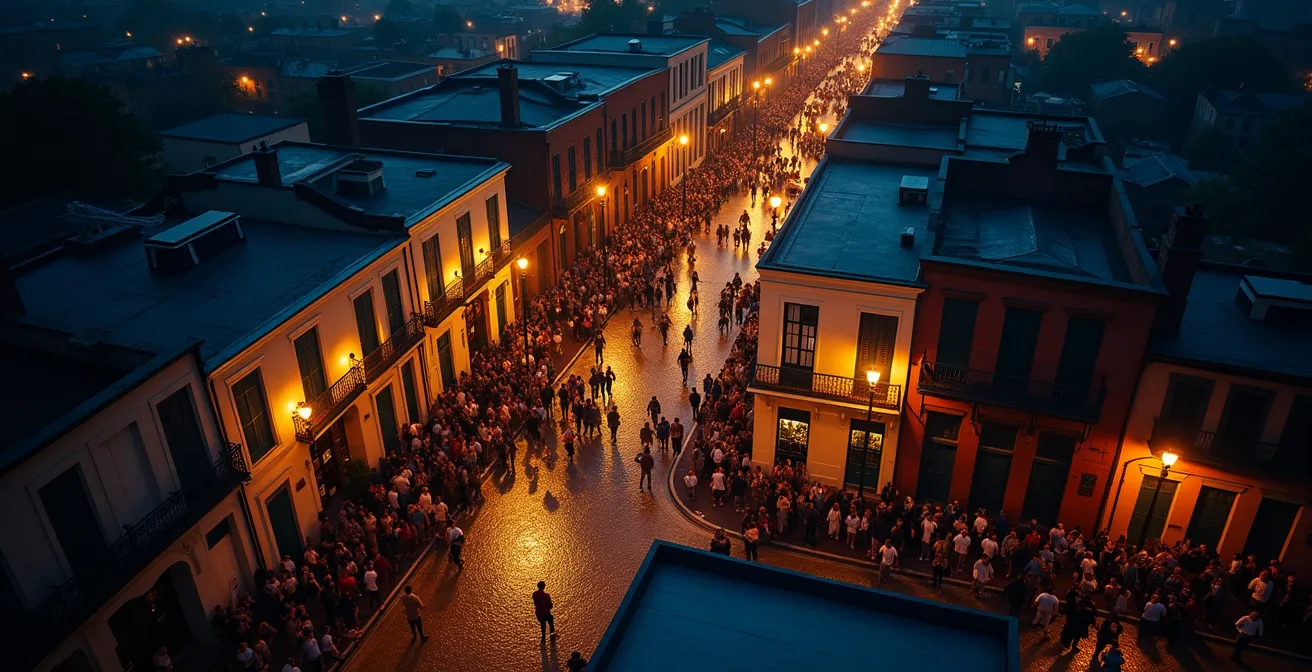
Advanced navigation involves using the environment to your advantage. Experienced locals don’t just stick to the streets. They use a network of “cut-throughs”—hotel lobbies, courtyards, and bars with multiple exits—to bypass street-level chokepoints entirely. This requires pre-event reconnaissance to identify viable passages. Following the flow of police movement is another key tactic; they are creating channels through the crowd, and moving with them is always easier than moving against them. These tactics transform you from someone trapped in the crowd to someone navigating through it with purpose.
This principle of a timed, planned exit from a high-density area is the single most important tactical skill for mastering Mardi Gras and any other major street festival.
How to Leave the Esplanade After the Show Without Getting Stuck for 2 Hours?
The challenge of a mass exit isn’t unique to parades. It’s a fundamental problem at any large, contained venue like a stadium or festival ground. The New Orleans Jazz Fest, held at the Fair Grounds Race Course near the Esplanade, provides a perfect case study in venue egress. After the final act, tens of thousands of attendees funnel towards a few designated exits, creating massive bottlenecks for pedestrians, transit, and rideshares. The key to beating this is applying game theory: when the majority of people choose the most obvious path, the greatest advantage lies in choosing the path of most resistance—or rather, the path that *seems* less convenient.
Case Study: The Contrarian Exit at Jazz Fest
Crowd psychology dictates that over 80% of attendees will use the main gate on Gentilly Blvd, the most direct and well-marked exit. This creates a severe chokepoint. The “Contrarian Exit” strategy involves using the less popular Sauvage Street exit. Although it may involve a longer initial walk away from the main thoroughfares, it bypasses the primary congestion. Analysis shows this strategy saves an average of 45 minutes in total exit time by avoiding the human traffic jam and the gridlocked rideshare zones that form around the main gate.
Your exit strategy must also account for modern transit challenges. Rideshare services use geofencing to create “no-go zones” around major venues, forcing pickups to occur several blocks away in chaotic, designated lots. To bypass this, you must optimize your pickup location. By walking 10-15 minutes to a secondary pickup zone outside the geofenced area, you not only find a driver faster but also avoid the extreme surge pricing that hits the primary zones. For Jazz Fest, pinning your pickup at the intersection of Esplanade and N. Broad is a proven tactic. Additionally, consider alternative transport like the RTA bus line 94, which is often faster than the crowded streetcars post-event. Or, for complete traffic immunity, a pre-arranged bicycle rental is the ultimate logistical hack.
The lesson is clear: whether leaving a parade route or a festival ground, the fastest way out is rarely the most obvious one. A contrarian mindset and a multi-modal transport plan are your best weapons.
When to Visit New Orleans to Catch Jazz Fest Instead of Mardi Gras?
The ultimate strategic decision is choosing the right mission altogether. Sometimes, the best way to “navigate” Mardi Gras is to consciously choose not to go, opting instead for an alternative event that better matches your objectives. For many, the New Orleans Jazz & Heritage Festival offers the cultural flavor of the city with a completely different logistical footprint. Mardi Gras is a decentralized, city-wide street party with a college party atmosphere, while Jazz Fest is a contained, ticketed music festival geared toward aficionados and families. Understanding their distinct profiles is key to making an informed choice.
The financial and logistical pressures of the two events differ significantly. As industry data shows, Jazz Fest offers better availability, with hotel occupancy averaging 75-80% compared to the 90-95% seen during Mardi Gras. This translates to more options and slightly less inflated prices. While Mardi Gras parades are technically “free,” the associated costs for prime viewing, food, and drinks can add up quickly. Jazz Fest requires a ticket, but it offers immense value, with dozens of world-class acts included in the price. Furthermore, the event’s impact on the city is concentrated at the Fair Grounds, leaving other neighborhoods like the French Quarter and Garden District more navigable than during Carnival season.
The following matrix breaks down the core differences in the experience, allowing for a clear strategic choice based on your priorities.
| Factor | Mardi Gras | Jazz Fest |
|---|---|---|
| Crowd Type | College party atmosphere | Music aficionados & families |
| Cost Structure | Free parades, expensive extras | Ticket required, better value per act |
| City Impact | Downtown/Uptown paralyzed | Concentrated at Fair Grounds |
| Local Participation | Tourist-heavy | Higher local attendance ratio |
| Hotel Occupancy | 90-95% citywide | 75-80% with more availability |
| Weather | February cold/wet risk | April/May warm but humid |
Choosing the right event isn’t a compromise; it’s a strategic maneuver that ensures the experience aligns with your tolerance for crowds, cost, and logistical complexity from the very beginning.
Key Takeaways
- Mega-events operate on predictable systems of economics and crowd dynamics; learning these systems gives you a tactical edge.
- Your most powerful tool is strategic pre-planning, from choosing the right event to mapping specific ingress and egress routes before you arrive.
- True situational awareness is not just avoiding danger, but actively using the physical environment and logistical patterns to your advantage.
How to Watch the DC Fireworks from the National Mall Safely?
The final principle is mastering your environment through strategic positioning. Watching the Fourth of July fireworks from the National Mall in Washington, D.C., presents a classic mega-event problem: the single “best” viewing spot attracts the largest, densest crowd, creating the worst possible experience. The instinct is to get as close to the Washington Monument as possible, but this is a tactical error. The crush of the crowd, security checkpoints, and the post-show gridlock make it a logistical nightmare. The professional approach is to sacrifice a few degrees of “perfect” view for a massive gain in safety, comfort, and ease of exit.
This means identifying and moving to asymmetrical vantage points—locations that offer excellent views without the crushing density of the primary zone. Your pre-event reconnaissance should focus on finding elevated positions or alternative locations across the river. For the D.C. fireworks, this includes places that most tourists would never consider. The steps of the National Cathedral, for example, offer an elevated, panoramic view of the city from a distance, with far less density. Similarly, viewing from Arlington, Virginia, near the Iwo Jima Memorial, provides a stunning perspective of the fireworks over the D.C. skyline with the added benefit of easier parking and exit routes. Rooftop bars in Rosslyn, while often ticketed, offer a controlled, comfortable environment entirely above the chaos.
Even if you choose to be closer, strategic positioning matters. West Potomac Park provides more open space than the central Mall, and using the western security checkpoints near the Lincoln Memorial often involves shorter lines than the eastern access points. The timeline is also critical: arriving by noon is necessary for a prime spot on the Mall, but arriving by 3 PM is sufficient for an acceptable view in one of these smarter, alternative locations. This trade-off is the essence of smart event navigation.
Apply this strategic mindset to your next large-scale event, and transform your experience from a test of endurance into a masterfully executed operation.