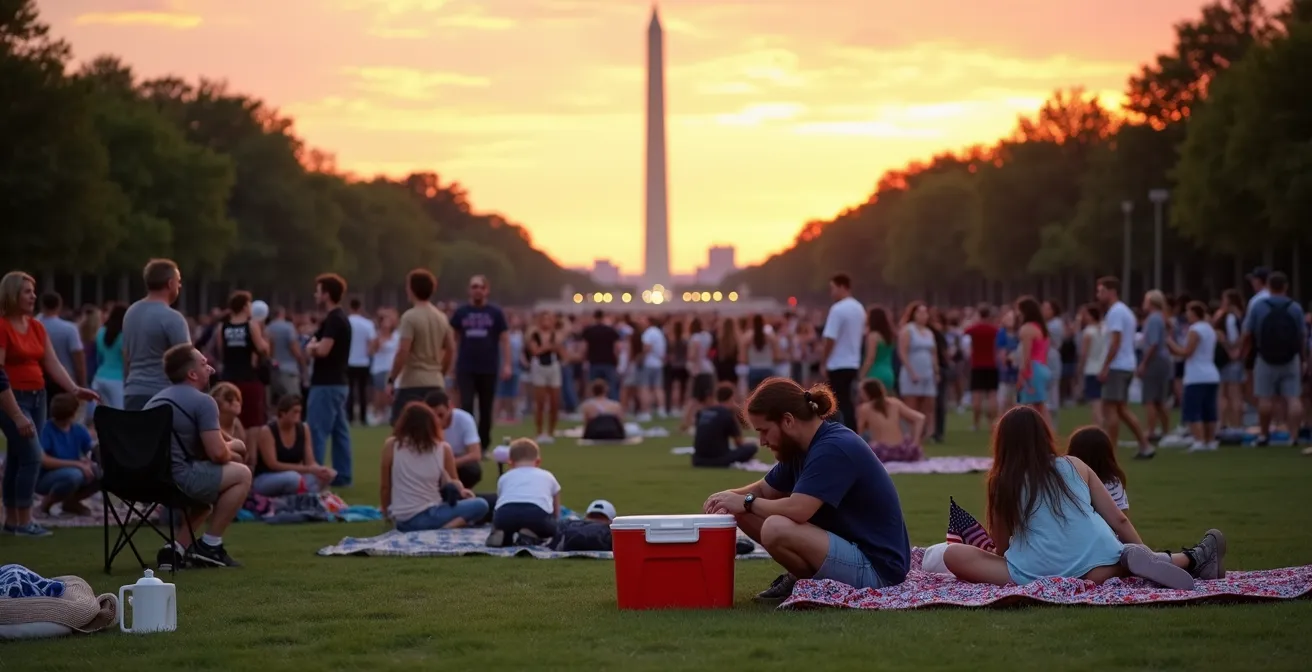
The key to a safe and enjoyable July 4th on the National Mall is not enduring the crowd, but mastering the system with strategic planning.
- Leverage alternative viewing spots and transportation routes to bypass peak congestion, even with a late arrival.
- Adopt an expert-level hydration strategy to combat heat, and plan your exit before you even arrive.
Recommendation: Shift your mindset from being a passive spectator to a strategic operator who understands and uses the event’s logistics to their advantage.
The annual Fourth of July fireworks in Washington, D.C. are a quintessential American experience. The image of brilliant colors exploding behind the Washington Monument is iconic, drawing hundreds of thousands of patriotic travelers to the National Mall. Yet, for many, the dream of a perfect patriotic evening quickly turns into a logistical nightmare of crushing crowds, long waits, and overwhelming heat. Standard advice often feels inadequate, boiling down to simplistic platitudes like “arrive early” and “bring water.” Many believe the only way to get a good spot is to commit to a full day of camping out under the sweltering July sun.
But what if that premise is wrong? What if the key to a successful experience isn’t about endurance, but about intelligence? From a security and event management perspective, massive public gatherings are complex systems with predictable patterns of flow and pressure. The secret isn’t to fight the system, but to understand and leverage it. This involves making counter-intuitive choices that most of the crowd won’t consider. It means thinking about hydration not as a simple necessity, but as a performance strategy, and planning your exit vector with the same precision you use to choose your viewing spot. The fireworks typically begin around 9:09 PM, but your strategic planning starts long before.
This guide moves beyond the generic tips. We will deconstruct the event’s logistics to provide you with an expert-level operational plan. We will analyze the DNA of different types of large-scale events to understand crowd behavior, explore how to find prime viewing locations without an all-day commitment, and detail the critical safety measures—from hydration to crowd navigation—that will ensure your Independence Day celebration is memorable for all the right reasons.
To help you navigate this iconic event like a seasoned professional, this guide breaks down the essential strategies into a clear, actionable plan. Explore the sections below to master every aspect of your July 4th experience on the National Mall.
Summary: Your Strategic Guide to the National Mall Fireworks
- Why July 4th Is Celebrated Differently in Boston Than in Texas?
- How to Arrive at 8 PM and Still See the Fireworks in NYC?
- Boston Pops vs. Macy’s Fireworks: Which Show Has Better Music?
- The Hydration Mistake That Fails You on a July Afternoon
- How to Leave the Esplanade After the Show Without Getting Stuck for 2 Hours?
- The Line Mistake at the Liberty Bell That Wastes Your Whole Morning
- How to Find the Best Observation Deck That Isn’t the Empire State Building?
- How to Navigate Mardi Gras in New Orleans Without Getting Crushed?
Why July 4th Is Celebrated Differently in Boston Than in Texas?
To develop a strategy for the D.C. fireworks, it’s crucial to first understand that not all large-scale celebrations are created equal. The “DNA” of an event dictates its crowd dynamics. A celebration in Texas might be a series of decentralized, community-focused gatherings. In contrast, an event like the Boston Pops Fireworks Spectacular is a hyper-centralized affair. Its identity is tied to a live, world-class orchestra performance, meaning the most valuable real estate is within earshot of the Hatch Shell. This single point of interest creates immense crowd density in a specific zone.
The scale is staggering; in a typical year, the Boston Pops Fireworks Spectacular can draw over half a million people to the Charles River Esplanade. This concentration forces a specific type of spectator behavior: an early, land-grab style arrival to secure a spot within the audio radius. Washington, D.C.’s celebration has a different DNA. While the launch site near the Lincoln Memorial Reflecting Pool is a focal point, the experience is primarily visual. The monuments themselves are part of the spectacle, creating a vast, panoramic viewing area.
This key difference is your first strategic advantage. Unlike Boston, you don’t need to be clustered in one small area to have a premium experience in D.C. The fireworks are designed to be seen from great distances. Understanding this frees you from the psychological trap that you must be at the physical center of the Mall. This decentralized nature allows for more flexible arrival times and a wider array of strategic viewing positions, which we will explore. Your goal is not to be at the epicenter, but to find the optimal location that balances view, comfort, and ease of access.
How to Arrive at 8 PM and Still See the Fireworks in NYC?
The title’s mention of NYC highlights a common challenge in major cities: the belief that a late arrival means no view. This is a myth born from conventional thinking. On the D.C. National Mall, arriving at 8 PM and still securing a fantastic view is entirely possible if you employ a “reverse flow” strategy. Instead of heading toward the most congested points like the Washington Monument grounds, you should target less obvious, often elevated, locations that the masses overlook.
The key is to use public transit strategically. Don’t get off at the Smithsonian or Federal Triangle Metro stations, which will be saturated. Instead, travel one or two stops beyond and walk back toward the Mall. For instance, using the Rosslyn Metro in Virginia places you a short walk from the Iwo Jima Memorial, which offers a stunning panoramic view of the D.C. skyline with the fireworks. This is a classic “reverse flow” move: while everyone pushes into the city’s core, you approach from the periphery with less resistance and competition for space.
Other excellent late-arrival options include Hains Point in East Potomac Park, which provides a more serene viewing experience with ample space. While some rooftop bars require expensive reservations, others in nearby neighborhoods may operate on a first-come, first-served basis, especially after the dinner rush. The core principle is to trade proximity for elevation and perspective. You might be further from the launch site, but a clear, unobstructed view from a location like Arlington is vastly superior to a partial, crowded view from the middle of the Mall. A WUSA9 guide to D.C. fireworks viewing often highlights these alternative spots, confirming their viability. This approach requires you to abandon the herd mentality and embrace the geography of the entire region.
Boston Pops vs. Macy’s Fireworks: Which Show Has Better Music?
This question is less about musical taste and more about understanding how an event’s audio component dictates crowd strategy. As an event security expert, I analyze this to predict crowd behavior. Comparing the Boston Pops to the Macy’s NYC Fireworks reveals two completely different logistical scenarios that directly inform how you should plan your evening in D.C.
The Boston Pops event is an acoustic-first experience. The main draw is a live orchestra performance, culminating in the “1812 Overture” with real cannons. Audio quality degrades rapidly with distance, forcing attendees into a dense pack near the stage. The Macy’s show, by contrast, is a broadcast-first event. The musical soundtrack, featuring contemporary pop artists, is perfectly synchronized and transmitted via radio and apps. This decouples the audio from the physical location, allowing viewers to spread out over miles of waterfront in two boroughs.
The D.C. fireworks fall somewhere in between, but lean closer to the Macy’s model. While there is a televised concert on the West Lawn of the U.S. Capitol, the fireworks themselves are the main event for the vast majority on the Mall. Their audio is a generalized soundtrack of patriotic music, not a nuanced live performance that demands proximity. This confirms our earlier strategic assessment: you do not need to be at the epicenter. The table below breaks down the fundamental differences, which you can apply to your D.C. planning.
This comparison shows that a live orchestra (Boston) centralizes crowds, while a broadcast soundtrack (Macy’s) decentralizes them. Since the D.C. show is primarily visual and has a broadcast-style soundtrack for most viewers, your strategy should be to take full advantage of the dispersed viewing opportunities.
| Aspect | Boston Pops | Macy’s NYC |
|---|---|---|
| Music Type | Live orchestra performance | Pre-recorded broadcast soundtrack |
| Musical Style | Classical/patriotic tradition | Pop/contemporary hits |
| Signature Piece | 1812 Overture with real cannons | Current chart-toppers |
| Guest Artists | Classical/Broadway performers | Pop celebrities & A-listers |
| Audio Quality | Degrades with distance from stage | Perfect clarity via radio/app |
The Hydration Mistake That Fails You on a July Afternoon
On a hot July day in D.C., the most common safety advice is to “drink water.” This is dangerously simplistic. The critical mistake isn’t just failing to drink enough; it’s failing to implement a preventative hydration strategy that properly manages electrolytes. Waiting until you feel thirsty is a sign that dehydration has already begun. For a long-duration outdoor event, you must begin hydrating the morning of, consuming about 8 ounces of water every hour consistently.
However, drinking excessive amounts of plain water can lead to a serious condition called hyponatremia, where sodium levels in your blood become dangerously diluted. This is why your hydration strategy must be a balance of water and electrolytes. You can achieve this by alternating water with an electrolyte drink or by consuming salty snacks like pretzels throughout the day. This is the same methodology used by endurance athletes, and you should view a day on the Mall as a similar endurance event. The seriousness of this is underscored by the fact that Boston EMS deploys numerous medical stations for heat emergencies during its July 4th event, with dehydration being a primary cause.
Your toolkit should also include external cooling methods. A simple spray bottle used to mist your face, neck, and wrists can provide significant relief by promoting evaporative cooling. Always wear light-colored, loose-fitting clothing and a wide-brimmed hat. During the peak heat of the afternoon (typically 2-5 PM), actively seek out the cooling centers or shade provided by trees or structures. It’s not a sign of weakness; it’s a core tactical decision to conserve energy and maintain peak physical condition for the evening. Monitor for early symptoms of heat-related illness in yourself and your group, such as headache, dizziness, or nausea.
How to Leave the Esplanade After the Show Without Getting Stuck for 2 Hours?
The post-fireworks exodus from Boston’s Esplanade is legendary for its gridlock, a scenario that mirrors the mass departure from the National Mall. The mistake most people make is that they don’t think about leaving until the show is over. A security professional plans their exit vector before they even arrive. Your choice of viewing spot should be influenced as much by its egress routes as its sightlines.
When you arrive, perform a mental reconnaissance. Don’t just look for a patch of grass; identify the nearest exit points, cross-streets, and, most importantly, the nearest Metro station. Position yourself on the side of your viewing area that is closest to your chosen exit. This simple act of positioning can save you 20-30 minutes of fighting through the densest part of the crowd. The goal is to move perpendicular to the main flow of the departing masses for as long as possible before merging.
Another advanced tactic is the staggered departure. Do not wait for the grand finale. The final, most intense part of the fireworks show often lasts several minutes. By beginning to slowly pack up and move toward your exit during the “pre-finale,” you can get a crucial head start. You’ll still see the best part of the show while walking, and you’ll be ahead of the massive human wave that is unleashed the second the last firework fades. Alternatively, you can do the opposite: wait it out. Instead of rushing into the gridlock, have a post-show snack and drink ready, relax for 30-45 minutes, and let the peak saturation of the Metro stations and streets dissipate.
The Line Mistake at the Liberty Bell That Wastes Your Whole Morning
Waiting in line for hours at a popular attraction like Philadelphia’s Liberty Bell is a classic tourist trap, analogous to waiting in the massive security checkpoint lines for the National Mall on July 4th. The common mistake is to passively accept the queue as inevitable. The strategic approach is to actively leverage the system the organizers have put in place. For the National Mall, this means treating the security screening not as an obstacle, but as a system to be navigated intelligently.
The single most effective tool is booking your entry in advance. For many D.C. attractions and even for some special event access, the National Park Service offers advance timed tickets for a minimal processing fee. This is the single best investment you can make. It allows you to bypass the long standby queues and enter through a designated, faster-moving lane. This is the difference between a 15-minute wait and a 2-hour wait.
If you don’t have a timed ticket, you can still be strategic. First, walk the entire perimeter of the access area. Security checkpoints are often placed at multiple points, and the ones furthest from main Metro exits are almost always less crowded. Don’t join the first line you see. Second, use the official communication channels. For the D.C. fireworks, you can often text JULY4DC to 888777 for automated alerts about crowd conditions, gate closures, and wait times. This real-time intelligence allows you to make informed decisions and divert to less congested entry points. Finally, observe the flow of tour buses. Time your arrival for the lull *between* large group drop-offs to avoid being stuck behind several hundred people at once.
How to Find the Best Observation Deck That Isn’t the Empire State Building?
Just as the Empire State Building is the most obvious (and often most crowded) viewpoint in NYC, the Washington Monument grounds are the most obvious spot for the D.C. fireworks. A smart traveler knows that the best views are often found where others aren’t looking. For D.C., this means looking across the Potomac River to Arlington, Virginia.
Northern Virginia offers a multitude of elevated, less-crowded vantage points that provide spectacular, panoramic views of the entire D.C. skyline. As the National Park Service itself notes, the experience is designed for this. In their official announcement, the NPS stated:
The fireworks will be launched from both sides of the Lincoln Memorial Reflecting Pool and will be visible from many locations throughout D.C. and Northern Virginia
– National Park Service, 2024 Independence Day Celebration Official Announcement
This official acknowledgment confirms that a view from Virginia is not a compromise; it’s a designed feature of the event. Locations like the Iwo Jima Memorial and the nearby Netherlands Carillon offer fantastic, elevated perspectives. Further south, parks along the Mount Vernon Trail or in Crystal City provide comfortable, picnic-friendly environments with lighter crowds. A comparative analysis of these Arlington locations demonstrates the variety of options available, each with its own character.
Choosing an alternative observation point is a strategic trade-off. You sacrifice the booming sound and the feeling of being “in the middle of it all” for significant gains in comfort, personal space, and, most critically, ease of entry and exit. For families with small children or anyone who finds dense crowds stressful, this is an unequivocally superior choice. The table below, adapted from local tourism resources, highlights some of the best options in Arlington.
| Location | Best For | Access | Crowd Level |
|---|---|---|---|
| Iwo Jima Memorial | Panoramic views with statue backdrop | Rosslyn Metro | Moderate |
| Long Bridge Park | Picnic-friendly with athletic fields | Crystal City Metro | Light-Moderate |
| Mount Vernon Trail | Multiple vantage points | Bike or walk | Light |
| Netherlands Carillon | Elevated views | Short walk from Iwo Jima | Light |
| Rooftop bars | Comfort with views | Various Metro stops | Reservation required |
Key Takeaways
- Strategic Positioning: Your viewing spot should be chosen based on ease of exit and access to transportation, not just sightlines.
- System Leverage: Use official tools like timed tickets and text alerts to bypass the longest lines and get real-time intelligence.
- Active Safety: Hydration is an all-day endurance strategy involving electrolytes, and crowd navigation requires situational awareness of flow patterns and escape routes.
How to Navigate Mardi Gras in New Orleans Without Getting Crushed?
The mention of Mardi Gras evokes images of extreme crowd density, a scenario that holds valuable lessons for navigating the National Mall. While the D.C. crowds are more spread out, the principles of personal crowd safety remain the same. Your safety in a massive crowd is not a passive guarantee provided by law enforcement; it’s an active skill you must cultivate.
First, prepare for technology to fail. With hundreds of thousands of people in one area, cell service will become unreliable or completely unavailable. Before you leave, download offline maps of the D.C. area to your phone. Establish clear, low-tech meeting points with your group that are several blocks away from the Mall itself—for example, “the corner of the Natural History Museum” is a bad plan, while “the steps of the Archives-Navy Memorial Metro station entrance on Pennsylvania Ave” is specific and distant enough to be reliable. Carry a fully charged power bank; your phone is your lifeline for communication if you can find a signal.
Second, master situational awareness. Always position yourself on the edge of a crowd, never in the middle. Stay near cross-streets or park pathways that can serve as an escape route if the crowd surges or becomes uncomfortable. Watch the crowd’s “tides”—the patterns of density and movement. If you feel the pressure increasing, move upstream or find a parallel street to bypass the bottleneck. Apps like what3words can be invaluable for sharing your precise location with your group or emergency services if needed. These small, proactive measures are the bedrock of personal security in any large-scale public gathering.
Your Essential Crowd Safety Checklist: National Mall Edition
- Pre-Event Comms Plan: Download offline maps and establish a specific, non-obvious meeting point at least 4 blocks away from the Mall.
- Power & Tech: Carry a fully charged power bank and pre-install a location-sharing app like what3words for precise coordination.
- Strategic Positioning: Always station your group near a cross-street or identifiable landmark that provides a clear exit path away from the main crowd flow.
- Situational Awareness: Actively monitor crowd density. If you feel pressure building, immediately move upstream or to a parallel street to avoid being caught in a crush.
- Exit Vector Lock-In: Before settling in, identify your primary and secondary Metro stations or parking locations and the clearest paths to reach them post-event.
By adopting this strategic, operator-first mindset, you transform the Fourth of July on the National Mall from a potentially stressful ordeal into a masterfully executed, memorable celebration. Plan your operation, execute your plan, and enjoy the freedom that comes with confidence and control.