The key to a stress-free Thanksgiving journey is not hope, but a strategic plan that anticipates and neutralizes predictable system failures.
- Ground travel risks (driving and rental cars) and return traffic have data-proven “red zones” that must be actively avoided.
- Air travel efficiency relies on leveraging underused systems like Mobile Passport Control and non-obvious booking strategies for flights and even dinners.
Recommendation: Shift from a reactive mindset (“what if my bag is lost?”) to a proactive one by building a logistical firewall around your entire journey.
The vision of a perfect Thanksgiving—a warm family gathering, a feast on the table—often begins with a nightmare: the journey. For families, the prospect of navigating the busiest travel week of the year is fraught with anxiety. The fear of catastrophic delays, endless traffic, and the dreaded announcement of lost luggage can overshadow the holiday spirit before it even begins. Standard advice often feels hollow; “pack a carry-on” is impractical for a family with children and gifts, and “arrive early” feels like a passive surrender to inevitable chaos.
This approach is flawed because it treats Thanksgiving travel as random bad luck. It is not. The chaos is a series of predictable system failures under extreme load. The rental car counter will be understaffed. Baggage systems will be overwhelmed. Certain highways will become parking lots at specific hours. The key to not just surviving, but mastering, Thanksgiving travel is to stop reacting to problems and start proactively building a resilient plan that anticipates these specific choke points. It requires thinking like a logistician, not a hopeful tourist.
This guide provides that strategic framework. We will dissect the journey’s primary failure points—from the highway to the customs hall—and provide tactical countermeasures. By understanding the underlying mechanics of the chaos, you can insulate your family from its effects, ensuring your holiday begins with peace of mind, not panic. This is your plan for a seamless operation where everyone, and every piece of luggage, arrives on schedule.
This article provides a detailed operational plan for navigating the complexities of Thanksgiving travel. The following sections break down each critical phase of the journey, offering data-driven strategies and actionable checklists to build your logistical firewall.
Table of Contents: A Strategic Plan for Thanksgiving Travel
- Why the Day Before Thanksgiving Is the Most Dangerous Time to Drive?
- How to Book a Thanksgiving Dinner at a Restaurant Before It’s Too Late?
- Tuesday vs. Thanksgiving Morning: Which Flight Is Actually Cheaper?
- The Seating Mistake That Ruins the Multi-Generational Road Trip
- When to Drive Home on Sunday to Avoid the 8-Hour Traffic Jam?
- How to Clear JFK Customs in Under 45 Minutes During Peak Season?
- When to Downgrade Your Premium Card to Avoid the $500 Fee?
- How to Plan a Trip That Satisfies Both Toddlers and Grandparents?
Why the Day Before Thanksgiving Is the Most Dangerous Time to Drive?
The Wednesday before Thanksgiving is not just busy; it’s statistically one of the most hazardous days on the road. The combination of peak travel volume, traveler fatigue, and a rush-to-destination mentality creates a perfect storm for accidents. The risks are compounded by travelers operating unfamiliar rental cars, navigating congested urban areas, and driving longer distances than usual. According to a grim forecast, an estimated 439 people may die on U.S. roads during the 2025 Thanksgiving holiday period, a testament to the heightened danger. This isn’t about being fearful; it’s about being prepared.
The primary contributors to this risk are congestion-induced stress and unfamiliarity with the vehicle. Drivers are more likely to make aggressive maneuvers when stuck in traffic, and the controls and handling of a rental car are different from a personal vehicle. A simple action like finding the windshield wiper controls in a sudden downpour can become a critical safety issue. Therefore, the first step in mitigating risk is to create a calm, controlled environment before you even pull out of the rental car lot. This involves a thorough vehicle check that goes beyond a cursory walk-around.
Building a logistical buffer starts here. If you must travel on Wednesday, shift your departure to before 6 a.m. or after 9 p.m. to avoid peak congestion. More importantly, treat your rental car pickup as a critical pre-flight check. This disciplined approach transforms a moment of high stress into a controlled procedure, significantly reducing your risk profile on the road.
Your 5-Point Rental Car Safety Check
- Test all lights and turn signals before leaving the rental lot; unfamiliar controls can cause delays and confusion in traffic.
- Adjust all mirrors and the driver’s seat position for optimal visibility and control in an unfamiliar vehicle.
- Locate and test the windshield wipers, emergency flashers, and horn before you need them in an emergency.
- Check tire pressure if the vehicle has a monitoring system and document any existing vehicle damage with time-stamped photos on your phone.
- Program your GPS destination and any key contacts (like your hotel) before putting the car in drive to minimize distractions.
How to Book a Thanksgiving Dinner at a Restaurant Before It’s Too Late?
One of the biggest logistical hurdles for Thanksgiving travelers isn’t the journey itself, but securing the culminating event: the Thanksgiving dinner. For those opting to dine out, popular reservation platforms like OpenTable often show no availability weeks, or even months, in advance, leading to family stress. The common assumption is that all desirable restaurants are fully booked. This is a strategic error. The real opportunity lies in a channel most travelers overlook: hotel restaurants.
Major upscale hotel chains operate on a different reservation model. Their primary allegiance is to their own guests, and they intentionally hold back a significant number of tables from third-party apps to service them. This creates a hidden inventory of reservations that is accessible to those who know where to look. The strategy is to bypass the digital gatekeepers and connect directly with the source.

This approach provides a powerful counter-maneuver to the perceived scarcity of reservations. Instead of competing with the entire public on a booking app, you are tapping into a more exclusive pool of availability. This is especially effective in major tourist destinations where luxury hotels are abundant.
Case Study: The Hotel Restaurant Backdoor Strategy
Major US hotel chains like Marriott, Hyatt, and Four Seasons consistently have more Thanksgiving dinner availability than standalone restaurants. This is because they prioritize hotel guests first, leaving remaining spots for those who book directly. For example, resorts like Primland in Virginia or hotels in Hawaii offering special holiday events often have tables that never appear on public reservation platforms. The winning strategy is to call the hotel’s concierge or the restaurant directly. They manage their own reservation lists and often keep tables aside specifically for direct bookings and high-value clientele, a category you can fall into with a simple, polite phone call.
Tuesday vs. Thanksgiving Morning: Which Flight Is Actually Cheaper?
The debate over the optimal day to fly for Thanksgiving is often oversimplified to a binary choice: the chaos of Tuesday versus the risk of Thanksgiving morning. From a purely logistical standpoint, the answer depends on your tolerance for risk and your budget’s sensitivity. Tuesday is traditionally one of the most expensive and crowded days, as everyone tries to get a head start. Thanksgiving morning, however, presents a different value proposition: lower prices and significantly less airport congestion in exchange for a compressed timeline upon arrival.
Airlines and airports operate on a skeleton crew on Thanksgiving Day, but the first flights of the morning are typically the most reliable. Delays cascade throughout the day; an 8 a.m. flight has the highest probability of departing on time because the aircraft and crew are already in position from the night before. This operational reality is a key piece of data for the strategic traveler. As travel expert Scott Keyes notes, this principle is especially crucial during periods of operational strain:
If the US government shutdown continues up to or through Thanksgiving, some airport functions could slow down—but not stop. Book the earliest flight of the day. Delays stack as the day goes on, especially with reduced ATC staff.
– Scott Keyes, Going.com Thanksgiving Travel Guide
The financial incentive is also compelling. Flying on the holiday itself is almost always cheaper than flying on the preceding Sunday, Monday, or Tuesday. For a large family or group, these savings can be substantial, often amounting to hundreds of dollars per ticket. This allows a family to reallocate funds toward a better rental car, a more comfortable accommodation, or special holiday activities. The trade-off is a tighter schedule, but for many, a guaranteed on-time departure and significant savings outweigh the inconvenience of an early start on the holiday itself.
The Seating Mistake That Ruins the Multi-Generational Road Trip
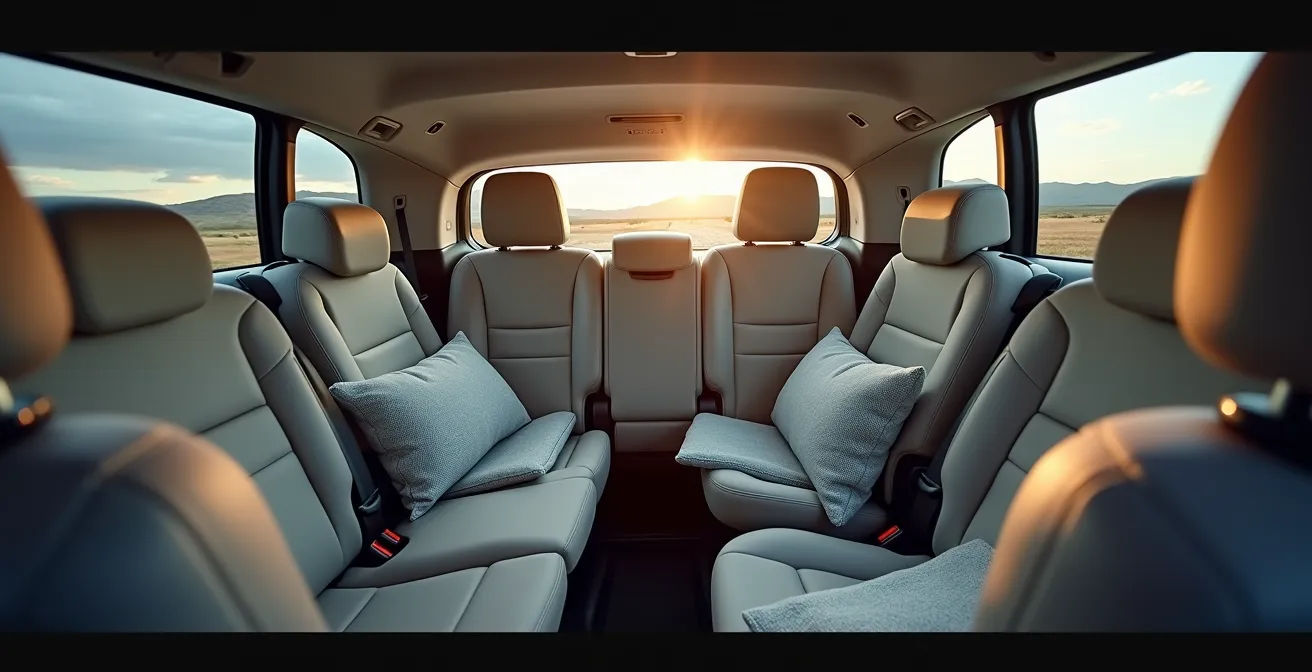
For families embarking on a multi-generational road trip, the choice of vehicle is only half the battle. The most common and corrosive mistake is not the route you take, but the seating arrangement inside the car. A “first come, first served” approach to seating inevitably leads to conflict, discomfort, and a ruined holiday spirit before you even reach the destination. The key is to implement a strategic seating plan that anticipates the unique needs of each generation: the motion-sensitive, the easily bored, and those who need to stay connected.
The “Comfort Triangle” is a seating strategy designed for 7-seater SUVs and minivans that optimizes for harmony. It’s a logistical solution to a human problem. It dictates placing the most motion-sensitive person (often a grandparent or a child) in the driver’s-side middle-row seat, which experiences the least amount of lateral sway and buffeting from passing trucks. The “family entertainer”—the one who tells stories or plays games—is placed in the rear passenger-side seat to engage both the front and back rows. Finally, the tech-savvy navigator and charging-station manager is positioned to easily access the center console. This isn’t about rigid rules, but about designing for comfort and minimizing friction.
This level of planning must extend to the vehicle rental itself. Waiting until the last minute is a critical error, as the most desirable vehicles are the first to go.
Case Study: Enterprise Data on Vehicle Demand
According to rental data from Enterprise Rent-A-Car, the Wednesday before Thanksgiving is their single busiest day of the year. The highest demand is for 7-seater SUVs and minivans—the exact vehicles needed for multi-generational trips. The highest demand is seen in major hub cities like Orlando, Atlanta, and Los Angeles. To combat this, the company recommends picking up your vehicle on Monday or Tuesday. They often provide discounts for early pickups to spread out demand. As per a report in Only In Your State, which analyzed the trend, securing the right vehicle early is the foundational step for a successful road trip.
When to Drive Home on Sunday to Avoid the 8-Hour Traffic Jam?
The return journey is the final logistical hurdle of the Thanksgiving holiday, and Sunday is the day of maximum gridlock. With a projected 81.8 million Americans traveling 50+ miles for the holiday, a significant portion of them will be on the road Sunday afternoon, creating coast-to-coast traffic jams that can turn a three-hour drive into an eight-hour ordeal. The question is not *if* there will be traffic, but *when* it will be impassable. The answer lies in identifying and avoiding the “Red Zone.”
Traffic data consistently shows a clear pattern for the Sunday return. The flow is manageable in the early morning, builds rapidly from mid-morning, peaks to extreme levels between 11 a.m. and 6 p.m., and then gradually subsides in the late evening. This “Red Zone” is when average speeds plummet and accident risks skyrocket due to driver frustration and congestion. A strategic departure is the only effective countermeasure. Leaving before 7 a.m. or after 9 p.m. is not a suggestion; it is an operational imperative for anyone who values their time and safety.
For those with ultimate flexibility, the optimal strategy is to bypass Sunday altogether. Leaving very late on Saturday night or waiting until Monday morning offers a journey with minimal traffic. However, for most families, this is not feasible. The following data provides a clear decision-making framework for planning your Sunday departure.
This table, based on historical traffic analysis, illustrates the stark differences in travel conditions throughout the day. The data, detailed in an analysis of Thanksgiving accident statistics, clearly defines the windows of opportunity and the periods of high risk.
| Departure Time | Traffic Level | Average Speed | Accident Risk |
|---|---|---|---|
| Before 7:00 AM | Light | 65-70 mph | Low |
| 11 AM – 6 PM (Red Zone) | Extreme congestion | 25-35 mph | High |
| After 9:00 PM | Moderate | 55-65 mph | Moderate (fatigue factor) |
| Saturday 10 PM – Sunday 6 AM | Minimal | 70+ mph | Low (best alternative) |
How to Clear JFK Customs in Under 45 Minutes During Peak Season?
For international travelers, John F. Kennedy International Airport (JFK) during Thanksgiving week represents one of the most formidable logistical choke points in the world. The combination of peak holiday travel and standard customs and immigration processing can lead to wait times of two hours or more, jeopardizing connecting flights and exhausting families. However, a federally-run program, Mobile Passport Control (MPC), offers a powerful and underutilized tool to bypass these lines entirely. It is a free app that allows eligible travelers to submit their information digitally and access a dedicated, faster-moving lane.
The effectiveness of MPC lies in its low adoption rate. While thousands of travelers queue in the main lines, the MPC lanes are often nearly empty. The key is to complete the submission process on the app as soon as your plane lands, even while taxiing to the gate. By the time you reach the customs hall, you will have a QR code ready, granting you access to the express lane. Knowing the specific location of these lanes in each terminal is a crucial piece of operational intelligence.
Your JFK Mobile Passport Control (MPC) Terminal Guide
- Terminal 4: The MPC lane is located immediately to the left after you enter the main customs hall. It is often unmarked, but look for the lane where regular lines (which can stretch to 200+ people) are absent.
- Terminal 7: A dedicated MPC kiosk is positioned near Gate 7, and using it can save an average of 35 minutes during peak hours.
- Terminal 8: Two MPC lanes are available. The one on the far right is typically the fastest for processing.
- Setup Tip: Download the MPC app and create your traveler profiles before your trip. Complete your declaration using airline WiFi before landing.
- Pro Strategy: Submit your completed form while walking from the gate to the customs hall to have the QR code instantly ready for the officer.
However, clearing customs is only the first hurdle for those with connecting flights. A secondary choke point exists at the baggage re-check counters.
Case Study: The JFK Terminal 4 Baggage Re-check Gauntlet
JFK’s Terminal 4 presents a unique challenge. After clearing customs, travelers with connecting flights cannot simply proceed to their next gate. They must claim their bags, exit the customs area, and then find a separate baggage re-check counter organized by airline alliance (e.g., Star Alliance, SkyTeam, OneWorld). During Thanksgiving, this secondary checkpoint can add another 30-45 minutes to your connection time. The strategic solution is to leverage any available priority re-check access offered through airline status or premium credit cards, as this can bypass the longest lines.
When to Downgrade Your Premium Card to Avoid the $500 Fee?
An essential, yet often overlooked, part of travel logistics is financial strategy. Many families hold premium travel credit cards with hefty annual fees ($500+), justified by perks like lounge access and travel credits. However, the value of these cards is entirely dependent on usage. Heading into a new year after the Thanksgiving travel season is the perfect time to audit whether these cards are still serving your needs or have become an expensive liability. A retention offer call or a strategic downgrade can save you hundreds of dollars.
The decision to keep or downgrade a card should be a cold calculation, not an emotional one. The central question is: are you extracting more value from the card’s benefits than you are paying in the annual fee? For a frequent international flyer, a card like the Amex Platinum can be a powerhouse. For a family that primarily travels domestically once or twice a year, its value proposition collapses. A downgrade to a no-fee or low-fee card from the same issuer allows you to preserve your credit history and points balance while eliminating the financial drain.
Before your annual fee posts, call the card issuer and inquire about retention offers. Banks would rather give you a statement credit or a bonus of 20,000-30,000 points than lose you as a customer. This single phone call can often offset the majority of the annual fee. The decision matrix below provides a clear, data-driven framework for evaluating the most popular premium cards.
| Card Type | Annual Fee | Keep If… | Downgrade If… | Retention Offer Target |
|---|---|---|---|---|
| Amex Platinum | $695 | 3+ international trips planned | No travel for 6 months | 30,000 points or $300 credit |
| Chase Sapphire Reserve | $550 | $750+ in travel credits used | Domestic travel only | $250 credit or 25,000 points |
| Amex Gold | $250 | Using dining credits monthly | Credits unused 3+ months | 20,000 points |
Key Takeaways
- Thanksgiving travel chaos is predictable; focus on mitigating specific “choke points” like rental car lines, customs, and peak traffic hours.
- Leverage underused tools like Mobile Passport Control and direct hotel bookings to bypass the biggest crowds and access hidden availability.
- Data, not hope, is your best tool. Use traffic analysis to plan departures and vet accommodations with a detailed checklist to ensure comfort for all generations.
How to Plan a Trip That Satisfies Both Toddlers and Grandparents?
The ultimate logistical challenge of Thanksgiving is planning a trip that caters to the vastly different needs of toddlers and grandparents. A successful multi-generational trip hinges on two key elements: the right accommodation and a flexible itinerary. The common mistake is to book a standard hotel or rental home without meticulously vetting it for multi-generational compatibility. This leads to issues with mobility, safety, and personal space, creating friction that undermines the entire trip.
The solution is to use a detailed vetting checklist before booking. This moves beyond simply counting bedrooms and bathrooms. It involves confirming the presence of a ground-floor bedroom for grandparents, a bathtub for toddlers, and a walk-in shower for seniors. It means verifying kitchen facilities for special dietary needs and ensuring the property has both reliable cell service and separate quiet spaces for naps and early bedtimes. This level of detail-oriented planning is the foundation of a harmonious trip.
Once the right “base of operations” is secured, the next step is to abandon the idea of a one-size-fits-all daily plan. The most successful model is the “Parallel Itinerary.”
Case Study: The Orlando Parallel Itinerary Success Model
Orlando serves as a perfect example of this model in action. One family successfully managed their Thanksgiving trip by splitting up for part of the day. In the morning, the grandparents enjoyed a leisurely visit to the peaceful (and wheelchair-accessible) Harry P. Leu Botanical Gardens. Simultaneously, the parents took their toddlers to an early character breakfast at Magic Kingdom to take advantage of shorter lines. Both groups then reconvened for a relaxed lunch at Disney Springs, which offers diverse dining and entertainment suitable for all ages. This approach, which reported a 90% satisfaction rate across age groups, allows each subgroup to enjoy activities at their own pace without forcing anyone into a situation that is too strenuous or over-stimulating.
By adopting a logistical mindset, you transform Thanksgiving travel from a chaotic ordeal into a well-managed operation. The key is to shift your focus from reacting to problems to proactively neutralizing the systemic choke points that create them. This strategic foresight ensures your family’s holiday begins not with stress, but with the calm confidence of a journey under control. To build on this foundation, continually revisit the core risks of your travel plan.