In summary:
- State fair victory for urbanites means targeting non-livestock competitions like baking, crafts, and eating contests.
- Conquer fair food with a “Competitive Eating Strategy”: start savory, stay hydrated, and share the wildest creations.
- Outsmart midway games by understanding their physics, setting strict limits, and targeting games with modest prizes.
- Master “Fairground Logistics” by using the fair app, planning your route, and visiting major attractions during off-peak times.
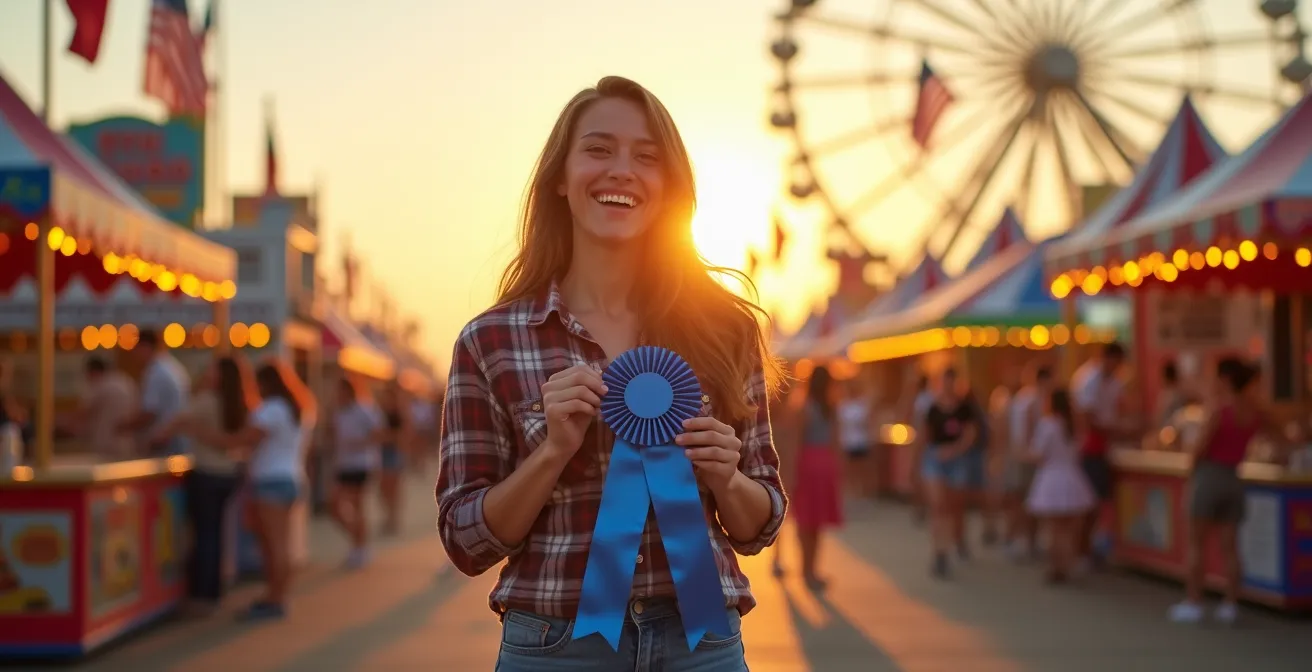
The scent of kettle corn and grilled meat, the roar of the midway, the sight of a Ferris wheel against the sunset—the American State Fair is a sensory overload in the best way possible. For many, it seems like a world apart, a spectacle where rural life is king and blue ribbons are reserved for the biggest pumpkins and the best-bred livestock. The common wisdom is that to truly compete, you need acres of land and a year of agricultural toil. This is the stage for farmers and 4-H kids, right?
But what if that’s only half the story? What if the fair is also a massive, glittering arena of opportunity for the savvy city dweller? The truth is, beyond the cattle barns and swine shows lies a universe of competition ripe for the taking. From the fiercest pie bake-offs to the most strategic food conquests and the physics-defying challenges of the midway, the fair offers countless paths to victory for those without a single farm animal to their name. This isn’t about raising the heaviest hog; it’s about deploying strategy, knowledge, and a competitive spirit.
This guide is your roadmap to becoming an “Urban Champion” of the state fair. We’ll decode the culture, strategize the eating, demystify the games, and plan the logistics. Forget what you think you know. Your quest for a blue ribbon starts not in a barn, but with a plan.
This article provides a complete strategic overview for conquering the state fair as an urban visitor. Explore the sections below to master every aspect of your visit, from understanding the core culture to finding hidden gems beyond the main event.
Summary: How to Win a Ribbon at the State Fair Without Owning a Farm?
- Why Rural Kids Spend All Year Preparing for a 3-Day Fair?
- How to Eat Deep-Fried Butter Without Getting Sick?
- Texas State Fair vs. Minnesota State Fair: Which Is the Ultimate Experience?
- The Ring Toss Mistake That Costs You $50 for a $2 Plush Toy
- How to Hit the Butter Cow and the Midway in One Afternoon?
- When to Visit Rural Vermont to Catch the Authentic Maple Festivals?
- Barrel Racing vs. Roping: Which Event Requires More Horse Skill?
- How to Find Hidden Gem Small Towns That Aren’t on the Tourist Map?
Why Rural Kids Spend All Year Preparing for a 3-Day Fair?
To an outsider, the intensity surrounding the 4-H and FFA (Future Farmers of America) livestock shows can seem baffling. It looks like an all-consuming hobby. In reality, it’s a high-stakes career launchpad. For these rural kids, a prize-winning steer or hog isn’t just about a blue ribbon; it’s a direct path to higher education and financial stability. This year-long dedication is an investment in their future, turning animal husbandry into a serious business.
The financial incentives are staggering. Major events like the Houston Livestock Show and Rodeo are among the largest scholarship providers in the United States. Since its inception, it has awarded funds from over 22,000 scholarships valued at more than $305 million. Winning at a state fair can mean a full-ride scholarship to a top agricultural university, setting a young person up for life. The prestigious Iowa State Fair Sale of Champions is a perfect example, where champion livestock are auctioned off to supportive businesses and community members, with proceeds funding scholarships for students pursuing agriculture-related degrees.
This context is crucial for the “Urban Champion.” It explains why the livestock barns pulse with such competitive energy. It’s not a world you can just walk into and win. But it also defines the battlefield: their intense focus on livestock leaves dozens of other competitive arenas wide open. While they’re mastering animal genetics and feed ratios, you can be perfecting your grandmother’s pie recipe, designing an award-winning quilt, or strategizing your assault on the competitive eating categories. Their world is the barn; your world is everywhere else. Understanding their game helps you better define your own.
How to Eat Deep-Fried Butter Without Getting Sick?
Welcome to the gastronomic heart of the state fair, where culinary innovation meets the deep fryer. For the uninitiated, the menu can be intimidating: deep-fried butter, fried Oreos, fried Snickers, fried Coke… the list is endless. The challenge isn’t just trying these novelties, but surviving them. Conquering this landscape requires not just a big appetite, but a Competitive Eating Strategy. Think of it as an endurance sport, not a sprint.
The first rule is to plan your attack. Diving headfirst into a ball of deep-fried butter at 10 AM is a rookie mistake that will end your day early. Instead, build a foundation. Start with savory, less greasy items to get your stomach warmed up. A grilled corn on the cob or a turkey leg is a solid opening move. As you venture into the world of extreme fried foods, remember the power of acidity. Pairing a greasy dish with fresh-squeezed lemonade or a tart cider helps cut through the fat and reset your palate. Most importantly, this is a team sport. The “one item for every three people” rule is critical; it allows you to sample a wide variety of bizarre treats without any one person having to heroically finish a whole serving of something they might regret.
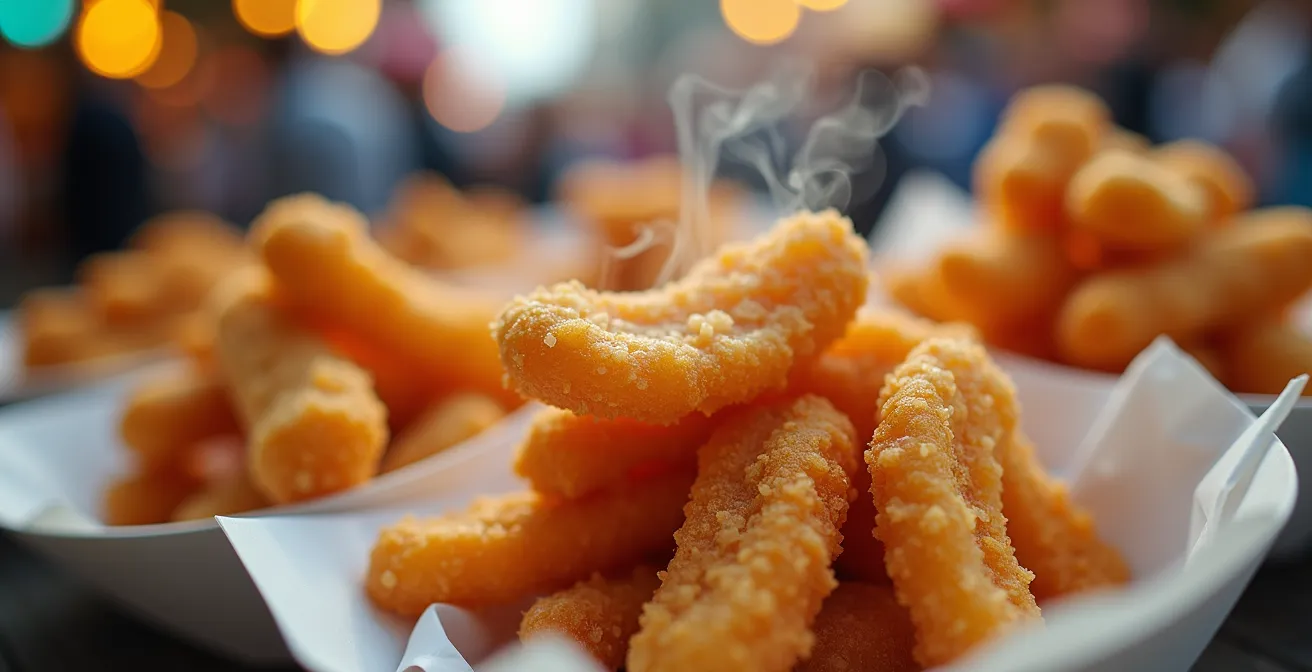
As the image above shows, the appeal is undeniable: golden, crispy, and glistening. To ensure the best experience, timing is everything. Arrive early when the frying oil is at its freshest. If the oil looks dark or smells acrid, walk away. Finally, listen to your body. Take breaks in shaded areas or inside the air-conditioned exhibit halls to let your digestive system catch up. The goal is to taste victory, not to be defeated by a deep-fried pickle.
Texas State Fair vs. Minnesota State Fair: Which Is the Ultimate Experience?
Choosing a state fair is like choosing a side in a rivalry; each has its own proud identity and devoted fanbase. Two of the undisputed heavyweights are the State Fair of Texas and the Minnesota State Fair. While both offer a quintessential American experience, they represent two very different philosophies of fair-going. Your choice depends on whether you seek spectacle or charm, bravado or community.
The State Fair of Texas is defined by one word: scale. Everything is bigger in Texas, and its fair is no exception. It’s the longest-running fair in the country, home to the iconic 55-foot-tall “Big Tex” statue, and held in a massive complex that hosts college football games in the middle of the fairgrounds. The food is equally ambitious, with the “Big Tex Choice Awards” crowning aggressively innovative (and often fried) new creations each year. The vibe is loud, proud, and unapologetically Texan. As Karissa Condoianis of the State Fair of Texas notes:
The State Fair of Texas captures a uniquely American — and distinctly Texan — spirit and experience, bringing together tradition, innovation and community pride.
– Karissa Condoianis, State Fair of Texas
In contrast, the Minnesota State Fair, affectionately known as “The Great Minnesota Get-Together,” is all about community and tradition. While still one of the largest fairs by attendance, it feels more intimate. Its identity is famously tied to “food-on-a-stick,” with vendors competing to put nearly any edible item on a convenient wooden skewer. It’s also home to the iconic butter sculptures, where a “Princess Kay of the Milky Way” has her likeness carved from a 90-pound block of butter. The atmosphere is less about spectacle and more about a shared, multi-generational experience. Choosing between them is a matter of taste: do you want the roaring stadium of Texas or the giant, friendly block party of Minnesota?
The Ring Toss Mistake That Costs You $50 for a $2 Plush Toy
The midway is a dazzling symphony of lights, sounds, and the siren call of giant plush toys. It’s also a masterclass in applied physics and psychology designed to separate you from your money. The biggest mistake players make is believing the games are purely about skill. They’re not. They’re about understanding a system engineered to be *just* shy of winnable, and your secret weapon is “Midway Physics.”
Carnival games are designed with subtle disadvantages. That ring you’re tossing? It’s often barely wider than the neck of the bottle, leaving almost no margin for error. The surface you’re trying to land a ball on? It’s intentionally bouncy to prevent a clean shot. These games prey on the “sunk cost fallacy,” a psychological trap where you feel you’ve invested too much to quit. After spending $10 and getting “so close,” your brain tells you the next $5 will be the winner. This is how a $2 plush toy ends up costing $50. The games with overwhelming walls of giant prizes are often the most difficult, using the allure of a massive reward to mask nearly impossible odds.
The key to beating the midway is to play with your head, not your ego. Watch others play first to spot unwinnable games. More importantly, create a hard-and-fast budget for games and stick to it. The moment that money is gone, your game time is over. By treating it as a calculated expense for entertainment, rather than a genuine attempt to “win” an overpriced prize, you’ve already won.
Your Action Plan to Beat the Midway
- Set a strict ‘three-try maximum’ rule before you start playing any single game, then walk away, win or lose.
- Budget your game money separately from food and ride funds, and when it’s gone, you’re done.
- Observe others playing first to identify ‘gaffed’ (unwinnable) games or learn the specific trick to a winnable one.
- Favor games with modest, smaller prizes; they often have better odds than the ones with walls of giant stuffed animals.
- Avoid games where the equipment makes winning nearly impossible, such as rings that barely fit over the targets.
How to Hit the Butter Cow and the Midway in One Afternoon?
The sheer size of a major state fair is often the most underestimated challenge for a first-timer. These are not local carnivals; they are sprawling temporary cities. The Iowa State Fair, for example, covers over 450 acres, and it’s not uncommon for visitors to log over 25,000 steps in a single day. Without a plan, you’ll spend most of your time wandering aimlessly, exhausted before you even see the main attractions. Winning the day requires “Fairground Logistics.”
Your first step should happen before you even arrive: download the official fair app. These apps are invaluable tools, often providing real-time crowd level indicators, show schedules, and an interactive map. Use this map to plot your day. Instead of zig-zagging across the grounds, plan your route using a “hub and spoke” method. Start at a central landmark, venture out to a specific zone (like the livestock barns or the midway), and then return to the center before heading to the next zone. This prevents backtracking and saves precious energy.
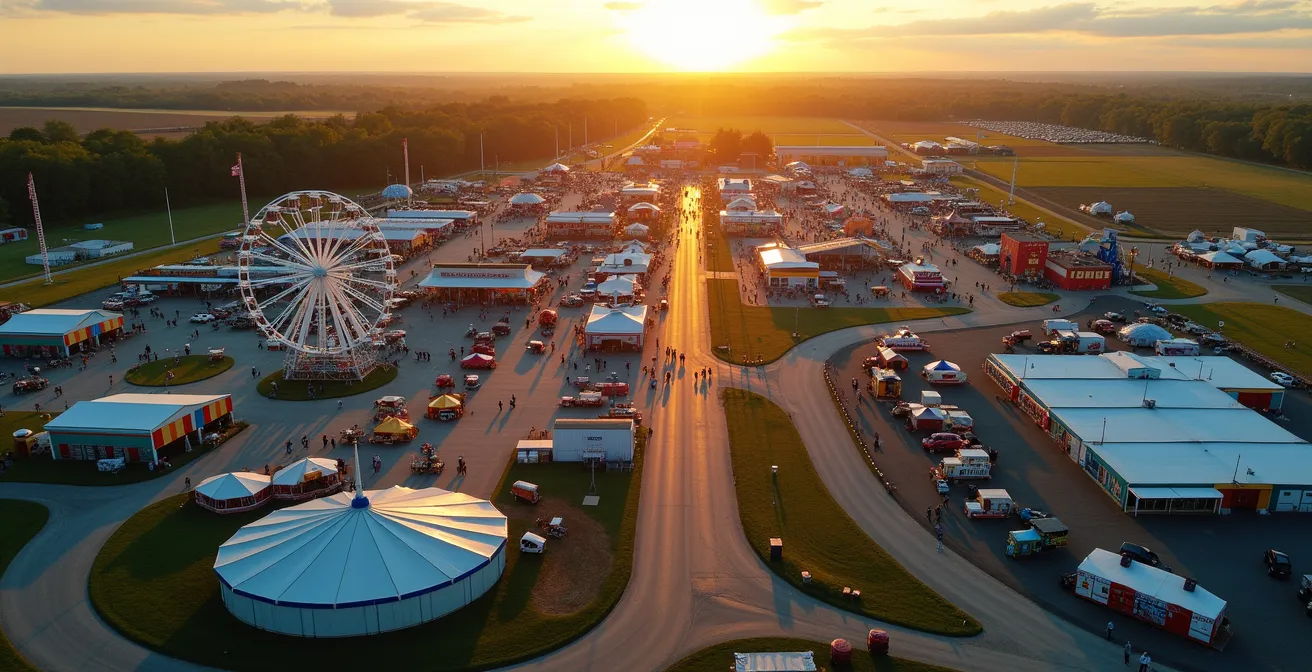
Be strategic with your timing. The best time to visit popular indoor exhibits like the famous butter cow sculpture is during a headline concert or a major grandstand event. While a large portion of the crowd is diverted to one location, you can enjoy smaller lines elsewhere. Use the fair’s transportation—like trams and sky-gliders—as strategic tools, not just rides. They can save you a 20-minute walk across the park. Finally, arrive right at the gate opening, usually around 9 AM, to take advantage of the smallest crowds of the day and get a head start on your must-see list.
When to Visit Rural Vermont to Catch the Authentic Maple Festivals?
While the giant state fairs offer a spectacle of entertainment and fried food, another kind of authentic American experience can be found in the small, hyper-local festivals that celebrate a region’s unique harvest. For an “Urban Champion” seeking a different kind of prize—the prize of authenticity—few events rival Vermont’s maple sugaring season. This isn’t about massive midways; it’s about community, tradition, and the sweet science of turning sap into liquid gold.
Timing is everything. The sugaring season is dictated by the weather, specifically the cycle of freezing nights and thawing days that causes the sap to run. While the season can stretch from late winter into spring, the most prized, lightest-grade syrup comes from the very first sap runs in late February and early March. This is the connoisseur’s choice. The broader “sugaring off” season, when most festivals and sugarhouse tours occur, typically runs through April. This is the best time for visitors to see the process in action, from tapping the trees to boiling the sap in steaming sugar shacks.
The true “hidden gem” of this season is the traditional “Sugar on Snow” party. This is where hot, boiled maple syrup is poured onto fresh, clean snow, creating an instant, chewy candy that’s often served with a plain donut and a dill pickle to cut the sweetness. Finding a genuine, small-scale party is the ultimate prize. Instead of relying on major tourism websites, the secret is to go local. Check the bulletin boards at town halls, read the flyers in local general stores, and browse community Facebook groups. These are the channels where you’ll find the authentic gatherings, the ones that feel less like a tourist event and more like a neighborhood potluck.
Barrel Racing vs. Roping: Which Event Requires More Horse Skill?
To the uninitiated, a rodeo can look like a chaotic display of speed and power. But for the Urban Champion trying to understand the arena, it’s a showcase of highly specialized athletic partnerships between horse and rider. Two of the most popular events, barrel racing and roping, perfectly illustrate this. While both require incredible horsemanship, they demand fundamentally different skills from the animal athletes, much like comparing a Formula 1 car to a muscle car.
Barrel racing is about speed, agility, and precision. It is a timed event where horse and rider race in a cloverleaf pattern around three barrels. The horses are the Formula 1 cars of the rodeo world—bred for explosive acceleration and the ability to make hairpin turns at top speed without losing momentum. The key skills are anticipation and control; the horse must know the pattern and respond to the rider’s subtle cues to shave fractions of a second off their time. It’s a sport where women have long dominated the professional ranks, showcasing a unique synergy of grace and raw power.
Roping, on the other hand, is about explosive power and intelligence. In events like tie-down or team roping, the horse’s job is to chase down a calf, position the rider perfectly for the throw, and then stop on a dime, often pulling the rope taut to hold the calf. These horses are the American muscle cars—powerful, durable, and possessing an innate “cow sense” that allows them to anticipate the calf’s movements. This partnership is a testament to traditional western heritage, emphasizing livestock handling skills that are still vital in modern ranching. As demonstrated by programs across the nation, Texas has the largest number of 4-H and FFA livestock projects, where these foundational skills are taught.
As the comparison below shows, each event requires a different, but equally impressive, set of skills.
| Aspect | Barrel Racing | Roping |
|---|---|---|
| Horse Type | Formula 1 cars – speed, agility, precision | American muscle cars – explosive power, intelligence |
| Key Skills | Anticipation, turning angle, acceleration | Cow sense, communication with rider, durability |
| Gender Demographics | Predominantly female-dominated professional sport | Traditionally male-dominated events |
| Training Focus | Pattern precision, speed control | Livestock handling, quick stops |
| Cultural Impact | Featured in country music, growing popularity | Traditional western heritage, featured in shows like Yellowstone |
Key takeaways
- True state fair mastery for an urbanite isn’t about livestock; it’s about dominating the dozens of other competitions in food, crafts, and games.
- A strategic approach always beats impulse. Plan your food tour like a marathon, your midway budget like an investment, and your route like a military operation.
- The ultimate prize isn’t just a blue ribbon but the discovery of authentic experiences, whether at a giant state fair or a tiny local festival.
How to Find Hidden Gem Small Towns That Aren’t on the Tourist Map?
Once you’ve conquered the state fair, a new challenge emerges for the seasoned Urban Champion: the hunt for true authenticity. The ultimate blue ribbon is discovering those hidden gem small towns that aren’t on any tourist map, the places that embody the spirit of Americana far from the crowds. This is an advanced quest that requires a different kind of strategy, moving beyond official tourism guides and into the realm of grassroots research.
Your best roadmap is the calendar of county fairs. While state fairs are massive events, county fairs are intimate, local celebrations that offer a direct window into the heart of a community. Use a state’s calendar of county fairs, which typically run from July through October, as a guide to find vibrant small towns during their peak week of activity. When a town is celebrating its county fair, it’s at its most lively, welcoming, and authentic. This is when you’ll see the real-life versions of the traditions and competitions you’ve observed on the grander stage.
To identify these towns, look for specific indicators of a thriving local culture. A town with a busy, locally-owned hardware store, a well-kept town square, and multiple non-chain coffee shops is a town with a strong sense of self. Ditch the Instagram geotags and instead browse local newspaper websites and community Facebook groups. These are the places where you’ll find announcements for pancake breakfasts, church potlucks, and local parades—the true fabric of small-town life. A fun rule of thumb is the “Dollar General Rule”: look for towns large enough to support a Dollar General but still too small for a Walmart. This often hits the sweet spot of having basic amenities without having lost its local character.
Armed with this strategic knowledge, your journey from city dweller to State Fair Urban Champion is complete. The next step is to get out there and start your own ribbon hunt, turning this guide into your personal playbook for victory and discovery.
Frequently Asked Questions About Local Festivals
When is the best time to visit for maple sugaring season?
Late February through early March produces the most prized, lightest-grade syrup from the first sap runs. The ‘sugaring off’ season typically runs through April.
What are Vermont’s four official maple syrup grades?
Golden Delicate, Amber Rich, Dark Robust, and Very Dark Strong – each with distinct flavor profiles that judges evaluate at tastings.
How can I find authentic ‘Sugar on Snow’ parties?
Check local town hall bulletin boards and general store flyers rather than tourism websites for genuine small-scale gatherings.