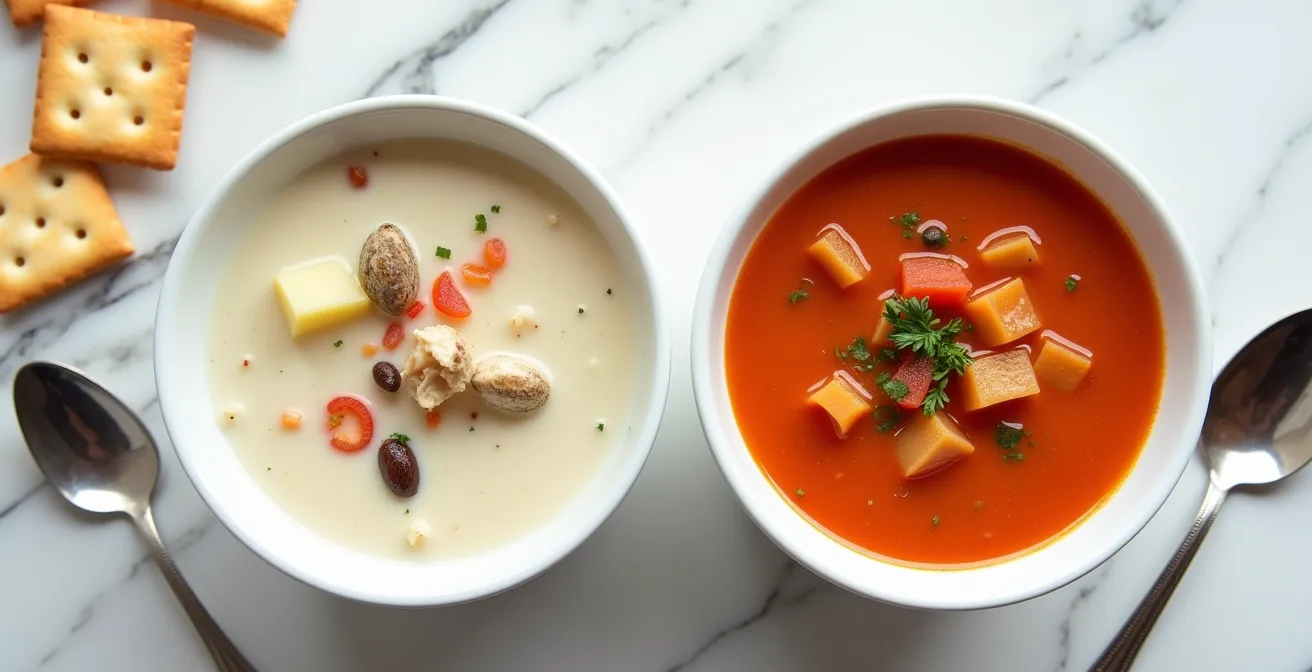
The debate isn’t about red versus white; it’s about culinary integrity versus a tomato-based seafood soup.
- True chowder builds its creamy, rich body from potato starch and high-quality dairy, a delicate balance that acidic tomatoes shatter.
- The secret to exceptional chowder lies in technique: proper thickening, selecting the right clams, and precise cooking to avoid rubbery texture.
Recommendation: Always choose New England Chowder. You’re not just picking a soup; you’re upholding a culinary tradition. The other is a compromise not worth making.
Every day, someone walks into a seafood shack somewhere in the Northeast and faces the same dilemma: Manhattan or New England? It’s presented as a simple choice, a matter of personal preference between a red, brothy soup and a white, creamy one. This is the great lie of American chowder. This isn’t a choice between two equals. It’s a choice between a legitimate, time-honored dish and what amounts to a vegetable soup that happens to have clams in it. As a chef who has spent a lifetime perfecting the craft in New England kitchens, let me be clear: only one of them is true chowder.
The common wisdom says to pick your favorite. But this ignores the fundamental principles of what makes a chowder a chowder. The soul of the dish is the delicate interplay of briny clam liquor, sweet cream, and the subtle, earthy body provided by slow-cooked potatoes. It’s about building a rich, satisfying texture and a flavor that speaks of the sea. Throwing in acidic tomatoes, as the Manhattan version does, doesn’t ‘add a different flavor’; it wages war on that delicate balance. It curdles the dairy, overwhelms the clams, and turns a symphony into a cacophony.
But if you truly want to understand the superiority of New England chowder, you must go beyond the ingredients and into the craft. The real conversation isn’t about red versus white, but about technique. It’s about knowing how to thicken a soup without it tasting like paste, how to select a clam that will remain tender, and how to find an authentic bowl that hasn’t been compromised for tourists. This guide will settle the debate not with opinion, but with culinary facts. We’ll start with the craft of creating perfect New England chowder, then broaden our view to understand how this single dish reflects the larger truths of authentic American cuisine.
This article explores the essential techniques and culinary truths behind America’s most debated soup, guiding you from the fundamental rules of the kitchen to the heart of what makes regional food authentic.
Summary: A Chef’s Guide to Chowder and American Cuisine
- Why You Should Never Order Chowder on a Monday?
- How to Thicken Chowder Without Using Too Much Flour?
- Quahog vs. Cherrystone: Which Clam Makes the Tenderest Soup?
- The Overcooking Error That Turns Your Clams into Rubber
- Where to Find the Best Chowder in Boston Away from Faneuil Hall?
- Why Northwest Cuisine Is Obsessed with Mushrooms and Berries?
- Plant-Based vs. Local Meat: Which Has the Lower Carbon Footprint in Texas?
- Why American Food Is Much More Than Just Burgers and Fries?
Why You Should Never Order Chowder on a Monday?
There’s an old culinary adage: never order fish on a Monday. The logic was that fish markets were closed over the weekend, so Monday’s special was Friday’s leftovers. For decades, this was sound advice, a simple rule that separated the savvy diner from the tourist. However, in the modern culinary world, this rule has become more of a myth than a hard fact. Modern supply chains and refrigeration are marvels of logistics. A reputable restaurant, especially one that prides itself on its seafood, has access to fresh deliveries nearly every day of the week. The idea of a chef serving three-day-old clams in a flagship dish is an insult to their craft.
In fact, the entire dining landscape has shifted. According to the SevenRooms “2024 Restaurant & Consumer Dining Trends Report,” trends are moving in the opposite direction. As they point out:
Mondays are one of the most popular days people book restaurant reservations across regions.
– SevenRooms, 2024 Restaurant & Consumer Dining Trends Report
Furthermore, recent dining trend data shows a 40% year-over-year increase in searches for “restaurants open on Monday near me.” This shows that diners are actively looking to eat out at the start of the week, and restaurants are meeting that demand. So, the new rule isn’t “never order chowder on a Monday.” The new rule is “only order chowder from a restaurant you trust.” A kitchen built on integrity and quality will serve you a superb bowl of chowder on a Monday because they wouldn’t dare serve anything less, any day of the week. The day of the week is a lazy proxy for quality; the reputation of the establishment is what truly matters.
How to Thicken Chowder Without Using Too Much Flour?
Walk into any tourist-trap kitchen and you’ll see them committing the cardinal sin of chowder-making: thickening it with a heavy-handed roux or, even worse, a cornstarch slurry. This is a lazy cook’s shortcut, and it ruins the soup. Flour dulls the delicate, briny flavor of the clams and leaves a pasty, gummy texture on the palate. A great chowder should have a body that is creamy but not heavy, velvety but not gluey. This proper starch structure comes not from a tasteless powder, but from the ingredients themselves.
The real secret to a perfectly thickened chowder is the potato. During a slow, patient simmer, potatoes release their natural starches into the broth. This process creates a foundational creaminess that respects and enhances the other flavors. For a slightly thicker consistency, a classic technique involves removing a cup or two of the cooked potatoes, mashing them into a purée, and stirring them back into the pot. This method adds body without introducing any foreign taste or texture. It is the purest expression of the ingredients.
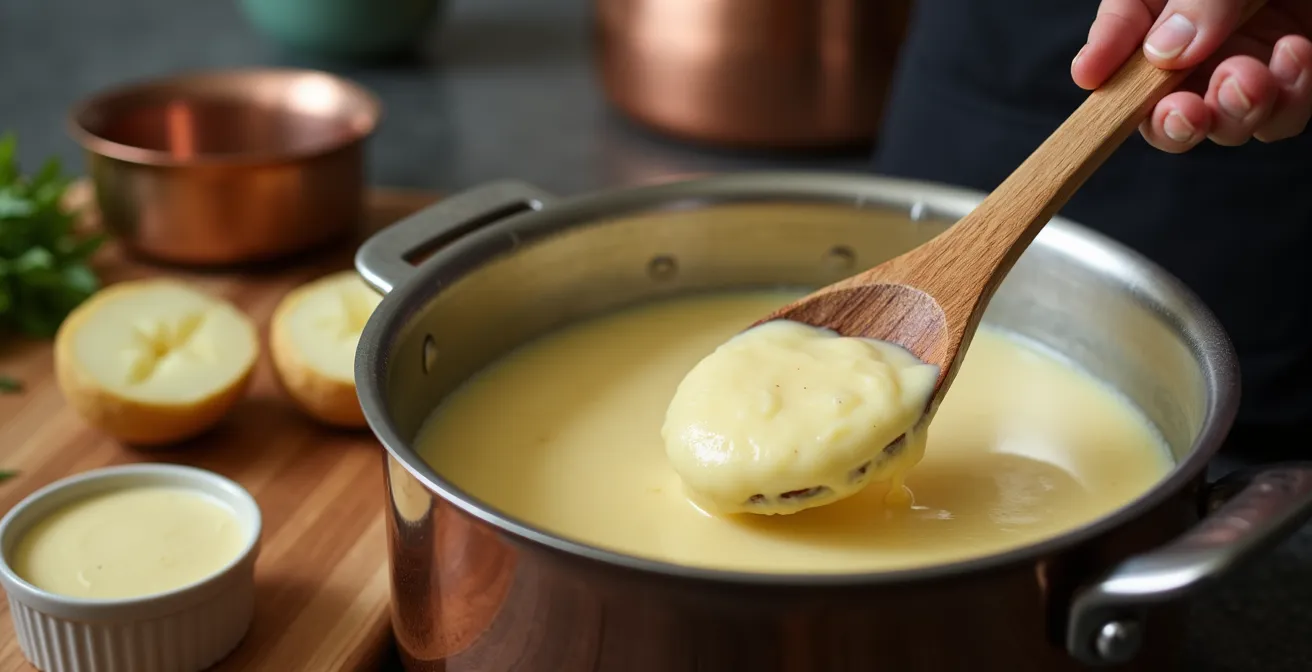
As the image shows, folding a potato purée back into the soup is a gentle process that builds texture organically. Other traditional methods exist for minor adjustments. Some old-school cooks swear by crushing a sleeve of oyster crackers directly into the pot, which lends a specific biscuity note. More modern kitchens might use a sprinkle of instant potato flakes at the very end for a final tweak. But all these methods share a common principle: they honor the potato as the primary thickening agent, ensuring the chowder’s flavor remains clean, bright, and focused on the clam.
Quahog vs. Cherrystone: Which Clam Makes the Tenderest Soup?
Not all clams are created equal, and the clam you choose has the single greatest impact on the final texture of your chowder. The names can be confusing—quahog, littleneck, cherrystone—but they generally just refer to the size of the same species of hard-shell clam, *Mercenaria mercenaria*. The rule is simple: the smaller the clam, the more tender the meat. A massive, chowder-grade quahog has lived a long life and its meat is tough and muscular. It’s full of flavor, but if you just chop it up and throw it in the pot, you’re making clam-flavored rubber.
For a truly superior chowder, the goal is tenderness. This is where professional kitchens often use a two-stage method. As noted in a breakdown of professional techniques, many chefs will first steam smaller, more tender clams like littlenecks or topnecks just until they open. This not only cooks the clam meat perfectly but also creates a deeply flavorful clam liquor—the soul of the chowder. The tender clam meat is then removed from the shells and set aside, while the liquor becomes the base of the soup. The meat is then added back in only during the last minute or two of cooking, just to heat through, preserving its delicate texture perfectly.
This table breaks down the common clam sizes and their best uses. While large quahogs have their place for flavoring the broth, the tenderest results will always come from the smaller varieties.
| Clam Type | Size | Best Use | Texture |
|---|---|---|---|
| Littlenecks | Smallest (1-2 inches) | Steaming, raw bars | Most tender |
| Topnecks | Medium (2-3 inches) | Steaming, chowder | Tender |
| Cherrystones | Large (3-4 inches) | Chowder, stuffing | Moderately tender |
| Quahogs | Extra Large (4+ inches) | Chowder (chopped) | Toughest, needs proper cooking |
The Overcooking Error That Turns Your Clams into Rubber
The most common mistake in chowder-making, whether at home or in a restaurant, is overcooking the clams. A perfectly cooked clam is tender, plump, and bursts with a sweet, briny flavor. An overcooked clam is a piece of chewy, tasteless rubber. The window between these two states is brutally short. The transformation from tender to tough happens at a specific temperature, a point of no return for the delicate proteins in the clam meat.
This isn’t just a matter of opinion; it’s food science. As clams are heated, their proteins begin to coagulate and contract. Gentle heat cooks them through, but excessive heat causes these proteins to seize up, squeezing out all moisture and creating that dreaded rubbery texture. According to food science research, this process accelerates dramatically above a certain point. The critical threshold for clam proteins is around 145°F (63°C), the temperature above which they rapidly toughen. This is why the “low and slow” simmer that works for potatoes is a death sentence for clams if they are in the pot the whole time.
Case Study: Restaurant Chain Quality Control
To ensure consistency, many of the best restaurant chains have adopted a technique that isolates the clams from prolonged heat. A 2024 taste test of major chains highlighted this practice. It found that restaurants using high-quality, pre-cooked canned clams and adding them only in the final moments of preparation consistently served chowder with more tender clams than establishments that tried to cook raw clams throughout the entire simmering process. This method removes the risk of a line cook getting distracted and boiling the clams into oblivion, ensuring a better textural balance every time.
The lesson is clear: clams should spend the absolute minimum amount of time in the hot soup. Whether you’re using fresh-steamed or high-quality canned clams, they should be the very last thing added to the pot before serving. Stir them in, let them warm through for a minute or two, and then ladle the chowder into bowls immediately. Any other method is a gamble you are likely to lose.
Where to Find the Best Chowder in Boston Away from Faneuil Hall?
Faneuil Hall and the Freedom Trail are magnets for tourists in Boston, and the restaurants there know it. They serve thousands of bowls of chowder a day, often prioritizing speed and volume over quality. While you might find a decent cup, you’ll rarely find a great one. The best, most authentic chowder is found where the locals eat: in the cozy, unpretentious seafood joints tucked away in the city’s neighborhoods. This isn’t just a romantic notion; it reflects a broader trend in how people want to dine.
People are increasingly seeking authentic, comfortable dining experiences over formal or tourist-centric ones. In fact, recent consumer dining surveys reveal that 69% of Americans prefer casual dining restaurants when eating out in 2024. To find a truly memorable bowl of chowder, you have to think like a local. This means getting off the beaten path and exploring areas like Dorchester, South Boston, or even the hidden gems in the North End that are family-run and have been for generations.

Finding these places requires a bit of strategy. It’s about looking for the small details that signal authenticity: a handwritten specials board, a worn wooden bar, and a clientele that clearly isn’t consulting a map. These are the places where the chowder is made in smaller batches with more care, where the recipe has been passed down, and where the chef’s reputation is on the line with every bowl.
Your Action Plan: Finding Authentic Boston Chowder
- Explore the Neighborhoods: Look for restaurants in areas like Dorchester, South Boston, Roslindale, or Jamaica Plain, away from the downtown tourist core.
- Follow the Competition: Check the winners and participants of local events like the Boston Chowdafest to discover spots that are celebrated by the community.
- Seek Out Old-School Spots: Visit the North End’s oldest family-run seafood restaurants, which are often overlooked by tourists heading for pasta.
- Ask a Local: Instead of relying on generic travel sites, ask a shopkeeper, a bartender, or anyone who looks like they live there for their personal favorite spot.
- Time Your Visit: Go during off-peak hours (e.g., a weekday lunch) when the kitchen isn’t rushed and the senior “A-team” chefs are more likely to be on the line.
Why Northwest Cuisine Is Obsessed with Mushrooms and Berries?
As a New England chef, my culinary world is defined by the Atlantic: the clams, the lobsters, the cod. But a good chef respects that every region has its own “ocean,” its own unique bounty that defines its cuisine. In the Pacific Northwest, that bounty comes from the forest floor. The region’s obsession with wild mushrooms and specific, tart berries isn’t a fleeting trend; it is the deepest expression of its terroir—the way a region’s specific climate, soil, and ecosystem shape the flavor of its food.
The reason for this is ecological. The PNW’s climate is unlike almost anywhere else in the United States. It’s a landscape of cool, damp, and shady forests, creating the perfect conditions for fungi and berries that struggle to grow elsewhere. As the Pacific Northwest Culinary Institute explains in a study on regional cuisine:
The Pacific Northwest’s unique climate—cool, damp, and shady—creates one of the world’s most perfect ecosystems for wild fungi and specific berries that don’t thrive elsewhere in the US.
– Pacific Northwest Culinary Institute, Regional Terroir and Cuisine Study 2024
This natural abundance of ingredients like chanterelles, morels, porcini, and uniquely tart berries like huckleberries and salmonberries has shaped the region’s palate for centuries. This tradition, rooted in the foraging practices of indigenous Coast Salish peoples, has been embraced by the modern farm-to-table movement. A case study on the restaurant scenes in Portland and Seattle found that dishes featuring these hyper-local foraged ingredients are not just a point of pride but a significant economic driver. Restaurants reported that menu items with local chanterelles or huckleberries saw 30% higher sales than similar dishes without them, proving that diners are actively seeking these authentic regional flavors.
Plant-Based vs. Local Meat: Which Has the Lower Carbon Footprint in Texas?
The conversation around food is no longer just about flavor and technique; it’s increasingly about sustainability. As chefs, we are forced to confront the environmental impact of our ingredients. The debate between plant-based and meat-based diets is a global one, with The Guardian estimating there are nearly 79 million vegans worldwide as of 2024. However, the carbon footprint question gets incredibly complex when you factor in geography. A head-to-head comparison in a place like Texas reveals that the “right” answer isn’t as simple as “plants good, meat bad.”
On the surface, the case for plant-based alternatives seems overwhelming. Producing beef is notoriously resource-intensive. But when you look at locally-raised meat versus a processed plant-based alternative, the picture becomes much more nuanced, especially concerning “food miles.” A grass-fed steak from a ranch 50 miles outside of Austin has a dramatically different transportation footprint than a plant-based patty made from soy or peas grown in the Midwest, processed in a factory hundreds of miles away, and then shipped back to Texas.
This comparative table illustrates the trade-offs. While Texas beef has high water and land use, it excels in low food miles. Furthermore, emerging practices like regenerative grazing argue that well-managed cattle can actually be a net positive for the environment by improving soil health and sequestering carbon, a benefit plant-based agriculture on its own doesn’t offer.
| Factor | Texas Grass-Fed Beef | Plant-Based Alternative |
|---|---|---|
| Water Usage | 1,800 gallons per pound | 200-300 gallons per pound |
| Land Use | 20-30 acres per cow | 1-2 acres per ton of protein |
| Methane Emissions | High (natural cow digestion) | Minimal |
| Food Miles | 50-100 miles (local) | 500-1000 miles (Midwest farms) |
| Carbon Sequestration Potential | Positive with regenerative grazing | Limited |
The conclusion here is that there is no single, easy answer. A truly sustainable choice requires looking beyond simple labels and considering the entire lifecycle of the food, from farm to factory to plate. In some contexts, a local, responsibly raised piece of meat may have a more favorable overall profile than a highly processed, long-distance plant-based product.
Key Takeaways
- True chowder is defined by creamy, balanced flavor, not the color of its broth; the New England style embodies this culinary integrity.
- Technique is paramount: use potato starch for natural thickening, choose smaller clams for tenderness, and add them at the very end to prevent overcooking.
- Authenticity is found off the beaten path. The best chowder is in neighborhood spots, not tourist traps.
Why American Food Is Much More Than Just Burgers and Fries?
The world often dismisses American cuisine as a monolithic culture of fast food—burgers, fries, and pizza. This is a profound misunderstanding. It’s like judging all of Italian food by a single slice of street pizza. The reality is that America is not one food culture, but dozens. It is a vast, complex, and delicious tapestry woven from countless regional traditions and waves of immigration. The chowder “war” between Boston and New York is a perfect, small-scale example of the fierce regional pride that defines this country’s food.
Americans are passionate about food, and they spend accordingly. According to the USDA Economic Research Service, Americans spent $1.5 trillion on food away from home in 2023. This spending supports an incredibly diverse ecosystem of restaurants. As Technomic Research aptly states, “Global cuisines have never been more popular.” This isn’t happening in a vacuum; it’s happening in American towns and cities.
Case Study: Immigration’s Direct Impact on Regional Cuisine
The truest expression of American culinary diversity comes from immigration. Look at Houston, where Vietnamese immigrants fleeing the fall of Saigon took the local Cajun crawfish boil and infused it with garlic, butter, and Southeast Asian spices, creating the now-iconic Viet-Cajun cuisine. Or consider Minneapolis, home to a thriving Somali community due to refugee resettlement, where you can find incredible sambusas and Somali-style goat that have become part of the city’s food identity. These are not fusion trends; they are new, authentic American regional foods born from the meeting of cultures.
To say American food is just burgers is to ignore the cioppino of San Francisco, the gumbo of New Orleans, the barbecue of Kansas City, the Sonoran hot dogs of Tucson, and yes, the perfect bowl of clam chowder on a cold Boston day. These dishes are the true heart of American food. They tell the story of a place, its people, and its history. The burger is just one word in a very long and fascinating book.
Exploring this rich culinary landscape is the real adventure. The next time you travel, even in your own country, skip the familiar chains. Seek out the dish that a place is proud of, the one the locals argue about. That is where you will find the true taste of America.