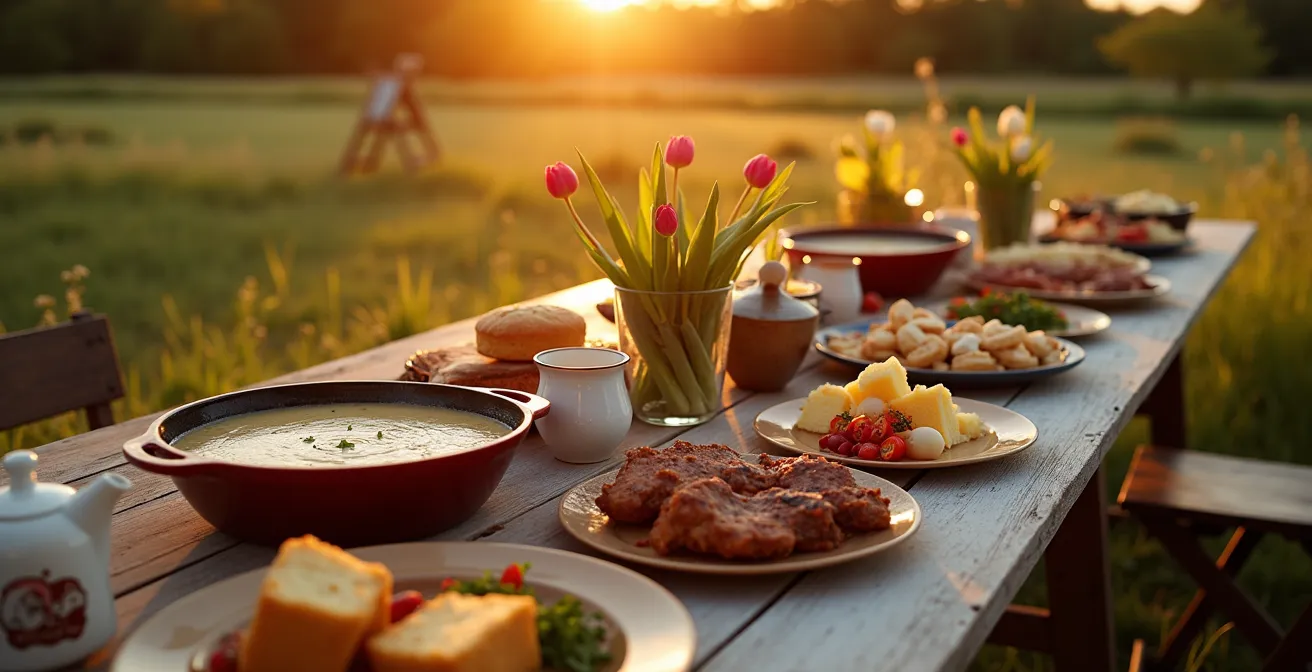
Contrary to the global cliché of fast food, America’s true culinary identity is a dynamic economic engine defined by sophisticated regionalism and a thriving artisan spine. This is not a cuisine of simple burgers and fries, but a complex gastronomic landscape where every dish, from a craft cheese to a Michelin-starred plate, tells a story of entrepreneurial spirit and deep-rooted local identity.
Let us be frank. When the international foodie thinks of “American cuisine,” the mind often conjures a rather grim triptych: a greasy burger, a pile of limp fries, and a fizzy soda of monolithic size. It is a caricature, a culinary shorthand that is as pervasive as it is profoundly incorrect. This perception, fueled by the global ubiquity of American fast-food chains, paints a nation of 330 million people with the brush of its most basic caloric export.
The common discourse attempts to counter this by pointing to regional specialties like BBQ or Cajun cooking, which is a start, but still misses the fundamental point. The defense of American food cannot rest on a few isolated examples. It must be a systemic one, an exploration of the very structure that makes the nation’s culinary scene one of the most vibrant and innovative in the world. The true story of American food is not about a single dish; it’s about the economic and cultural systems that underpin it.
But what if the key to understanding American cuisine was not in deconstructing a recipe, but in understanding its economic terroir? What if the $15 burger and the $500 tasting menu were not opposites, but two ends of a single, uniquely American “High-Low” spectrum? This is the perspective we will adopt. We are not here to apologize for the hamburger, but to place it in its proper context—as one small part of a vast, decentralized, and fiercely proud culinary nation.
This analysis will deconstruct the tired stereotypes by examining the pillars of the modern American food system. We will explore the sophisticated industries hiding behind simple labels, the intricate rituals of its dining culture, and the powerful economic impact that ripples from a single plate, proving that American cuisine is a story of craft, complexity, and profound regional identity.
Summary: A Deep Dive Into America’s Culinary Soul
- Why ‘American Cheese’ Is a Misnomer for a Complex Dairy Industry?
- How to Get a Reservation at America’s Top Michelin Spots Without a Bot?
- Diner vs. Bistro: Which Defines the True American Neighborhood Vibe?
- The Tipping Mistake That Will Offend Your Waiter Immediately
- How to Survive a 12-Course Tasting Menu Without Feeling Sick?
- Why Your $15 Burger Supports a Small Business Owner Directly?
- Why a 3-Star Rating Changes the Economy of a Small Town?
- How to Identify the 5 Major American Flavor Profiles by Region?
Why ‘American Cheese’ Is a Misnomer for a Complex Dairy Industry?
The term “American cheese” is perhaps the single greatest slander against the nation’s dairy industry. It evokes an image of a flimsy, plastic-wrapped, orange square—a processed product designed for shelf stability, not flavor. While this product exists, to let it define American cheese is like letting a cheap souvenir define a nation’s entire artistic output. The reality is that the United States is home to a formidable and world-class artisan cheese movement.
This is the artisan spine of the American food revolution. Far from being a corporate monolith, the industry is incredibly diverse, with nearly 1,000 artisan and specialty cheesemakers operating in the U.S. today. These are small-scale producers dedicated to terroir and craft, creating cheeses that express the unique character of their local environments, from the rolling hills of Vermont to the coastal pastures of California.
Case Study: The Global Triumph of Rogue River Blue
For the ultimate proof, one need only look to Rogue Creamery in Oregon. In 2019, its Rogue River Blue cheese was crowned World Champion at the World Cheese Awards. This was not a “best American cheese” award; it was the highest honor in the global cheesemaking community, beating thousands of entrants from traditional powerhouses like France, Italy, and Switzerland. It was a singular moment that shattered the stereotype and validated the quality and artistry of the American craft.
This is not a niche hobby. This is a significant economic force built on quality. It demonstrates a profound shift from industrial production to a celebration of provenance and skill. So, the next time you hear “American cheese,” reject the lazy stereotype. Instead, picture the complex, award-winning creations that truly represent the nation’s dairy prowess.
How to Get a Reservation at America’s Top Michelin Spots Without a Bot?
The difficulty in securing a table at one of America’s elite, Michelin-starred restaurants is often mistaken for snobbery. It is not. It is a simple function of supply and demand, a testament to a level of culinary excellence that attracts diners from around the globe. Navigating this system is not about luck; it is about understanding the mechanics of “systemic gastronomy” and employing an insider’s strategy. Forget hitting refresh on a website at midnight; the real methods require more finesse.
The key is to think outside the main dining room and beyond the standard booking window. Many top-tier establishments operate multiple, distinct reservation systems within their own walls. The path of least resistance often leads to the most rewarding experiences.
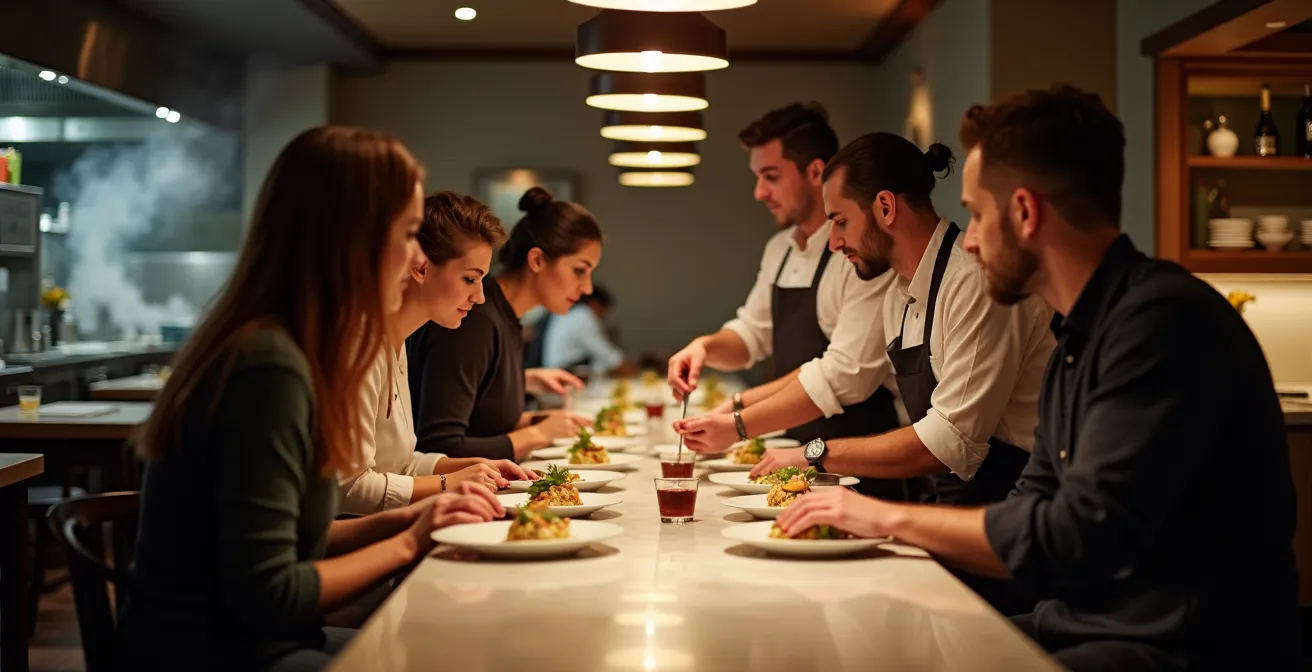
As the image above suggests, some of the most coveted seats are not tables at all. The chef’s counter or bar often has its own booking process or is reserved for walk-ins and last-minute calls. These seats offer an intimate, theatrical experience that is often superior to a standard table. Success requires flexibility, persistence, and a willingness to embrace unconventional dining times.
Your Strategic Plan for Securing a Table:
- Plan Ahead (Far Ahead): For the most famous restaurants, you must begin the process 3-4 months in advance. Set a calendar reminder for the day reservations open.
- Master the Last-Minute Call: High-end restaurants have cancellations every day. Call 1-2 days before your desired date, preferably in the mid-afternoon, to inquire about openings. Be polite and concise.
- Target Alternative Seating: Explicitly ask for bar seats or chef’s counter spots. These are the hidden gems of the reservation world.
- Leverage Concierge Power: If you hold a high-tier credit card like an Amex Platinum or Chase Sapphire Reserve, their concierge service has relationships and block-booked tables that you cannot access. Use them.
- Be Flexible: The ability to accept a 5:30 PM or 9:45 PM seating will dramatically increase your chances. Rigidity is the enemy of a successful booking.
Diner vs. Bistro: Which Defines the True American Neighborhood Vibe?
To understand an American neighborhood, one must understand its restaurants. Two archetypes often come to mind: the classic American diner and the more recent neighborhood bistro. Asking which one *truly* defines the local vibe is the wrong question. The correct insight comes from seeing them as two poles of a single, telling spectrum—what we can call the “High-Low” spectrum. Their coexistence, or the dominance of one over the other, tells a rich story about a neighborhood’s history, class structure, and aspirations.
The diner is a monument to democratic accessibility. Born from 20th-century industrial America, its counter service, bottomless coffee, and all-day breakfast menu serve everyone from construction workers to late-night students. It is a “third place” in its purest form, unpretentious and woven into the fabric of working-class life. Its presence signals a stable, traditional community.
The neighborhood bistro, often a European import adapted for American tastes, signals something else entirely: change and culinary sophistication. Its appearance is frequently a marker of gentrification, bringing with it higher price points, table service, and a focus on culinary craft. It caters to a clientele that views dining as a form of cultural expression, not just sustenance. The table below outlines these crucial distinctions.
| Aspect | Classic American Diner | Neighborhood Bistro |
|---|---|---|
| Historical Origins | 20th-century industrial America, prefabricated design | European import, adapted for American tastes |
| Social Function | Democratic ‘third place’ for all classes | Often indicates neighborhood gentrification |
| Service Style | Counter service, all-day menu | Table service, defined meal periods |
| Price Point | $8-15 per meal | $20-40 per meal |
| Cultural Significance | Working-class accessibility | Culinary sophistication marker |
Therefore, the “true” American neighborhood vibe is not found in one or the other, but in their dynamic tension. A neighborhood with both a beloved 60-year-old diner and a trendy new bistro is one that is complex, evolving, and quintessentially American—a place that holds onto its past while aspiring to a different future.
The Tipping Mistake That Will Offend Your Waiter Immediately
For many international visitors, the American tipping custom is the most confusing and uncomfortable part of the dining experience. It is often perceived as an optional bonus for good service. This is a fundamental misunderstanding of the system. In the United States, a tip is not a gift; it is a critical and expected component of a server’s wage. To undertip is not just a critique of the service—it is a direct reduction of an employee’s income.
The federal minimum wage for tipped employees is significantly lower than the standard minimum wage, with the explicit understanding that tips will make up the difference. When you fail to tip appropriately, the restaurant owner is legally required to cover the shortfall, but it creates an atmosphere of conflict and devalues the server’s work. The baseline for service has a clear and unwritten rulebook. According to a 2025 report on tipping trends, the expectation is clear: tipping should range from 20-25% for excellent service, with 20% being the standard for good service and 15% the absolute minimum for satisfactory service. Tipping below 15% sends a strong message of deep dissatisfaction.
This principle extends even to the highest echelons of dining. While some might assume the high prices at Michelin-starred restaurants negate the need for a tip, the opposite is true. The level of intricate, personalized service demands it, and a tip of 10% to 20% is generally expected, unless a service charge is explicitly included in the bill. Furthermore, a common faux pas is asking for change from a cash tip—for instance, paying a $42 bill with a $50 note and asking for $3 back. This signals you are an uninformed diner. The correct etiquette is to leave the intended amount or simply leave the full change as a generous gesture.
Navigating this system is not about generosity; it’s about respecting the labor and economic structure that defines American hospitality. Treating the tip as an integral part of the bill is the single most important adjustment an international visitor can make to dine with grace and respect in the USA.
How to Survive a 12-Course Tasting Menu Without Feeling Sick?
The multi-course tasting menu is the pinnacle of a chef’s artistic expression—a culinary marathon, not a sprint. It is an immersive, hours-long journey through an artist’s vision, with each small plate acting as a new chapter. However, for the uninitiated, this marathon can feel overwhelming, leading to palate fatigue or physical discomfort. Surviving, and more importantly, *enjoying* a 12-course menu requires a strategic approach. It’s about managing your endurance to appreciate the final courses as much as the first.
The primary mistake is treating it like a normal meal. The pacing is deliberate, and each component is designed to be part of a larger whole. Your role as the diner is to be a receptive audience, and that requires preparation and a conscious effort throughout the experience. From hydration to sensory processing, a few key techniques can transform the ordeal into an ecstasy.
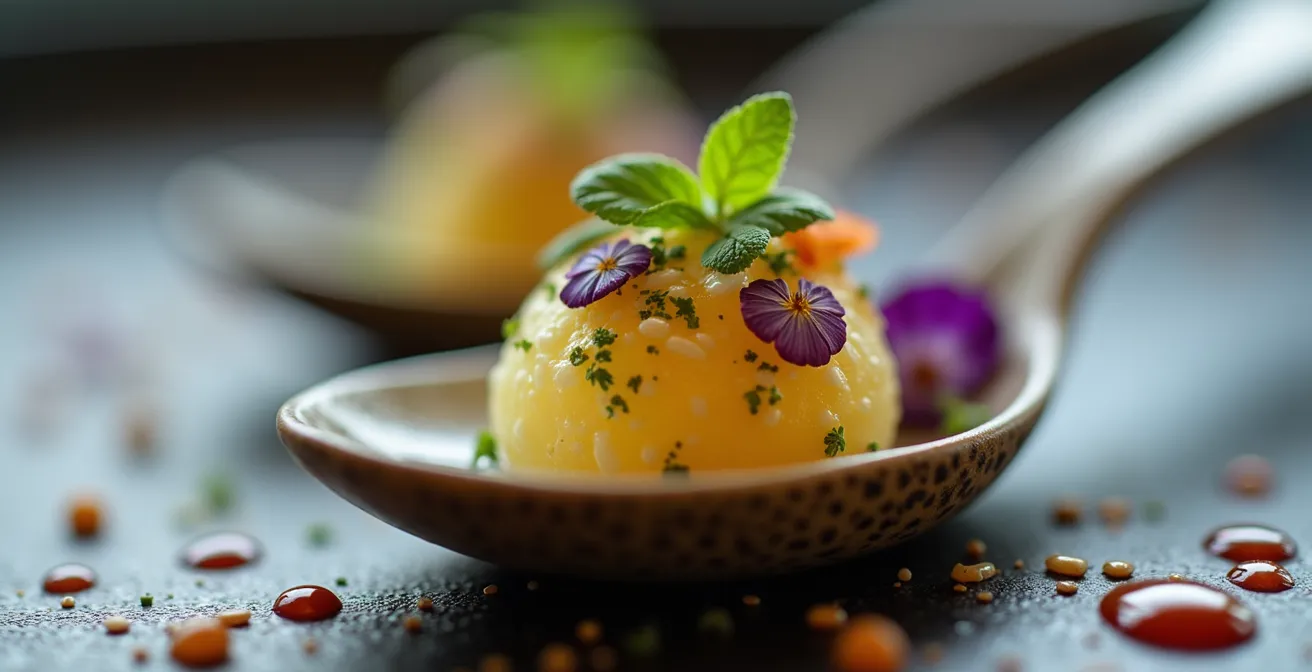
The beautifully arranged succession of dishes, as seen here, is a test of sensory stamina. The goal is to keep your palate sharp and your stomach settled. This is achieved not by abstaining, but by actively managing the experience with cleansers, proper breathing, and clear communication with your service team.
Your Action Plan for Conquering the Tasting Menu
- Internalize the Pace: Accept that the meal will last 3 to 5 hours. Do not rush. Savor each course and the interval between them.
- Use Your Tools: Water and bread are not just sides; they are palate cleansers. Use small sips of water and bites of plain bread to reset your taste buds between distinctly different flavor profiles.
- Breathe Through Your Nose: To fully appreciate complex aromas without being overwhelmed, practice nasal breathing. This allows your olfactory system to process the nuances more effectively.
- Hydrate Strategically: If you’re doing a wine pairing, alternate each sip of wine with a sip of water. This prevents the compounding effects of alcohol and keeps you hydrated.
- Communicate in Advance and During: Inform the restaurant of any dietary needs or strong aversions when you book. If midway through you feel overwhelmed, it is perfectly acceptable to quietly request lighter sauces or smaller portions for the remaining courses.
Why Your $15 Burger Supports a Small Business Owner Directly?
The $15 “gourmet” burger is another flashpoint for criticism, often cited as an example of American excess. This view is remarkably short-sighted. In the modern American food landscape, that expensive burger is not an indulgence; it is a miniature economic engine. It represents a vital nexus point in the local food supply chain, a single product that directly supports a web of independent, small-scale entrepreneurs.
Think of it as a case study in Economic Terroir. The value is not in the ground beef alone. That $15 price tag accounts for a brioche bun from a local artisan bakery, a slice of sharp, aged cheddar from a regional cheesemaker, heirloom tomatoes from a nearby organic farm, and bacon cured by a neighborhood butcher. The restaurant owner, another small business proprietor, is the conductor of this orchestra, assembling these high-quality components into a cohesive, desirable product.
The scale of these component industries is massive. For instance, the total U.S. cheese production is a testament to the depth of this supply chain. According to the USDA, the total U.S. cheese production in 2023 was 14.1 billion pounds, with states like Wisconsin and California leading a vast network of producers. A portion of that craft output finds its way not just onto fine cheeseboards, but into high-end comfort foods like the gourmet burger, pizza, and sandwiches, creating a continuous demand that sustains these artisans.
When you buy a $15 burger, you are not just paying for a meal. You are casting a vote for a more sustainable and diverse food system. You are subsidizing craft over corporation, and quality over quantity. That single transaction creates a ripple effect, paying the rent for the baker, funding the cheesemaker’s next experiment, and ensuring the farmer can continue to grow unique, flavorful produce. In this context, the $15 burger is one of the most direct and delicious forms of local economic support available.
Why a 3-Star Rating Changes the Economy of a Small Town?
Nowhere is the profound economic power of American cuisine more evident than when a prestigious award, like a 3-star Michelin rating, is bestowed upon a restaurant in a small, otherwise overlooked town. It is an event that transcends the culinary world and becomes a major economic catalyst. It validates the idea that, as the experts at the Escoffier School of Culinary Arts state, “it’s the local dishes that really tell the story of who we are.” A 3-star rating broadcasts that local story to the world, with transformative results.
Suddenly, the restaurant is no longer just a place to eat. It becomes a destination, a pilgrimage site for international food tourists. This influx of visitors acts as a powerful economic stimulus, creating a “halo effect” that revitalizes the entire town. The restaurant must hire more staff, from chefs to servers to foragers. But the impact goes far beyond its four walls. New boutique hotels open to house the visitors. Art galleries and specialty shops spring up to cater to their tastes. Property values rise as the town becomes a more desirable place to live and visit.
The restaurant becomes an economic anchor, proving that a commitment to world-class excellence in a single craft can lift an entire community. The following table illustrates the dramatic, real-world impact that such recognition can have.
| Impact Area | Before Recognition | After 3-Star Rating |
|---|---|---|
| Local Employment | 5-10 restaurant staff | 30-50 staff plus ancillary businesses |
| Tourism Revenue | Local customer base | National/international destination dining |
| Property Values | Regional average | 15-30% increase in surrounding area |
| New Businesses | Standard retail mix | Boutique hotels, galleries, specialty shops |
This phenomenon is the ultimate expression of food as a driver of culture and economy. It is definitive proof that a plate of food can be as vital to a town’s health as any factory or corporation. It is the American dream, served on a plate.
Key Takeaways
- The “American Cheese” stereotype is invalidated by a robust “Artisan Spine” of nearly 1,000 craft cheesemakers producing world-champion products.
- American cuisine operates on a “High-Low Spectrum,” where both the humble diner and the sophisticated bistro contribute to a neighborhood’s identity.
- The value of a dish is tied to its “Economic Terroir,” with a single gourmet burger capable of supporting an entire local ecosystem of small businesses.
How to Identify the 5 Major American Flavor Profiles by Region?
The ultimate refutation of the “monolithic American food” myth lies in its profound regionalism. The United States is not a single culinary entity but a federation of distinct gastronomic ‘nations,’ each with its own history, ingredients, and flavor profiles. Understanding this concept of Culinary Federalism is the key to truly appreciating the nation’s diversity. As a contributor to the exhaustive guide on American Cuisine on Wikipedia notes, different regions possess “distinctive elements, reflecting local food resources, local demographics, and local innovation.”
While there are dozens of micro-regions, a traveler can begin to navigate this landscape by learning to identify the five major flavor profiles. These are broad umbrellas, but they provide a foundational map for understanding the country’s palate. Each profile is a direct reflection of the region’s climate, immigration history, and agricultural strengths.
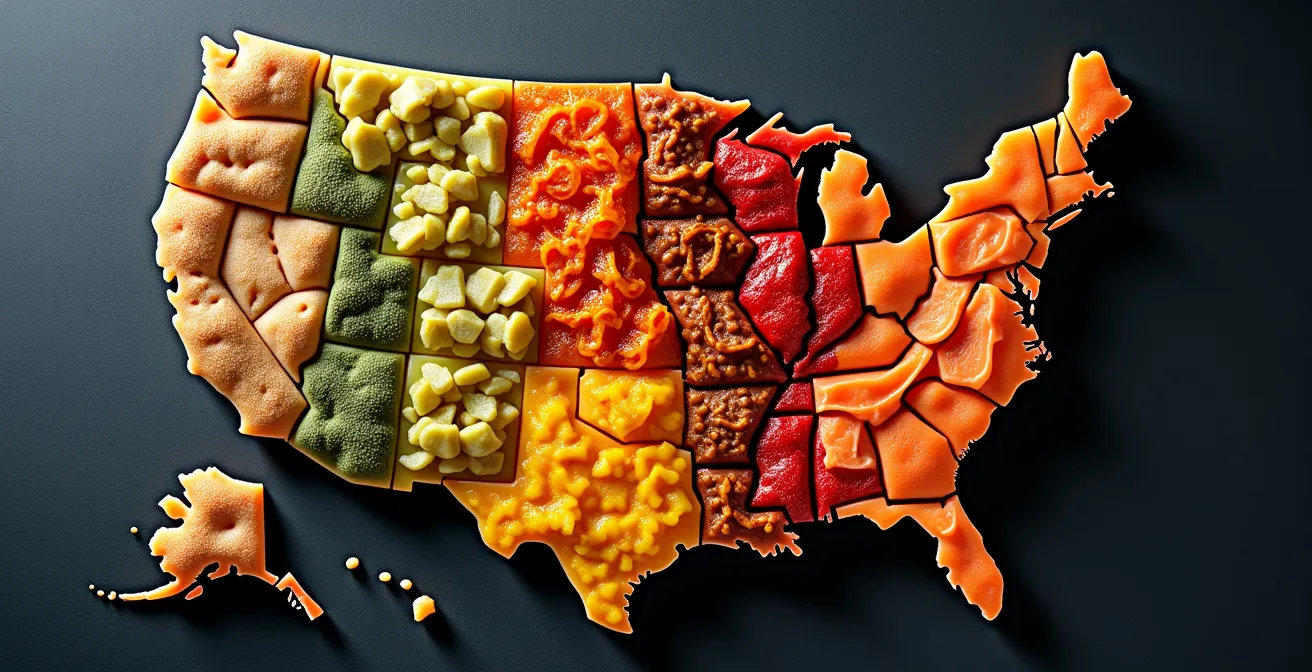
Just as the ingredients above visually represent the country’s bounty, the flavor profiles provide a sensory map. From the dairy-rich comfort of the Midwest to the chile-spiked heat of the Southwest, these culinary identities are as distinct and deeply rooted as any found in Europe or Asia. Learning to recognize them is the first step toward becoming a true connoisseur of American food.
A Guide to America’s Core Flavor Palates:
- Northeast: This region is defined by the Atlantic. Flavors are seafood-forward, often enriched with butter, cream, and the foundational sweetness of maple syrup. Think clam chowder or lobster rolls.
- South: A complex region built on techniques of deep frying and slow-cooking. Proteins are often pork-centric (bacon, ham, pulled pork), with cornmeal (grits, cornbread) serving as a ubiquitous base.
- Southwest: The defining trinity here is chiles, corn, and lime. Flavors are built on a foundation of smoke from slow-roasting techniques, with a characteristic earthy heat.
- Midwest: Often called the nation’s breadbasket, this region’s cuisine is rooted in comfort. It is dairy-heavy (cheese, butter, cream) and shows strong German and Scandinavian influences in its sausages, breads, and casseroles.
- Pacific Northwest: A modern profile driven by a foraging culture (mushrooms, berries) and proximity to the Pacific. It features clean flavors, a strong influence from Asian fusion, and a penchant for fermentation techniques.
To explore American food is to explore America itself. It requires a curious palate and a willingness to look past the global brands to the fierce, local identities that truly define the nation’s table.
The journey from a processed cheese slice to a Michelin-starred economic engine is a long one, but it is the true story of American cuisine. The next time you plan a trip to the United States, challenge yourself to look beyond the clichés. Seek out the artisan, celebrate the regional, and participate in the vibrant, complex, and delicious economic system that is the real heart of American food.